






How to Build a Link Building Campaign System That Actually Works

The internet is full of backlink-building strategies. And the crazy part is that pretty much all of them can be effective.
Why, then, do over 55% of SEO experts still believe link building is the hardest part of SEO?
More often than not, it is due to the lack of a system.
Random outreach or some one-off experiments might land you a few external URLs, but they won’t give you consistent growth and better rankings for years to come.
So, unless you have a clear workflow, you can’t really expect any long-term impact on search engine rankings.
That’s why today, we’ll share an effective 8-step link-building campaign system that will help you organize all your efforts and finally achieve the results you’ve always wanted.
Why do you need a system for a successful link-building campaign?
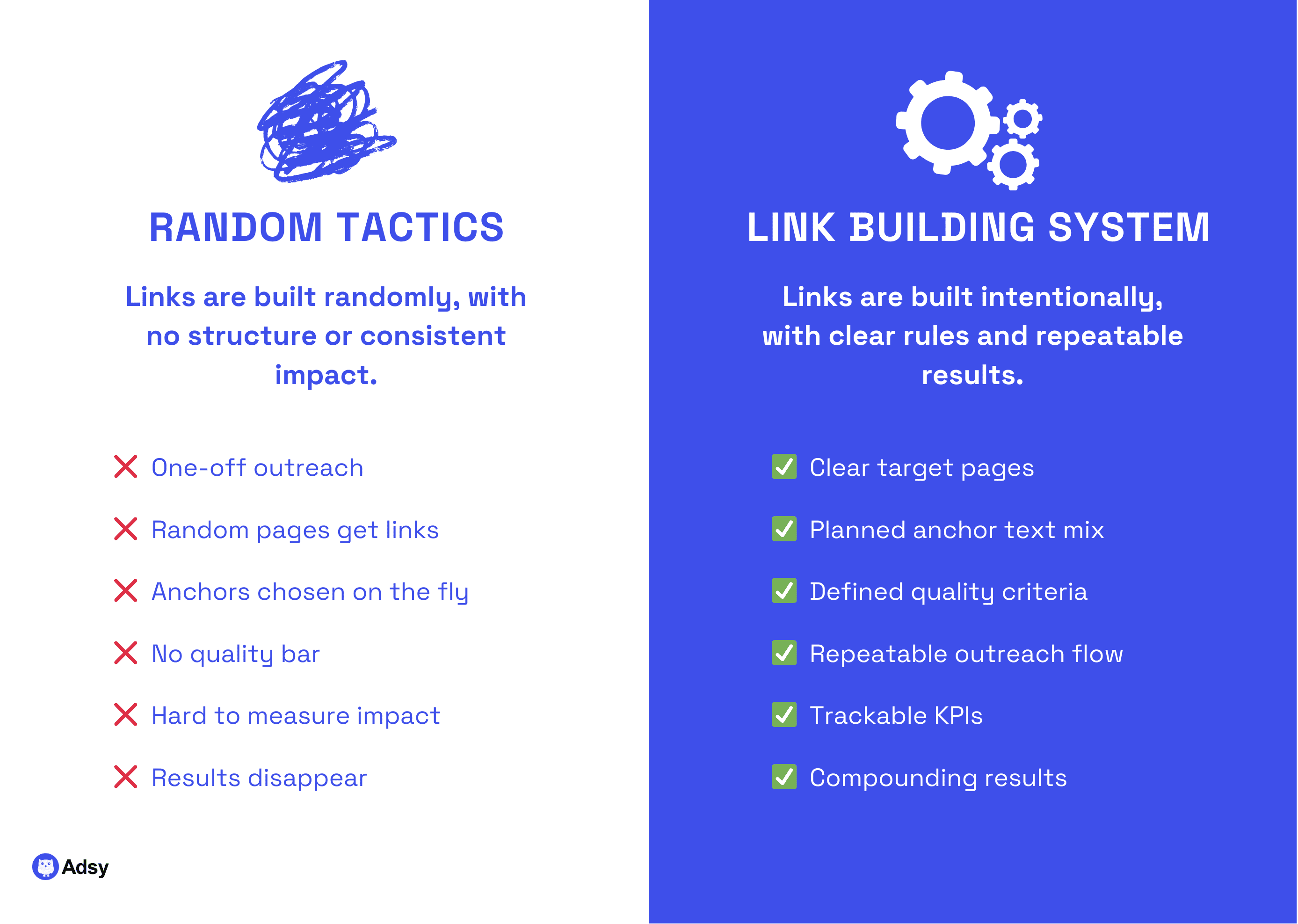
If you’ve had experience building links without a system, you already know how this usually plays out:
- You start with motivation and collect a handful of prospects.
- You send some outreach emails, maybe you land a guest post or two, then things slow down.
- Replies, unfortunately, drop. Links stop coming in. And you’re left wondering whether all these tactics still work or whether you did something wrong.
What usually goes wrong is not the tactic itself. It’s the lack of structure.
Search engines, as you know, have clear algorithms. Of course, they’re complex, and we don’t know all the details.
But what we do know is that Google greatly appreciates consistent mentions from relevant websites, steady growth in referring domains, and a backlink profile that looks natural.
You don’t get that by chasing one tactic at a time. You get it by following a proven blueprint you can use again and again.
If you feel your link-building campaigns are messy or too unpredictable, most likely, you just need to add some order, a system.
And that’s what we’ll help you build today.
8-step system with proven white-hat link-building strategies
As we said before, the main reason so many link-building strategies fail is that they are not treated as a whole.
Randomly getting a couple of URLs to your website from some shady pages won’t really help your link-building efforts. So, if you want your backlinks to work, the first thing you need is a system.
Here, we offer the tested and efficient one.
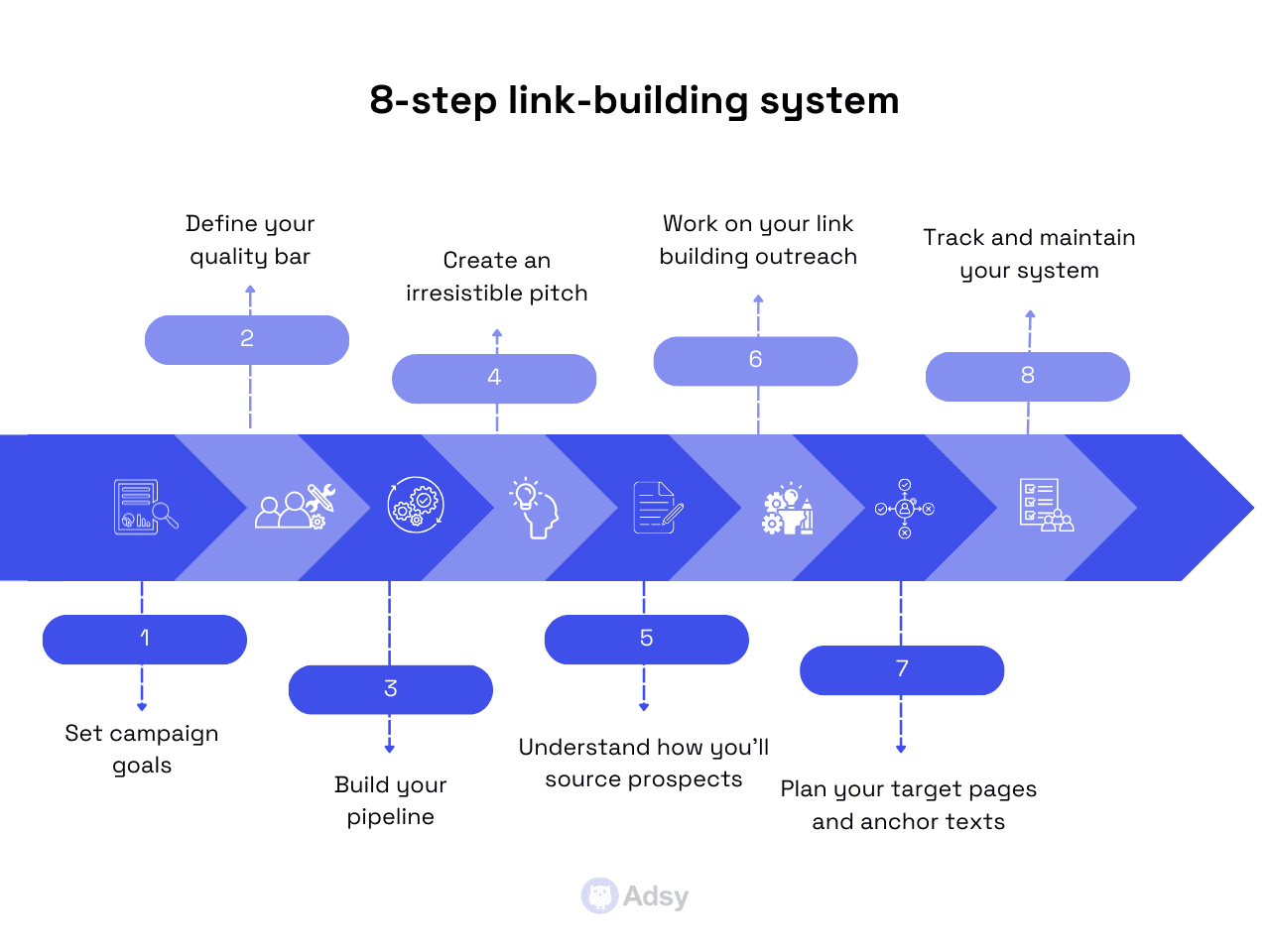
Step 1: Set campaign goals
As with anything in SEO, link-building campaigns might have different purposes. And unless you make your goals clear from the start, it will be hard to measure your success.
So, before you start outreaching, ask yourself whether you want:
- Higher domain authority,
- More brand visibility,
- PR mentions,
- More referral traffic,
- Ranking a specific money page, etc.
This matters for a couple of reasons.
First of all, it will influence your selection of pages and tactics.
For example, some backlinks can work extremely well for your DA/DR growth. But if it’s just a niche edit, you can’t generally expect lots of referral traffic. For that, some newsworthy content would work much better.
Secondly, budget, time, and human resources are typically limited.
Look, it’s fine to want everything from the list above.Really. Just don’t expect that one outreacher and a modest budget can accomplish all that.
A successful link-building campaign always matches goals to available resources.
So, be realistic about your resources and your objectives.
For a little reality check, you might want to review what your competition is doing first. This will give you a better idea of where you could potentially allocate your time and effort.
Step 2: Define your quality bar
A lot, if not most, backlink campaigns fail exactly at this step.
If you don’t define what a “good” link is, you’ll accept almost anything that looks decent in a spreadsheet.
And what do you get with such an approach over time?
Usually, it leads to a profile full of backlinks that don’t help SEO performance and don’t drive referral traffic in any way. Moreover, it sometimes actively hurts your trustworthiness in the eyes of search engines (and users).
That’s why you need a quality bar.
What is it? Actually, nothing complicated. It is simply a set of non-negotiable requirements every referring domain has to meet before it’s considered for outreach.
It doesn’t mean that you will get only extraordinary links every time. Not at all.
Reality will also come into play (whether we like it or not). But this quality bar will help you filter out most fishy domains that can really hurt your SEO and destroy the entire link-building campaign.
Now, let’s see what a high-quality domain actually is.
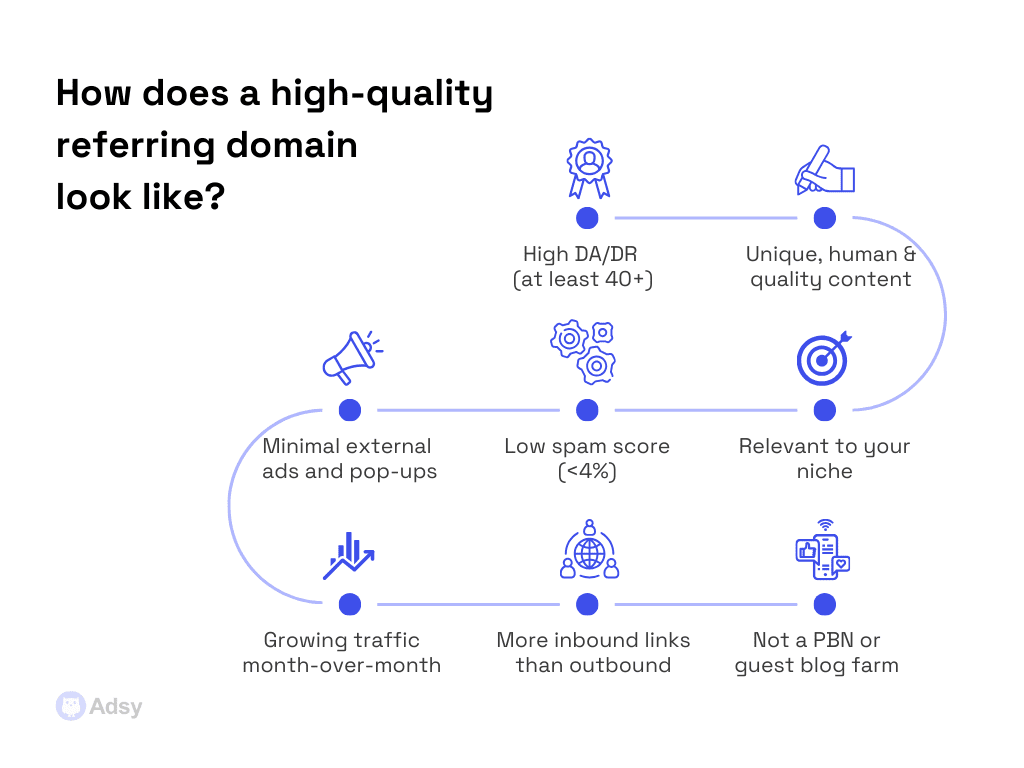
First of all, you need to work with niche-relevant websites that publish valuable content. Besides, they need to have real audiences. If they exist purely to sell links, you'd better stay away from them.
Domain authority or page authority metrics are useful, but they’re just one of the components.
For example, a medium-DR site that’s tightly aligned with your topic can deliver more value than a high-DR page that’s barely related to your industry.
These are some other important red flags to watch out for:
- Sites overloaded with ads, aggressive popups, or obvious “write for us” funnels.
- More outbound than inbound URLs.
- Links to sensitive niches (unless that’s your space and you’re fine with it).
- AI-generated content that looks generic and has no substance.
- Declining organic traffic (especially if it happens for several consecutive months).
Defining this quality bar upfront keeps trashy links out of your pipeline and makes decision-making easier for everyone involved.
So, there’s no debate later about whether a site is “good enough”. It either passes the bar or it doesn’t.
And on top of it, this helps you create a truly sustainable link-building campaign, instead of focusing on volume alone.
Step 3: Build your workflow
Once you know your goals and your quality standards, you need a clear way to move your links from idea to publication.
This is where things can get incredibly messy:
- Your prospects can live in tons of different documents and spreadsheets.
- Outreach threads will usually sit in your inbox.
- Negotiations might be scattered across chats.
- Published links? Hopefully, there’s at least some spreadsheet that gets updated once in a blue moon (if they’re tracked at all).
Sounds familiar? If it does, don’t feel bad. It’s very common because the process of getting external mentions is typically all over the place.
It can be because it often takes a lot of time, because there are many different goals to achieve, or even because several teams are involved. So, yes, it’s often messy.
And that chaos makes it almost impossible to run consistent link-building campaigns that actually deliver results.
This is why you need a clear workflow that everyone on your team understands.
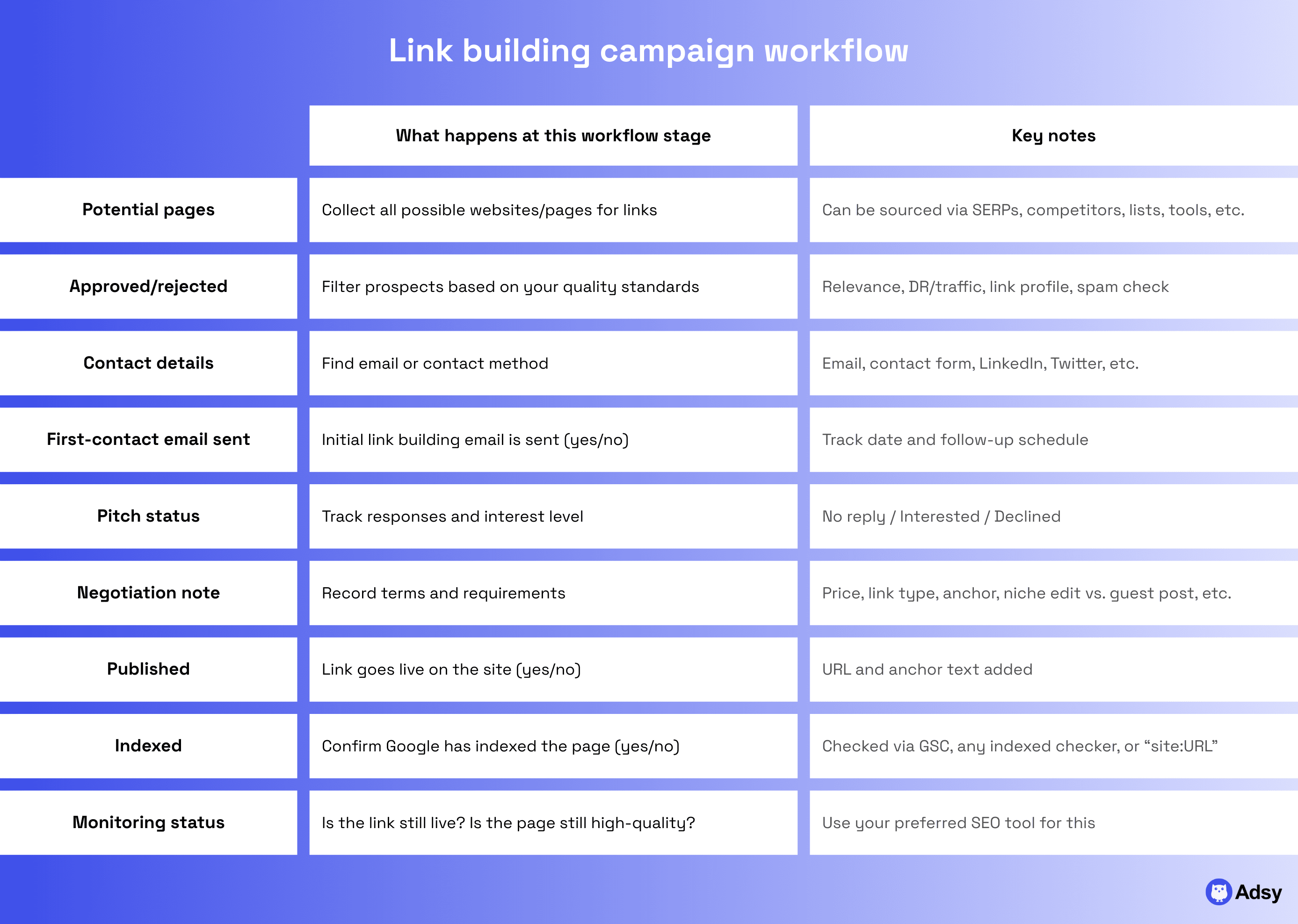
It can vary a lot, depending on your business needs. But today we offer you this quite universal structure that you can adjust if needed:
- Potential pages,
- Approved or rejected (based on quality bar),
- Contact details,
- First-contact email sent (yes/no),
- Pitch status,
- Negotiation notes (price, terms, exchange, niche edits, guest post, etc.),
- Published (yes/no),
- Indexed (yes/no),
- Monitoring status (1-2 months+ update).
The exact tool you use to manage this doesn’t matter as much as the clarity.
You can create this as a Notion board or even a simple spreadsheet in Google Sheets. Whatever works for you.
Just make sure it’s collaborative so that everyone on your team can participate, understand what happens next, and know who’s responsible for what.
Step 4: Create an irresistible pitch
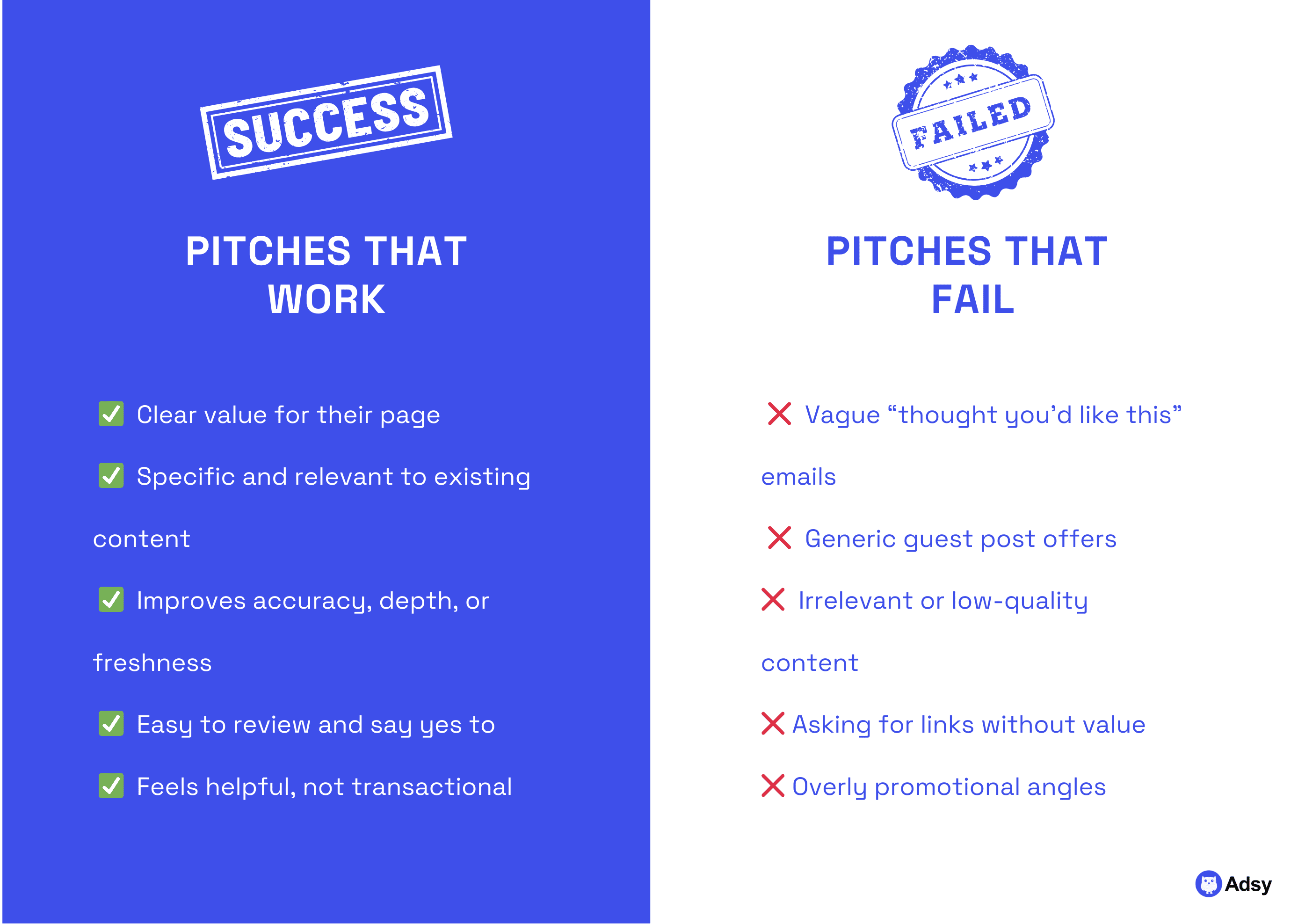
Outreach often fails for predictable reasons. Not because link building is hard (even though it sort of is), but because most pitches are... weak. Or sent from accounts that don’t give you a sense of trust.
Before writing any emails, you have to make sure that your “persona” looks trustworthy. Ideally, you should have:
- A real company or personal brand that fits the niche,
- A warm email address (company domain preferred),
- A LinkedIn profile that shows who you are and what you do,
- A short list of previous publications or mentions.
If you don't have at least a few things from this list, even a well-written pitch won’t look interesting and legit to most website owners.
Next comes the offer.
High-quality sites don’t really care if you say that you “want a backlink.” They care about their content and their audience. That's it.
Your pitch needs to explain (clearly and quickly) what you’re offering and what’s in it for the other website.
Of course, there are many link-building tactics and approaches. And if you’ve been doing this long enough, you know that the reality doesn’t work “by the book.”
But you still have to come up with some ideas that seem valuable (for one reason or another) to the other website owner.
These are some of the offers that could work:
- A researched guest post customized to a specific page,
- An original research (insights) you are ready to share on their page,
- An expert quote or interview (but this has to be quite special),
- Original data or research they can reference (you can even write a guest post based on this data to add some additional value).
Sure, there are some pages that can accept pretty much any content. We have to make it clear.
But when it comes to the actually trusted and relevant sites, these tactics don’t really work anymore:
- Generic “write for us” requests,
- Promises to “add value” without specifics.
- Mass-sent templates with basic personalization,
- Pretending money is not part of the conversation when it is.
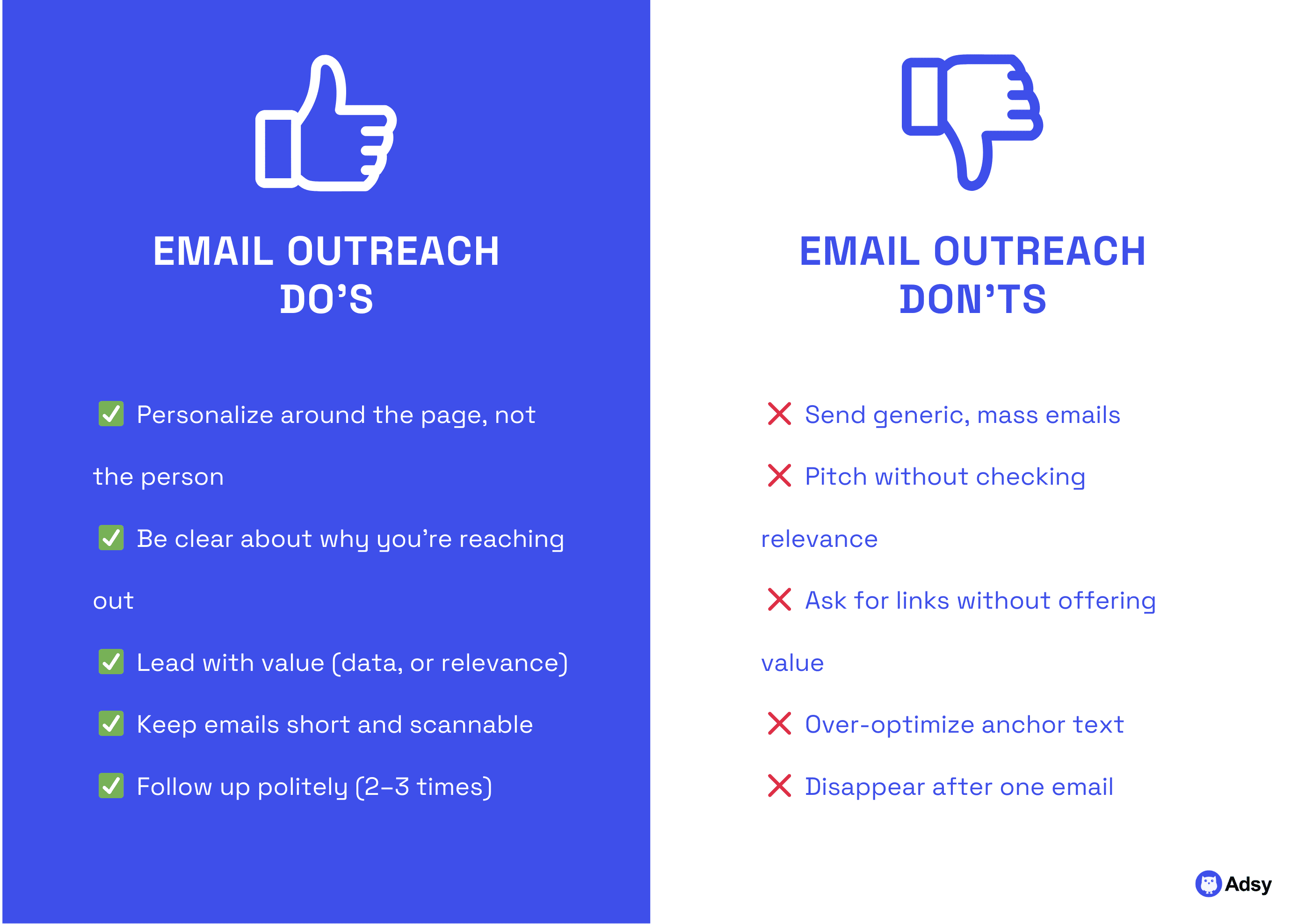
A good pitch is short and to the point. It references a specific page and explains the idea in one or two sentences. That's pretty much it.
Ideally, you should also make it easy for the site owner to say “yes” or “no”.
Step 5: Understand how you will collect prospects
Most link-building campaigns break the moment you run out of sites to contact.
That usually happens because prospecting is treated as a one-time task. Someone builds a list at the start of the campaign, outreach runs for a few weeks, and then everything stops.
Why? Simply because there’s nothing left in the pipeline.
Prospecting has to be continuous.
The first rule is simple: only collect prospects you could realistically get a link from. This sounds obvious, but many teams waste time scraping huge lists of sites that would never respond. Or worse, that don’t even make sense for their goals.
That’s why you must understand where to find your prospects.
What are your options?
Of course, there are countless things you could potentially try, but these are some of the most effective ones:
- Competitor backlink analysis, focusing on URLs that are editorial or contextual,
- Blogs and resources already ranking for your core keywords,
- Industry publications and niche blogs you already read,
- Slack groups, private communities, and direct introductions,
- Publisher inventories and platforms with good selection processes (like Adsy:).


Competitor links are usually the fastest starting point.
If a site has already mentioned another company in your space, it’s very likely that they can mention more brands in the same niche. Besides, you know for sure that they accept guest posts or niche edits.
When analyzing your competitors' profiles, you can also see the type and quality of content they’ve submitted. This will help you understand whether you can offer something comparable or even better.
Here is another important aspect:
As you collect prospects, qualification should happen immediately.
Don’t dump everything into one big “review later” list. Review as you go. Check:
- Relevance,
- Content quality,
- Outbound link patterns,
- And whether the site looks actively maintained.
When it fails your quality bar, as we discussed earlier, discard it right away.
If you wish, you can first collect potential sites and then review them later. But do that regularly and in batches, or even split this task between different people on your team (if needed).
The goal of prospecting, contrary to what it might seem, is not just volume. It is to keep a steady flow of realistic opportunities entering your pipeline so outreach can stay consistent.
Step 6: Work on your link-building outreach
Outreach, in its essence, is all about managing conversations.
If your outreach strategy is to “send one email and two follow-ups,” you’re not doing that well. Real campaigns plan for replies, objections, delays, and negotiation.
At a minimum, your outreach system should define:
- How many new contacts you reach out to per week,
- When and how you follow up,
- How you respond to common replies,
- When you stop pursuing a prospect, etc.
Follow-ups matter, but they should have a reason. A second email can clarify the idea or add context. A third might reference a new article or data point.
Repeating the same message every five days just makes people ignore you. Can you blame them, though?
You also need to decide how you handle money, link exchanges, and requirements.
Some website owners charge. Some ask for very specific formats. Some want links placed on existing web pages rather than new posts (i.e., link insertions/niche edits).
None of this is inherently bad. What matters is consistency and following your campaign goals.
Good outreach avoids pressure. It gives the site owner room to think and makes it easy to decline. Ironically, that’s what often leads to more yeses.
Don't corner people, and they will be more open to discussion.
Over time, you’ll start seeing some patterns. Certain types of sites will respond better, and some will convert more often. This is where your system will really pay off.
Step 7: Plan your target pages and anchor texts
Building backlinks without a clear idea of where those URLs should point is one of the most common mistakes.
Not every page on your site deserves links right now.
And not every piece of content benefits equally from them. If a page is poorly structured or has no clear purpose, pointing links to it doesn't make much sense. In many cases, it just wastes good opportunities.
Before you start outreach, you should already know which target URLs are part of the campaign and why.
There are usually three categories of pages that make sense as targets:
- First are the content pieces that already rank somewhere on page two or three and need a push. These are often the easiest wins, because search engines already understand these assets and just need stronger signals.
- Second are core money-making or strategic business pages that must rank, even if they’re currently weak. These require more mentions and more patience, but the value justifies the effort.
- Third are informational or resource pages designed to attract shares naturally and pass authority internally. This works especially well for categories or content hubs.
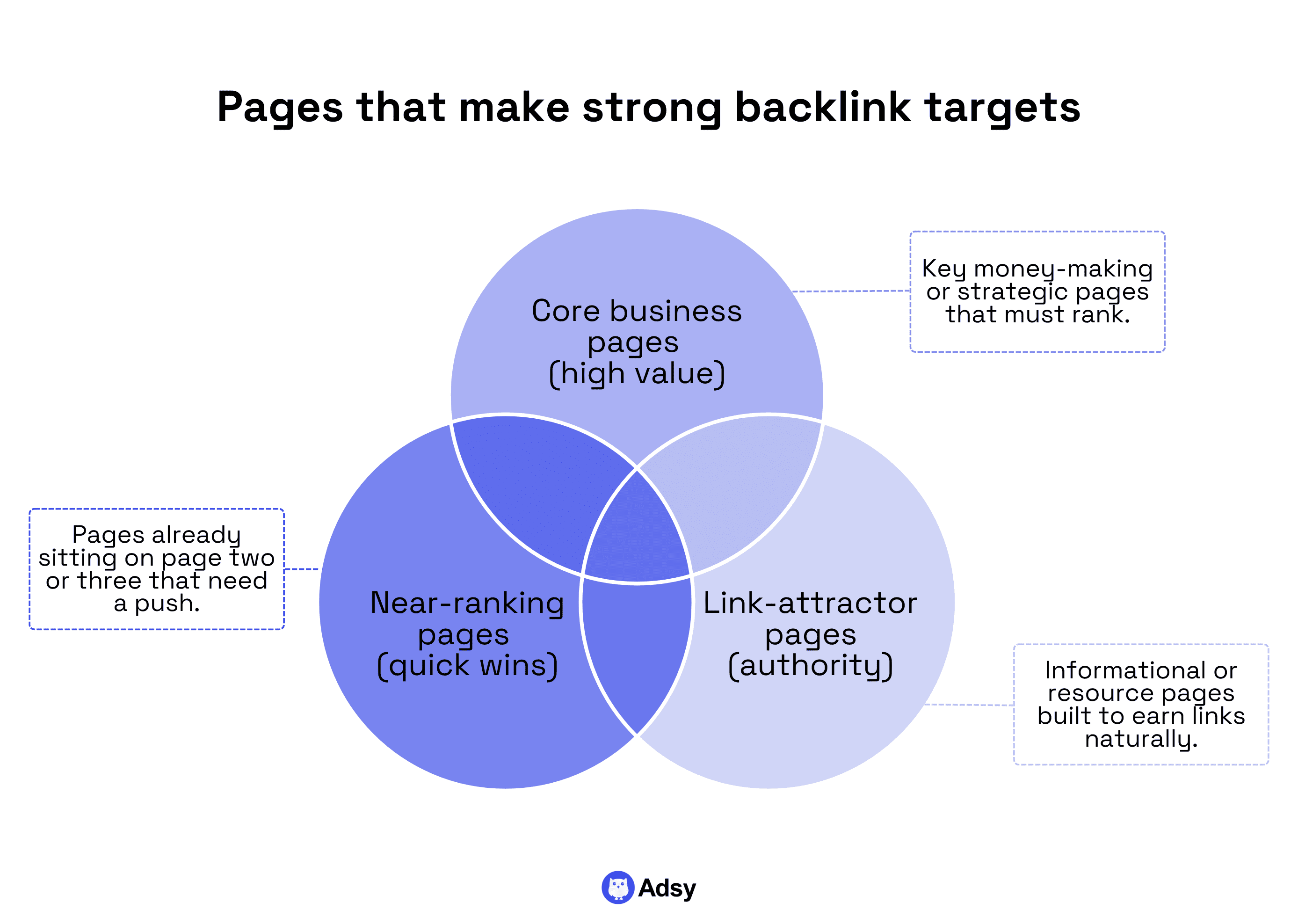
Choosing between these is about timing, intent, priorities, and general common sense.
But whatever you do, just keep in mind that a page targeting a competitive keyword with no rankings, weak content, and no internal links is a bad starting point.
Fix your content and on-page SEO first, then build links.
Anchor text planning is just as important, and... just as often mishandled.
Search engines don’t expect every URL to scream your main keyword. In fact, over-optimizing anchor text is one of the fastest ways to raise red flags.
A healthy profile focuses on variety and context rather than “pure optimization.”
Good anchor usage usually means a healthy balance of:
- Branded anchors,
- Natural phrases that fit the sentence,
- Partial keyword references,
- Occasional exact keyword matches, used carefully.
This is the ratio you can stick to (it isn’t too strict, but it’s really helpful as a general guideline):
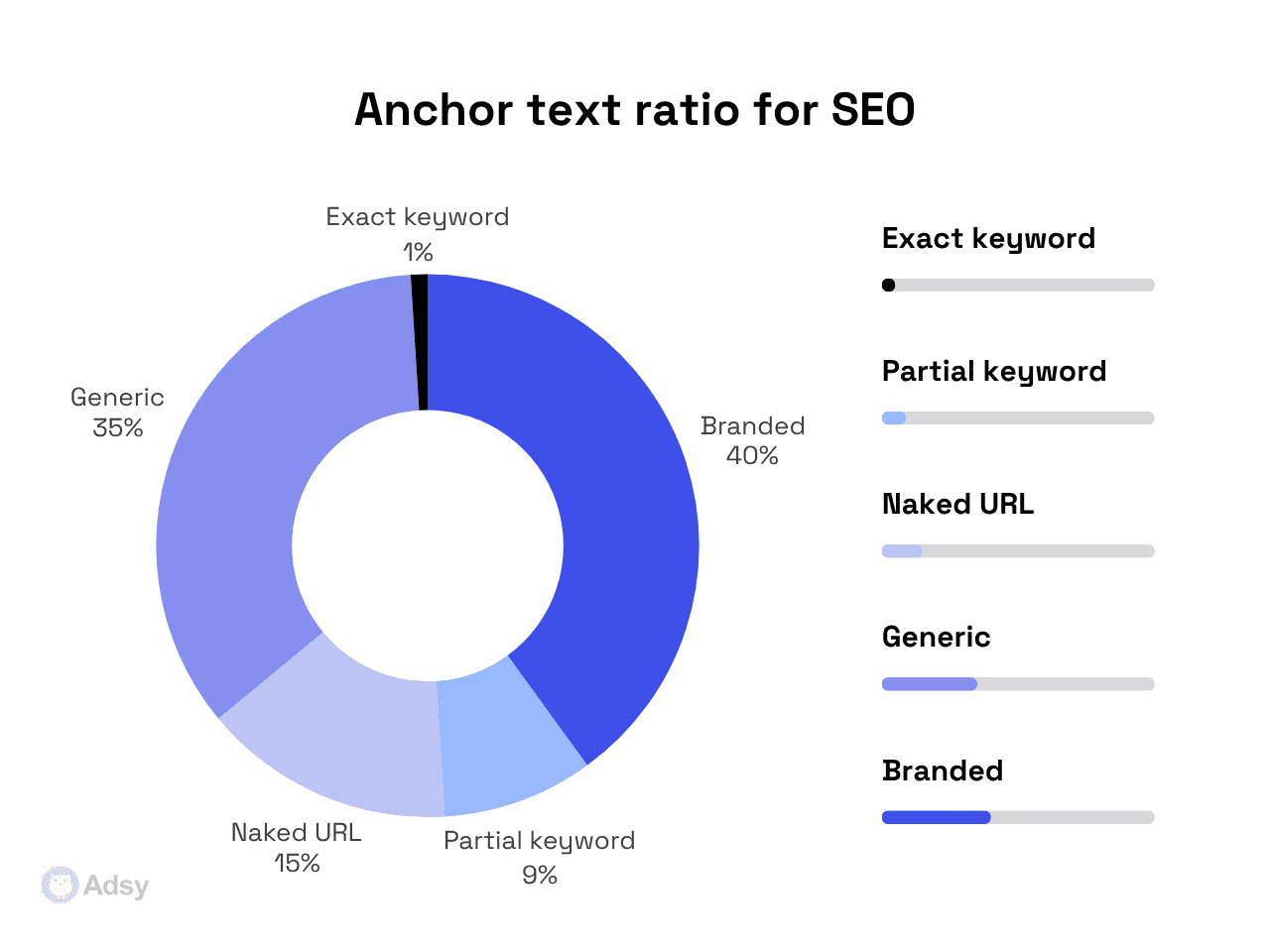
The idea is to make your anchors look as natural as possible. And if you want to sprinkle more optimization on top, add a keyword next to your URL.
For example, the anchor text could be “consider more options” (generic) and somewhere in the same sentence, you could add your keyword (e.g., “project management software,” “buy organic coffee,” etc.)
Step 8: Track and maintain
Getting a link published is the midpoint of the whole process. Why? Let's see.
Links won’t necessarily bring you the same value over time. Pages get updated, sites change ownership, and outbound URLs get removed. Once-good domains slowly become something you wouldn’t want to be associated with anymore.
If you don’t track what happens after publication, you’re flying blind. And while monitoring all the links pointing to your site might sound a bit overwhelming, you can start small. First, check:
- Which links are live,
- Which pages they point to,
- And whether they’re indexed.
These small things will really pay off later on. Here, we showed how you can check backlinks in Google Analytics, Google Search Console, and other SEO tools.
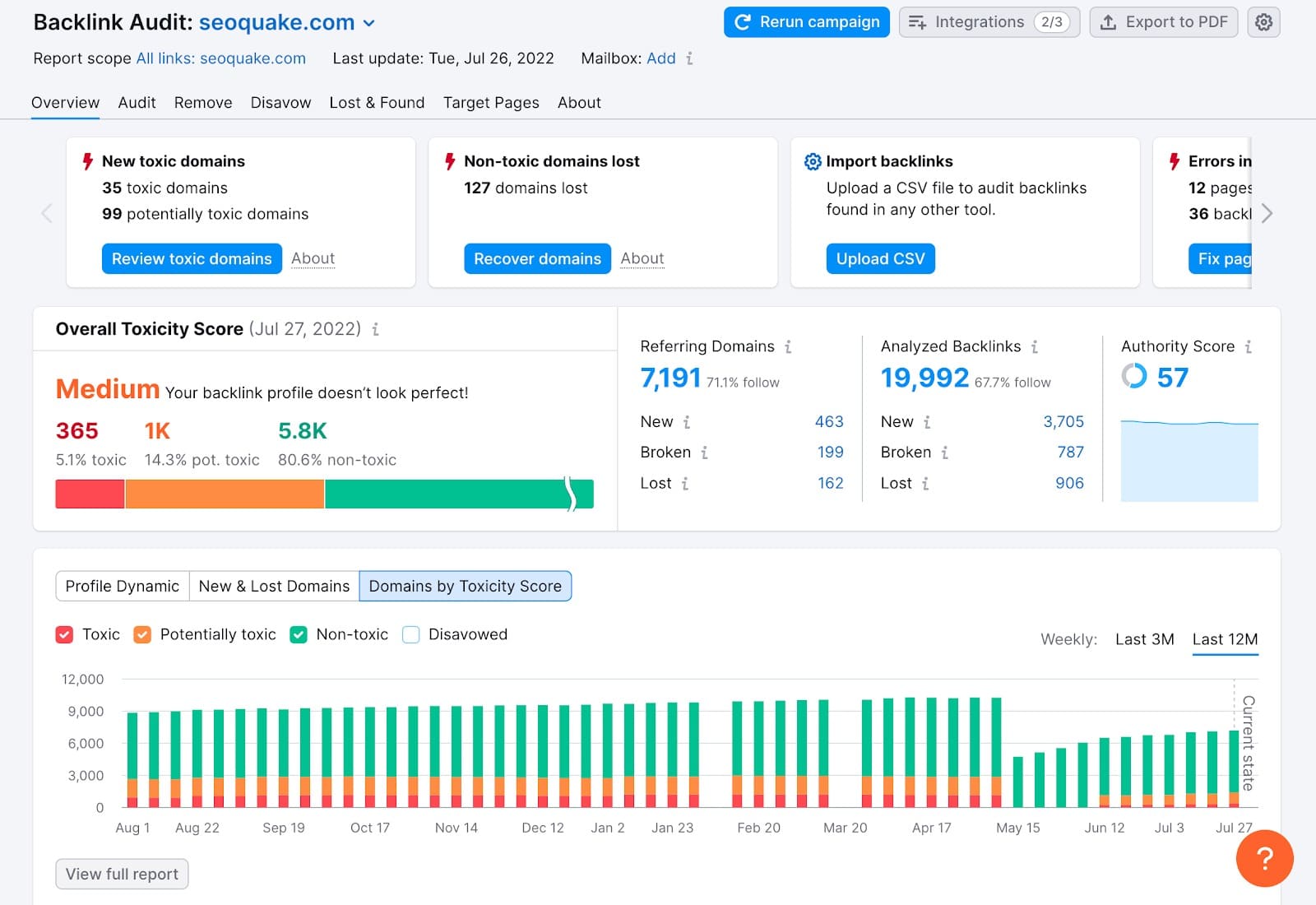
Source: Semrush
What actually matters at this stage is how links perform over time.
Of course, if you get backlinks from extremely authoritative sites (Forbes, NYT, or anything like that in your niche), most likely they won’t become junky over time:)
But some lesser-known sites can get too excited about the whole “guest blogging thing” and accept everything and anything.
Besides, some URLs can suddenly get a nofollow tag or get removed just because.
So, you want to watch whether they stay live and whether they continue to come from quality environments.
After all, maintenance is also where improvement happens.
By reviewing which mentions bring positive results and which don’t, you can refine prospecting, pitching, and page selection. Over time, this can actually lead to predictable growth.
Sure, this step is boring; it's hard to deny that. But it’s also where most of the long-term gains come from.
Common failures when building links (and fixes)
Most failed link-building campaigns fail not because your tactics stopped working.
No, the reason is that the campaign itself was never designed to work in the first place.
When you look at underperforming backlink profiles, the same mistakes show up again and again. Over and over.
These issues aren’t subtle. And they are not new.
These problems come from treating link building as a set of disconnected actions. But they should be viewed as a structured system built around white-hat link-building strategies.
Let's take a look at the most common failures you should be aware of.
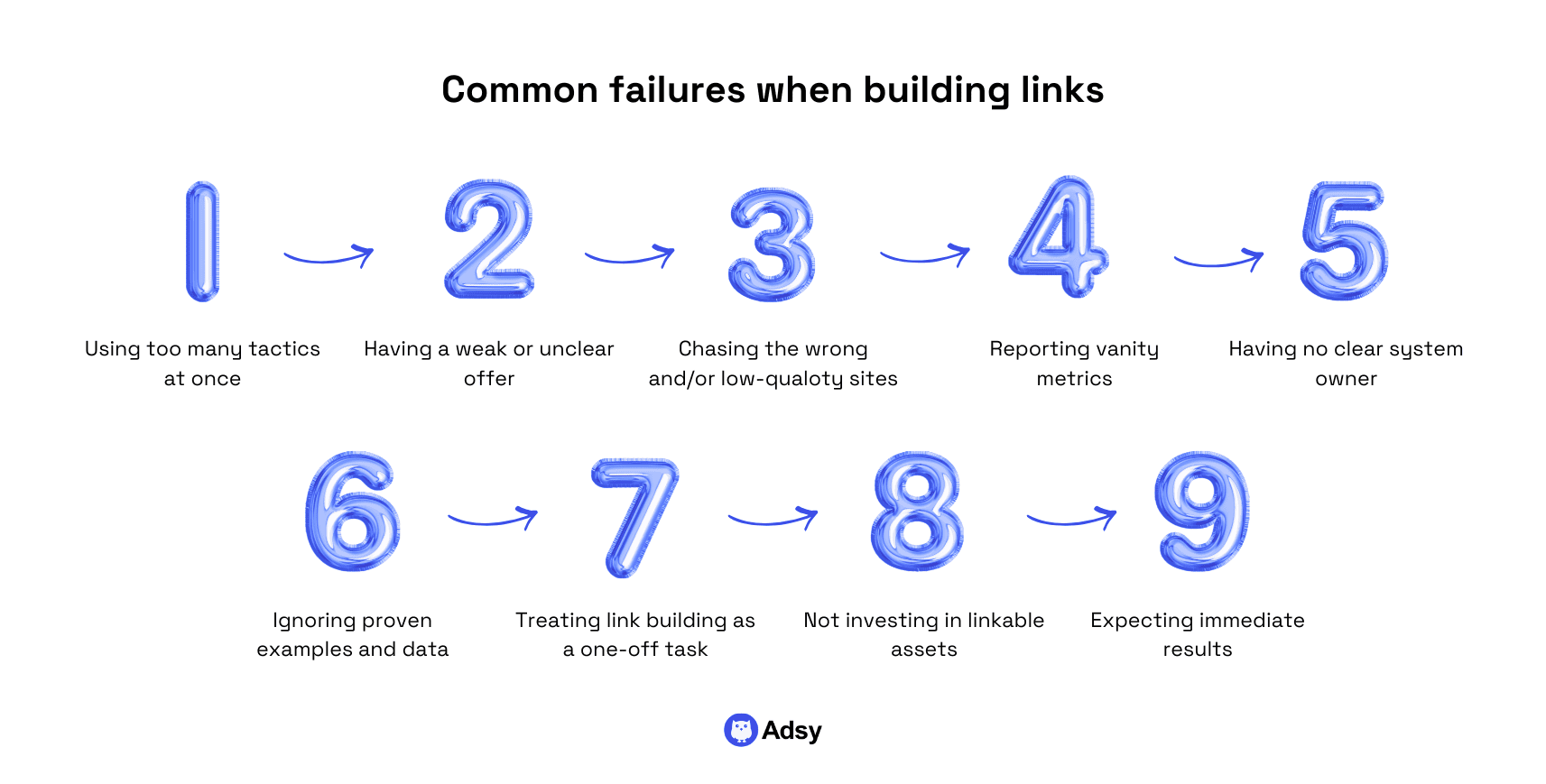
Failure 1: Using too many tactics at once
One of the fastest ways to kill link-building opportunities is to run too many tactics simultaneously.
Teams jump between guest blogging, niche edits, broken link building, digital PR, and link exchanges. Or start running random outreach experiments without committing to one approach to understand whether it works.
This leads to nothing but a shallow execution and scattered data.
Yes, it looks like an activity. But… it rarely leads to anything tangible. Anything that can actually bring you some results.
Every tactic requires different skills, assets, and workflows:
- Broken link building depends on scale and speed.
- Content link building depends on strong assets.
- Link exchanges depend on trust and relevance.
When everything is attempted at once, nothing is done well. Unless you have a big enough team and have been doing most of the things for quite a while.
Fix:
Choose a few relevant backlink-building strategies based on your currently available resources and work only with them at first.
Once you have clear workflows and some automations, you can expand, adding more tactics.
Failure 2: Having a weak or badly written offer
Offer is one of the most important things when it comes to dealing with reputable and authoritative sources. So, if you don’t make it compelling enough, you might lose valuable links.
Make sure you know what you can deliver to other sites you want to work with. And then, communicate it clearly. It’s also a really good practice to polish your offers and pitches over time.
Fix:
Make your offer as specific as possible, especially benefit-wise. Obviously, editors and website owners want to know what perks they will get from this collaboration.
Besides, make it clear that you’re open to different arrangements.
Failure 3: Bad qualification and chasing the wrong sites
A link from the wrong site is worse than no link at all.
Many campaigns chase high metrics, and they ignore relevance, audience, context, and common sense. This leads to mentions from sites that look strong on the surface but don’t help your site’s ranking in search results.
Posting unnatural URLs is another mistake.
Anything that looks spammy or random goes against search engine guidelines. This is especially true for forum and directory links that are clearly manipulated.
If they aren’t, and those are just contributions from the community, Google recommends using rel="ugc". It’s what Reddit does, for example:
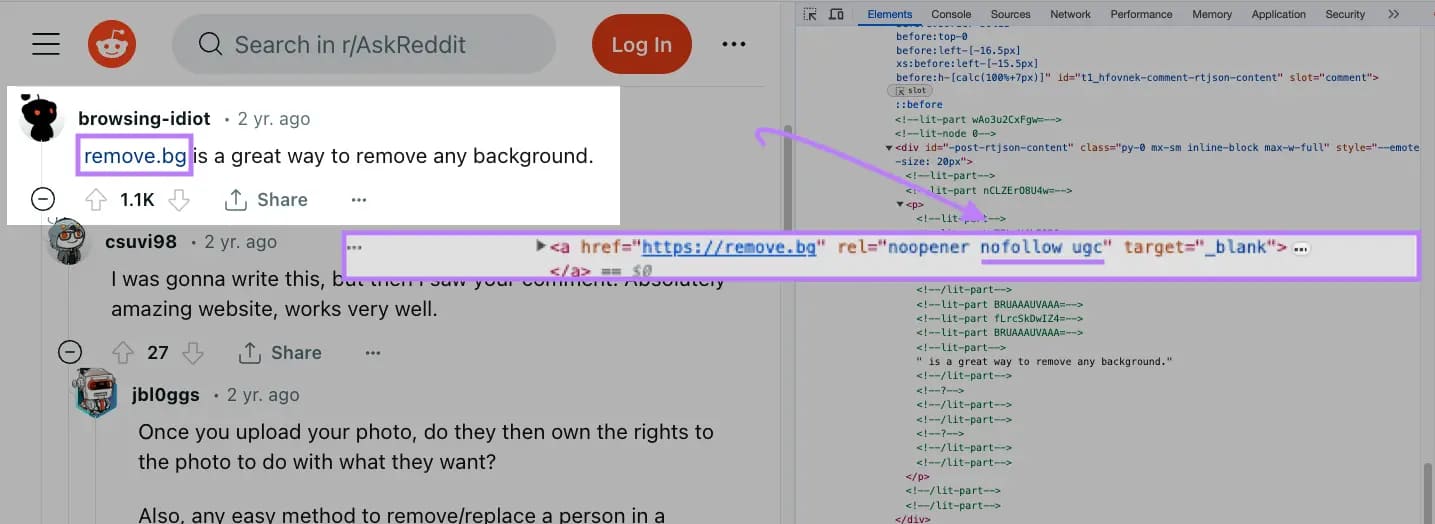
Source: Semrush
You don’t want to get a backlink profile bloated with mentions that don’t support search engine rankings or organic traffic. Because relevant link building is not optional. It’s a must for sustainable results.
Fix:
Qualification needs to happen early. Before outreaching to anyone, confirm that the site:
- Covers topics related to your niche,
- Publishes high-quality content for real readers,
- Has great key metrics we’ve already discussed above.
- Is on the same page with Google best practices and naturally attracts backlinks on its own.
Failure 4: Reporting vanity metrics instead of outcomes
Many teams simply report the number of links they gain with their DRs. Those numbers might look good in a deck, but they don’t explain whether the campaign is actually working.
Most external mentions do not automatically mean better SEO performance. And often, this is one of the biggest “disconnects” between your SEO efforts and actual business results.
Fix:
A proper link-building campaign tracks impact. As simple as that. That includes:
- Changes in search engine rankings,
- Growth in organic traffic,
- Improvements of target pages,
- Referral traffic from those mentions,
- Stability of referring domains over time, etc.
This is how SEO linking strategies are tested in real life. You might care about volume (and it’s okay), but your metrics should also explain your progress.
Failure 5: Having no clear system owner
When everyone is “involved,” no one is really responsible for the result.
If you have a team where everyone does everything, when something is wrong, no one owns the fix. This is what causes many campaigns to slow down (or even collapse).
Fix:
Every successful link-building campaign needs a system owner. One person responsible for:
- Maintaining the pipeline,
- Enforcing quality standards,
- Reviewing performance,
- Making adjustments, etc.
Obviously, you don't have to make one person do everything. It just means you need someone who ensures the system actually runs.
If you aren’t ready to hire a team lead yet, at least add clarity to your team’s responsibilities. Everyone has to be responsible for a very particular set of tasks.
Failure 6: Ignoring proven examples and real case data
A surprising number of campaigns operate without learning from the successful link-building case studies. Even though it is a basic thing in any industry.
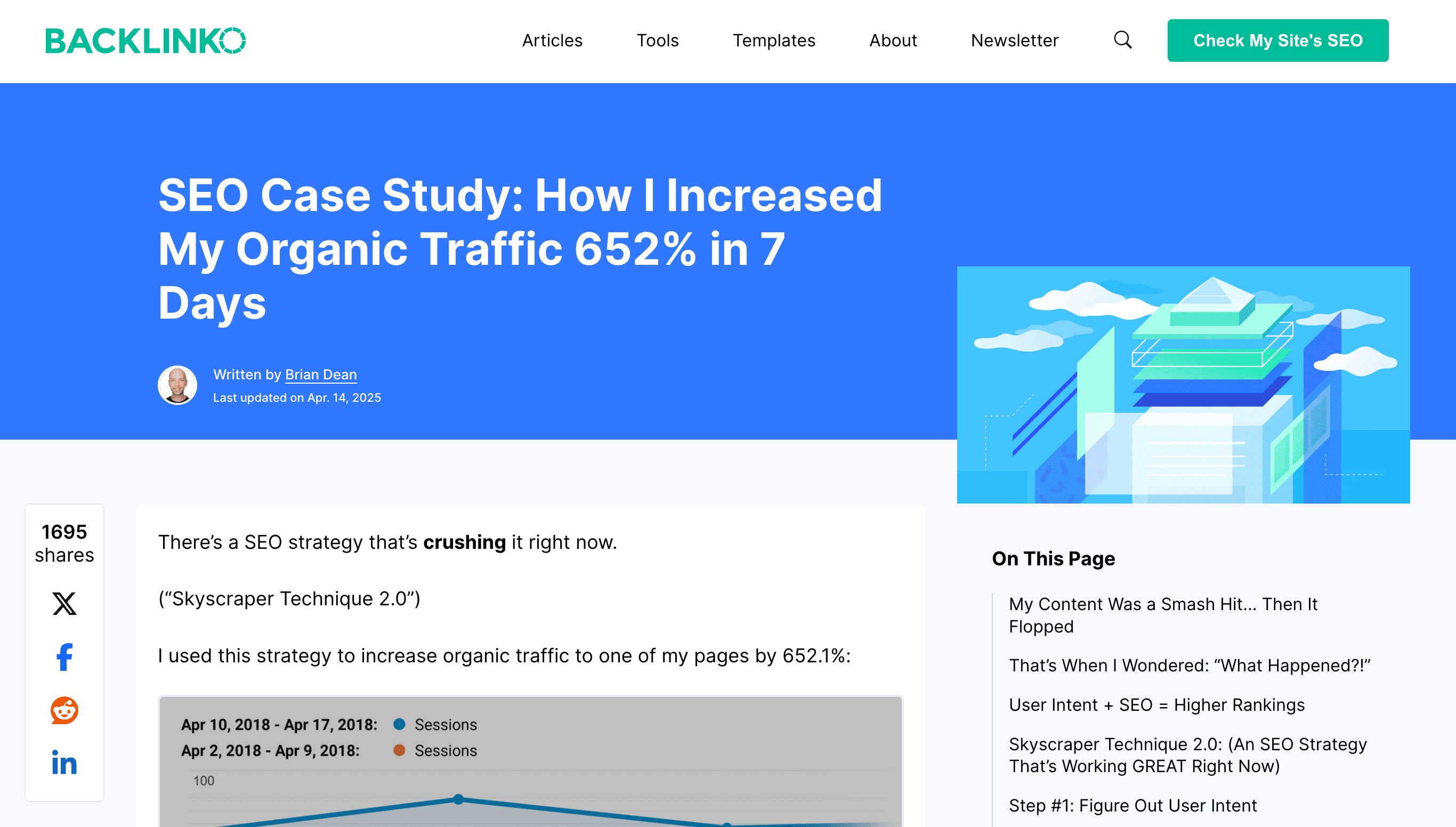
Source: Backlinko
Some teams avoid studying competitors and don't even try to analyze placements that look successful. This is why many campaigns repeat the same mistakes they could easily avoid.
Without a real reference point, how can you expect your decisions to work?
This is extremely useful to do at the very start of your external link-building strategy. But it’s also important to monitor this regularly to get new insights.
Fix:
It comes down to the following:
- Study examples that have worked in your niche.
- Analyze competitor outbound URLs, how they got them, and what content earned them.
- Monitor overall industry trends to know what’s new and outdated.
These small insights can actually help you refine your own strategy.
Failure 7: Treating link building as a one-off task
Backlink building is way too often treated as a sprint, while it should be seen as an ongoing process.
If you don't introduce follow-ups and forget about maintenance, it won't survive long. Not reviewing whether your mentions are still relevant or even live is also a huge mistake. But it's kind of obvious, isn't it?
Over time, this lack of control will weaken your backlink profile (almost inevitably).
Fix:
The process of gaining new backlinks should be continuous. Track URLs over time and consistently review quality. Remove or disavow links that no longer meet standards (again, back to the quality bar).
Consistent monitoring is truly a core part of SEO linking strategies.
Failure 8: Not investing in linkable assets
Without high-quality content, link building is expensive. And fragile (unfortunately).
Outreach-only campaigns depend on negotiation, payments, or exchanges. So you know the scenario: as soon as budgets tighten, mentions stop coming in.
Fix:
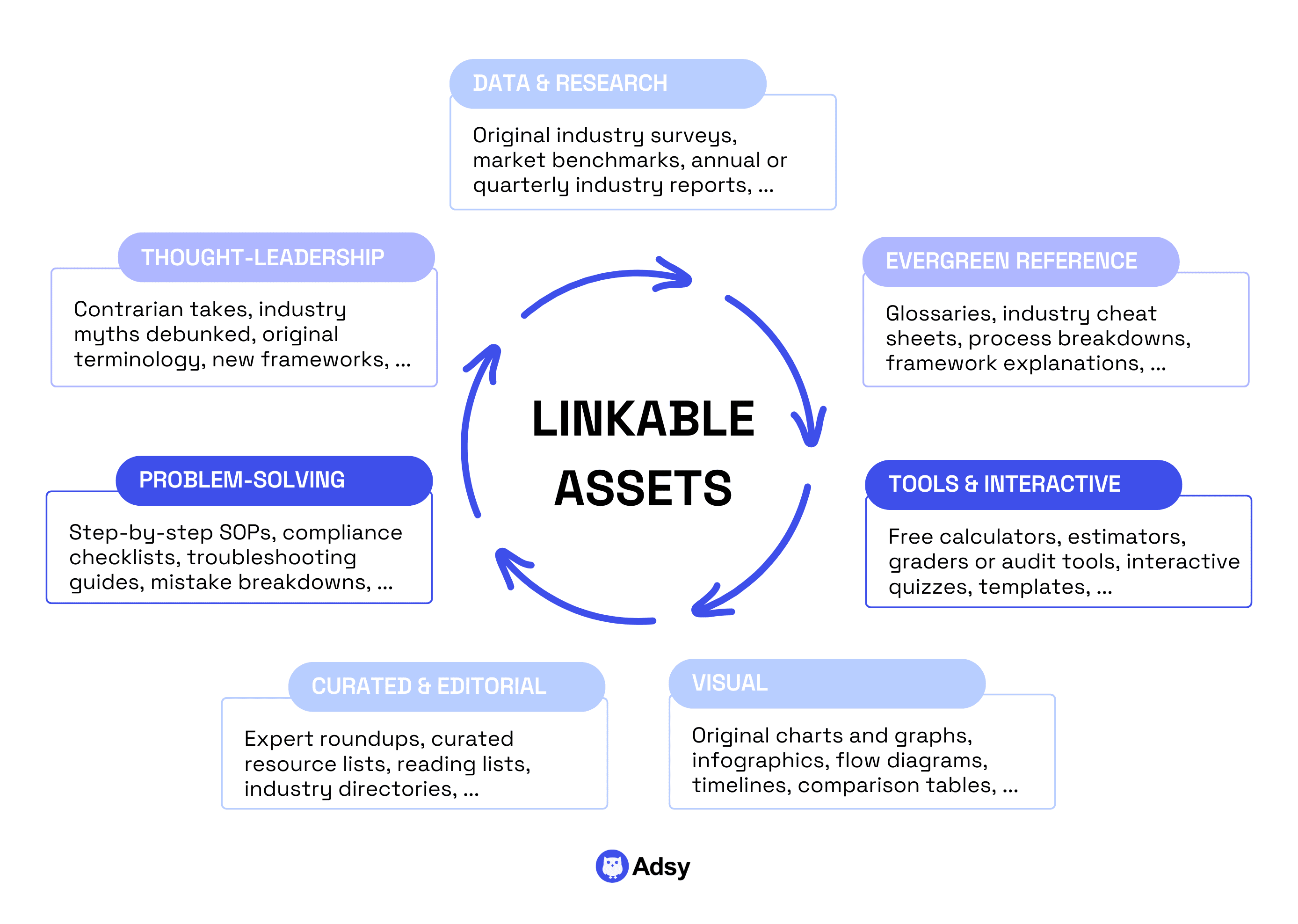
Make sure that your blog posts naturally attract links. You can do that by creating the following content:
- Original research,
- Industry data,
- Tools and widgets,
- Visual assets, etc.
Apart from helping you gain new outbound URLs organically, these assets also tend to improve outreach response rates. Because the higher the quality of your website, the more likely others are to link to it.
Failure 9: Expecting immediate results
This is one of the most harmless ones. Well, at least it seems like it. But actually, the consequences can also be serious.
The thing is, link building works, but it doesn’t show results in an instant.
Many campaigns are abandoned too early because rankings don’t improve within a few weeks. And then companies start constant resets and strategy changes.
But search engines need time to process URLs, evaluate patterns, and adjust rankings. So, it's very simple: SEO requires time and, therefore, patience.
Fix:
Set realistic expectations. Track progress over months, and don't expect changes in a few days. Instead, evaluate trends, and know that relevant link building compounds over time.
Just like any other tactic, it depends on many other things: technical SEO, search engine behavior, and content quality.
Conclusion
SEO changes, as well as your goals, rankings, budgets, and team members. But when it comes to link building, what doesn't change is the need for structure.
That’s why we’ve been constantly repeating the word system in this guide.
As you can see, all you need to do is treat link building as a multi-step process that can’t be replaced with random tactics. No matter how effective those are.
FAQ
What is a link-building campaign?
A link-building campaign is the process of acquiring backlinks for your website. Usually, the goal is to improve domain authority and search engine rankings, or get more referral traffic and overall exposure.
Is link building still relevant for SEO in 2026?
Yes, it is. Search engines still reward high-quality backlinks. So, if your sources are reputable and trustworthy, it is very effective.
Besides, more brand exposure is a great way to rank in ChatGPT and appear in AI Overviews.
What are the best link-building strategies?
It is usually a mix, depending on your site, budget, competition, and other variables. The most reliable backlink building strategies today are:
- Content link building: This includes guides, original research, etc.
- Relevant outreach: Pitching the assets only to sites where the URL makes contextual sense.
- Digital PR-style links: Earning mentions via your expert input.
- Partnership and relationship links: These come from ongoing collaborations.
- Niche edits: Placements inside existing content.
But some popular tactics are much less effective today, like identifying broken links and reaching out to website owners with your own replacement instead.
How much should I pay for link building?
There’s no universal price, but high-quality links can’t be cheap by default. If everyone can buy a placement on a particular website, sooner or later, it will turn into a dump.
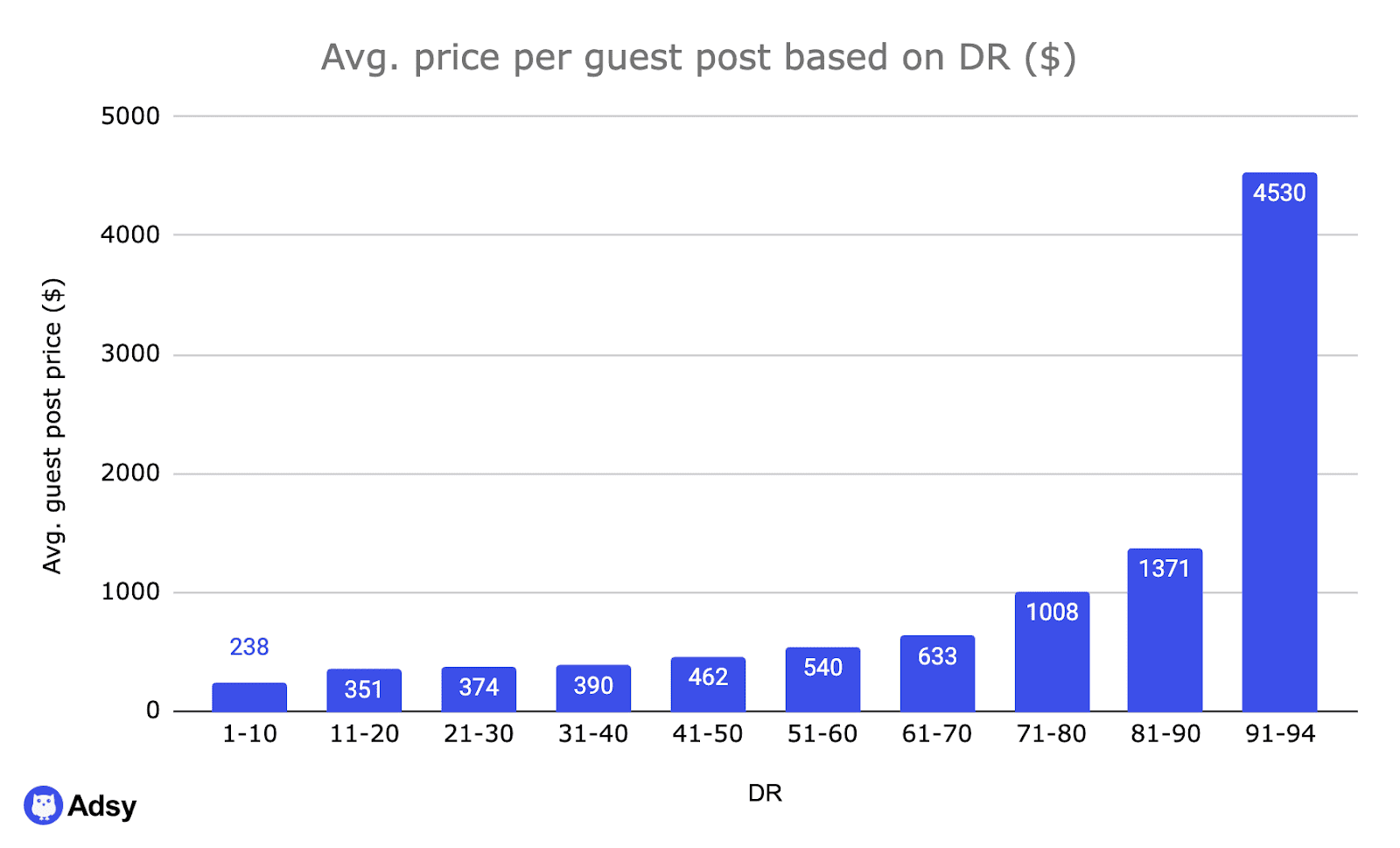
But if you want to get some realistic price estimations, we’ve analyzed over 37,000 websites that accept guest blogs to answer that question. You can find the full research here.
Long story short, this is what website editors and owners expect:
- DR 1-40 ranges from $238 to $390.
- DR 41-70 will cost you from $462 to $633.
- DR 71-94 has the asking price of $1008-$4530+.
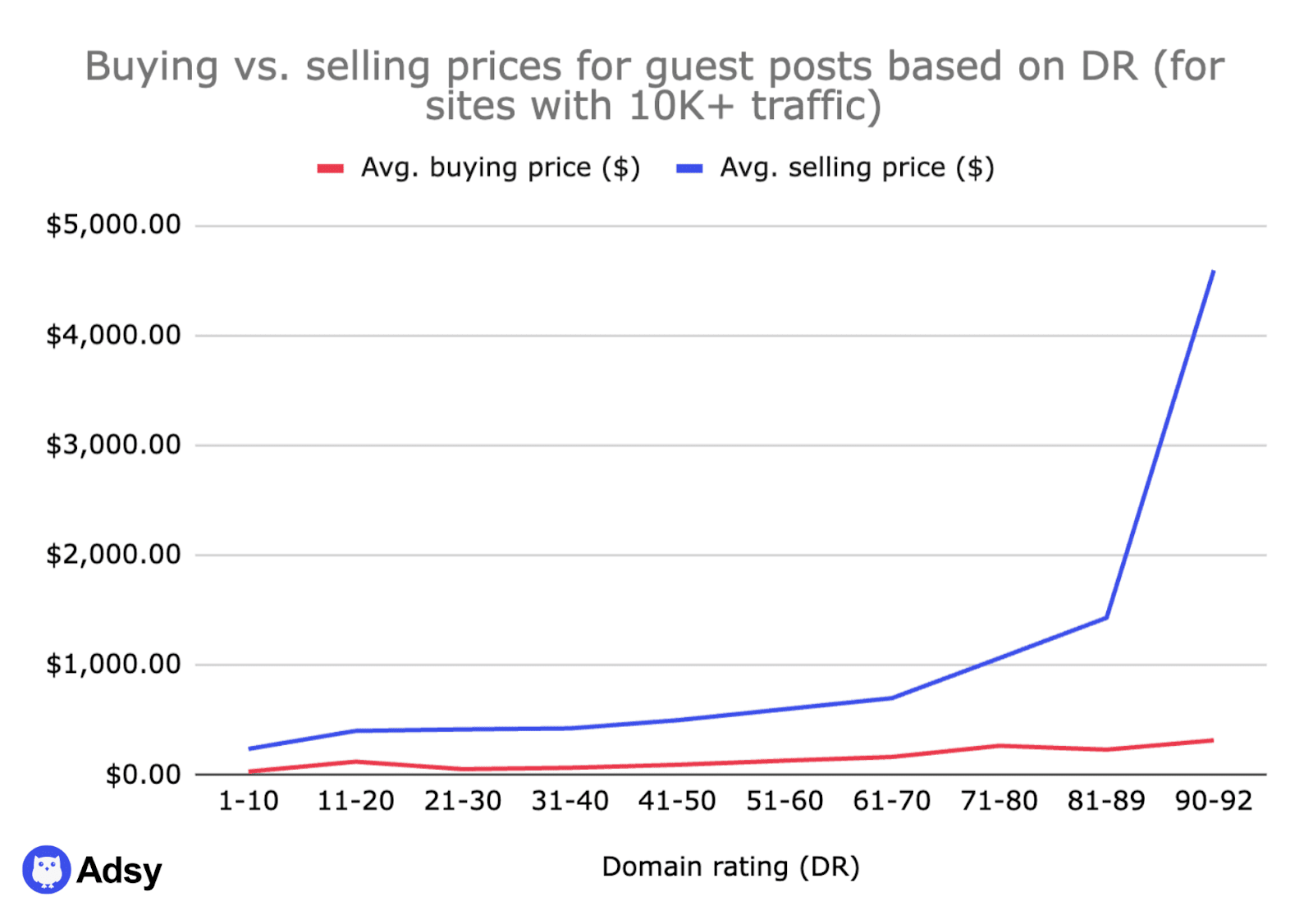
The interesting part, though, is that the selling (aka asking) and the buying prices vary insanely.
For example, the average asking price for guest blogs on the sites with DR 71-80 is 4x higher than what people usually pay ($1,066 vs. $269).
How long should I wait until backlinks impact rankings?
Typically, you will see the first results in 2 months. But the proper impact will be fully there in 6-12 months.
What metrics should I track?
This will vary depending on your objectives. But these are the basics you can focus on:
- Referring domains (not raw URL count),
- Page-level ranking movement,
- Organic traffic growth,
- Referral traffic growth,
- More AI visibility.
How many emails should I send per week?
A rational number is 50-100 personalized emails. If you want to scale, wait for a strong reply rate and qualification first.
All trademarks, logos, images, and materials are the property of their respective rights holders.
They are used solely for informational, analytical, and review purposes in accordance with applicable copyright law.



 Sign Up
 Sign Up