






SEO Predictions for 2026: The Shifts Experts Are Preparing For
For decades now, we’ve all been gasping at how fast things are progressing.
Well, now it’s truly faster than ever. At the current pace, yearly trend reports will be obsolete within a couple of months. That’s why we’ve asked top SEO experts for 2026 predictions to understand what they see coming and help you prepare for these shifts.
Before we get into the actual SEO predictions, here is what some of the most trusted industry reports have to say about current trends in digital marketing and SEO.
HubSpot State of Marketing Report, 2026:
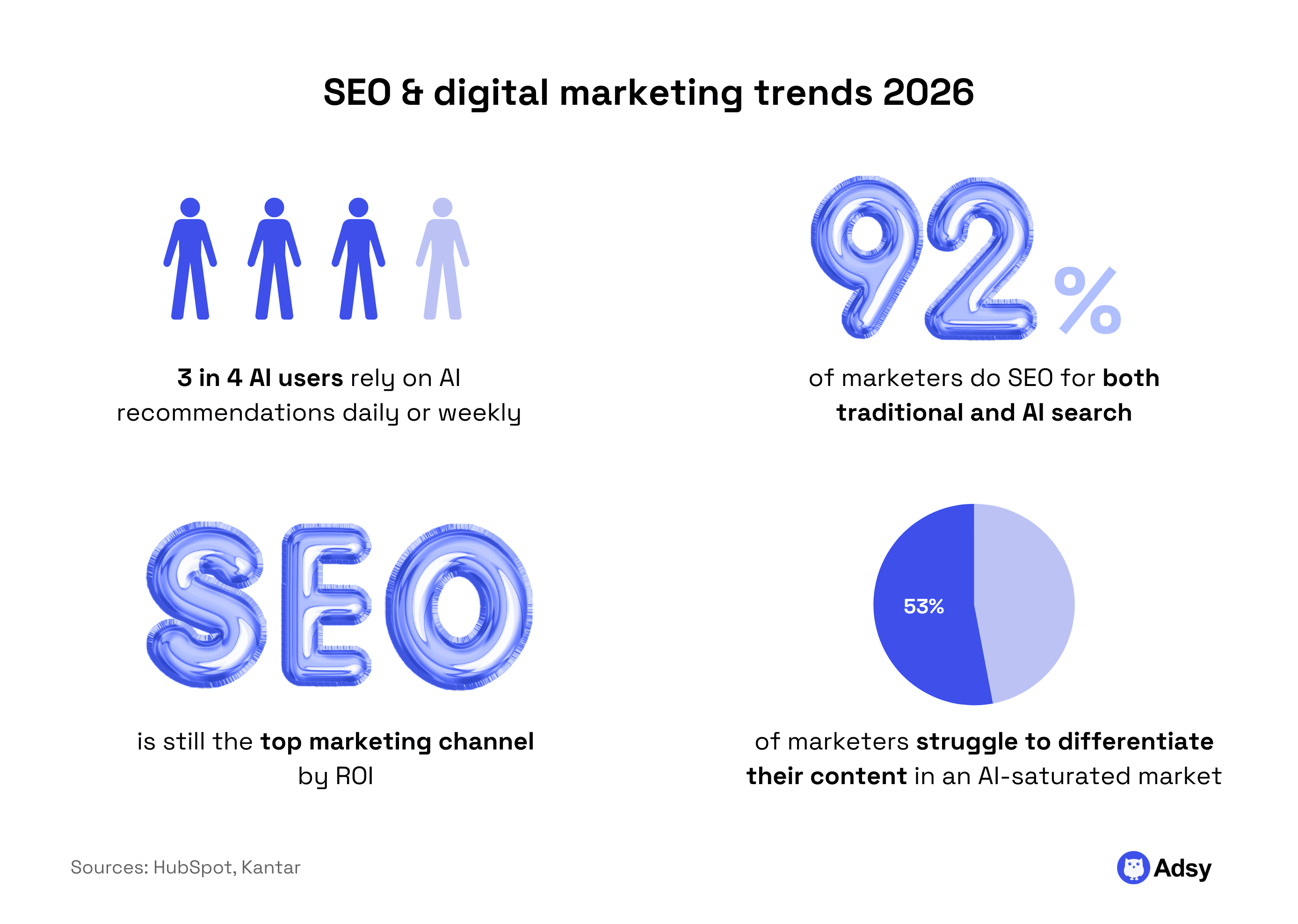
- 92% of marketers do SEO for both traditional and AI-powered search engines.
- Even though organic traffic has dropped because of AI answers, 58% of marketers notice that AI traffic has much higher intent than traditional search.
- 53% of marketers struggle to differentiate their content in an AI-saturated market (Note: That’s why original insights will be more valuable than ever).
- SEO is still the top marketing channel by ROI.
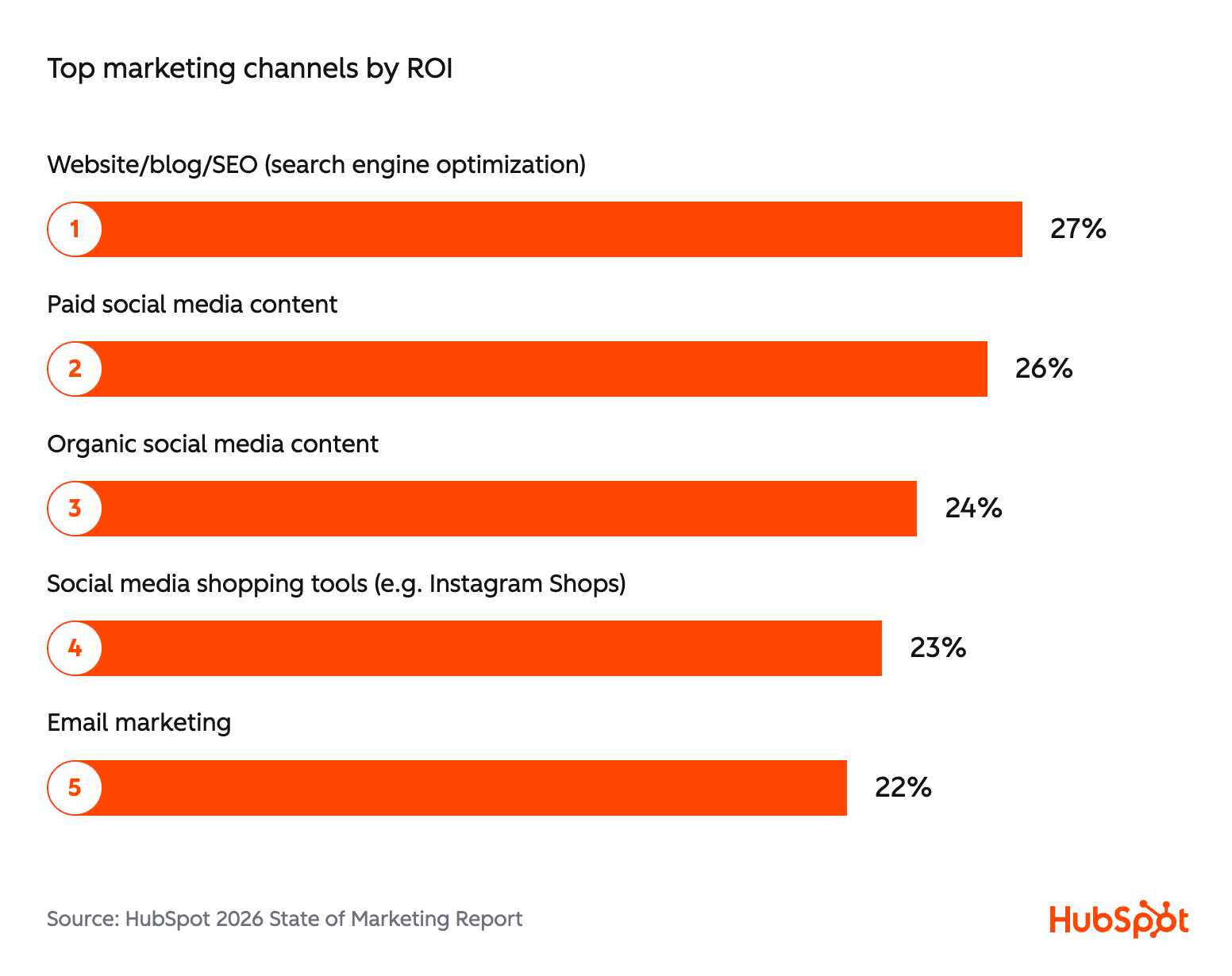
Source: HubSpot
- 3 in 4 AI users rely on AI recommendations daily or weekly.
- Synthetic data modeling can reach 94-95% accuracy compared to real datasets (Note: this can be useful for predictive SEO and GEO strategies, among other things).
While credible industry research is essential for keeping up with changes, it’s also really important to listen to experts in SEO who deal with optimization realities every day.
So, let’s get right into it.
Unfaked human expertise will beat AI content – David Pagotto
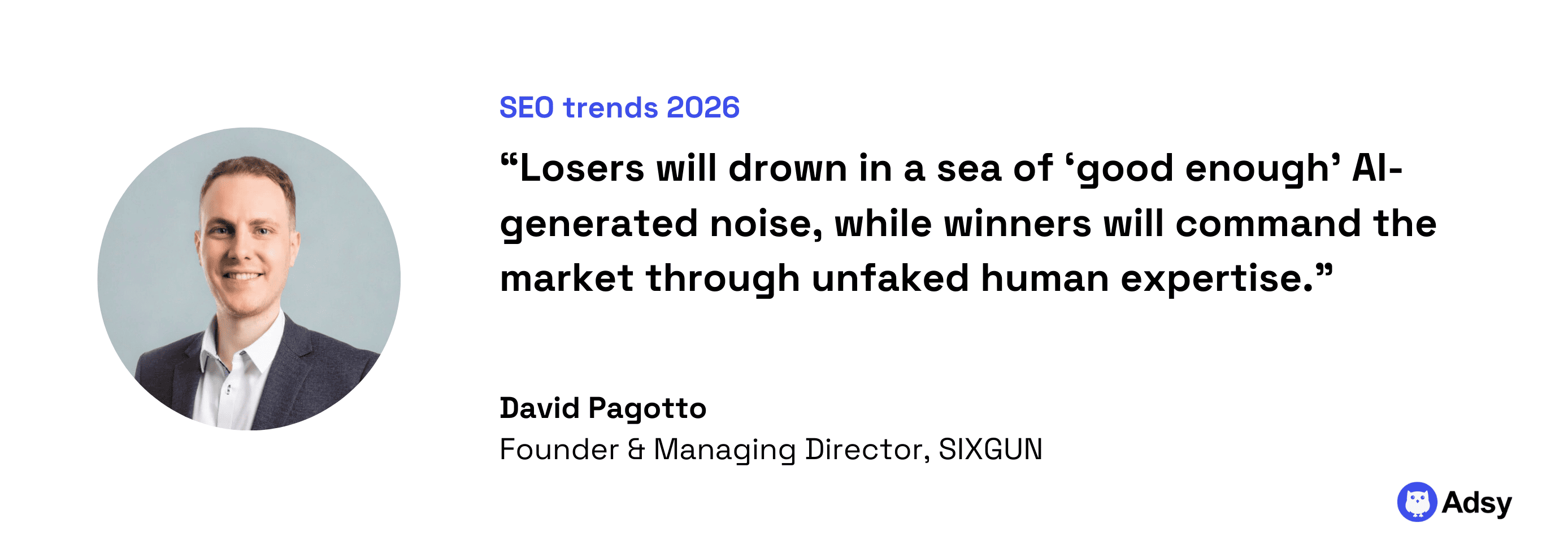
David Pagotto (Founder & Managing Director of SIXGUN) believes that in 2026, losers will drown in a sea of "good enough" AI-generated noise. But if you want to win, you have to prioritize:
- Unfaked human expertise,
- And quality user experiences.
In other words, if you want to succeed, you have to build brand authority, not a content farm that spits out average AI blog posts.
If your strategy isn't built around expert-led AI SEO performance and delivering actual value across the board, you're going to slip.
"Information gain" will become a priority – David Bachetti
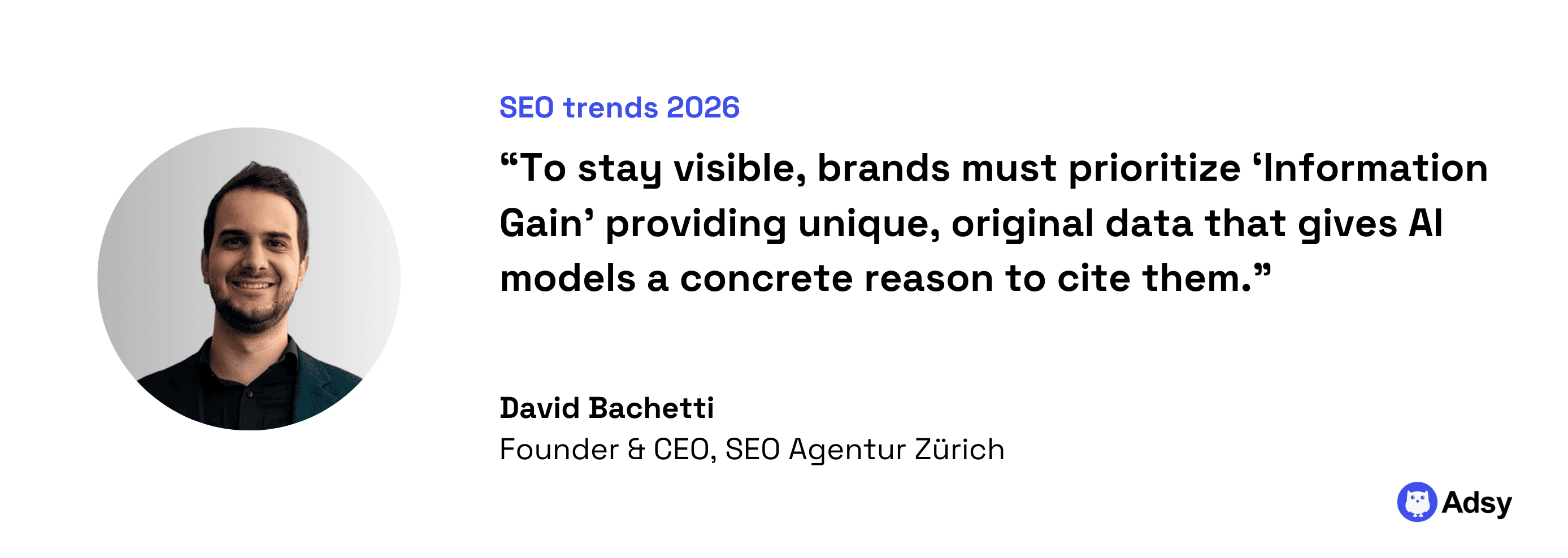 David Bachetti (Founder & CEO of Agent AGENTUR GmbH & SEO Agentur Zürich) predicts that SEO will shift from "search optimization" to "selection optimization." This refers to changing focus from ranking in search results to being selected by LLMs and other AI systems.
To stay visible, brands must prioritize “information gain,” which means focusing on unique content rather than rephrasing what’s already published online. This includes:
- Original data,
- Your own research,
- Real-life use cases and experiences,
- Fresh angles.
So, instead of writing generic, SEO-friendly content, you need to give AI models something new and different. This is the only clear reason to cite you and select your content over other alternatives.
Going beyond theory is essential for AI visibility – Davor Karafiloski
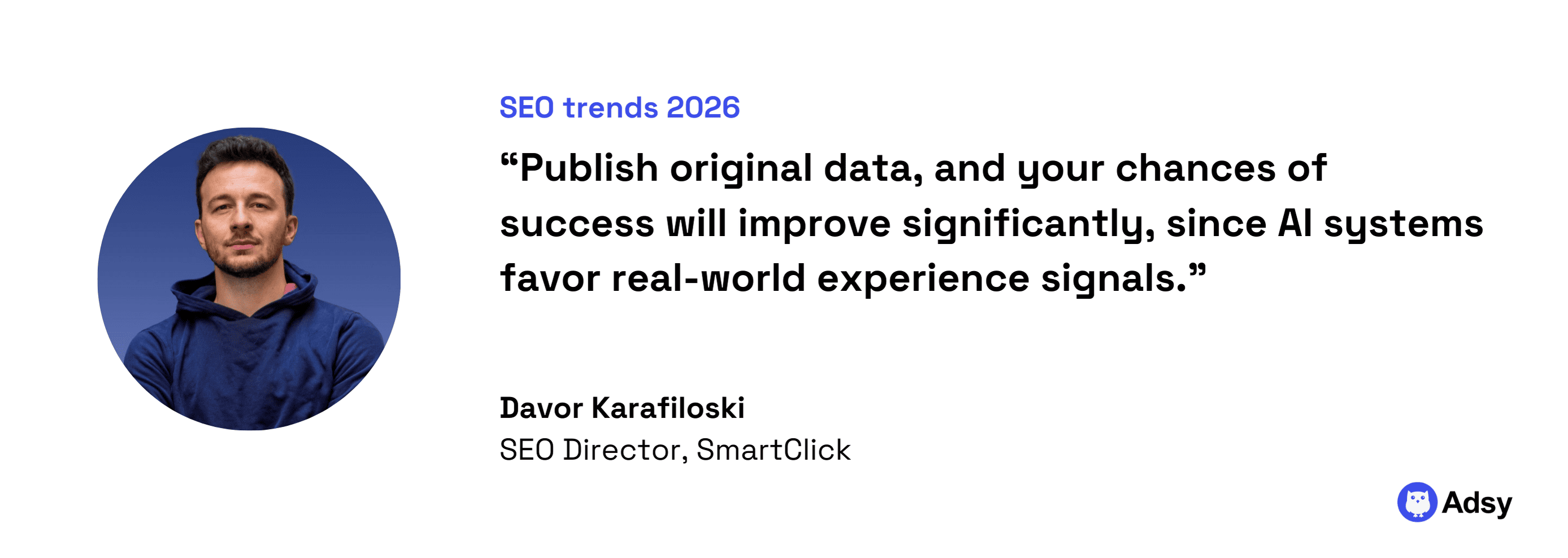
Davor Karafiloski (SEO Director at SmartClick) highlights that one of his main predictions for SEO in 2026 is that the search results won’t reward those who post more content. But those who have built an undeniable authority in their category.
AI systems are paying attention to credibility patterns across the web, not isolated optimized pages. Anyone can generate content now. That’s no longer a differentiator.
So, if you want to gain brand visibility in LLMs and AI search in 2026, work on your authority and real-world proof.
According to SmartClick’s own research, these are the things that actually work for AI visibility:
- Go beyond theory and use practical examples. The content that surfaces most in LLMs often gives clear, contextual answers and backs up claims with real case studies or research. So, add original data because merely repackaging what’s already ranking in the top 10 won’t work.
- Distribute your content across the web. Content distribution plays a key role in LLM visibility. If your brand isn’t being discussed on LinkedIn, YouTube, or other platforms relevant to your industry, it’s far less likely to be picked up and referenced by AI systems.
- Update your content regularly. Content freshness is another key element, as studies show that LLMs are likely to cite blog posts published or updated within the last year.
- Try different content formats. Apart from general blog content, experiment with review pages, comparisons, alternatives, and other similar formats. They are much more likely to drive MoFu and BoFu traffic.
- Prioritize provable experience, not content volume. You have to solve real problems, add value in your niche, and show it all on your content.
The brands that will win are the ones with consistent brand mentions, real customer proof, product-led visibility, and original data that gets referenced naturally.
AI agents will run the SEO workflow – Jasja ter Horst
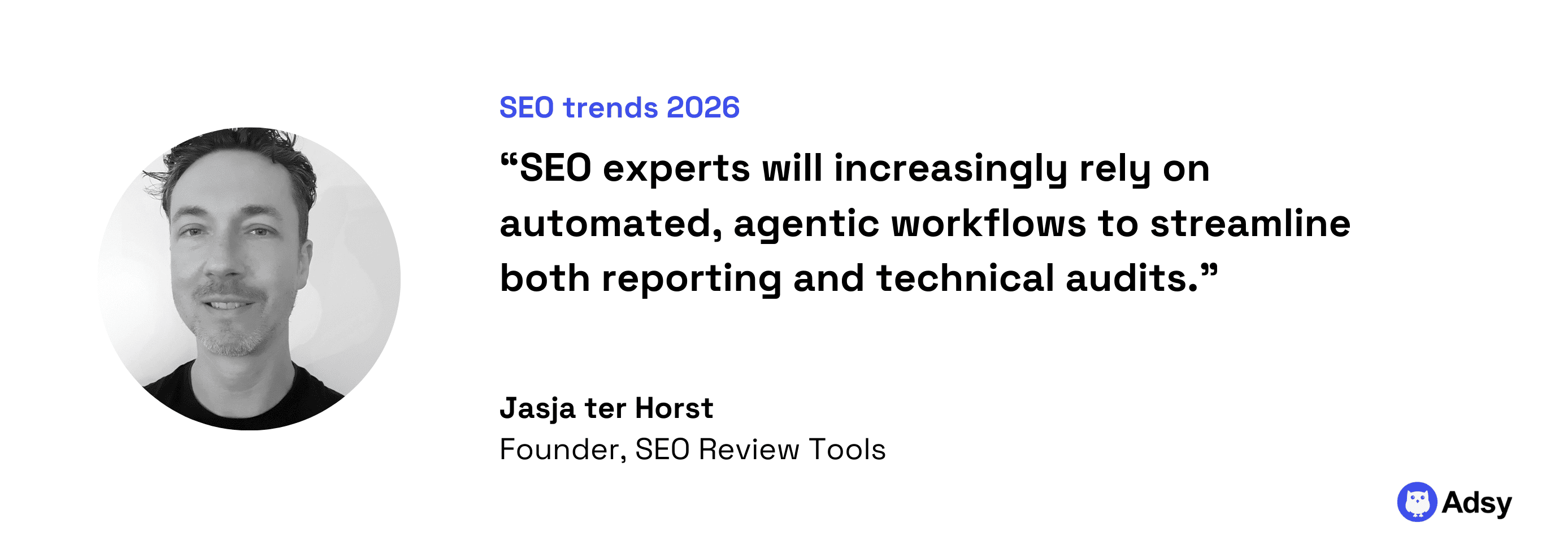
For Jasja ter Horst (founder of SEO Review Tools), one of the biggest AI predictions for SEO is the rise of AI agents in everyday workflows.
SEO experts will rely on automated, agentic systems to handle reporting and technical audits. These agents will pull data from:
- Traditional analytics platforms (Google Analytics, Search Console),
- Proprietary business sources (e-commerce and customer support data),
- Third-party APIs (SERP, competitor, and AI visibility data).
By combining all this information, AI agents will turn scattered data into clear insights and practical tasks.
Speed of adaptation is your biggest competitive advantage – Andrii Shum
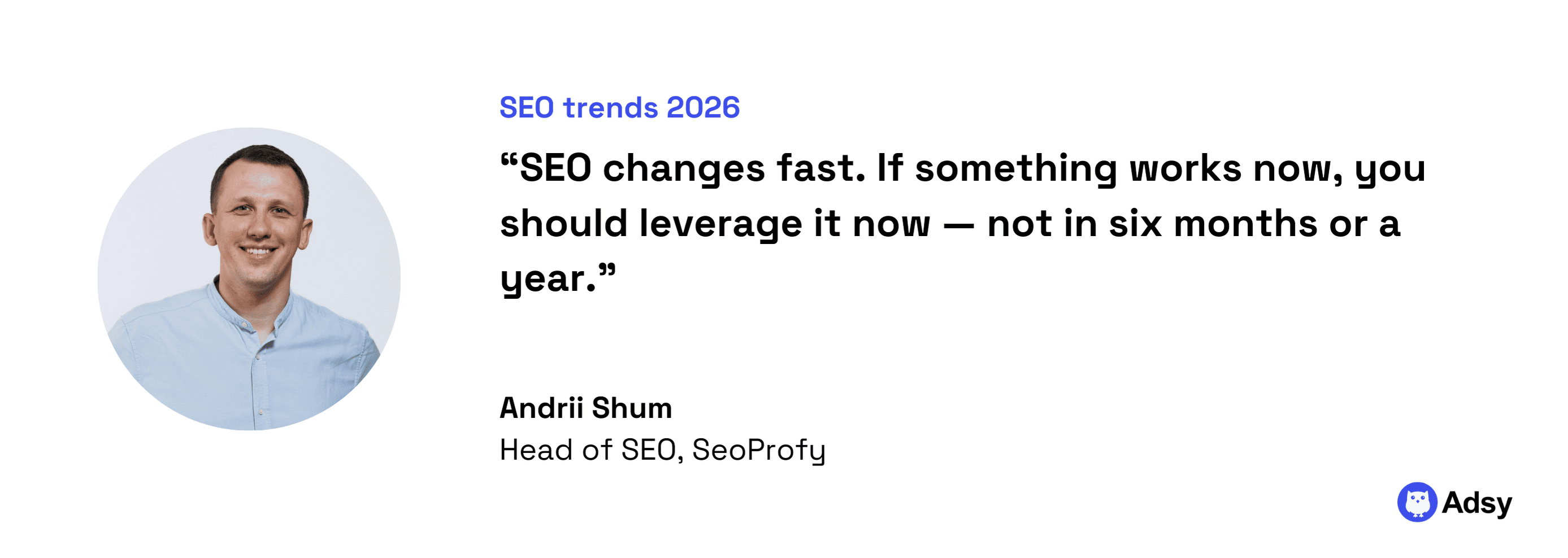
Andrii Shum (Head of SEO at SeoProfy) shared that many people read about current optimization trends and yet postpone actual implementation. But SEO changes fast. So, if something works now, you should leverage it now. Not in six months or a year.
Currently, the SEO trends you can focus on are:
- Get mentioned in relevant listicles. These days, listicles are one of the most effective link building methods that also help brands appear in AI-driven results.
- Avoid relying on traditional top-of-funnel (ToFu) content. Glossaries, basic definitions, and similar pieces will continue losing impact. Content where AI Overviews already provide a comprehensive answer has very low chances of generating traffic.
- Focus on timely and/or trending content. AI search engines always look for fresh information across the web. That’s exactly why up-to-date materials are more likely to get cited.
- Prioritize MoFu and BoFu content. The middle-of-the-funnel pieces drive citations. And bottom-of-the-funnel content drives traffic. So, that’s what you want to focus on.
- Make sure your brand appears on Reddit. Reddit, along with Quora, is one of the most cited sources in AI answers and LLMs. Try to be there without getting spammy.
But as mentioned before, none of these trends will last forever. That’s why treat them as a temporary advantage (even if some of them last), and adapt quickly.
SEO is shifting from keywords to entities – Dennis Benjak
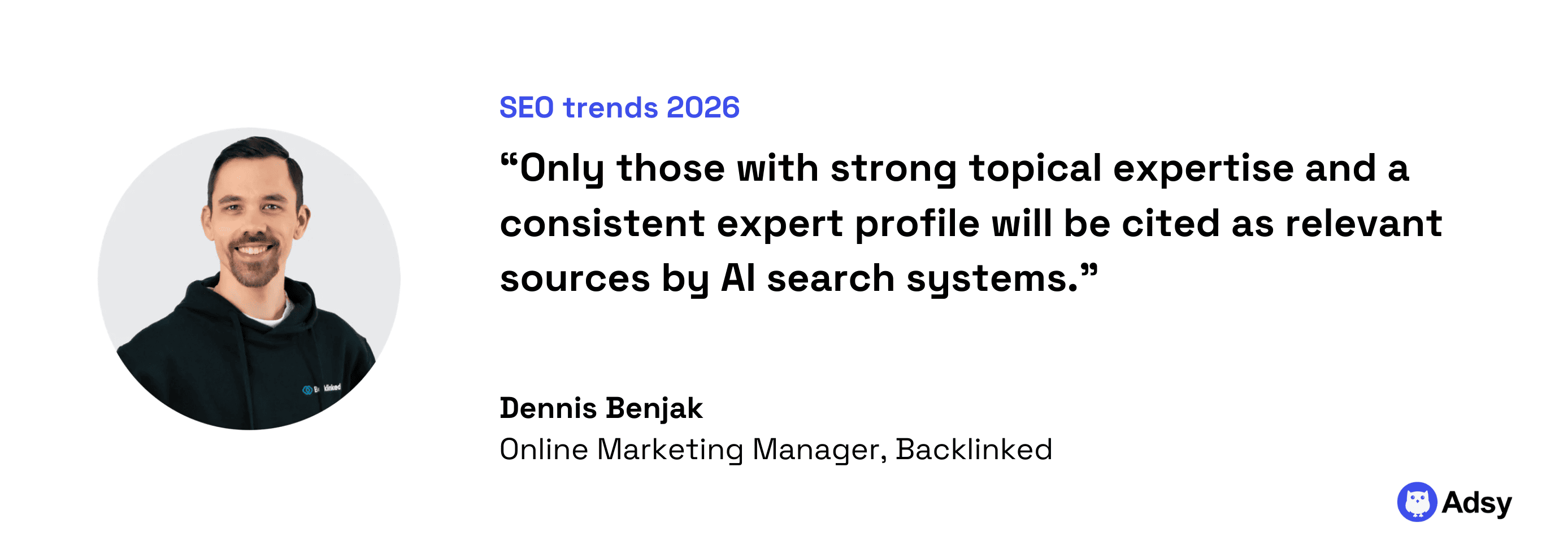
Dennis Benjak (Online Marketing Manager at Backlinked) believes the biggest change we’ll continue to notice is the focus on authority and trust.
Search engines (and AI systems) will be paying more attention to brands, people, and companies as entities, not just matching keywords. This basically means that we’ll see the following trends:
- You need to elevate the entire digital presence for AI citations: Google looks at the brand’s reputation, content depth, consistent expert profile, and the general contextual environment.
- AI-generated content without strategy can hurt brands: Many companies rely too heavily on AI tools, creating low-value content that does more harm than good to the brand.
- Your visibility depends on your expertise: Businesses that establish themselves as credible and knowledgeable experts in a particular topic will win.
Research will be the most impactful thing for visibility – Taylor Scher
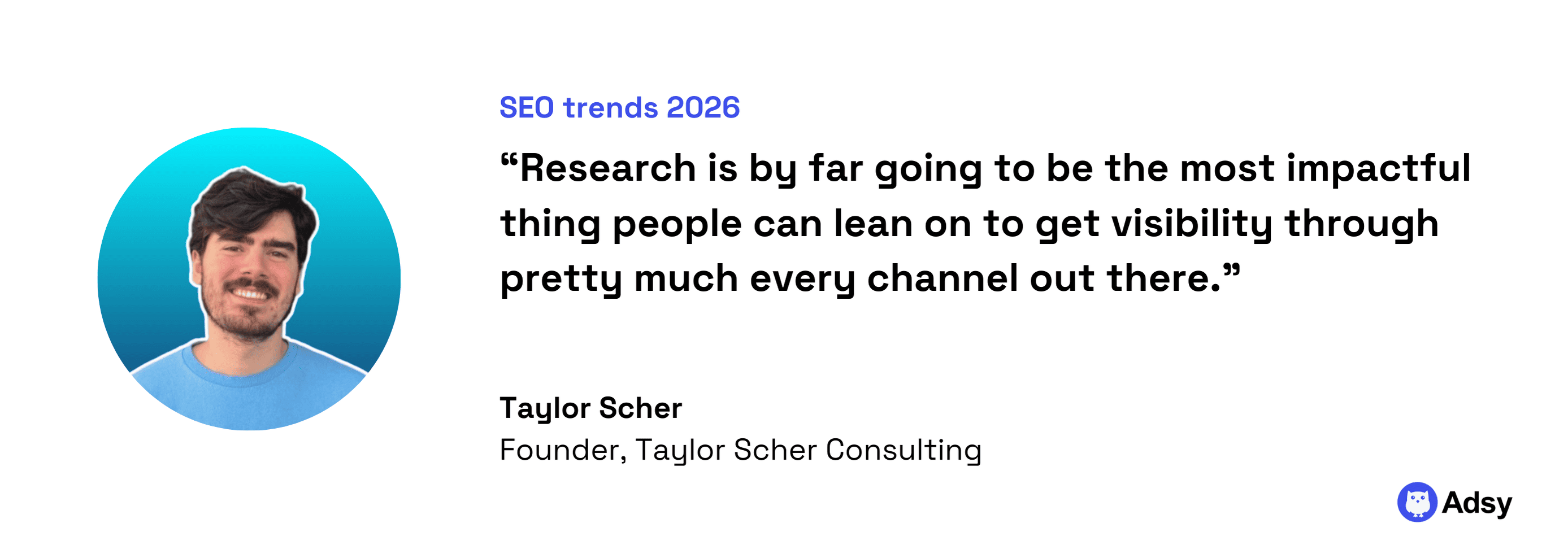
For Taylor Scher (founder of Taylor Scher Consulting), the biggest shift is in how we approach content. These days, largely thanks to AI, every inbound channel (social, SEO, AI search, etc.) is filled with mediocre content.
So, the only way to truly stand out is to do original first-party research.
LLMs are looking for the most recent content when surfacing answers, and statistics (research) happen to be one of the top 3 items LLMs cite in their output.
That’s why, if you want LLMs and users to recognize you, you have to:
- Treat yourself as an industry leader,
- Publish new data around areas that your audience cares about.
For example, if you look at Semrush's and Ahrefs’ blogs, you'll notice they've cut way back on MoFu and ToFu content. Now, they mostly publish industry insights. This type of content is exactly what will separate the winners from the losers in 2026.
Relevancy and topical authority in link building will matter more than DA – Mayur Bhatasana
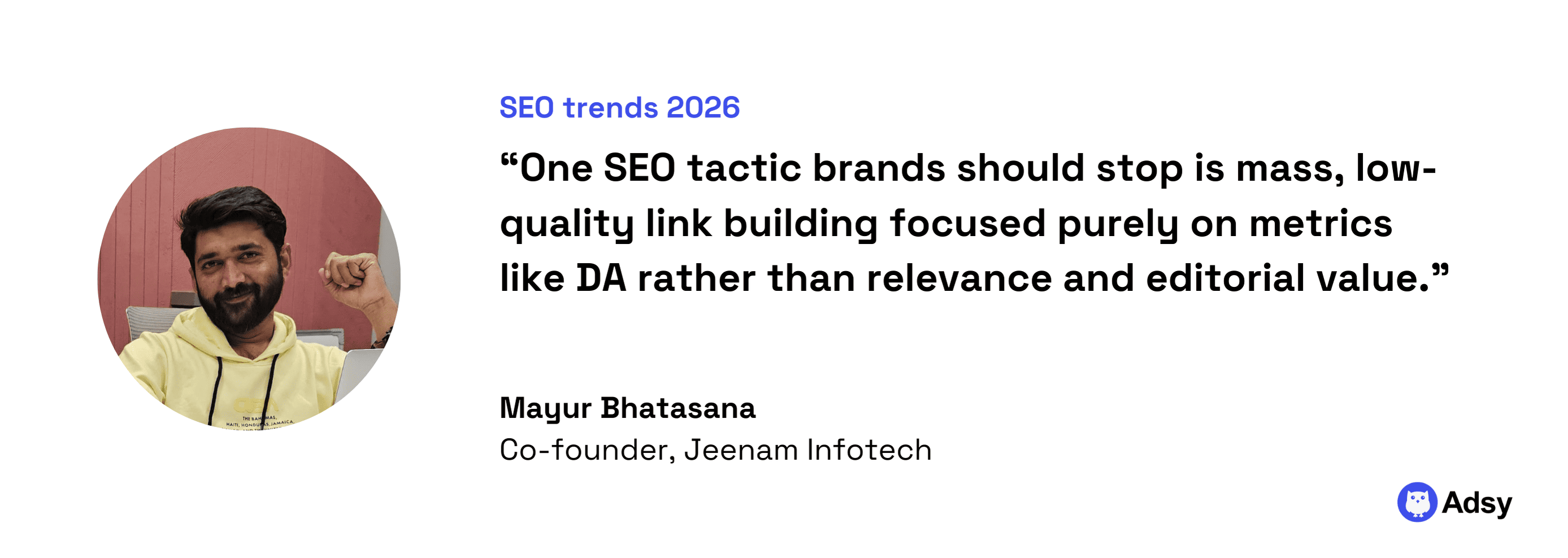
Mayur Bhatasana (co-founder of Jeenam Infotech) highlights one particular thing businesses should stop doing in 2026: mass, low-quality link building.
When choosing backlink donors, many companies still focus on link building metrics like DA instead of relevance. But search engines now care more about:
- Actual context,
- And real editorial value.
So, instead of prioritizing large link volumes, focus on fewer backlinks from trusted sources aligned with your niche.
Traditional keyword optimization will become secondary – Tuhin Banik
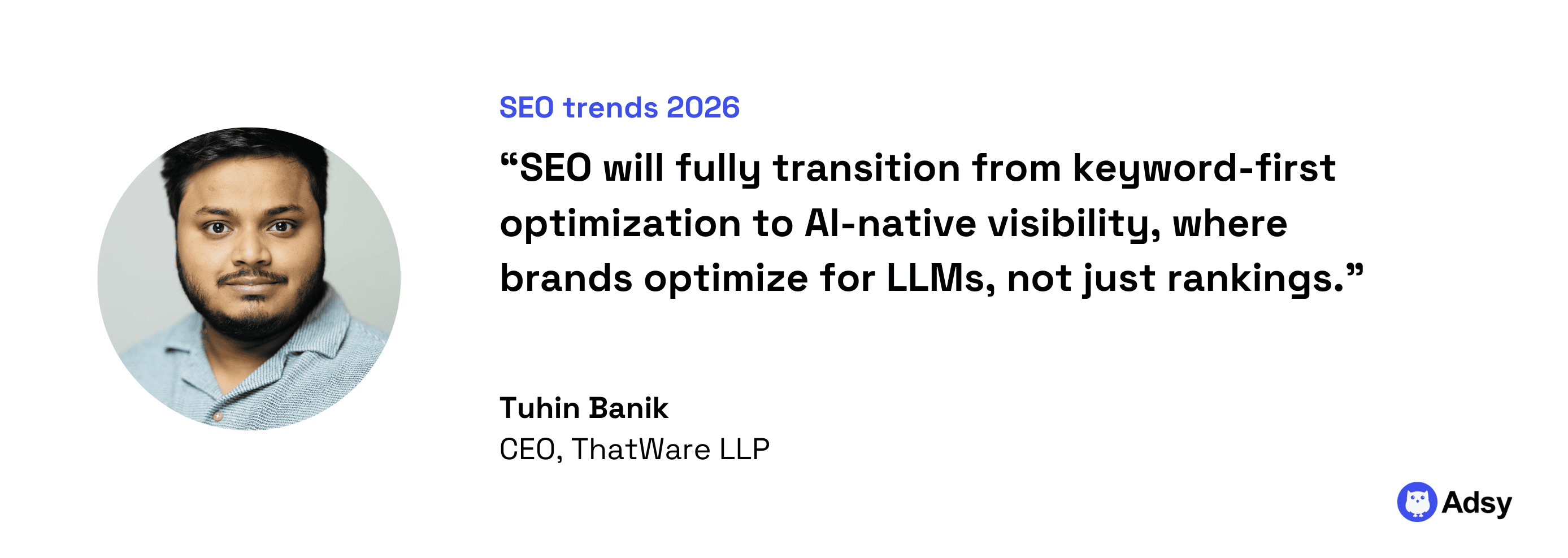
Tuhin Banik (CEO of ThatWare) highlights one of the major SEO ranking algorithm predictions: we’re moving away from keyword-first optimization.
Instead, in 2026, the focus will shift to AI visibility. Brands need to optimize for how LLMs discover, interpret, cite, and trust content across answer engines, not just how pages rank in traditional search.
Essentially, meeting user intent will matter more than traditional SEO metrics.
According to Tuhin, the SEO success will depend on:
- GEO (Generative Engine Optimization),
- Strong entity authority,
- And content that is easy for machines to understand and trust.
Stop relying on “hacks” and build a real system – Amit Raj
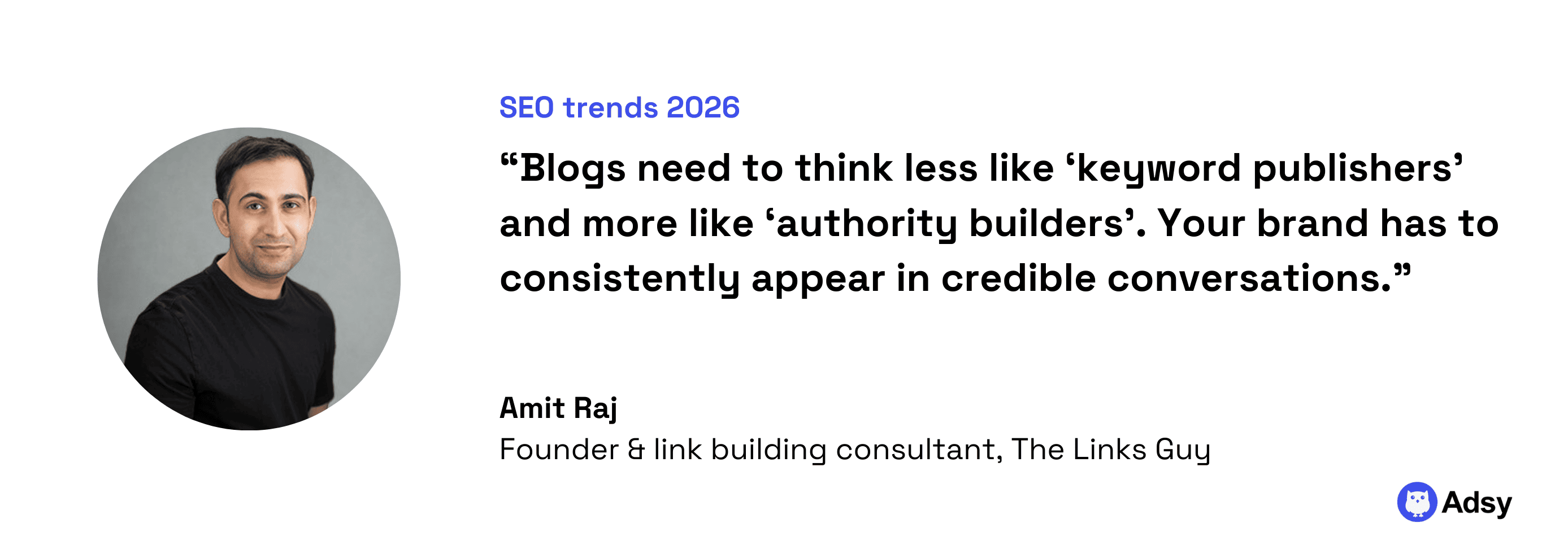
Amit Raj (founder and link building consultant at The Links Guy) predicts that one of the biggest changes will be the growing inefficiency of random, scattered hacks. If you want your brand to stay visible in the AI age, you have to look at the bigger picture:
- Instead of thinking like a “keyword publisher,” switch to an “authority builder” mindset.
- Instead of overrelying on listicles for LLM visibility just because everyone talks about them, focus on a strategy that produces durable AI visibility.
- Instead of chasing random backlinks, build well-structured, diversified off-site signals.
Overall, your 2026 SEO strategy needs to rely on two main elements:
- Original content: Focus on original insights, real experience, clear positioning within a niche, ideas that are worth citing or referencing, and content that journalists, communities, and other sites will link to or mention.
- Off-page brand visibility: Your main goal should be to consistently appear in credible conversations. This can be anything from media coverage and YouTube presence to Reddit and review platforms (e.g., Trustpilot, G2, Capterra).
So far, these two elements are among the most effective ways to appear in AI-generated answers.
Conclusion
Of course, none of us knows what the future of SEO really is. But what we can do is pay close attention to current trends and react quickly. If you apply at least some of the SEO predictions we’ve discussed today, you’ll definitely see better results.
So, while the uncertainty, especially with AI development, might seem overwhelming, it gets better once you’re flexible enough to adjust your strategies.
And we’ll do our best to keep you regularly informed about the most relevant trends and SEO expert advice. If you have anything particular in mind, just let us know.
All trademarks, logos, images, and materials are the property of their respective rights holders.
They are used solely for informational, analytical, and review purposes in accordance with applicable copyright law.
 Sign Up
 Sign Up