






Digital Media Planning: Build a Strategy That Reaches the Right People
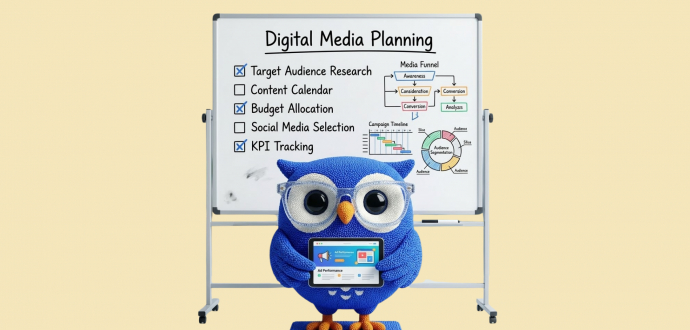
There are not so many moments in life when something lands at exactly the right moment. But with some things it happens more often than with others.
Set your business aside for a moment and put yourself in your audience’s shoes.
Imagine how they’re already halfway through making a decision about the new CRM (bookshelf or any other product/service). And then, bam, they see an ad exactly about that.
What is that? Coincidence? Luck? Or something else?
Well, when it comes to that miracle, there's a simpler explanation. In reality, it's digital media planning doing its job. You’ve probably guessed it:)
But the real question isn’t what it is. It is how you can use it effectively for your business.
And this is what this guide is all about.
What is digital media planning (and what it isn’t)
Digital media planning is the process of deciding where, when, and how your digital advertising should show up. As simple as that.
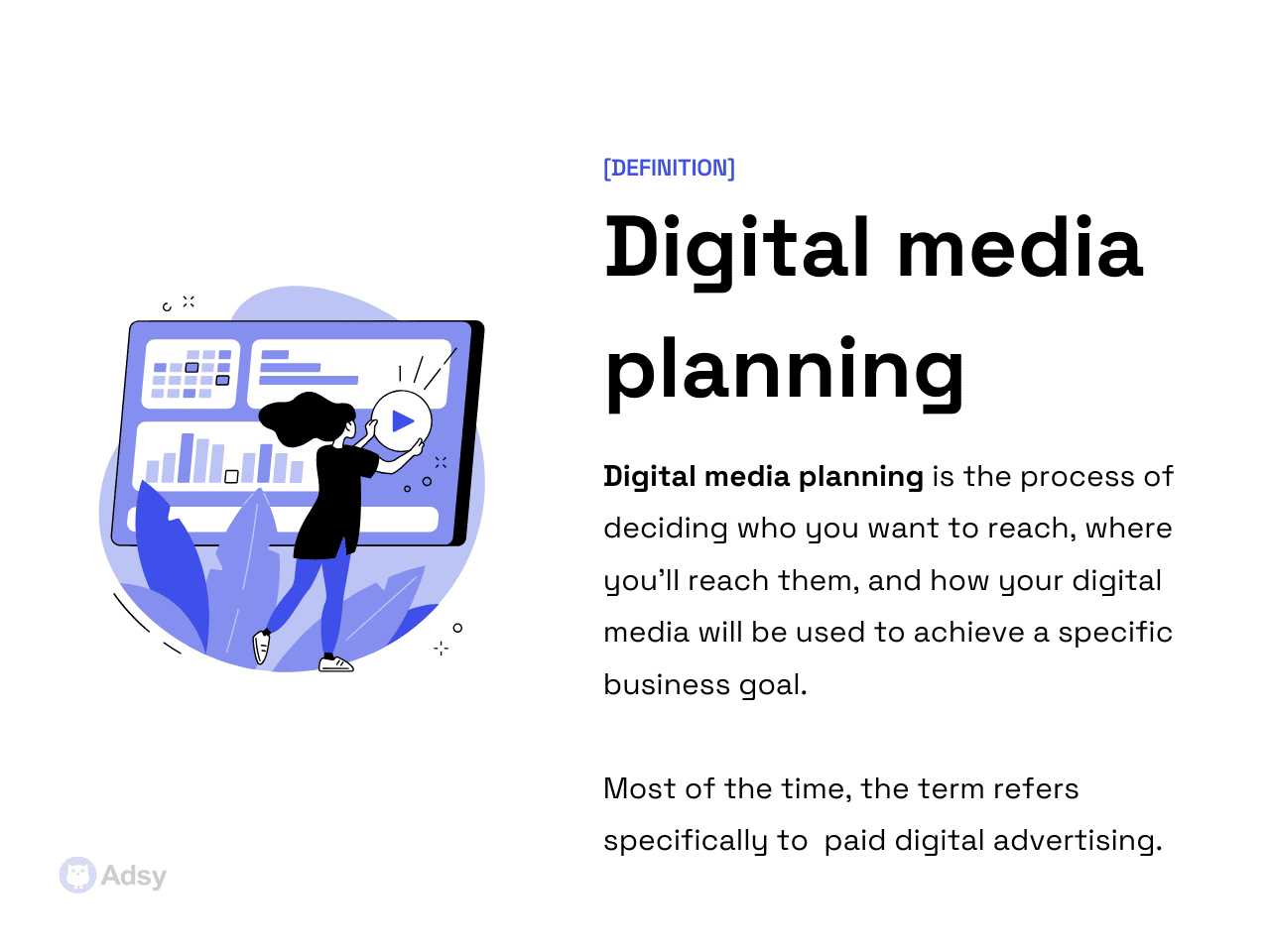
Essentially, media planning means making informed choices about how your ads will be shown across digital channels. This decision typically depends on the audience insights, business goals, budget, timing, and data quality.
This whole process invites you to look at the fragmented and noisy digital marketing scene and understand exactly what you need.
Here is an important detail, though.
While media planning mostly refers to paid channels, sometimes, you might see that this term is used more broadly, covering:
- Paid (all types of ads),
- Owned (everything you own, like your website, app, newsletter, etc.),
- And earned media (any mentions, reviews, backlinks, PR, etc., you “earn”).
In this guide, we’ll focus on paid channels, since it’s what most people are expecting when researching this topic.
Yet, you can still apply most of the strategies to any other channels you want to work with.
Now, let’s sum up.
What it is:
- A system that translates marketing goals into concrete decisions about digital platforms, content, most effective channels, ad formats, and media spend.
- A framework for aligning audience targeting with real-world context (what people are actually doing when they see your message).
- A planning layer that is somewhere between digital marketing strategy and execution.
What it isn’t:
- A media buying checklist.
- A list of platforms you “should be on.”
- A guarantee of performance.
But to understand it fully, there's a little bit more you have to know.
Media planning vs. media buying
These two terms often confuse many people. That’s because they have some connection, but they are far from being the same thing. Still, it's easy to misunderstand it all.
So, let’s make things clear:
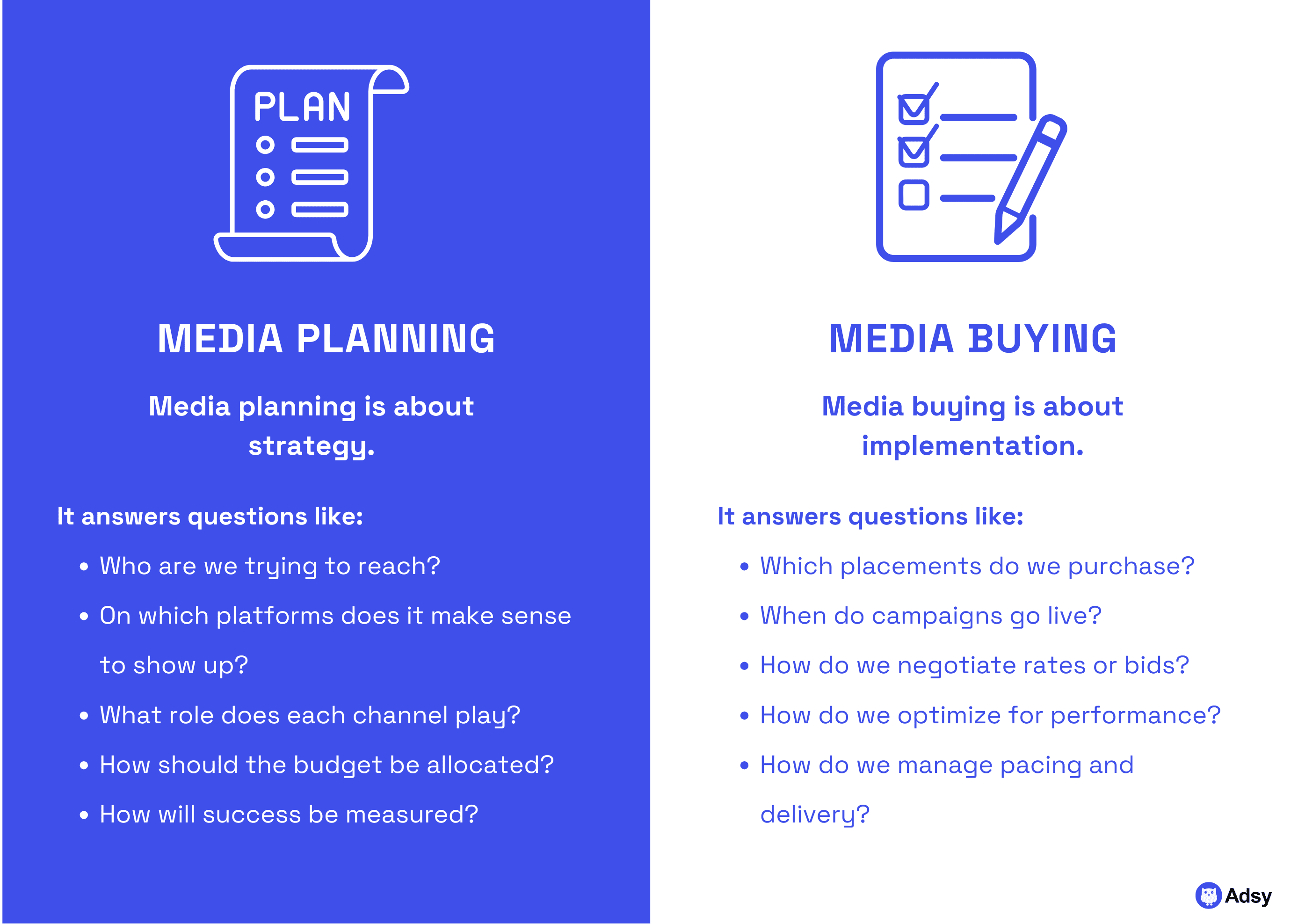
- Media planning is responsible for your strategy.
- Media buying is about the execution.
So, yes, it’s easier than it might seem at first glance.
Digital media planners are essentially… planners. No kidding:) They decide why a channel is used and who it’s meant to reach. They also focus on what platforms make sense for each case and where you should allocate your budget.
Media buyers, on the other hand, take that plan and put it into action by setting bids, managing ad spend, testing ad formats, etc.
When this separation breaks down, problems show up at the speed of light:
- Channels get judged too early because no one has defined the payback window.
- Media buyers optimize toward the wrong key performance indicators.
- Campaign management becomes reactive (when it should be international).
But a strong digital media plan gives media buyers room to do their job well.
Without it, they’re forced to make strategic decisions on the fly. And obviously, nothing “strategic” comes out of it.
Media strategy vs. marketing strategy
This is another common source of confusion. But these two are also very different:
A marketing strategy defines what the business is trying to achieve and why. It also sets the direction: business objectives, positioning, ideal customer, and so on.
A media strategy defines how attention is earned and used to support those goals. It answers practical questions:
- Which digital channels matter for this audience?
- How should paid media support content marketing, search, retention, etc.?
- What balance makes sense between performance and increasing brand awareness?
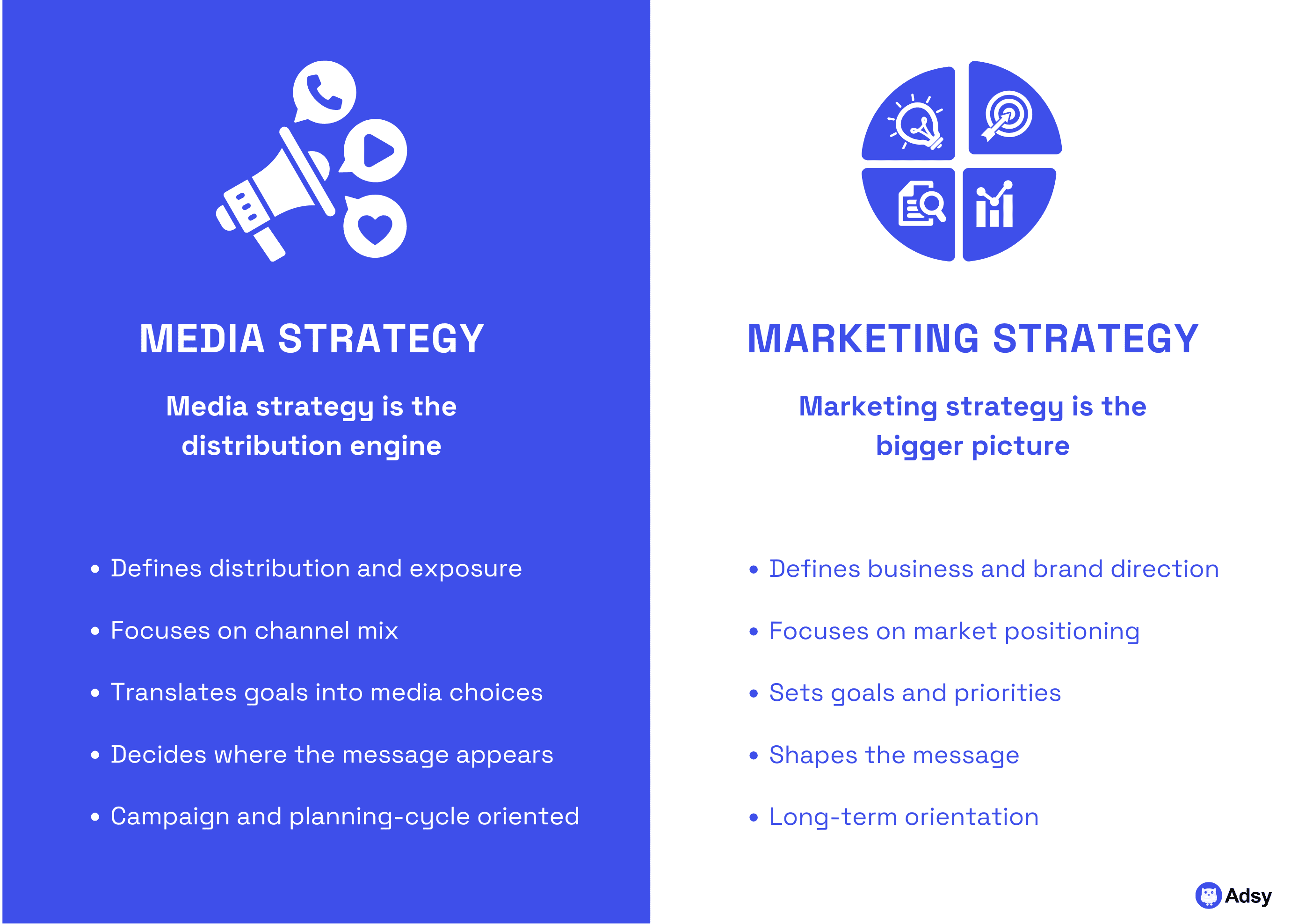
Basically, a marketing strategy is a bigger picture of how you position and promote your brand. And the media plan is more about reach and distribution.
How to build an effective digital media plan in 8 steps
An effective digital media plan, as many might think, should start with channels, ad formats, budgets, and converting copy.
But in reality, these can’t be your starting point.
It all begins earlier, way before you touch any ad platform, and before your team writes all the campaign goals on yet another dashboard.
The biggest mistake businesses make is seeing media planning as something you just “set up.”
But it requires several systematic steps, not just a random set of questions you can cover in one Zoom. Therefore, you can't rush into that.
What are those steps? Glad you’ve asked.
Below, we’ve collected the essential ones that form an effective, well-paced approach.
1. Conduct market research (if you haven’t already)
When people hear about market research, they often think about running a six-month analysis project. For some marketing objectives, this could be the case. True.
But in the context of digital media planning, market research is simply about answering one question: What are we walking into?
Before you commit to anything, you need an understanding of the market you’re about to compete in. At this stage, some basic market sizing can answer a crucial question: Is there enough reachable demand to justify the effort?
Not total market fantasies, but how many people you can realistically reach.
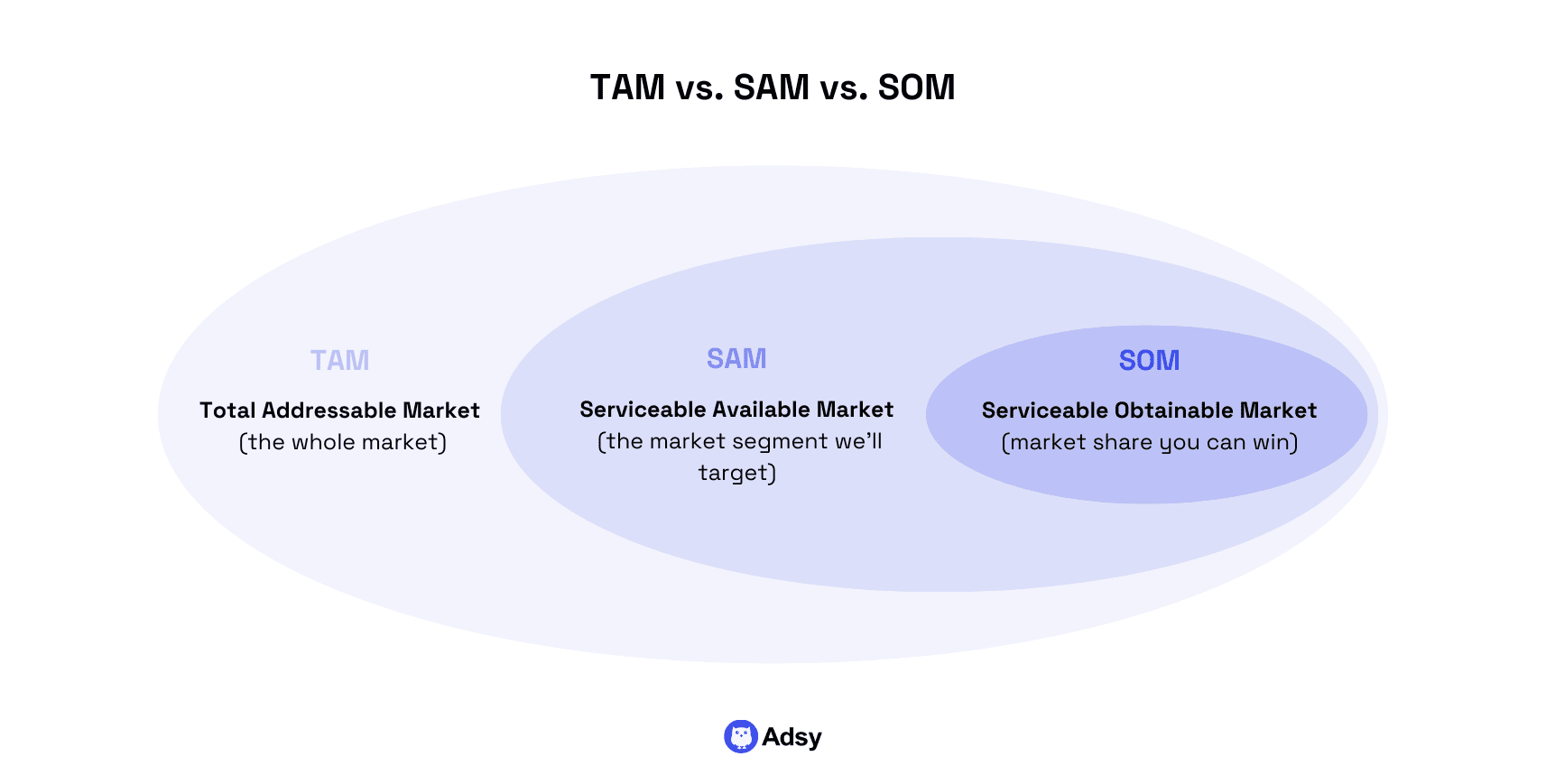
Ideally, your market research should give you the following answers:
- How crowded your space is across online platforms.
- How your competitors are using all their paid media.
- What kind of messaging already exists (and what people are numb to).
These fundamentals can make a huge difference later on. While they sound like tiny insights, they give you one important thing: context.
This step exists to prevent two very expensive mistakes:
- Copying what everyone else is doing.
- Assuming that no “obvious” competition means there’s room to win.
You don’t need to chase perfect data. You need to understand the direction you are taking. And that means checking what's already working (and not) in your niche.
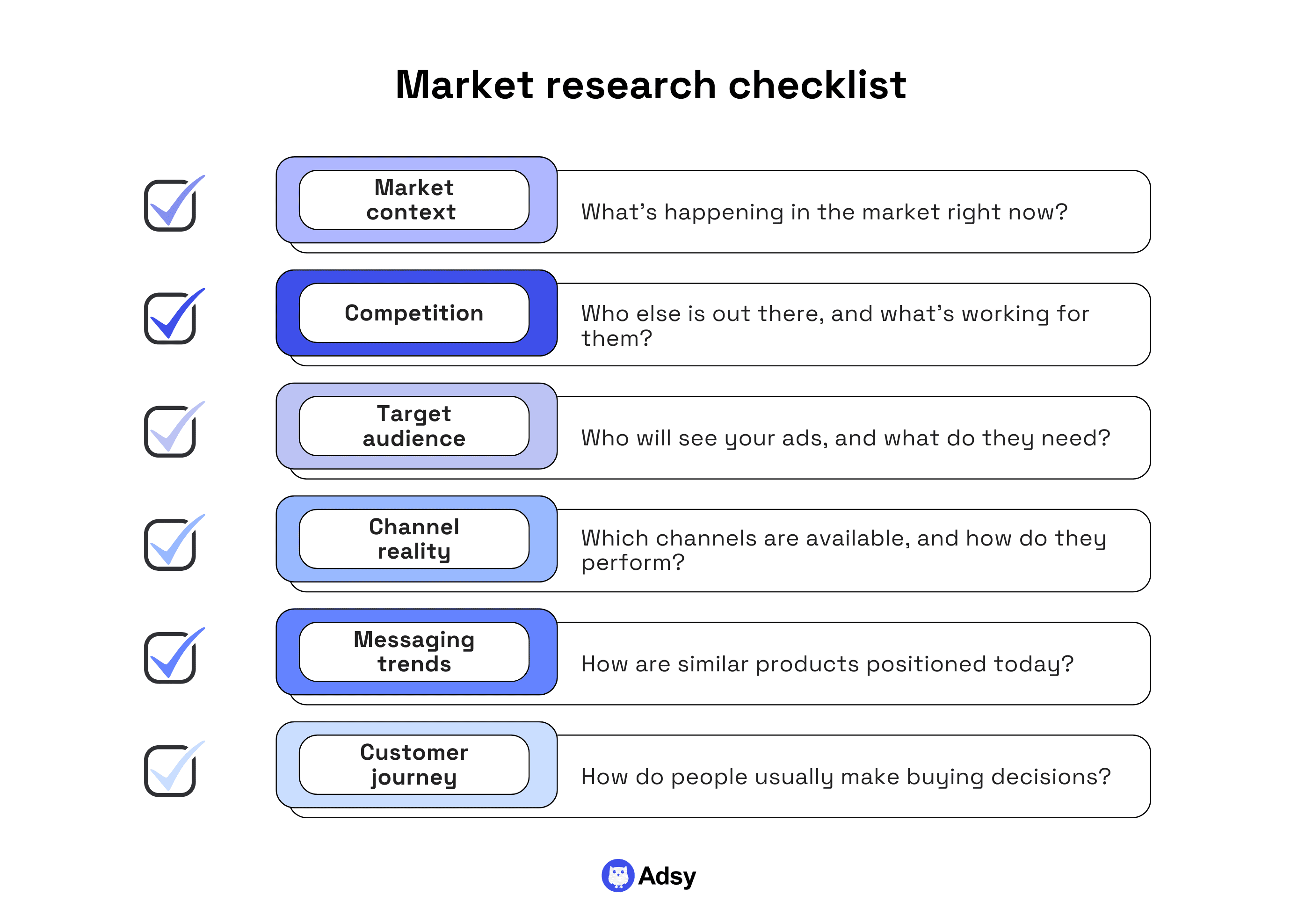
To make your research stage more straightforward, here is a checklist you can use:
- Market context. How is the “environment” doing?
- Your competition. Who else is out there, and what are their successes and failures?
- Your target audience. We’ll talk about this later in detail. But the main goal is to understand who will see your ads and what they need.
- Channel reality. What channel options do you have, and how do they perform?
- Messaging and content trends. How are other products/services like yours positioned? This will help you understand how to differentiate and what no longer works.
- Typical customer journeys. What tendencies do you see in terms of buying behaviors?
Long story short, good market research for digital media planning isn’t about having more data. It’s about having the right insights to guide you: who to target, where to be, what to try, and what to discard (extremely important).
Importantly, this step is not about deciding channels yet.
Here, you are trying to understand the basics you’ll work with. Competition, saturation, attention dynamics, general trends, etc. Everything that will later serve as the foundation for your future campaigns.
Depending on your business goals, you might also want to include this part in your usual marketing audit. After all, it's like a health check, and doing it regularly is a good idea.
2. Get real target audience insights
Most digital advertising problems are... merely “right people” problems.
There is a typical trap for lots of marketing teams: thinking you know your audience, because you have gathered the key demographics. But that can't be enough.
Yes, it might be enough for starters, but if you treat it as the most informative insight… it will definitely get you in trouble.
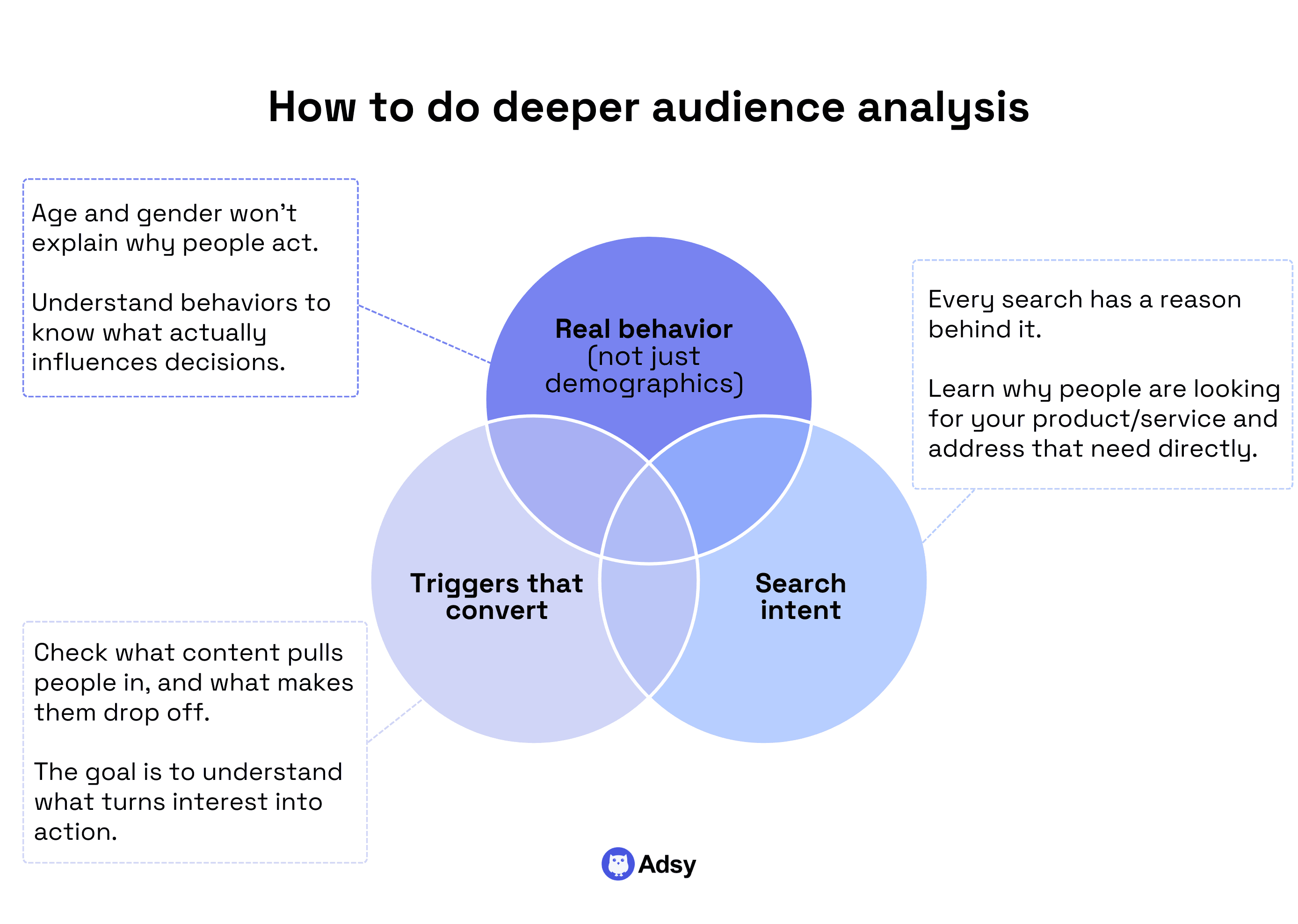
Generally speaking, you need to know three things about your target audience: Who exactly are you reaching for? What do they need right now? Why would they even act?
Essentially, this means looking into the following:
- Deep analysis (beyond demographics). Some basic insights, like age and gender, won’t help you understand why people buy after seeing one type of content and ignore the other. But if you understand their behaviors, it can be a real game-changer.
- The intent behind each search. Before you target any keyword, you have to know why people look for it in the first place. And then address that need.
- Effective and ineffective triggers. What content do your people engage with, and what makes them drop off? Your goal now is to understand what pushes someone from passive interest to action.
So, at this point, you need a lot of customer data and qualitative feedback.
The important detail is that audience behavior matters more than we usually give it credit for.
Someone searching on Google is in a different 'mental state' than someone scrolling a TikTok feed or watching YouTube video ads. Yes, even if that's the same person, the moments are different. Treating them the same across digital channels is how you lose relevance.
Each marketing team has different ways of understanding its target audience. And if yours is effective, just stick to what already works (at least, at the beginning).
But sometimes, when you feel like you’re still lacking some insights, it might be a good idea to try some new tools or methods. For example, Audience Intelligence by Semrush isn’t the most cliché option, yet it could be quite informative.
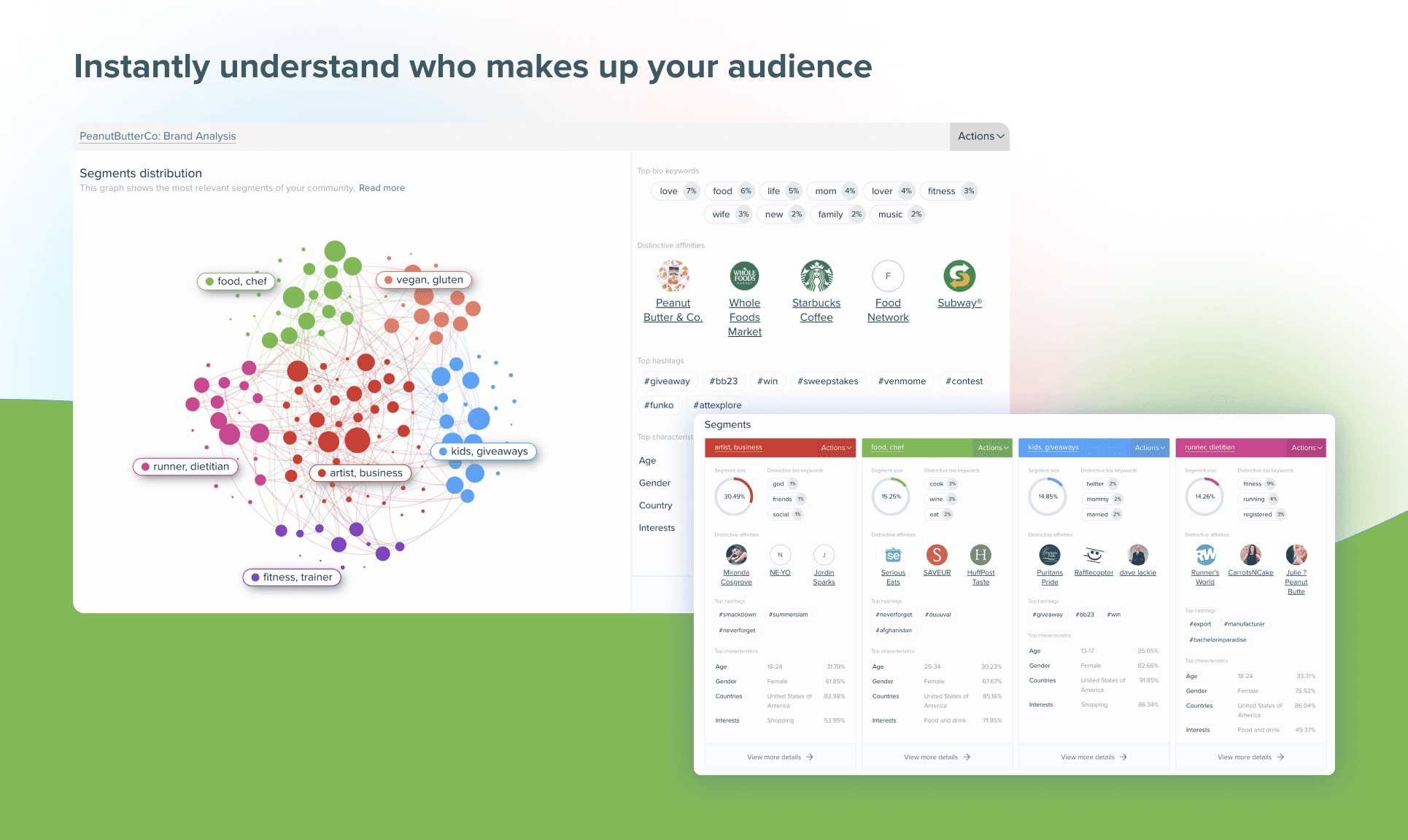
Source: Semrush
3. Make sure you know your goals
This is a foundational step you can't miss.
If you look at the inner processes of many (or dare we say most) marketing campaigns, you'll see a lot of hectic movements.
Often, teams are trying to do everything they can. Boosting brand awareness, growing traffic, acquiring users, working on industry leadership, and dozens of other things.
Now, can all of these “things” be unified as one big goal? The answer is most likely no.
But digital media planning can help you prioritize.
Ideally, you need one primary goal and one or two secondary goals (at most). You simply get better results when each channel has a clear job.
When setting your objectives, stick to these simple rules:
- Choose a clear business outcome (not more clicks or followers, but grow revenue, get newsletter subscribers, etc.).
- Pick media that works best for this goal (this might require some testing if you don’t have enough data already).
- Set a realistic timeline (you won’t see any tangible results in 2 days).
- Define your budget range (depending on the goal, you want to have a clear acquisition cost or other metric that makes sense).
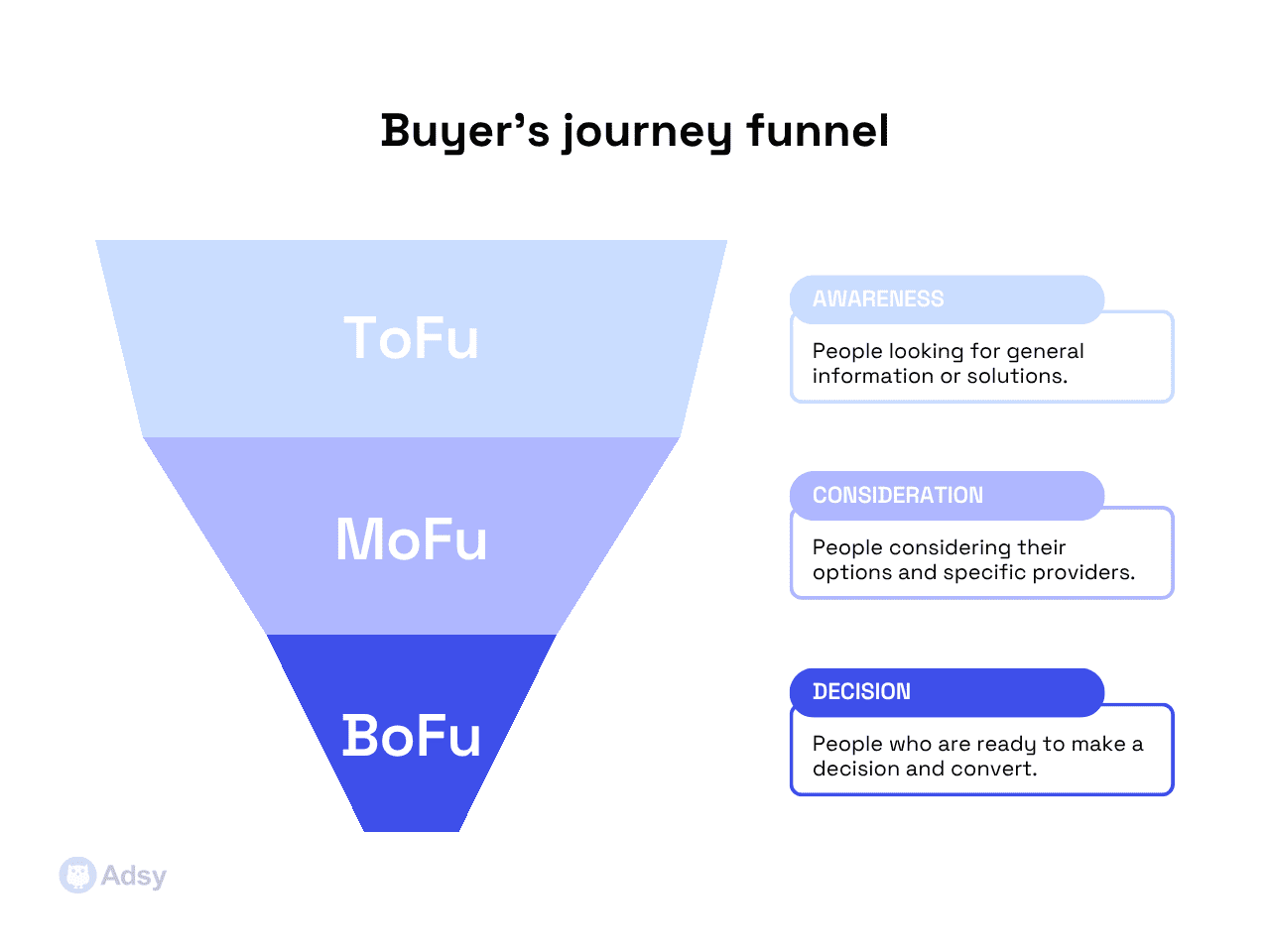
Next, it would often help to understand where your goal fits in the funnel. Is it an awareness problem? Or do you have to work on conversions? This will basically allow you to turn your “theoretical” objective into a “practical” one.
4. Select your channels
More often than not, when it comes to channel selection, many teams look at it as “well, let’s try something new.” Adding a video here and a new paid search monitoring tactic there, all while changing product positioning on the go.
While it's great to try new things, it isn’t a media plan. Unfortunately.
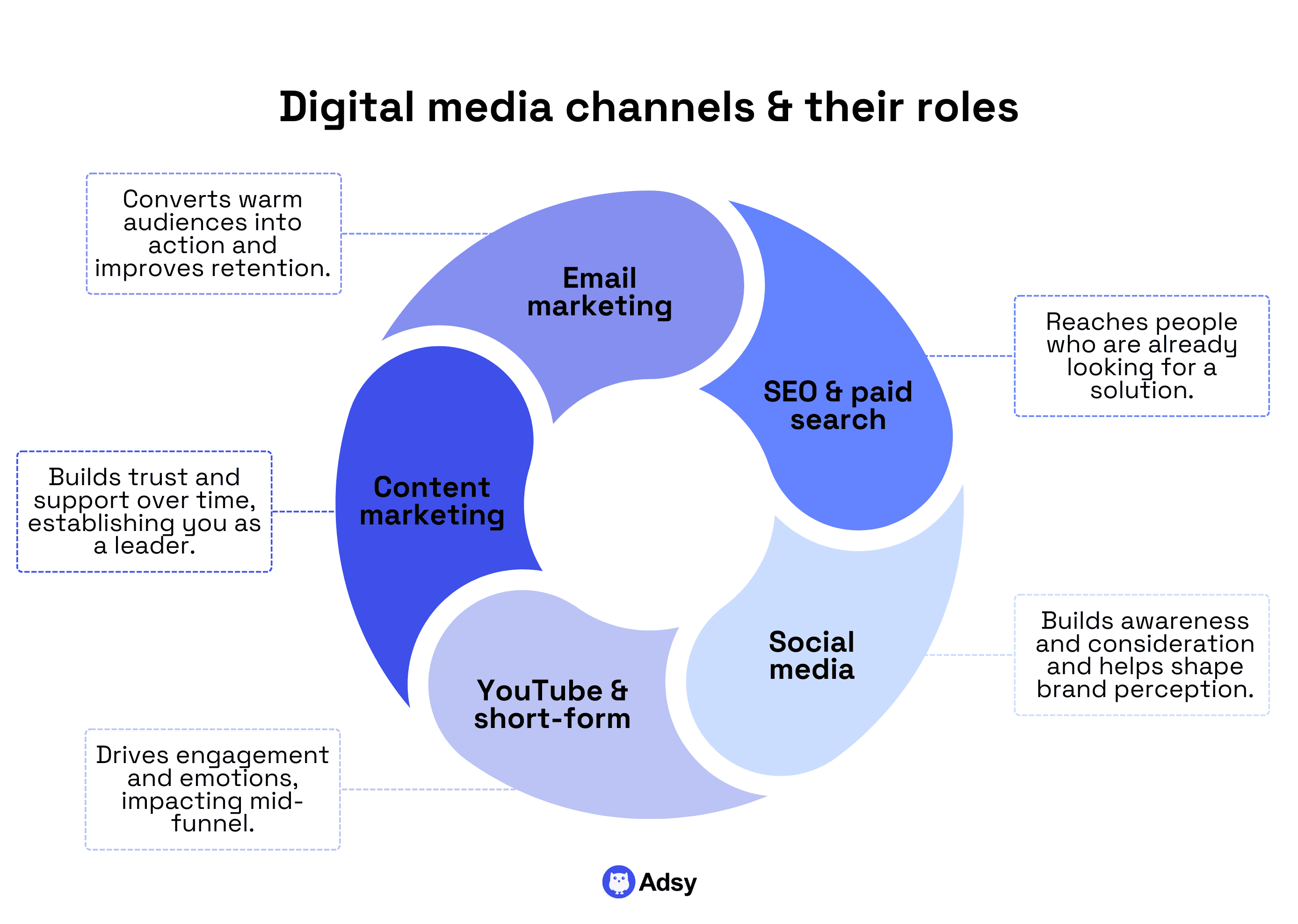
An effective media plan allows you to look at digital channels through the roles they can serve. For example:
- Search engines could work to catch existing demand.
- Social media platforms might work on your image and create interest.
- Video ads could build memory and emotional context.
- Content marketing might support depth and trust over time.
Of course, not every channel belongs to every plan.
The question is not where people spend time online in general. It’s where your target audience is most receptive to your message for your goal.
Just as other digital media planners, you wouldn’t want to overspend here. It is way too easy to spread your budget thin across too many platforms, dilute signals, and then struggle to read campaign performance.
Fewer channels, chosen deliberately, usually outperform a broad but shallow media mix.
Overall, when it comes to channel selection, it should reflect:
- Your target audience behavior and context.
- The primary business and campaign goals.
- Ad creative requirements and ad formats.
- Measurement reliability.
Some digital platforms are great for discovery, but weak for attribution. Others convert well but can't scale much. Media planning is about balancing those trade-offs intentionally.
Once channels are selected, everything else becomes much, much easier.
5. Create your channel matrix
Up to this point, digital media planning is still conceptual. You’ve done your market research, clarified your goals, analyzed the audience, and chosen your channels.
The channel matrix is where you can actually execute without reinterpretation.
This matrix is one of your best checklists to understand exactly what each channel does and how. So, if a media buyer, agency, or your team member looks at it and has to do any guesswork, your matrix still needs polishing.
To build one for each digital channel, you can use these 5 elements:
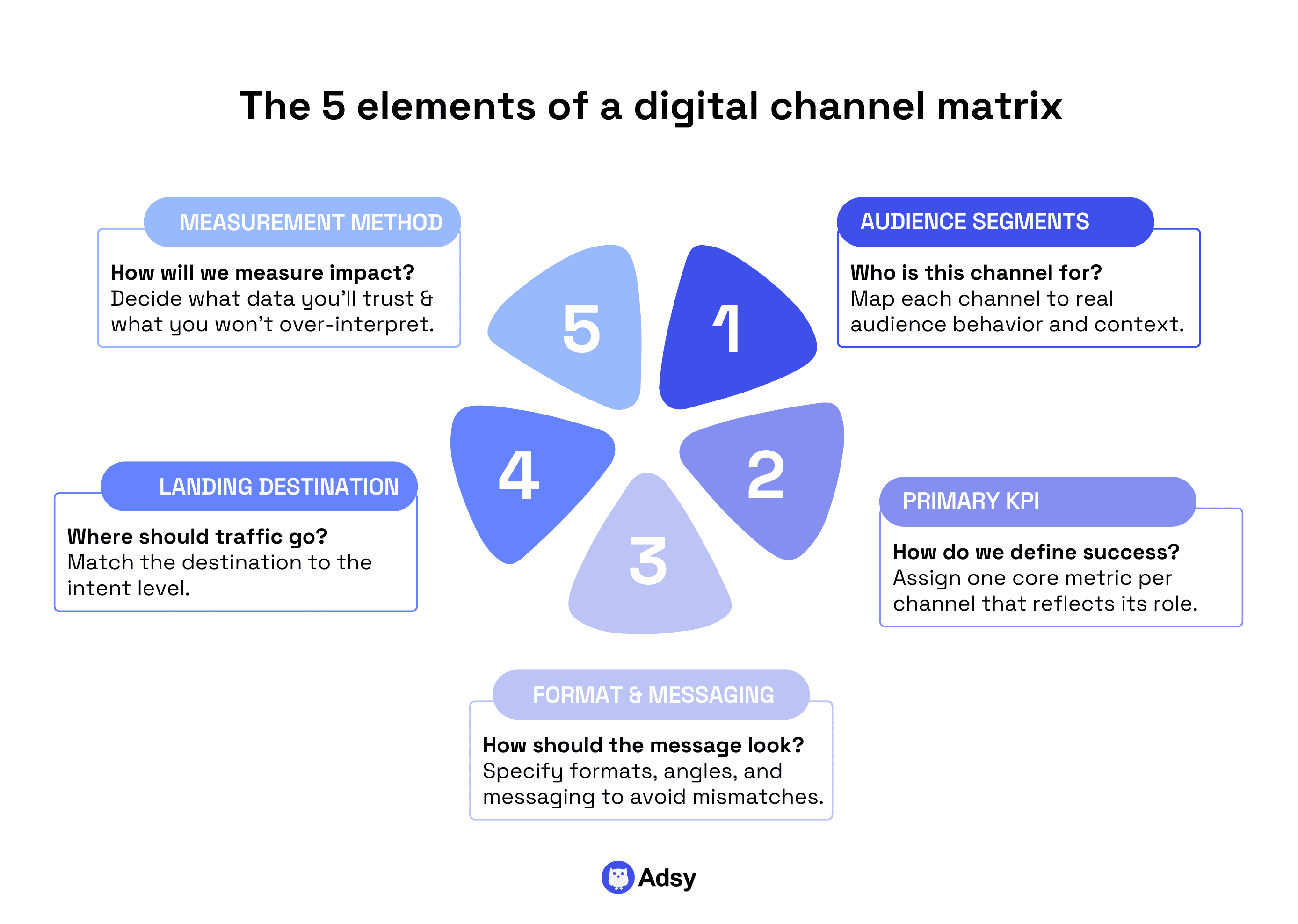
Element 1: Best-fit audience segments
This one answers one simple question: who is this channel for?
Usually, different channels work well for different audience segments. For example, some best reach users who are not aware of the problem yet. Others can work to make people engaged again, in case they bounce.
Of course, it can overlap from time to time. But it doesn’t have to. So, to understand this better, tie segments back to real audience behavior and context.
And of course, test a lot to see who comes through each channel.
Element 2: Primary KPI
Every channel needs one primary key performance indicator. Only one though. A single metric that defines success for that channel’s role:
- If the channel is for awareness, optimize for reach or attention (don't think about conversions).
- If it’s for acquisition, optimize for CPA or CAC.
Secondary metrics can exist for diagnostics, but they are not what the channel lives or dies by.
Element 3: Format and messaging
Every channel you choose impacts how people perceive your message (and therefore, your brand).
Here are some simple examples:
- Video ads won't act the same as words alone.
- TikTok and Instagram will likely push you to try different angles.
- Targeting pain points won’t feel the same as focusing on desired outcomes.
And every channel has its format and its messaging. And the earlier you can specify it, the better it will be for your performance.
Element 4: Landing destination
Since every channel has a different audience and messaging, each of them also has to lead to different destinations. This is only logical.
The main rule here is to match the audience’s readiness level:
- A product page fits high-intent traffic.
- A lead form works better for the consideration stage.
- Content or explainer pages are more appropriate for colder audiences, etc.
Sending everyone to the same page just “because it’s convenient” is one of the fastest ways to flatten your performance.
Element 5: Measurement method
This might require a lot of testing (more than any of the elements mentioned above).
- Some channels are showing very good platform-level reporting. And yet, their cross-platform attribution is weak.
- Others integrate well with Google Analytics, but not the PPC reporting tools you’re already using.
You don't need perfect measurement. What you need is honest measurement. So, define what data you’ll trust, what you’ll treat directionally, and what you won’t over-interpret.
6. Think about budgeting
The budget has to work really well in the long run. Imagine if it collapsed within a few weeks of launch? It would be a disaster that could simply destroy all your other efforts.
Sometimes, budgeting is a problem not because the budget is too small, but because the logic behind it is fragile.
Too vague? Let's explore this question closely.
A good budget is not built around ambition (and yet that's exactly how we often do that). It should be built around constraints that you have to oversee.
Before assigning spend for any channel, you need to define:
- CPA or CAC ceilings, you can’t exceed.
- Gross margin and contribution limits.
- Payback windows that actually work for your business.
Essentially, these are not even media metrics. They are the rules that will make your spending sane and controlled. Without them, budgets get more emotional and unpredictable. But with them, choices are much easier.
Why? Because you’ve defined the exact limits you can work with.
One of the strategies you could try is having a couple of budgets in mind, instead of just one:
- A small budget to test and learn,
- A “normal” one if things go as planned,
- A major one for when results are strong, and you want to push harder.
If you have this separation, it leads to two benefits:
- Fewer rushed decisions. Since digital advertising takes time to stabilize, it protects you from too much volatility. Simply put, you will not overreact to early data that doesn't make any sense yet.
- Easier growth. Essentially, it gives you a roadmap for future scaling. If you hit certain performance levels, you can increase the budget intentionally because you planned it already.
Still, pay extra attention to budgeting when you have lots of channels. It might be hard to prioritize. So, look realistically at what works and give new media enough time for testing.
To summarize it all, your budget should be a system, not just a mix of random decisions.
7. Choose your measurement approach upfront
Digital media performance is easier to measure compared to traditional media. But it is still often a challenge for many teams.
It's just that many marketers wait too long to decide what they trust. By the time advertising campaigns are live, everyone is staring at dashboards built by different platforms. What's worse, each is claiming credit for the same result.
Cross-platform planning makes this… only harder.
But it isn’t your fault. Digital media management is often all over the place. Primarily, because each platform measures success differently and uses different attribution models.
On top of that, whether we like it or not, today’s privacy policies make “truly detailed measurement” nearly impossible. As a result, the data we work with is often full of gaps.
Pretending this isn’t happening is how teams end up making “confident” decisions based on shaky foundations.
But avoiding paid search analysis isn’t really an option. That’s why you have to figure it out before launch. And this is what you can rely on:
- The first rule is simple: you can’t measure everything equally well. Some outcomes are observable. Others aren’t that much. So, a truly mature digital media plan just accepts this and works within it.
- The second rule is getting on the same page. Your KPIs must reflect the role of the channel and the goal of the campaign. So, for example, if your goal is to increase brand awareness, measuring success through last-click conversions makes no sense.
This is why measurement should be goal-first. But too many teams choose to go tool-first.
Google Analytics, platform dashboards, and attribution tools are just inputs. But there are no answers. Yes, all of them have their strengths. But each also has some blind spots.
The question is not which tool is “right,” but which combination gives you the most reliable signal for the decision you need to make.
Good digital media planning also distinguishes between:
- Optimization metrics (used to improve performance inside a channel).
- Evaluation metrics (used to judge whether the channel is worth keeping).
These are, obviously, not always the same. A channel can be optimized internally while still failing at the business level. Without that distinction, teams may look at the results and think that their marketing efforts are effective. While they aren’t.
Choosing a measurement approach upfront does something subtle, but powerful. It protects the plan from hindsight bias.
When everyone agrees in advance what success looks like, post-campaign analysis turns into a learning process. You know exactly how you measure it, so there is no space for misalignment.
8. Put it all together and select the tools that you actually need
At this point, you’ve covered everything you need.
The danger is no longer in some “missing knowledge.” At this point, the only thing you might miss is the connection between all the parts.
It won't make your media plan fail if you have one thing done badly. But failure is guaranteed if all your pieces don’t come together. So, before anything goes live, run through a simple checklist. Just to make sure your plan can survive what real life has to offer.
You can just use our little reminder below that will help you create successful campaigns.
It’s also a great moment to make sure you don’t have too many media planning tools.
Because you don’t need many. You need the right media planning tools that help you achieve your goals.
Too much variability here usually just creates a mess rather than helps you. Ideally, you can go through each step we’ve seen today and write the exact procedure, including the software you need.
Later, you can also streamline the whole process by choosing suitable PPC automation tools.
|
Area |
What You Need Before Launch |
|
Market context |
A clear understanding of how crowded the market is, how competitors use digital media, and what kind of messages your audience already sees across digital platforms. |
|
Market research |
Enough research to avoid copying competitors by default or assuming low visibility equals opportunity. Directional insight is needed. |
|
Target audience |
Defined audience segments based on real audience behavior. You understand their needs, motivations, pain points, and action triggers. |
|
Primary campaign goal |
One defined primary objective (awareness, acquisition, retention, etc.) that guides decisions across channels. |
|
Secondary goals (if any) |
No more than one or two secondary objectives, related to the primary goal. |
|
Channel roles |
Each digital channel has a specific job in the media mix. |
|
Channel matrix |
For every channel: best-fit audience segment, one primary KPI, format and messaging, landing destination, and measurement method. |
|
Budget constraints |
Defined CPA/CAC ceilings, margin limits, and payback windows tied to your business objectives. |
|
Measurement approach |
Agreed upfront on which metrics are trusted, which are directional, and how success will be evaluated based on your campaign goal. |
|
Learning expectations |
Clear learning periods and decision points for each channel, so performance is judged fairly. |
Conclusion
Media planning is not easy. And, as you probably realized, it requires a lot of effort. But once you put all of that in motion, you'll see tangible outcomes reasonably fast.
The only thing to keep in mind is that you have to be intentional and systematic first. Creativity and spontaneity are amazing, but they can’t become a foundation for your media planning.
And well, just test a lot to understand what really works.
Real-life FAQ
We didn't want to answer generic questions that you can easily find answers to on the first page of Google search. That's why we answered the ones companies usually struggle with most when they start their media planning journey.
Why did performance stay flat even though we followed best practices?
Because best practices are averages (so to speak). They aren’t tailored to your particular case. That’s why they can’t guarantee any outcomes.
They describe what tends to work across multiple cases, but it might not work in yours. And while they can be effective as a general guidance, unfortunately, there is no one-size-fits-all.
Overall, flat campaign performance usually means one of three things:
- The audience is right, but the context or message is wrong.
- The channel role is misaligned with the goal.
- The evaluation window is too short.
Media planning doesn’t eliminate this risk. However, if you’ve done a good job, you already have a tool that makes everything diagnosable.
How do we know if a channel isn’t working or just needs more time?
You’ll know it for sure if you cover a couple of things before launch. Essentially, every channel should have:
- A defined learning (aka testing) period.
- Clear success and failure thresholds.
If those weren’t set up front, teams end up arguing based on instinct or platform narratives.
But a channel that hasn’t stabilized yet is simply incomplete. And a channel that passed its learning window but still can’t meet constraints, probably is not the right fit.
Still, of course, the reasonable thresholds also come with experience and lots of tests.
How do we plan media if we have no historical data?
In that case, you have to plan for learning. This means:
- Smaller initial budgets,
- Fewer channels,
- Clear hypotheses per channel.
The goal of early campaigns is to create a direction. Don't look for scale at this point. Digital media planning without historical data should be all about reducing uncertainty.
And whatever you do, avoid any major decisions based on your gut feelings.
How much budget do you need for a “real” test?
Just enough to generate a signal.
A real test should give you information that you can immediately take and start acting on. If a budget is so small that results swing wildly day to day, you can't call it testing. It's not.
Overall, a test budget should be large enough to:
- Reach a meaningful number of people
- Generate a minimum level of conversions or engagements,
- Run long enough to learn more than just that daily volatility.
If you can’t meet these conditions, it’s better to postpone your testing or focus on fewer variables. Otherwise, your testing will simply lead to false conclusions.
Every platform says it’s driving conversions. Which data should we trust?
Trust the data that connects to the decision you’re making.
Platform data is useful for optimization inside the platform (bids, audiences, etc.). But when you’re deciding where to invest, for example, cross-platform tools and internal data are much more reliable. No single view is “the truth” as such. Just keep that in mind.
Good media planning accepts overlap and focuses on consistency in signals, not perfection.
With a limited budget, should we focus on one channel or multiple?
As a rule, fewer.
Limited media spend spread across too many digital channels often leads to misleading results. Typically, it also won't give you the outcomes you want.
One or two well-chosen platforms with clear roles almost always outperform a broad but shallow media mix.
Why did a channel perform well and then suddenly drop?
Because performance is never static. It changes due to many things: audience or ad creative fatigue, timing and seasons, overall trends and external conditions, etc.
A drop should be taken as a sign that something has changed. And strong media planning helps you spot what changed and react properly.
How often should we refresh a creative?
Only when performance is showing you the signs. Refresh when engagement or efficiency declines. But there is no rule like “refresh every 2 weeks.” That’s simply not how it works.
Creative fatigue shows up differently depending on the platform and goal. For example, awareness campaigns burn slower, while acquisition campaigns burn faster. So, act based on the signals you see.
All trademarks, logos, images, and materials are the property of their respective rights holders.
They are used solely for informational, analytical, and review purposes in accordance with applicable copyright law.



 Sign Up
 Sign Up