






Adsy Talks: Everything We Learned From Our First 5 Episodes
Constant search engines’ algorithms change, AI meteoric rise, shift in how people look for data, ranking is getting harder… That might leave not only beginners, but professionals frustrated.
40% of SEOs claim that earning backlinks is a huge struggle. About 60% of searches now end without people going to another destination site.
Should you panic, stoop to fate, or find a way to adapt to a new reality and use it for your advantage?
For us, the choice is obvious.
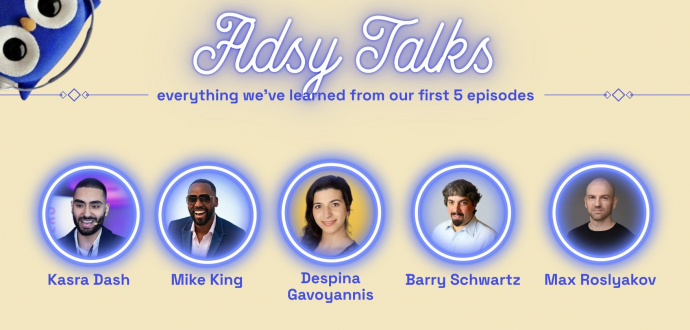
And that’s why we’ve launched Adsy Talks. There, we have honest, unfiltered conversations with people who are actually shaping the future of search — not just talking about it.
Five episodes in, and we've already collected a handful of ideas that genuinely made us rethink stuff. Our host, Anthony, a Head of Customer Experience at Adsy, chatted with the brightest minds in the SEO industry.
Here's a recap of each episode, the moments that surprised us most, and the lines of wisdom we keep coming back to.
This Is Why Your SEO Audit FAILS in 2026 ft Kasra Dash (Adsy Talks ep. 1)
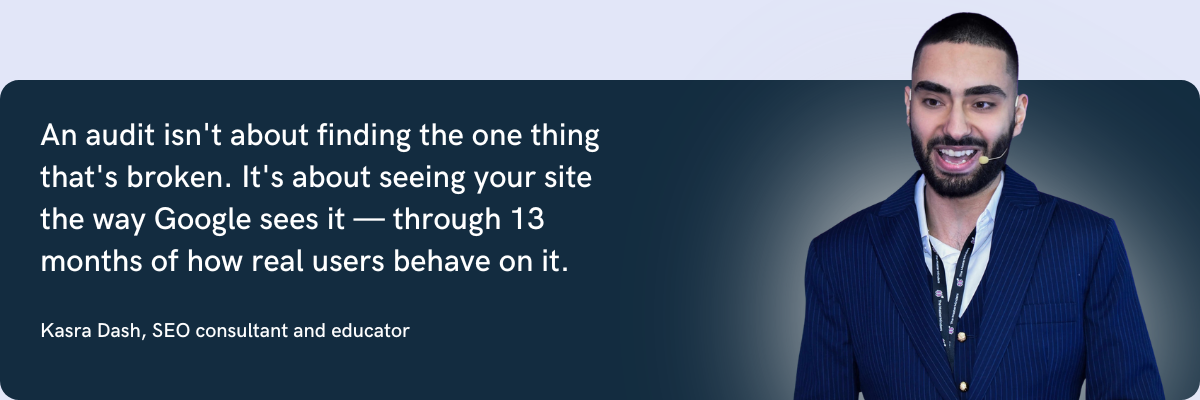
Introducing you to our first-ever guest — Kasra Dash. He is an SEO consultant and educator who has audited hundreds of websites across industries. He's known for his straightforward and no-fluff approach to technical SEO — the kind of practitioner who helps businesses get continuous wins rather than one-time results.
The conversation started with a question that sounds obvious but rarely gets a satisfying answer: why do most SEO audits fail to show real results?
Kasra's take was that people walk into an audit expecting a dramatic revelation — some magic spells that explain everything or a ready-made script of what to do. In reality, it's rarely that.
An audit's real value is in stacking up 1% improvements: image compression here, internal linking gaps there, or completely forgotten pages nobody's touched in years.
This makes SEO audits more essential in 2026. We're no longer in a ten-blue-links world. AI overviews, ChatGPT, Perplexity — all of these systems now sit between your website and your potential visitor.
And there was the thread that tied the whole episode together: mobile. Kasra noted that 67–70% of searches now occur on mobile, yet a surprising number of site owners still optimize primarily for desktop.
Our guest recommended running a quarterly audit — not weekly, not annually, but quarterly — is how you stay ahead of the slow decay that happens when small issues pile up unnoticed.
The most unexpected thing we learned is...
Google actively tracks a complicated checkout process on your e-commerce site as a negative ranking signal. Users bouncing to a competitor during checkout isn't just a conversion problem — it feeds directly into how Google evaluates your site's authority.
The episode's wisdom is:
An audit isn't about finding the one thing that's broken. It's about seeing your site the way Google sees it — through 13 months of how real users behave on it.
If this framing of the modern SEO audit resonates with you, the full episode is worth your time. Watch it below.
Is this the END of traditional SEO? ft Michael King (Adsy Talks ep. 2)
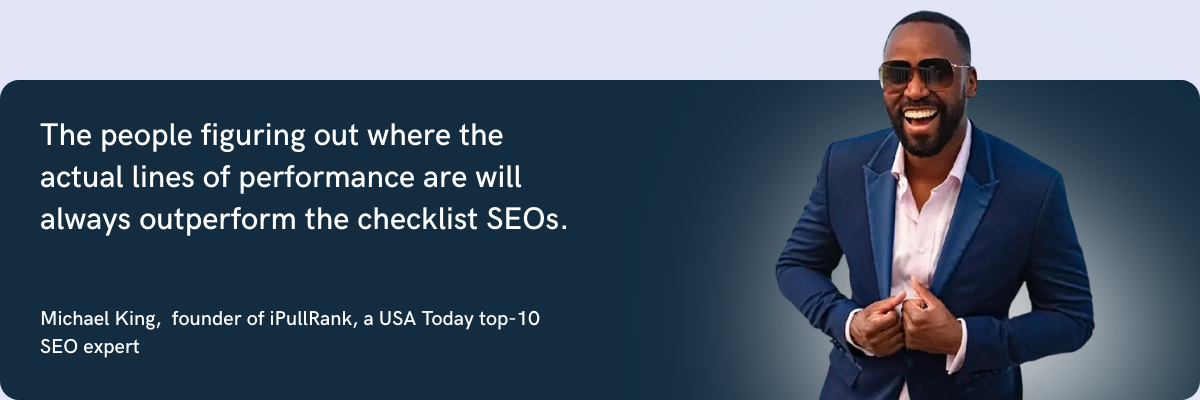
Meet our second guest — Michael King. Mike is the founder of iPullRank, a USA Today top-10 SEO expert, and one of the few people in the industry who approaches search from a genuinely scientific angle. He also happens to be a rapper — which, honestly, feels quite natural.
Mike didn't come in to say SEO is dead. His actual argument was more precise and, frankly, more unsettling: SEO is deprecated.
The old checklist approach — 60-character title tags, keyword density rules, best-practice tick-boxes — still brings in some results, but with dramatically diminishing returns.
The reason?
The systems we're trying to rank in have moved on. Google has been using semantic search since around 2013 and hybrid search (combining semantic and lexical analysis) for roughly seven years.
This is where Mike's concept of relevance engineering comes in. It's the intersection of information retrieval, AI, content strategy, UX, and digital PR. The point is, if you only optimize for your seed keywords, you're leaving the majority of AI-search visibility on the table.
Mike also teased his upcoming book, The Science of SEO, due in August 2026. A golden find for SEOs, designed so that the next generation of practitioners can start where Mike’s two decades of experimentation left off.
The most unexpected thing we learned is...
AI platforms like ChatGPT don't primarily look at the main ranking keyword when deciding whether to pull from your page — they evaluate your page title, meta description, and URL slug together to determine if the page is even worth opening. Meta descriptions, which Google famously ignores for ranking, suddenly matter again in the AI search context.
The episode's wisdom is:
The people figuring out where the actual lines of performance are will always outperform the checklist SEOs.
Don't miss the full conversation — Mike goes deep on retrieval-augmented generation, synthetic queries, and how to build for the AI search layer. Watch the episode below.
How to Audit Brand Mentions for Modern SEO ft. Despina Gavoyannis (Adsy Talks ep. 3)
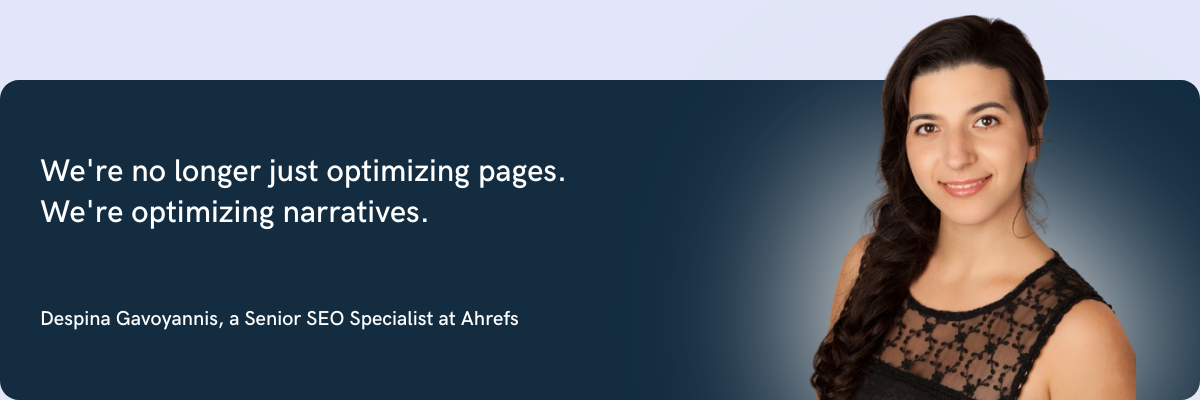
Say hello to the next wonderful speaker — Despina Gavoyannis. She is a Senior SEO Specialist at Ahrefs, where she focuses on the intersection of brand visibility, semantic search, and the fast-evolving world of AI-driven search. Her work on auditing brand mentions has been making the rounds in SEO Slack channels — which is usually a sign that someone has said something genuinely important.
The central idea Despina brought to the episode is elegant and a little alarming: brand mentions are becoming to AI search what backlinks were to traditional SEO.
Nowadays, AI systems understand context, sentiment, and the meaning surrounding a brand name. A mention in a trusted, relevant publication — even without a link — can actively shape what AI tools say about you in their responses.
Despina walked through the framework she uses for brand mention audits:
- tracking mention acquisition rate (think link velocity, but for mentions),
- correlating mention spikes with marketing activities,
- measuring the organic traffic of pages that mention you, and (crucially)
- checking whether those mentions actually appear in AI-generated responses.
She was dead honest, saying that no brand-mention tool fully automates the audit process. At least for now. Human touch is still required.
The most unexpected thing we learned is...
Responding professionally to a negative review — adding context, showing resolution — can actually improve how AI perceives your brand. AI systems read and process those response threads. A one-star review that ends with a public resolution can end up building brand reputation rather than hurting it.
The episode's wisdom is:
We're no longer just optimizing pages. We're optimizing narratives.
The full episode goes much deeper into the audit framework and the tools Despina recommends for teams of every size. Watch it below.
20 Years of Algorithm Updates: Lessons Learned ft Barry Schwartz (Adsy Talks ep. 4)
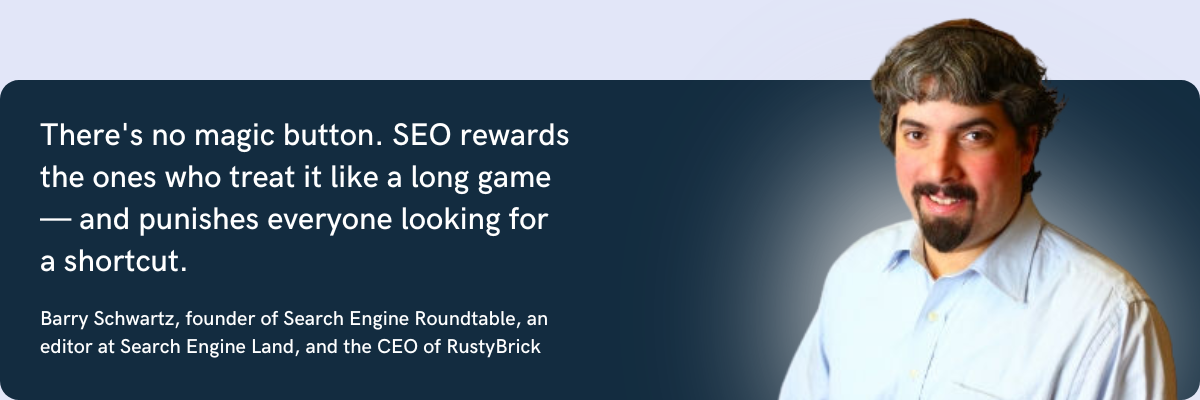
Meet an industry giant — Barry Schwartz. He is the founder of Search Engine Roundtable, a longtime editor at Search Engine Land, and the CEO of RustyBrick. He's been documenting the SEO industry for over two decades — as its most consistent and honest chronicler. If something has happened in search, Barry has probably written about it.
Barry walked us through the full arc of SEO manipulation — from keyword stuffing in the pre-Google era, to link schemes after Google's PageRank, to the current landscape where those kinds of tricks simply don't exist anymore.
Our guest also addressed the expectation of quick results. The biggest misconception business owners carry into SEO is that hiring an agency or adding some meta tags will deliver rankings fast. But organic search doesn't work that way.
We also talked about AI-generated content and the cyclical nature of user-generated content in Google's ranking preferences. Barry also touched on heading into the next few years: whether Google will seriously crack down on AI-generated slop, and how SEO as a profession continues to absorb more of what used to be called marketing.
The most unexpected thing we learned is...
The next big Google crackdown might not be about links or technical issues at all. It might be about the flood of AI slop that's quietly taking over the web.
The episode's wisdom is:
There's no magic button. SEO rewards the ones who treat it like a long game — and punishes everyone looking for a shortcut.
Think you know SEO? Test yourself before watching an episode.
This episode is a masterclass in perspective for anyone who works in or around SEO. Watch the full conversation below.
AI Search Is Here. Do Links Still Matter? ft Max Roslyakov (Adsy Talks ep. 5)
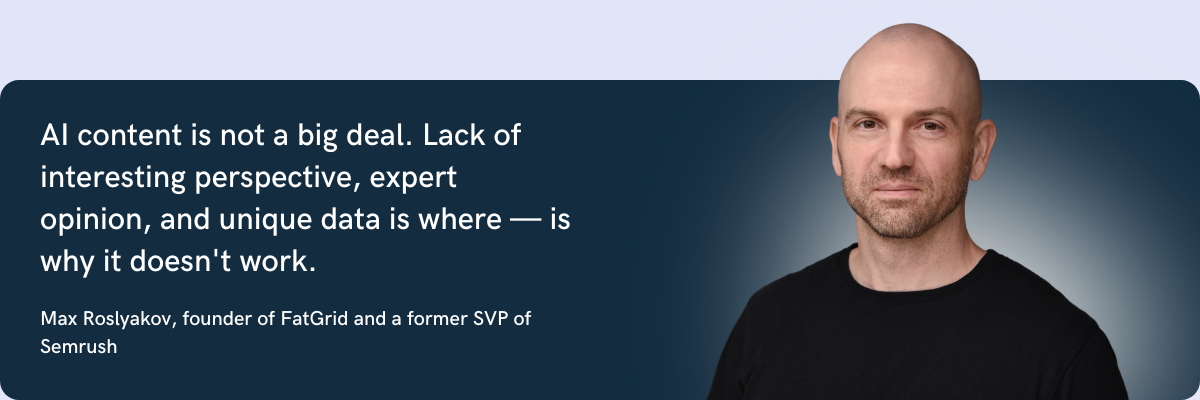
Here comes our fifth guest — Max Roslyakov. He is the founder of FatGrid and a former SVP of Semrush, where he spent years inside one of the industry's most data-heavy companies before turning his attention to something the market was badly missing: price transparency and honest metrics in link building.
It was a long and in-depth conversation, but we’ll try to sum up the key points for you.
Max tracked 10 million backlink offers just to understand what's actually happening. The outcome: demand for links is growing while inventory is barely moving. The structural issue isn't marketplaces themselves, it's the layers of middlemen sitting between website owners and buyers, quietly pocketing the margin.
What do SEOs consistently get wrong when judging link performance? Surprisingly, it’s DR and DA. Max argued that the contextually relevant website actually makes sense for the client being promoted.
The next statement that blew us away was that Google actually doesn’t care about AI-generated content. The search engine values the addition of new knowledge to content. And the problem with most AI-generated content is that it just rephrases existing knowledge. It doesn’t provide anything unique. And exactly that’s why it flops. If you have a unique opinion, original research, or unique data, you can AI-generate content around it and it will work fine.
The most unexpected thing we learned is...
Up to 5% of purchased links quietly disappear after placement. Turned out that most link building problems don't happen during selection or negotiation. They happen after the placement goes live. And that's precisely when most people stop paying attention.
The episode's wisdom is:
AI content is not a big deal. Lack of interesting perspective, expert opinion, and unique data is why it doesn't work.
Think you know SEO? Test yourself before watching an episode.
All trademarks, logos, images, and materials are the property of their respective rights holders.
They are used solely for informational, analytical, and review purposes in accordance with applicable copyright law.

 Sign Up
 Sign Up