






What Is Marketing Research? How Brands Turn Data Into Better Decisions

Intuition or the elusive sixth sense may be valid tools for everyday life choices or romantic relationships, but brands must go beyond that. To guide their decisions, they use something far more accurate and robust — marketing research.
In the digital world, marketing research has to deal with data, lots of data, including competitor data, market data, corporate data, and so on. This is a complex, multidata environment, and businesses and brands must know how to turn big data into better decisions virtually every day.
Why is marketing research important? What it means to have an established marketing research process and the concrete steps involved — these will be the key learning points if you read this guide to the end.
What marketing research is and why it is important today
What is marketing research? It’s the process of collecting and analyzing market, competitor, and internal corporate/business data with the goal of making better business decisions.
But if you had to sum it up in one line, marketing research is this:
It helps you make fewer bad decisions.
Not zero. Just fewer.
Because instead of acting on instinct, brands look at data. They analyze behavior, trends, and feedback — then try to figure out what it all means.
And yes, “try” is the right word here. Marketing research isn’t perfect. But it’s still much better than guessing.
Especially today, when data is everywhere.
Used correctly, it allows brands to:
- Understand what’s driving customer behavior.
- React to changes before competitors do.
- Test and refine ideas early.
- Focus on what brings results.
- Build strategies on something more solid than intuition.
One quick example to be more explicit:
💡 An example: A mobile app brand sees its users dropping off after signing up. Instead of redesigning everything, their well-established marketing research process has revealed that onboarding was confusing. They fix that — and retention improves.
The main types of marketing research explained
Let’s get theoretical, but only for a moment to avoid sounding overwhelming. Because there are different types of marketing research, different methods, different names… it can look more complicated than it actually is.
But if you zoom out, looking at the situation with a bird’s eye view, it’s pretty straightforward.
Basically, there are two main ways to approach research:
- Collect your own data (primary research).
- Use existing data (secondary research).
That’s the foundation.
Primary research gives you direct insight — what your users think, say, and do. It’s slower, more time-consuming as you involve your scarce internal resources (marketers, analysts, project managers, etc.), but it’s certainly more precise.
Secondary research helps you move faster. You learn from what’s already been studied or published. Just “Google it,” as they usually say, or dig into the existing data and apply critical thinking to evaluate and make up your own mind on what’s actually going on.
Then there’s another split:
- Qualitative — explores behavior and motivations.
- Quantitative — measures and compares.
If you’re trying to understand why something is happening, qualitative methods are your friend.
If you need proof or scale, quantitative is the way to go.
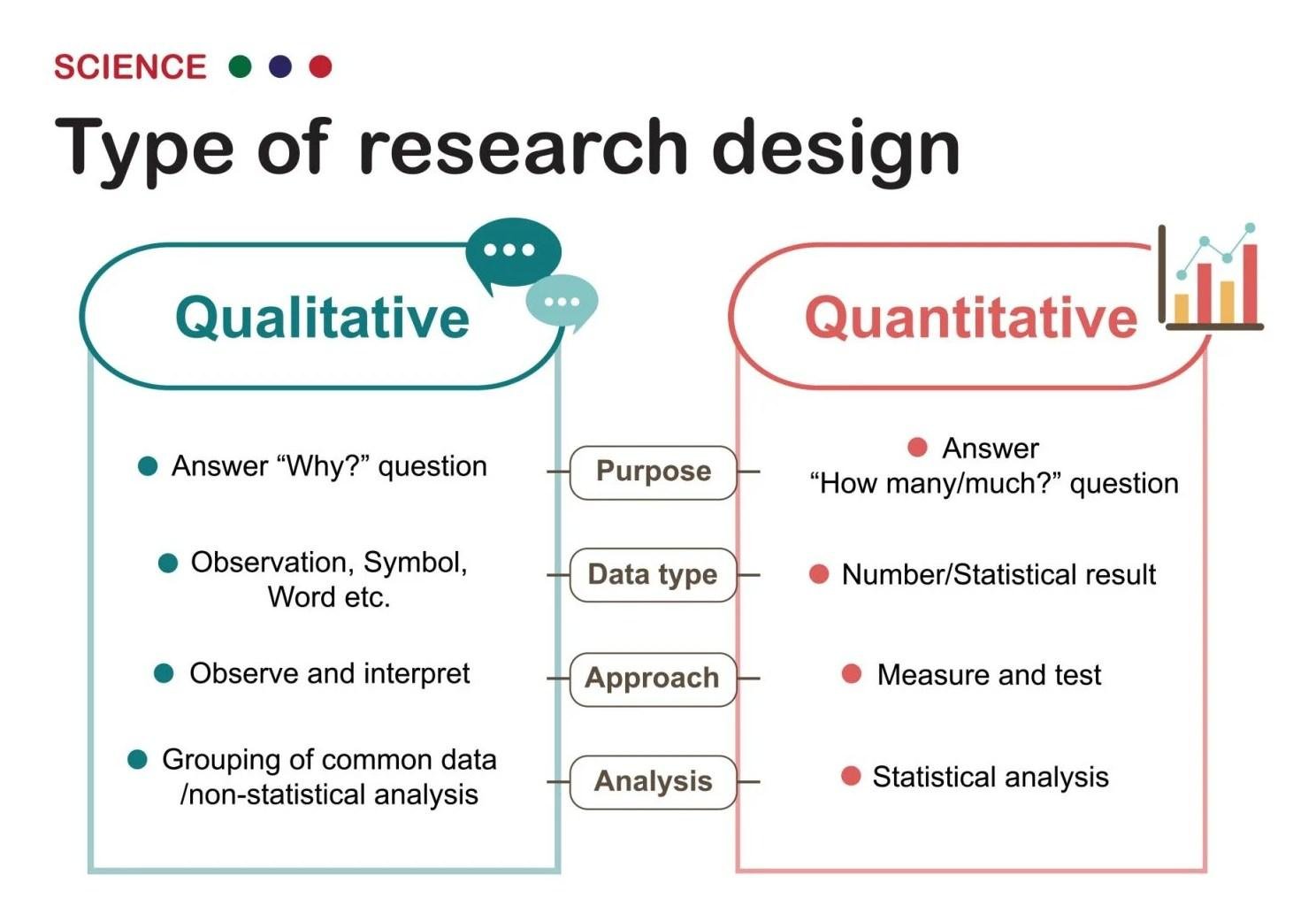
Source: Simplypsychology
In reality, most brands combine both. Even when they run surveys, they usually combine two types of questions: one is a closed type, where respondents are asked to pick a certain degree/number, while the other is open when respondents are asked to type their responses.
📝 The bottom line: A good research plan isn’t about choosing one type. It’s about using the right mix at the right time.
Key methods brands use to collect and analyze data
At this stage, marketing research becomes less about ideas and more about execution.
Because knowing what to do is one thing. Actually doing it is something else. That’s where newcomers start to make mistakes, but, as they say, only those who don’t act never make mistakes.
That said, all brands rely on different methods to collect and analyze data, and most of them are pretty accessible today.
You’ll usually see a mix of these four:
- Direct feedback (surveys, interviews).
- Behavioral data (analytics, tracking tools).
- Experiments (A/B tests).
- External insights (market and competitor research).
None of these is a fit-all solution. Those brands that stick to only one type can get a temporary progress, but will inevitably lose in the long run.
Together, these four methods give a much clearer picture. The important part is how you conduct them. Rushing through research just to “have data” rarely leads to anything useful.
💡 Example: A startup launches multiple A/B tests at once without clear hypotheses. The results conflict — and they can’t confidently act on any of them. So, the lesson is simple: understand what you want to achieve with your research method, and only then test your hypothesis with the best method for the expected result.
How to turn research insights into better business decisions
So you’ve collected data, or did all the hard work (as you thought). Great.
Now comes the part where most brands get stuck — turning all of that into actual decisions. Some brands prefer to review the findings, celebrate the good results (if present), and put it all aside.
However, results on their own don’t do much. They just sit there until someone acts on it. More often than not, acting is too late.
This is where a simple marketing research process helps. Not a complicated framework. Just a clear sequence you can follow.
You can think of it as the five steps of marketing research:
Step 1. Define the problem clearly
This is the first step in marketing research process, and it’s often rushed. What exactly are you trying to solve? Low conversions? Poor distribution? Lack of customer understanding?
Be specific. Doing research for the sake of research, or trying to solve everything at once, rarely ends well.
You may consider hiring a good consultant (firm) to help you define the problem, as this is the most important part of any research process. Understanding/acknowledging the problem is half the work done, as a famous business saying goes.
Step 2. Choose how you’ll collect data
Pick the right approach. As mentioned earlier, the choice is very wide here. From own data to external data. From qualitative to quantitative research methods.
Subsequently, you can employ surveys, analytics, interviews, behavioral data, experiments, and external insights — whatever fits the question and your current research capabilities.
The key is to use one data collection method per research iteration. Never mix three or more methods at once, as you’ll overwhelm yourself and your respondents.
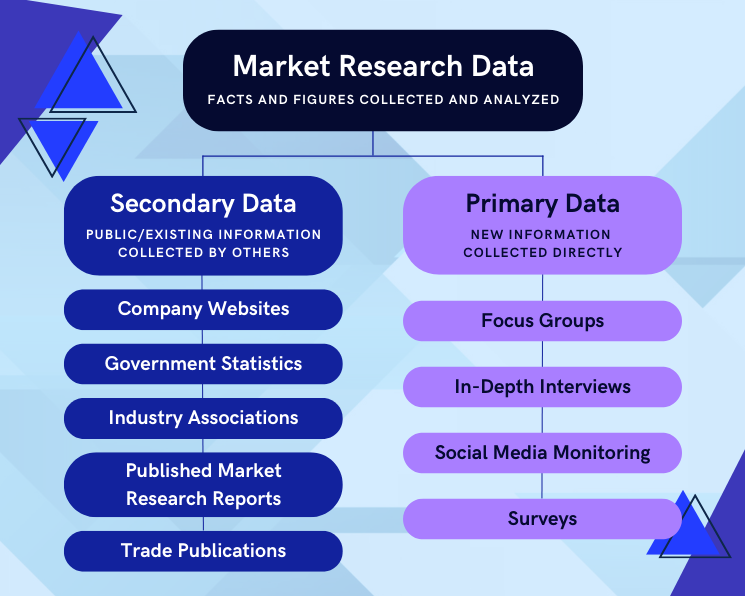
Source: Marketresearch
Step 3. Gather the data
Now you actually run the research. Nothing fancy here, just execution.
Set a clear launch date and duration. Think about interim reminders to research participants (if you run a survey) and one or two final ones. This is done to improve participation.
A few words should be said about the technical aspect of data collection. Plan in advance how you’ll organize your data, i.e., by audience category, group, behavior, or by your organizational structure (if you run research within your organization).
Step 4. Analyze what you found
So, you’ve got data, perhaps even lots of promising data. Now what?
Analyzing alone is certainly an option, but not the best one. The optimal choice is to connect the minds of those around you who, firstly, are experts in the given fields, and, secondly, have the power to make decisions.
Your actions should look like this:
- Run the analysis utilizing the available tools, and organize your findings in the form of a presentation (graphs, tables, etc., included).
- Call in a quick roundtable, a few-hour workshop, or a live call to discuss the findings with the stakeholders involved (experts and decision-makers).
Opinions will fly around, someone will agree, others disagree, but that's the whole point — there must be a discussion, and people must contribute to finding the consensus.
Step 5. Turn insights into action
The consensus among workshop participants reached in the previous step means it’s the best time to capitalize and to move from discussions to actions.
This is the whole point. If nothing changes after research, something went wrong, and time was wasted.
At a glance, this looks simple. In reality, most mistakes happen in this final step. Why? Because teams fail to take action.
Your goal as the moderator or facilitator is to make sure that each discovered opportunity is transformed into action and that each action has its responsible person (ideally, among experts and middle management).
There should be a clear timeline, a roadmap that everyone present at the workshop will commit to control and follow. Participants must have equal access to this roadmap, and the responsible people must report on the progress.
Common mistakes that make marketing research ineffective
It’s hard to find two equally successful or unsuccessful market research studies. Even if the same framework, the same research methods, and the same tools are used. By the same people.
Why is that?
Because marketing research is done by people and as such is prone to all sorts of errors related to human biases, preconceptions, changing moods, health conditions, energy levels, engagement, you get the point.
In this chapter, we’ll list the most common human marketing research mistakes and give the simplest solutions for avoiding them.
1. Starting research without a clearly defined problem or decision to make
The mistake. Research for the sake of research. Maybe because the management wanted it, maybe because you found that others are doing it. In either case, research without a real need and a clearly defined problem is going to be a waste of money and resources (in most cases).
How to avoid it. Start by writing down the exact decision this research should support — not a broad goal, but a particular outcome you’ll act on. If you can’t clearly say what will change after the research, pause and refine the question. A simple rule: no decision, no research.
2. Collecting too much data “just in case” and losing focus completely
The mistake. Enough data is good, and it's necessary for quality research. But researchers should know when to stop collecting data to avoid the data overload mistake.
With the abundance of data, you get a temptation to do everything at once, to find answers to vaguely or completely unrelated problems. Just in case somebody asks, or you won’t need to do any more research next week.
How to avoid it. Set clear boundaries for your data collection from the start. For example, if it’s a survey you run, define your respondents, organize them into organizational charts (if it’s a corporate survey), or into behavior, demographic, or other groups. If it’s a brand positioning you want to improve, make a perceptual map and clearly define “as is” and “to be” states.
3. Ignoring qualitative feedback and focusing only on numbers
The mistake. Let’s be honest,it’s easier to run through the quantitative data when doing analysis and presentation (of results) than to analyze the qualitative feedback from your customers, employees, clients, and whoever is the focus group of your research.
However, it’s the qualitative feedback that often contains the most valuable information, unique perspectives, experiences, and even recommendations.
How to avoid it. If it’s difficult (time-consuming) to analyze open answer feedback from your respondents, or from customers online, you can employ smart tools such as social listening tools (Brandwatch, Hootsuite Insights), text analysis and NLP tools (MonkeyLearn, Lexalytics), customer feedback platforms (Hotjar, Typeform), and review aggregation tools (Trustpilot, G2).
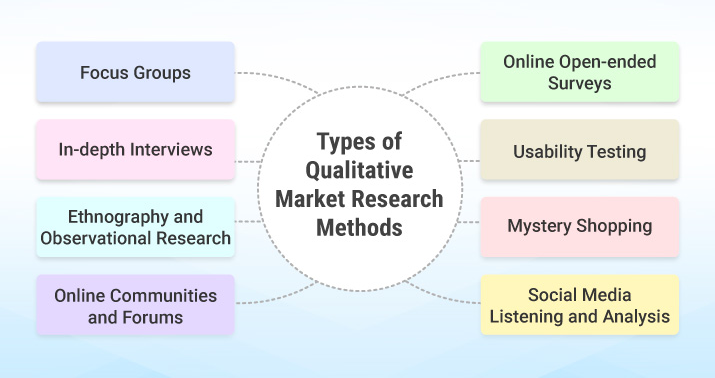
Source: Ideascale
4. Cherry-picking data that supports existing beliefs instead of challenging them
The mistake. This one is subtle. You don’t even notice it happening. You go into research with a hypothesis — and then naturally pay more attention to the data that confirms it. Everything else gets ignored, minimized, or explained away. The result? A “validated” conclusion that was never really tested in the first place.
How to avoid it. Force yourself to look for disconfirming evidence. Deliberately ask: what in this data contradicts our assumption? You can also involve a second reviewer or team member to challenge your interpretation, or use data visualization and BI tools (Tableau, Power BI) to see the full picture instead of selective slices.
5. Delaying decisions by overanalyzing instead of acting on clear patterns
The mistake. Just as with any marketing undertaking, time is a decisive success factor in marketing research. There are always quick wins and other, more resource-hungry choices to make. Marketers can gain an advantage by picking these quick wins, but instead, many choose to pursue the hard choices, overanalyzing and digging deeper and deeper into the problem.
How to avoid it. Look for the low-hanging fruit of our research undertaking and go for them whenever possible. Quick wins inspire, they give the energy to continue processing data (more often than not, in the right direction), and they allow your company to be one step ahead of the competition.
6. Failing to translate insights into actual changes in product, messaging, or strategy
The mistake. Most marketing teams do the easy part, the research, but postpone or drop entirely the most important and the hardest part — results implementation. Why do they do it in the first place? Firstly, it’s hard, and secondly, they simply fail to make decisions and translate insights into actual changes.
How to avoid it. Even if most of your research findings are positive and give you enough reasons to celebrate, you still shouldn’t rest on your laurels and do nothing with the few bad ones. Appoint the responsible people (ideally, project managers and middle managers) in your company or organization and delegate them enough responsibilities to actually get things done.
The role of AI and automation in modern marketing research
Most of us remember the time when marketing research meant long hours with spreadsheets, reports, and manual analysis. Challenging and hard work that demanded dedication, but brought enormous satisfaction when completed.
That hasn’t disappeared. But it has changed quite a bit.
AI and automation stepped in to take off the heavy manual workload burden off the shoulders of marketing researchers. What used to take hours and days now takes minutes, sometimes seconds. As the capabilities of the frontier AI models grow, marketers will soon be able to rely on AI to do most of the research tasks autonomously.
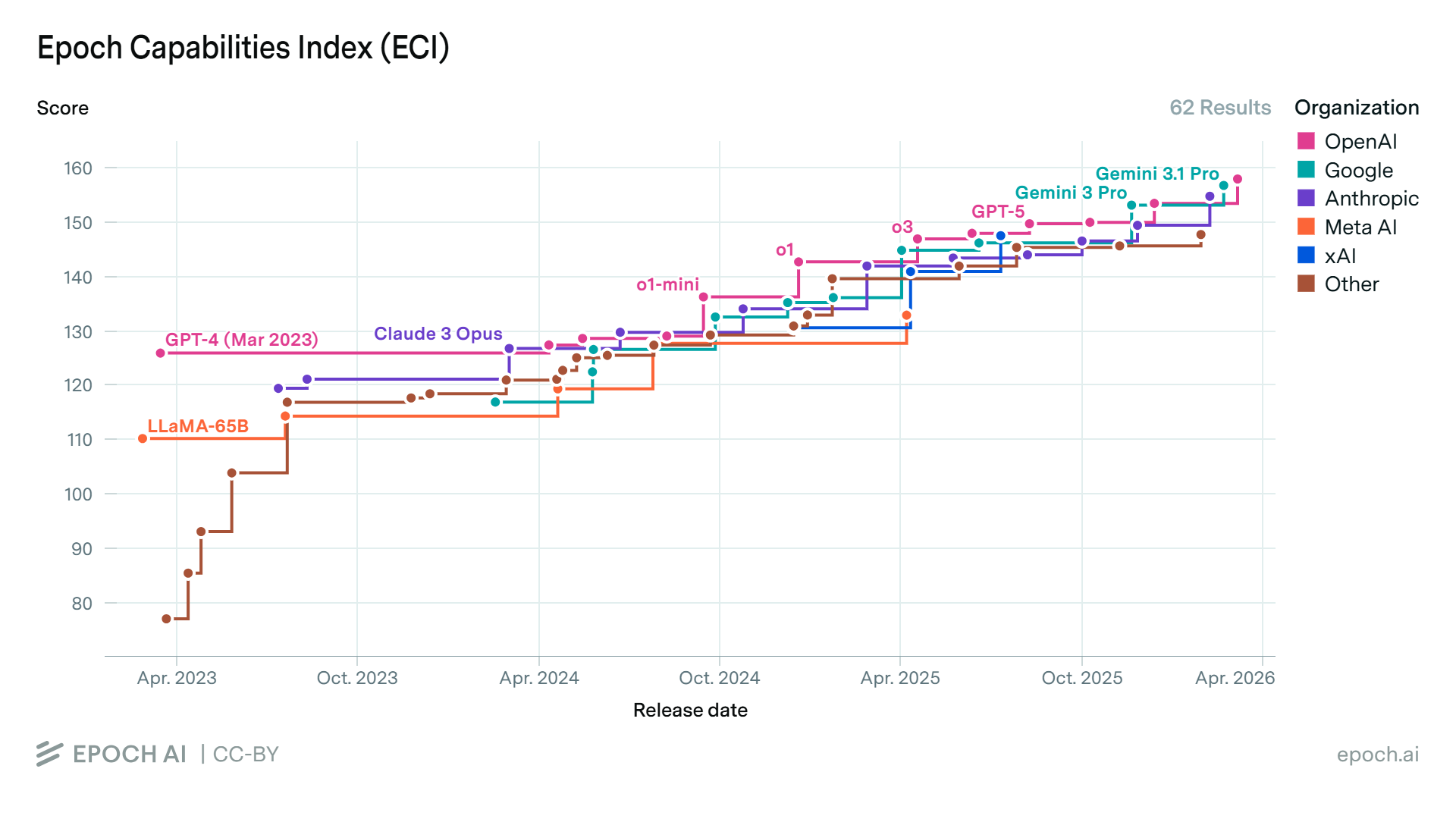
Source: EpochAI
And that completely changes how teams approach research.
Instead of spending most of the time collecting and organizing data (an activity prone to mistakes), you can spend more time strategizing and thinking about what it actually means.
Here’s where AI and automation become useful:
- Processing large datasets without slowing everything down.
- Identifying patterns that are hard to spot manually.
- Summarizing qualitative feedback at scale.
- Automating repetitive tasks like data entry, grouping, error detection, and filtering.
- Predicting trends based on historical behavior.
Sounds great. And it is. But there’s a small catch.
The easier it becomes to get insights, the easier it is to stop questioning them.
AI can highlight trends, but it doesn’t know your context. It doesn’t know your priorities, your constraints, or what your business actually needs right now.
That’s why automation works best when it empowers your thinking, not replaces it.
You still need to ask the right questions. You still need to decide what matters and develop a strategy with a clear plan of action.
AI just helps you get to that point faster.
Conclusion
Some marketers and business owners make decisions based on their intuition. Having made one or two successful business decisions once, they continue to believe that it’s the only strong option to stand out in the highly competitive environment.
Others collect marketing data, analyze it, employ modern IT and AI tools, and meticulously pursue the revealed opportunities.
Who is going to get the upper hand in the long run? The answer is obvious.
Marketing research is what differentiates successful brands from all the rest.
So, just to recap, what is marketing research really? It’s an organized activity that helps you replace assumptions with evidence, understand what’s actually happening in your market, and make decisions that are grounded in something more reliable than guesswork.
The exact methodology may vary. The key is to follow a few basic steps:
- Define and understand your problem.
- Make assumptions (hypotheses) on the root causes of your problem.
- Collect marketing data about your competitors and your business.
- Run analyses focusing on both quantitative and qualitative data. Note if your hypothesis was true or false.
- Present findings, find opportunities, design actions, and appoint responsible people.
The cycle can repeat. Marketing research is not something you do once and forget. As the marketing situation changes (and today that happens very often), and your business/brand also changes, you’ll need to update your initial research.
The pace of modern-day change, especially technological change, is counterintuitive, exponential, whereas we, humans, are used to linear thinking. That’s the key discrepancy that marketing research helps to address.
Evidence-based decisions are simply more resilient — they don’t guarantee success, but they significantly reduce the chances of costly mistakes.
Brands that rely on structured research don’t just react to change — they start anticipating it, adjusting faster, and staying relevant while others are still guessing.
All trademarks, logos, images, and materials are the property of their respective rights holders.
They are used solely for informational, analytical, and review purposes in accordance with applicable copyright law.



 Sign Up
 Sign Up