






Local SEO Landing Pages: Optimization Tactics, Content Best Practices & Real Examples
Most local landing pages are just copy-paste versions of the same template with a different city name.
And Google knows it.
If your “Portland,” “Austin,” “Chicago,” and “New York” pages look identical except for the headline, your local SEO will never do well.
In this guide, we’ll discover what actually makes local SEO landing pages rank: structure, content depth, internal linking, schema, and real examples that work.
So, if you want to start creating effective landing pages, this read is for you.
Why do you need local SEO landing pages?
We could write a 20-page essay on SEO benefits for local businesses. But instead, we’ll just give you two stats for context:
- 8 out of 10 people in the US search for local businesses online at least once per week.
- 58% of businesses don’t optimize for local search results.
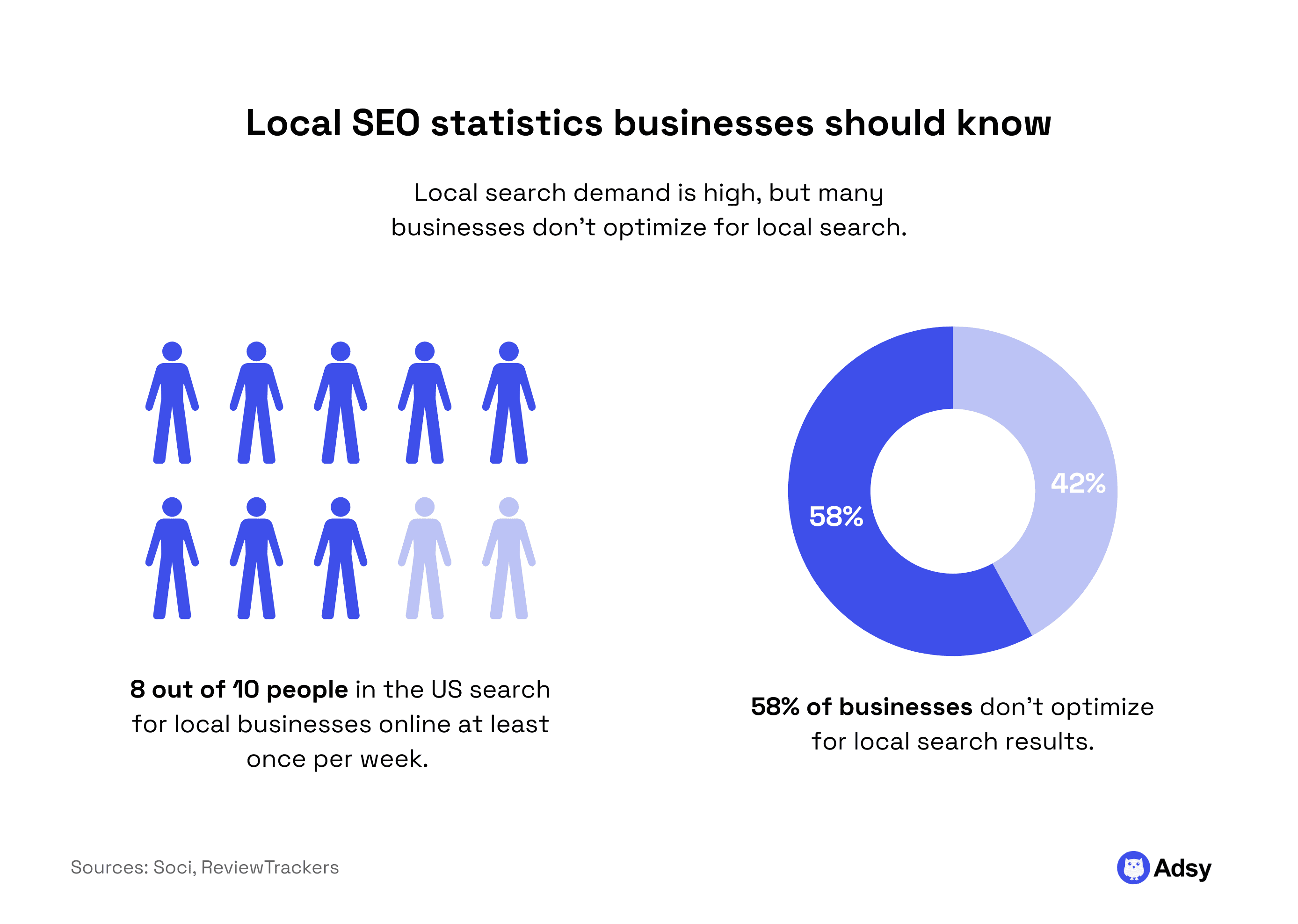
What do we see here? Huge demand (interest). And pretty low competition.
So, why do you need local SEO landing pages?
Simply because it’s one of the best ways to reach local customers who are already searching for products or services like yours.
And on top of it, as you’ve seen, on average, two-thirds of your rivals won’t even compete with you when it comes to local SEO.
Now, imagine yourself in your customers’ shoes.
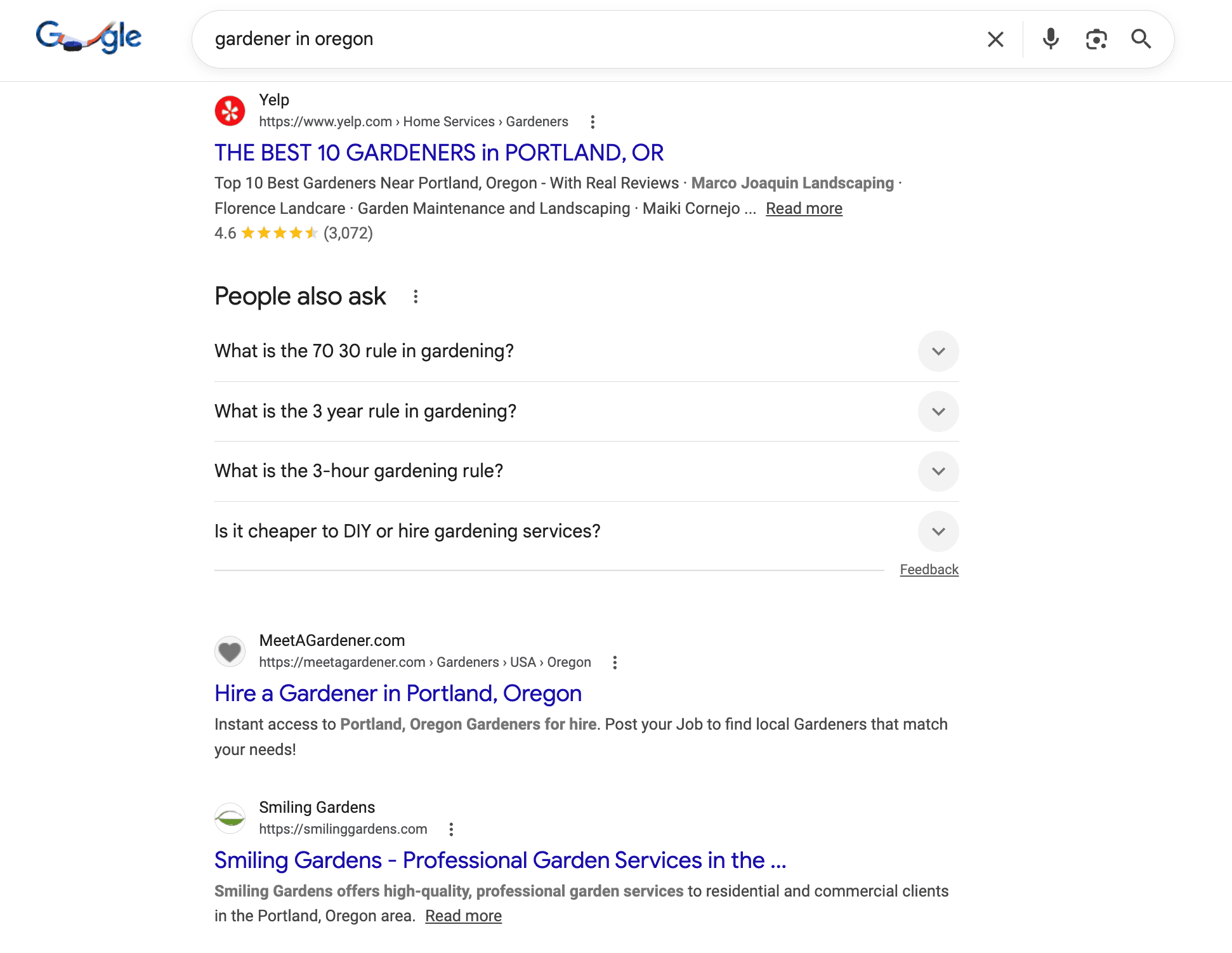
Say you wanted to find a gardener in Oregon. What would you do? Most likely, you’d google it, as most people would.
And these are the results you’d get:
Since this is a local search, you’d probably also pay attention to the local pack (the part of the search results next to the map). This is where you’d see more local businesses:
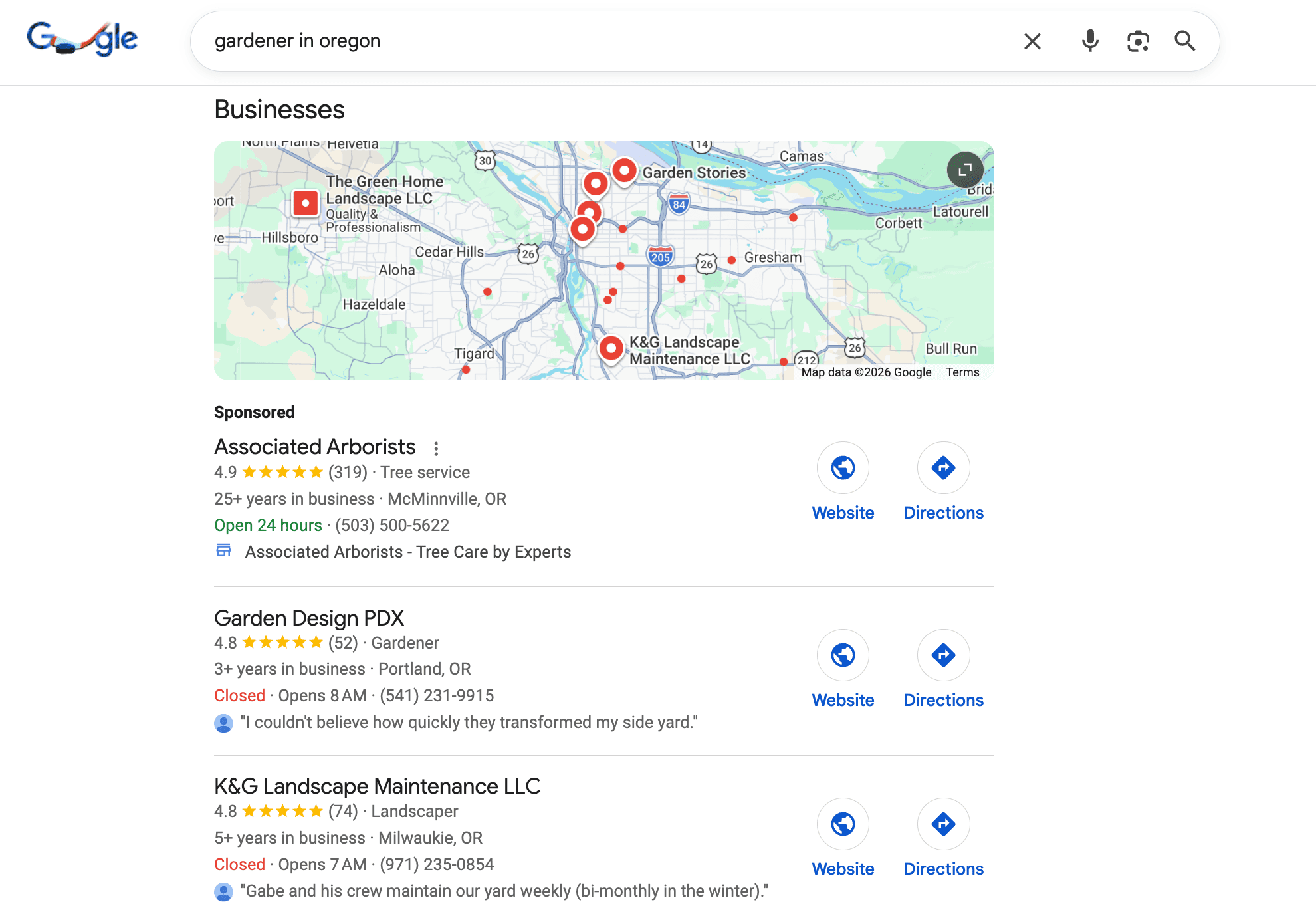
Now the real question for you as a business is: how do you get into any of these local search results? You have two main options:
- Run ads. While it’s much faster, CTR (meaning actual clicks) for PPC (paid ads) is much lower than organic search results. Besides, it isn’t sustainable: once you stop running ads, you get no landing page visitors.
- Work on your SEO. Sure, this one takes much more time initially. But it’s also one of the most cost-effective tactics to generate traffic to your local landing pages in the long run.
2 types of local landing pages: What’s the difference?
Generally speaking, there are two types of local landing pages. Let’s check how they differ and what you should prioritize for each.
Single-location business
When it comes to a landing page for a single-location business, it’s often a simpler website with a home page and a couple of additional pages, like:
- Contact,
- About,
- Services/products, etc.
Something like this:
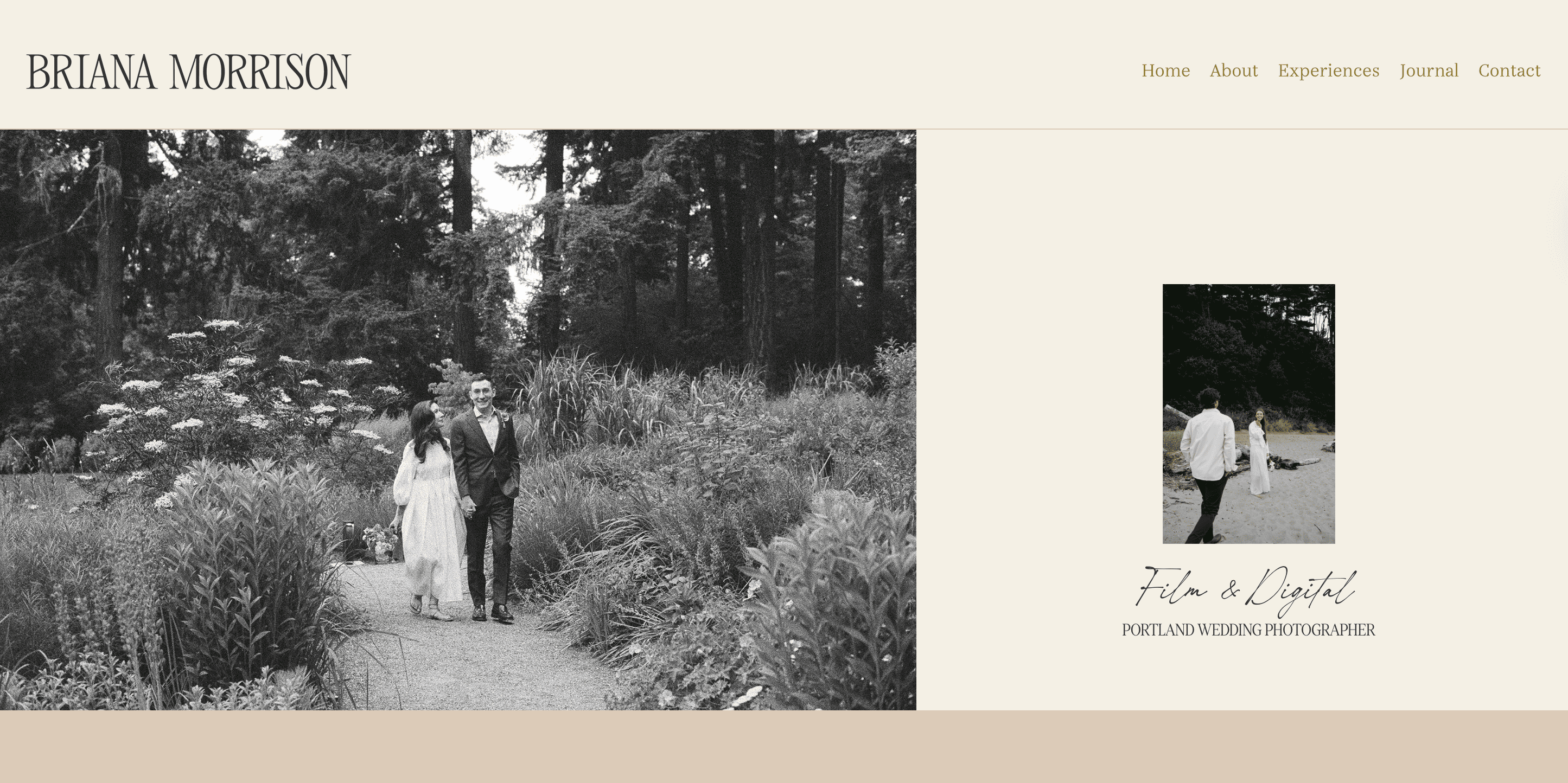
For this type of website, you have to focus on one city (area), one set of local keywords, and one Google Business Profile.
This clear focus is what often makes this type of landing page much easier.
The only thing to keep in mind is that you don’t need tons of pages for one location. Instead, do everything to strengthen one main local landing page.
This will bring you much better results over time.
Multi-location business
Multi-location business landing pages are the opposite of what we’ve just discussed.
Here, you have to create several pages for each city, district, area, etc. And each of those needs to have its own:
- Contact details,
- Team information,
- Services/products offered,
- Opening hours and addresses,
- Unique content (at least 40% of it), etc.
Here is an example of a multi-location business website.
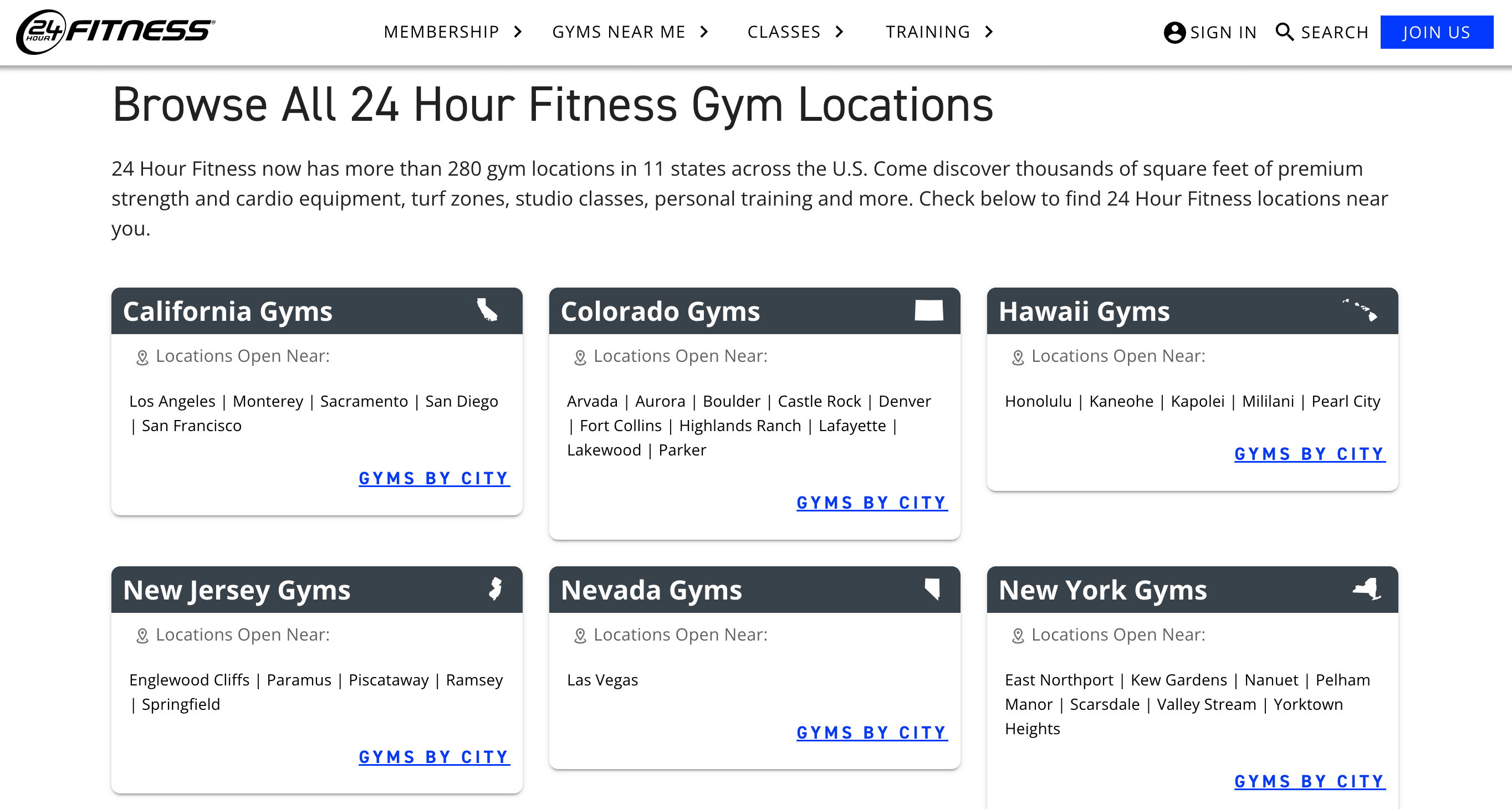
The biggest challenge of these landing pages is that you have to build authority and trust for each specific location separately.
Besides, you have to make sure that your content is relevant and unique.
Best SEO practices for location-based landing pages
Now, let’s focus on the actual, practical things you can do to improve the search engine optimization of your landing pages.
Choose the right URL structure
Your URL slugs help both search engines and your users understand what your page is all about. That’s why they can’t be random
What does a good URL for a local business landing page look like? Ideally, it needs these 3 elements:
- Your main keyword (niche, product, service, etc.),
- Your location (city, area, etc.),
- Clarity and brevity (you can’t make your slug too long).
Based on the elements above, you can clearly understand that this is a good URL:
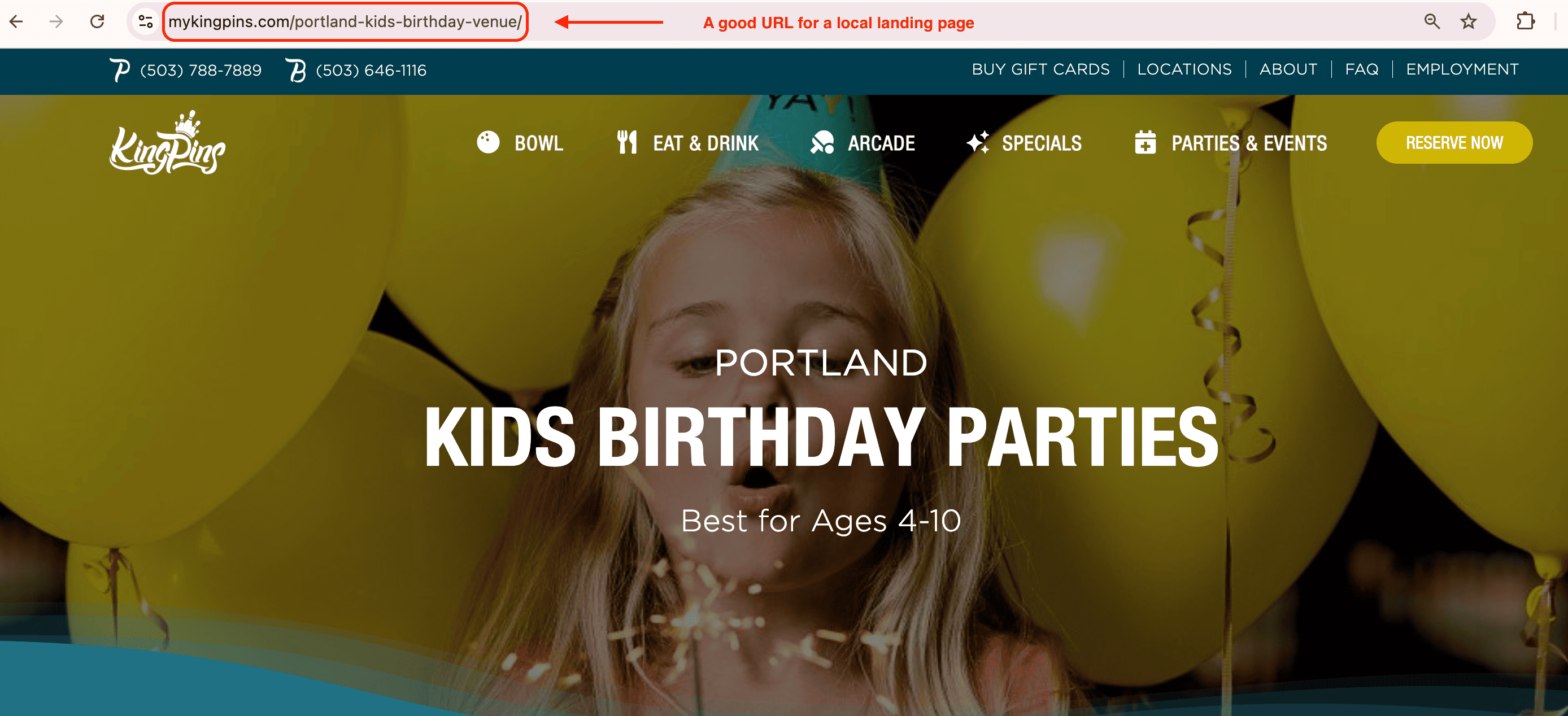
And this approach works even if you have multiple branches:


But something like this is a no-go:

Do local keyword research
Location-specific keywords differ from the standard keywords you’d use for your niche. But if you want to attract relevant potential customers, you have to make sure that you look for location-based queries.
Usually, most of your keywords will come down to your service/product + location or “near me”. And it’s okay. Many of your main target search terms will look like this:
- Birthday cakes Eastville,
- Pool maintenance Tampa,
- Catering Atlanta,
- Gluten-free bread near me.
What do you need to find these local keywords? Start by:
- Listing all the keywords (processes, potential issues, products, etc.) that people might be searching for in your niche.
- And thinking of the location-specific phrases (not just your city, but neighborhood, area, monuments nearby, local landmarks, etc.)
Then, ideally, you need an SEO tool like Ahrefs or Semrush to find the exact keywords that have a good search volume and aren’t too hard to rank for (with low or medium keyword difficulty).
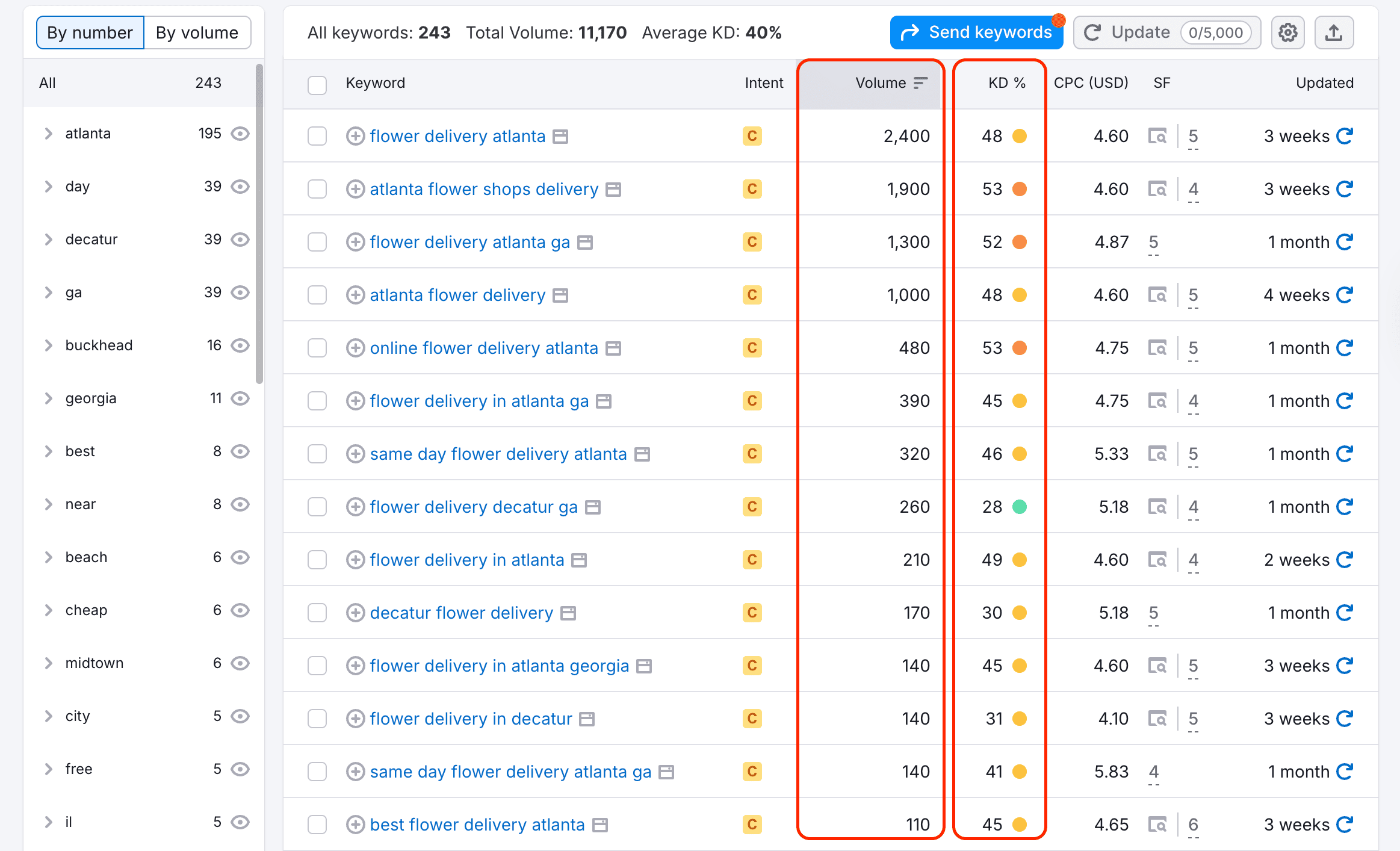
Here is, for example, how you can find this in Semrush:
- Go to Keyword Magic Tool,
- Enter your keyword and domain for more specific results (optional).
- Use the Include keywords fields and select Any keywords, add any relevant location modifiers, and click Apply.
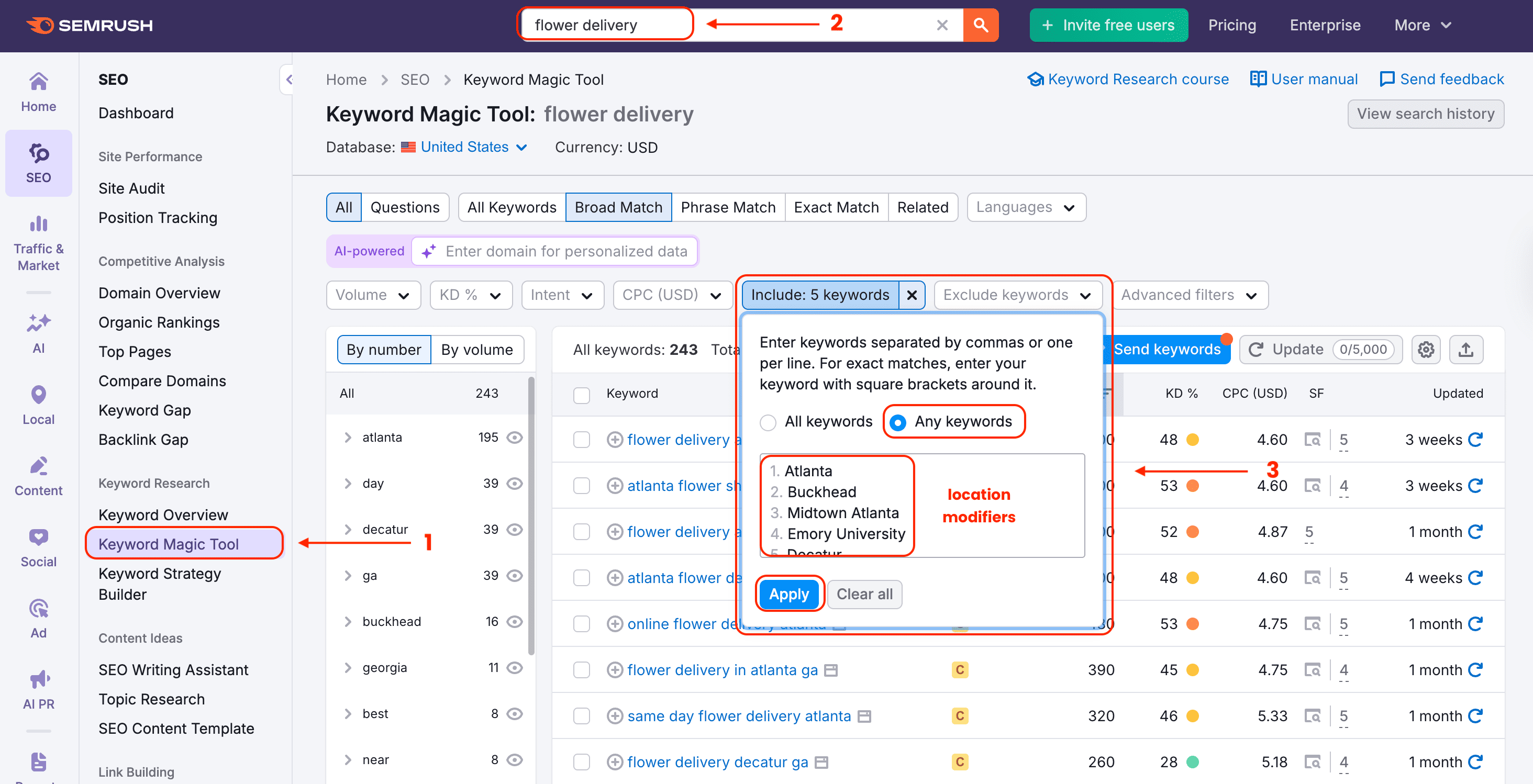
This is how you’ll get a list of relevant keywords that you can target on your website. As we’ve mentioned before, make sure to pay attention to keyword difficulty and search volume.
If you have competitors that rank well in local searches, you can also take a look at what location-based queries they target. Again, any SEO tool can help you with that.
Use one search intent per page
If your business only has one location and one main service, most likely, you won’t make this mistake.
But once your company is bigger, you might want to fit everything on one page: multiple physical locations, services, or products that aren’t related.
Imagine you make wedding cakes in Baltimore, and you also have classes for people who’d like to learn how to bake cakes in Baltimore (or maybe even online).
These terms are quite related, after all, they’re both about “cakes in Baltimore.” But the issue is that search intent is different:
- One group of people searches for a cake for their wedding or their client’s.
- And another group is bakers (or wanna-be-bakers) who want to learn how to make wedding cakes.
Sure, you can put it all on the same page, especially if your resources are limited. But it will be much harder (frankly, pretty much impossible) to rank one page for both “wedding cakes in Baltimore” and “baking classes in Baltimore.”
So, even if your resources are limited, simply create one design template and write different copy for each service, location, product category, etc.
Here is a great real-life example.
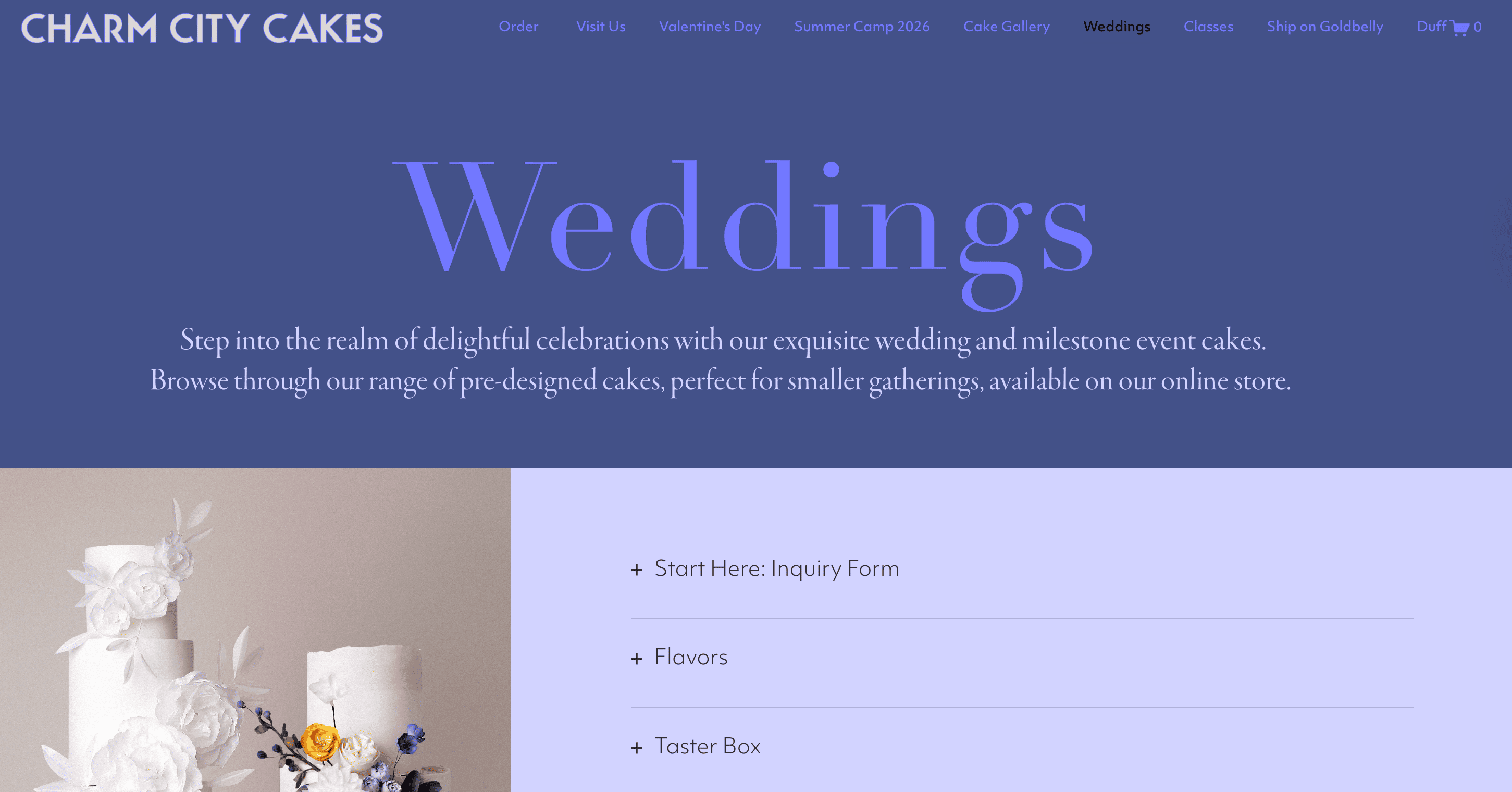
It’s a local landing page that ranks number 1 for the query “wedding cakes in Baltimore.”

Here is their page on wedding cakes:
But they also have cake decorating classes in Baltimore. And guess what? They have a separate page for this:

They even offer a baking camp for kids. And, of course, it also has its own dedicated page:
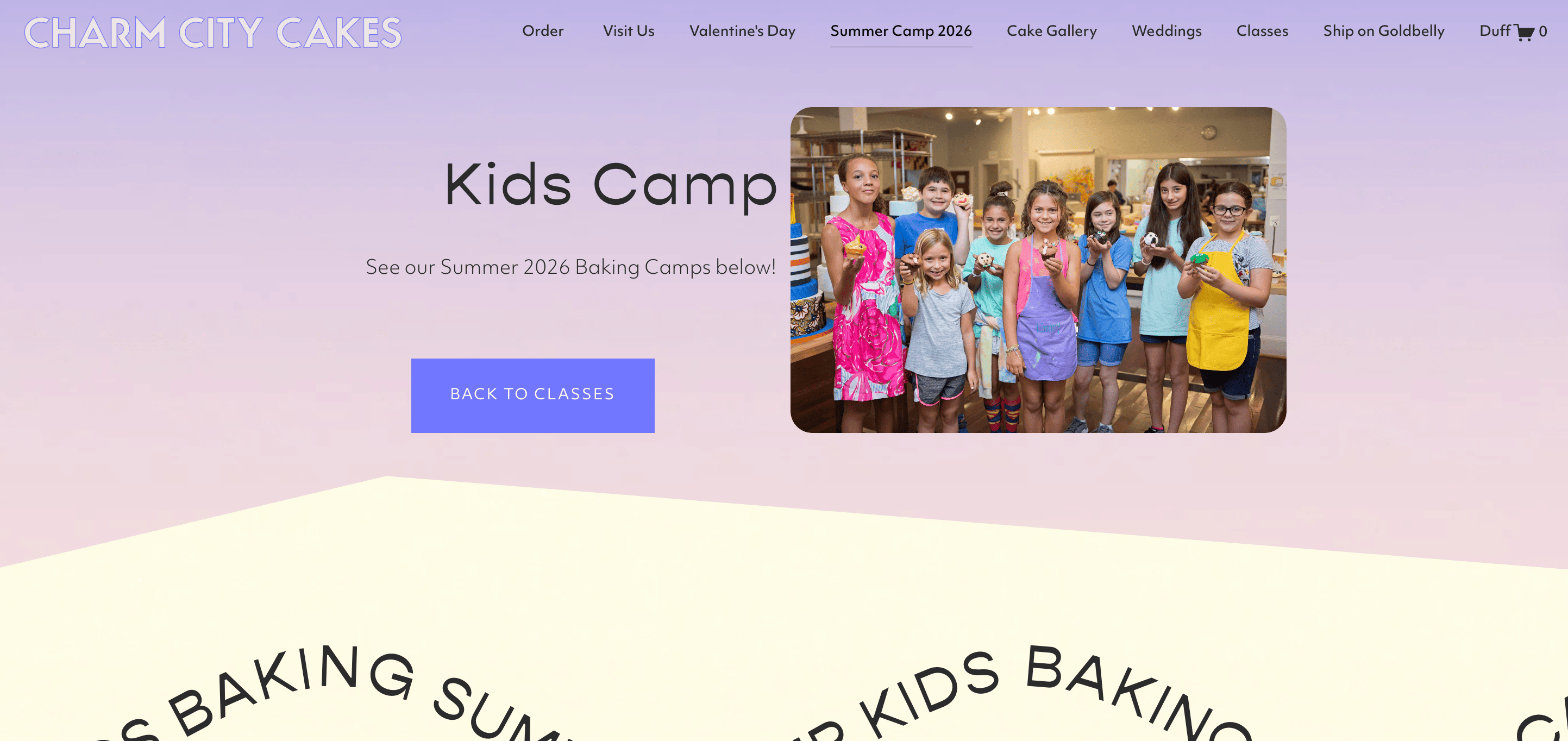
But if they were to try to fit all that into one landing page, it would be a small disaster. Because each of these local pages has a very different search intent.
Remember about the “40-60% unique content” rule
Speaking of templates, you have to remember that while your design can be identical (Google doesn’t really care about that), your copy must be unique.
So, if you have:
- Multiple physical locations, you can’t just swap “San Diego” to “Portland” and call it a day.
- Multiple services/product categories, you can’t simply change “dresses” to “skirts.”
The general best practice is to have at least 40%-60% of the unique content per page. But ideally, you need to write most of the copy from scratch, highlighting local events, location-specific offerings, local customer testimonials, specific location images, etc.
If you have too many services or locations, it’s best to focus on the major ones first and write decent copy there. Instead of creating dozens of thin pages that won’t get any visibility in search engines.
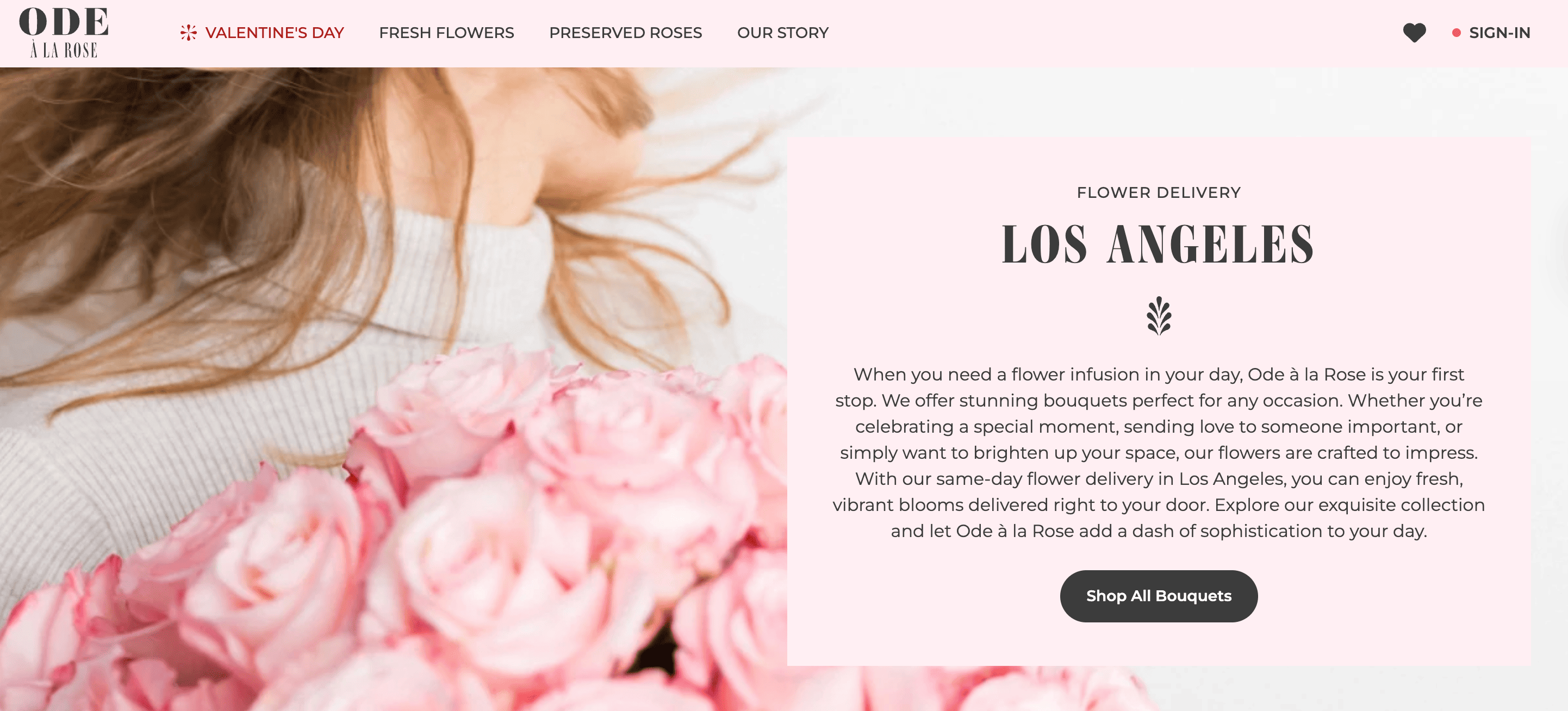
Remember, we showed you an example of multi-location URLs in one of the flower shops? Well, here are their local landing pages for each city. This is LA:
And this is Chicago:
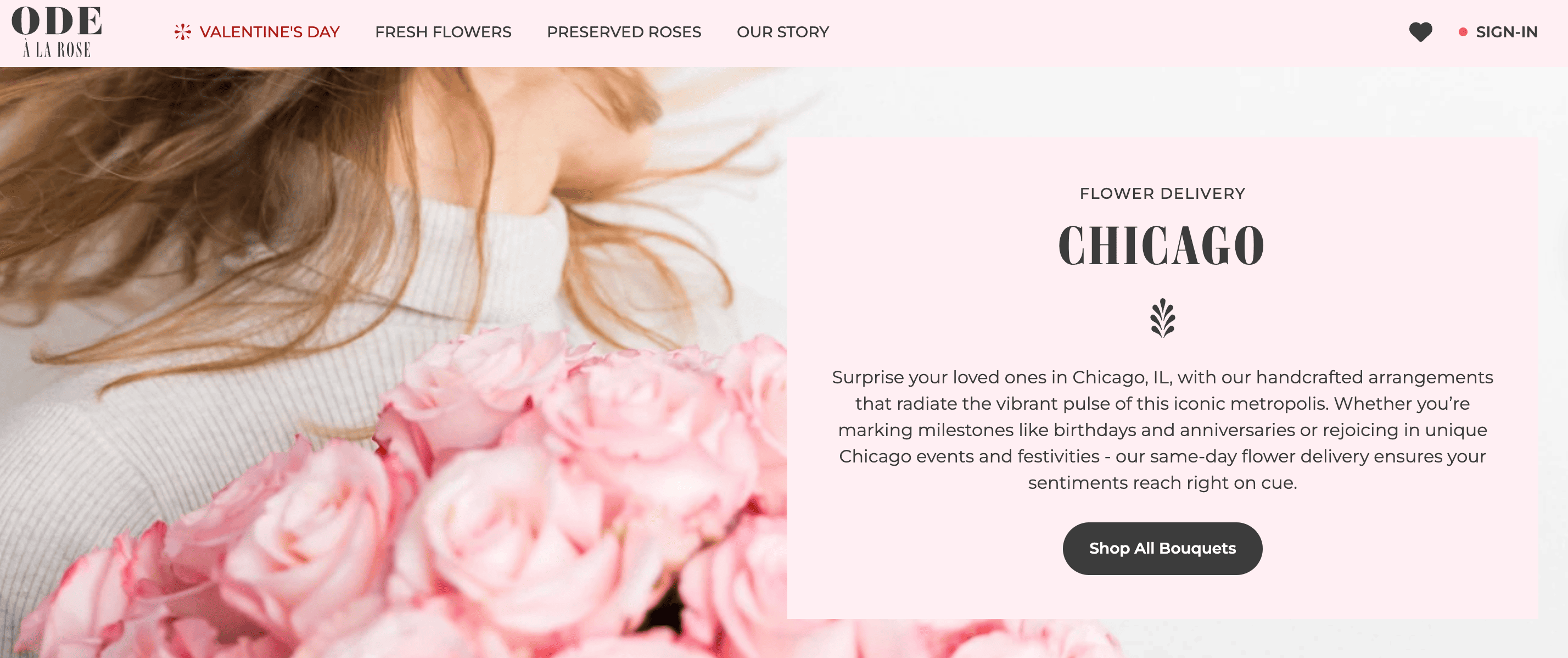
As you can see, the design is identical, but the copy is unique. And this is the best approach if you want to get good local search rankings.
Search engines simply don’t like duplicate content, as it has no real value in their “eyes.”
Do on-page SEO
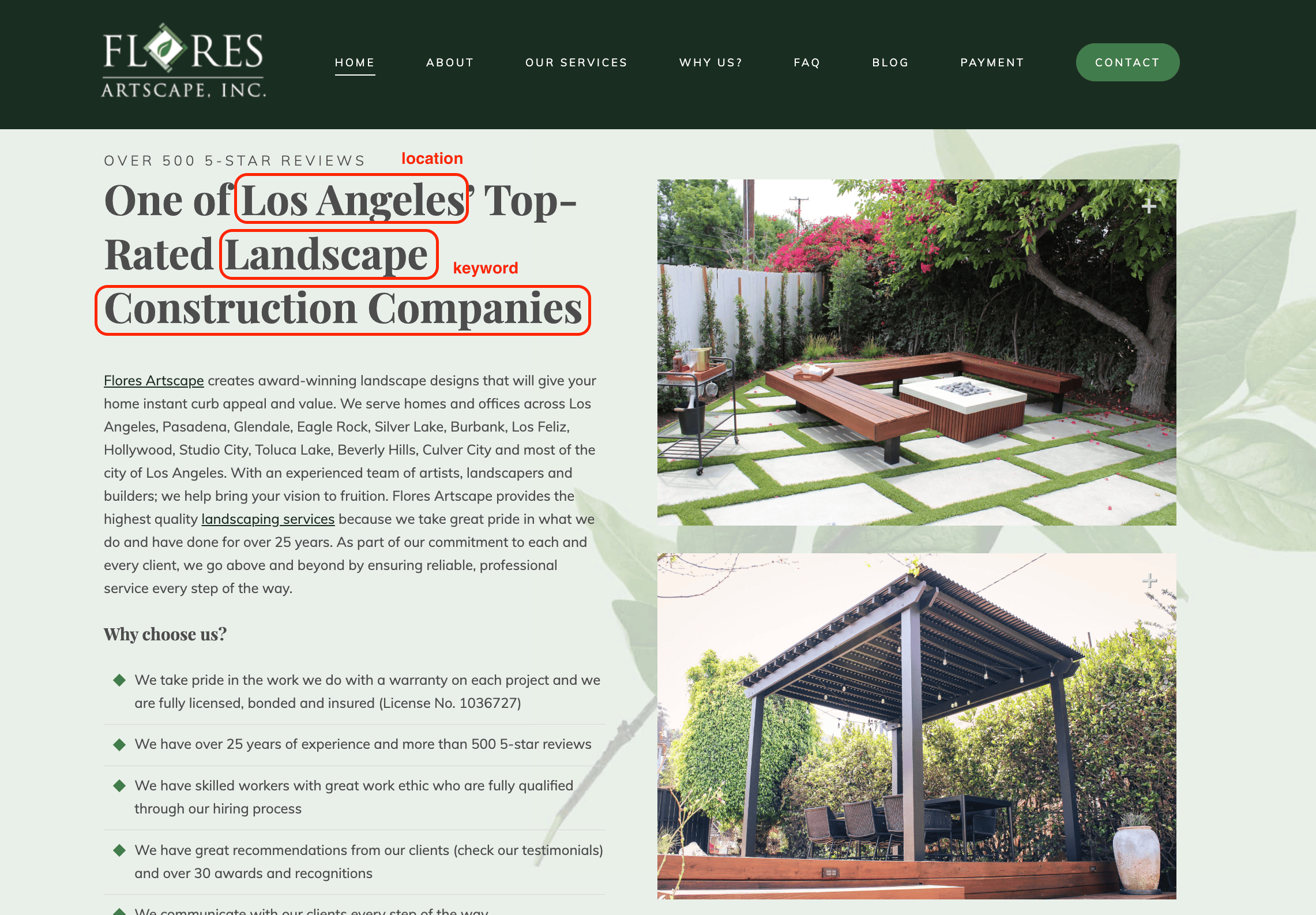
On-page SEO is the optimization we all typically think about, as it’s mostly about adding keywords to the right places. Those “right places” are:
- H1 title (it’s very important to have your main keyword here),
- H2 headings (not in every H2 heading, but some should include the main or additional keywords),
- Throughout the copy (you can’t just stuff your FAQ section with keywords: you need them evenly spread throughout your landing page).
Here is a good example:
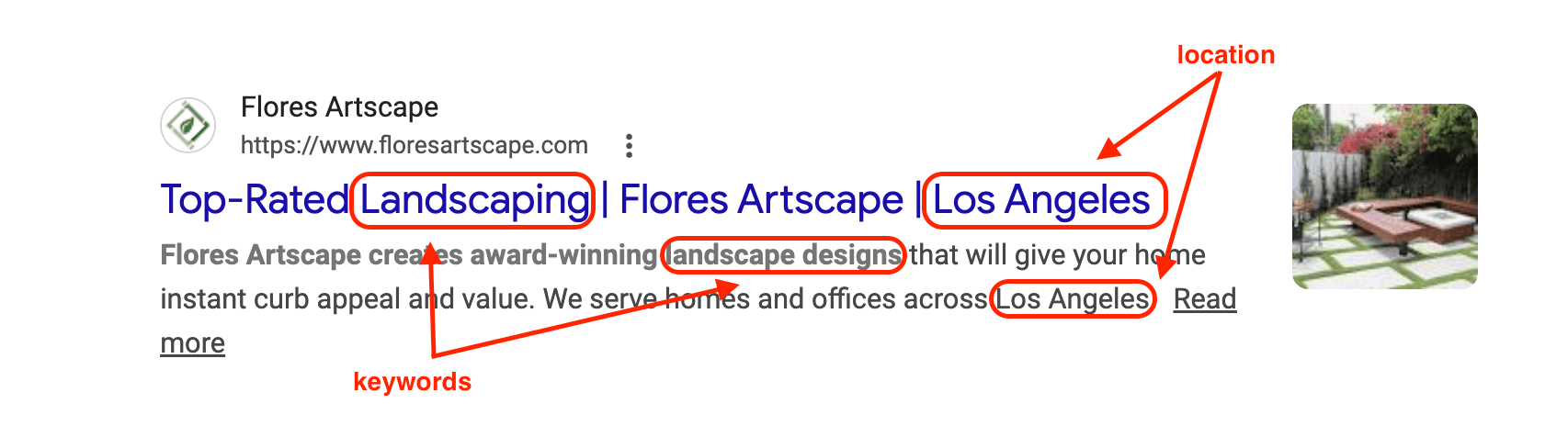
And your meta title and meta description also have to be naturally optimized, like this:
One more thing: don’t overoptimize.
Before, simply stuffing your landing pages with tons of keywords could work.
But these days, you will never rank with copy like this: “We’re the best cleaning service in San Jose, offering same-day cleaning in San Jose, for any type of property in San Jose.”
This is a real red flag because more isn’t better in this case.
Work on your technical SEO and UX
Technical SEO is an element that many want to skip because it is quite “invisible.”
When you navigate to your landing page, you can see images, watch videos, and read your unique copy. But can you really see your tech SEO? Nope.
Yet, if it’s broken, you will definitely feel it. And it’s not good.
When we talk about technical SEO and user experience (UX), we mainly refer to making sure that:
- Your landing page is indexable.
- Your loading speed is doing fine.
- You have mobile optimization in place.
- Your website structure is easy to understand and navigate.
- Your website is secure.
There are more things you can fix. And we’ve listed all of them in this technical SEO guide, so feel free to check that one.
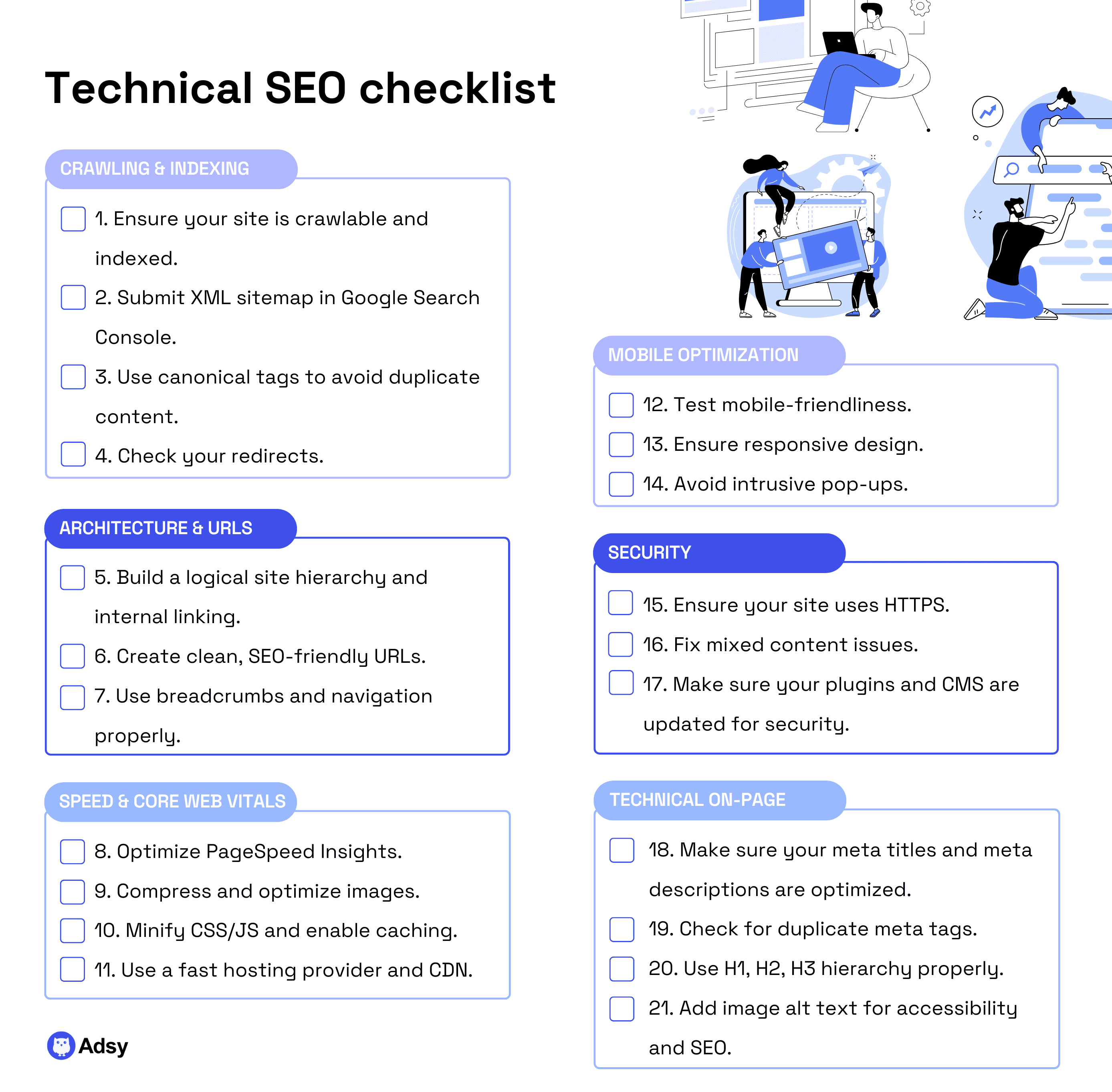
But for now, let’s focus on the major things we’ve mentioned above.
Where can you find all that information?
The good news is that you can check most of those things for free.
1. Indexability
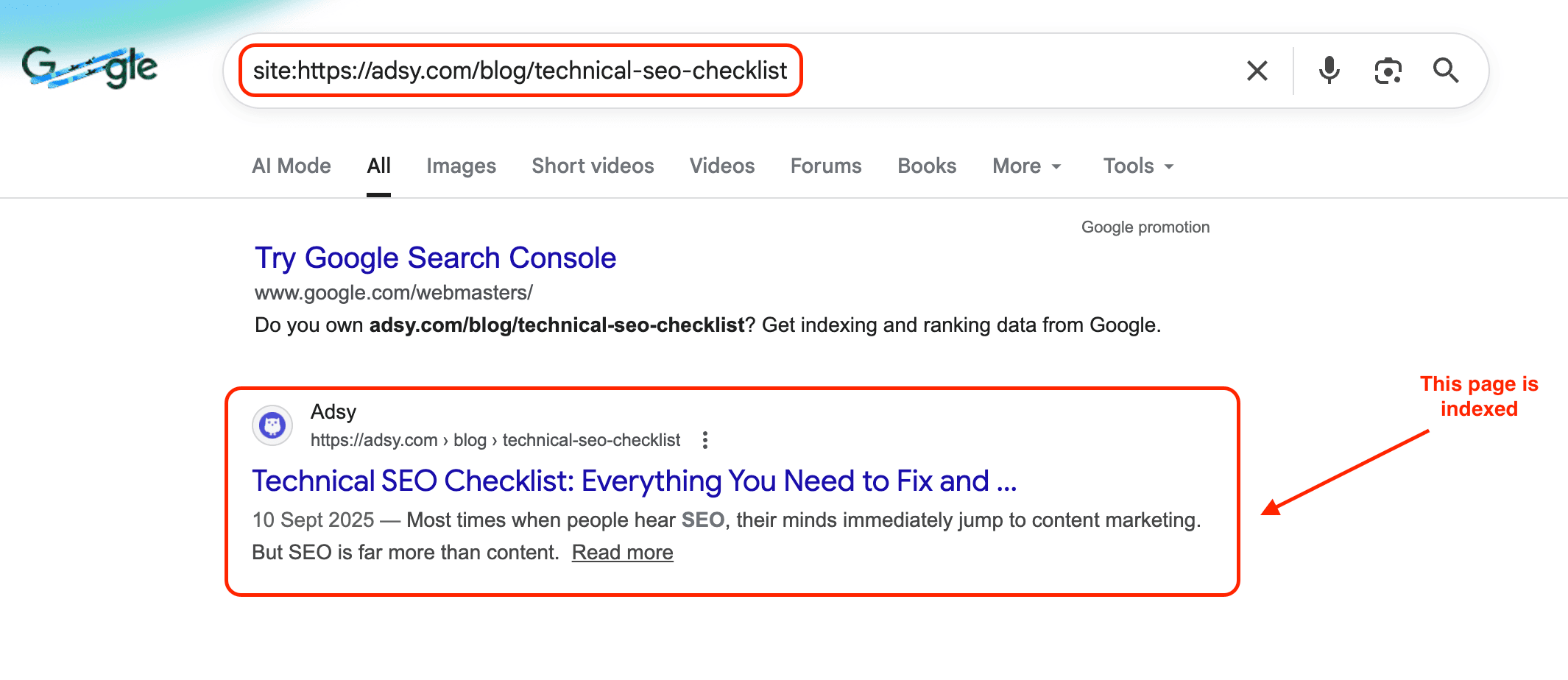
You can track it in Google Search Console, any online indexation tool, or by simply googling site:www.yourlandingpage.com. If you see your page showing up, it’s indexed, like this one:
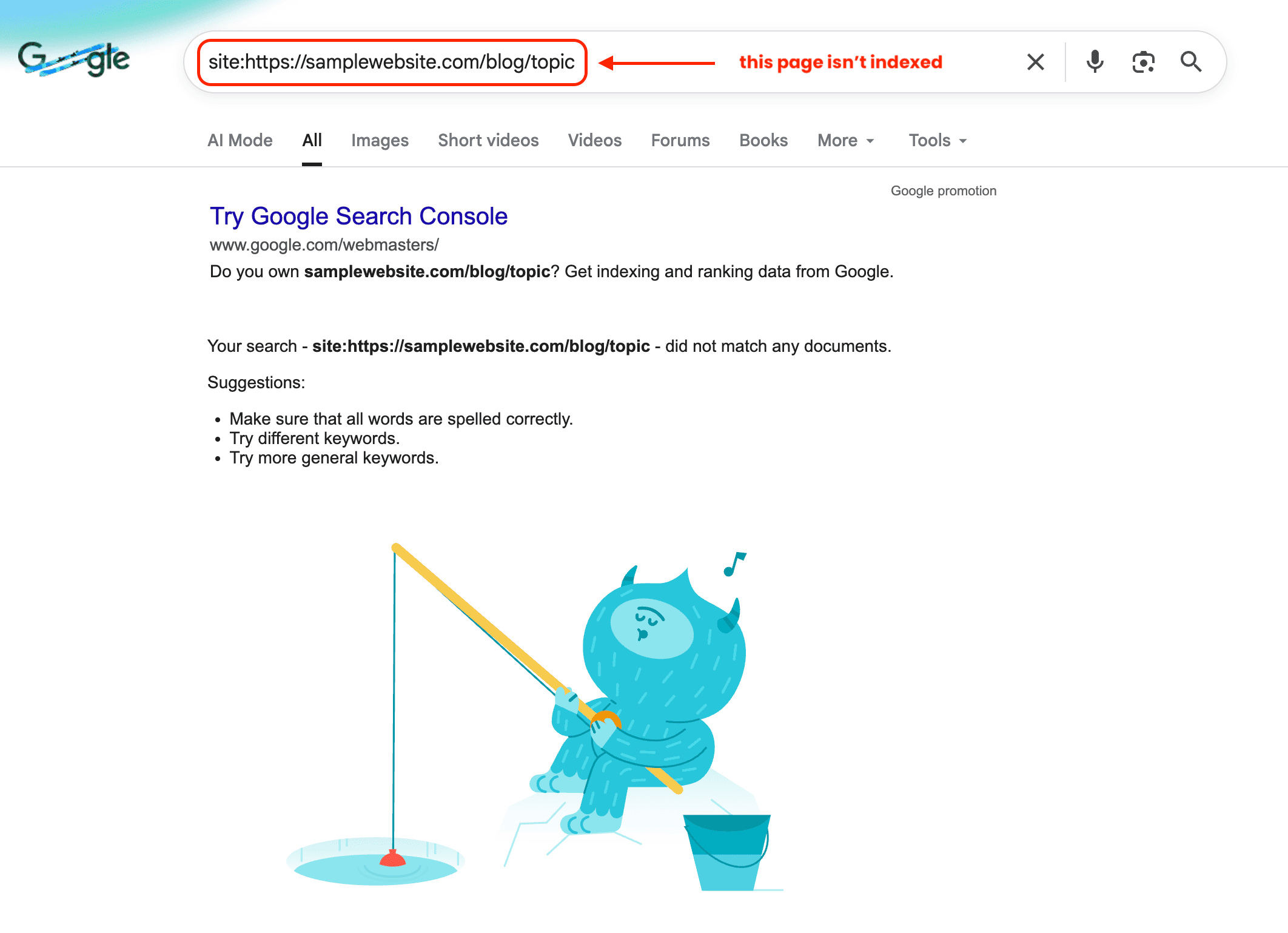
But if you get a result like this, it means that your landing page isn’t indexed:
2. Loading speed
Your website’s loading speed is also something you can easily track online by using Google’s tool called PageSpeed Insights.
Simply copy-paste your website address, and you’ll see lots of important information:
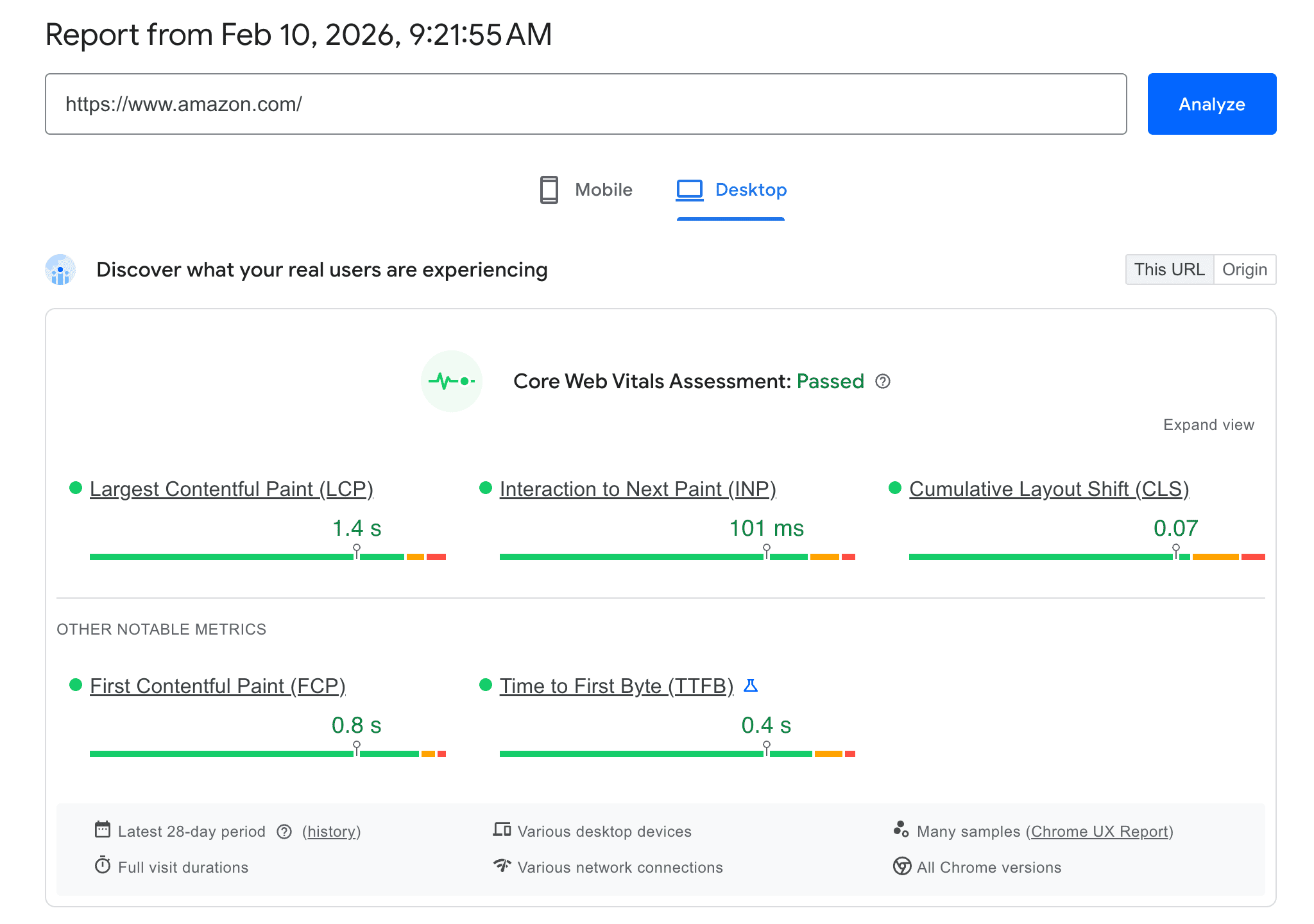
Source: PageSpeed Insights
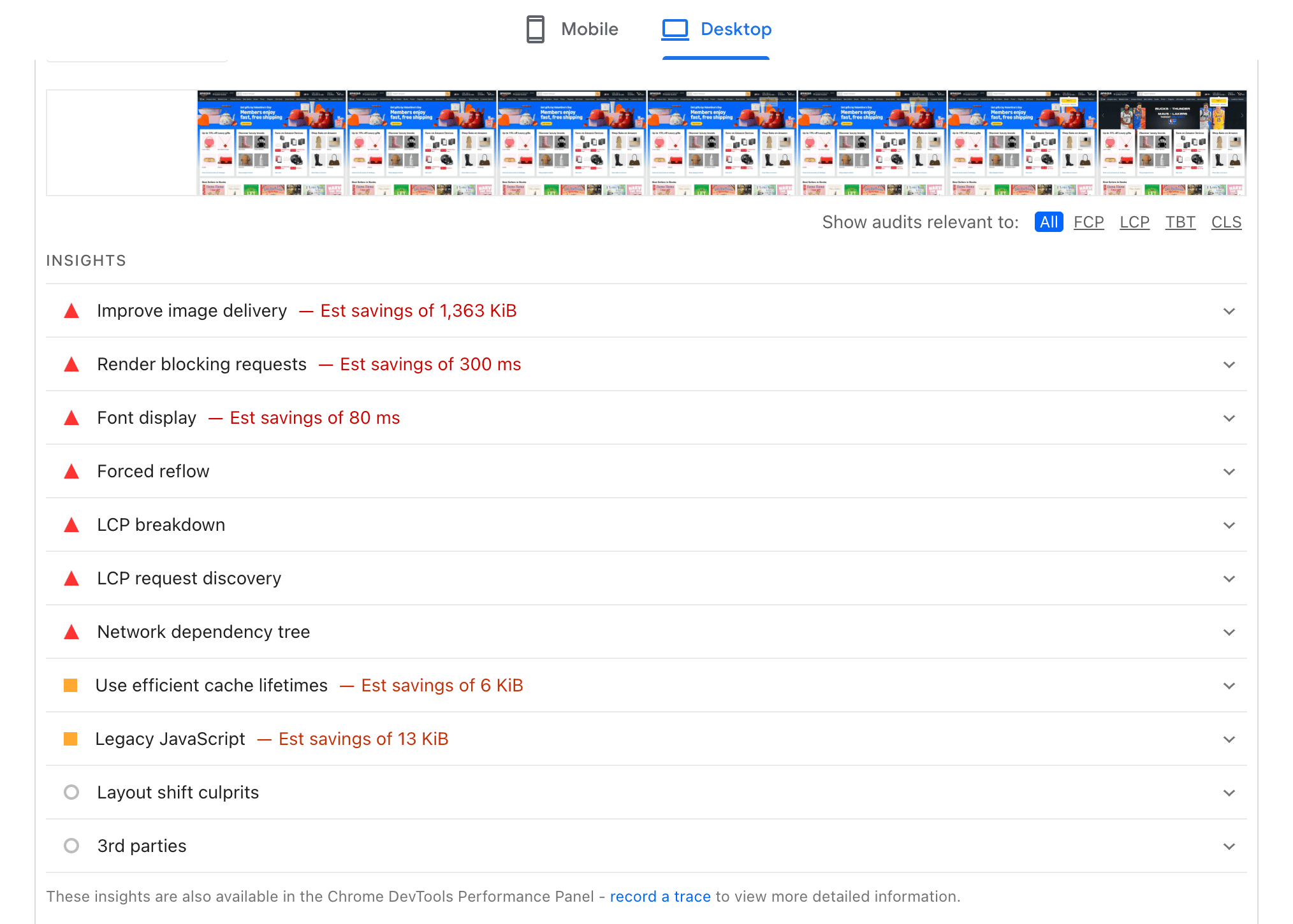
If you scroll down, you’ll also find some of the suggestions that could help you improve your performance.
Some of them will require development. But others will simply be about compressing your visuals, for example:
3. Mobile optimization
You can start working on your mobile optimization with PageSpeed Insights as well, as there is a mobile performance tab.
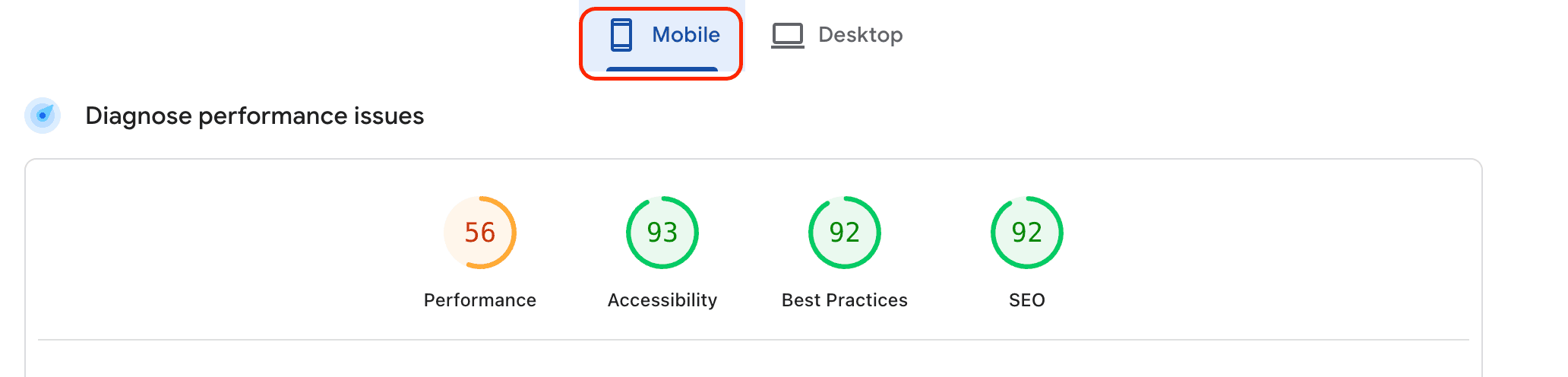
But try to go further. Take your smartphone and test your landing page by yourself:
- Are the buttons big enough?
- Is your text big enough to read?
- Is your cookie pop-up so huge that it covers most of the page? And so on.
The idea is to make sure your website is easy to use on mobile. And there is no better way to find it out than by actually testing it in real life.
4. Website structure
It’s really important that your site’s architecture is clear. If people can’t find your services or contacts, that’s a no-go.
So, before publishing your local landing pages, make sure you have a clear hierarchy that’s not confusing.
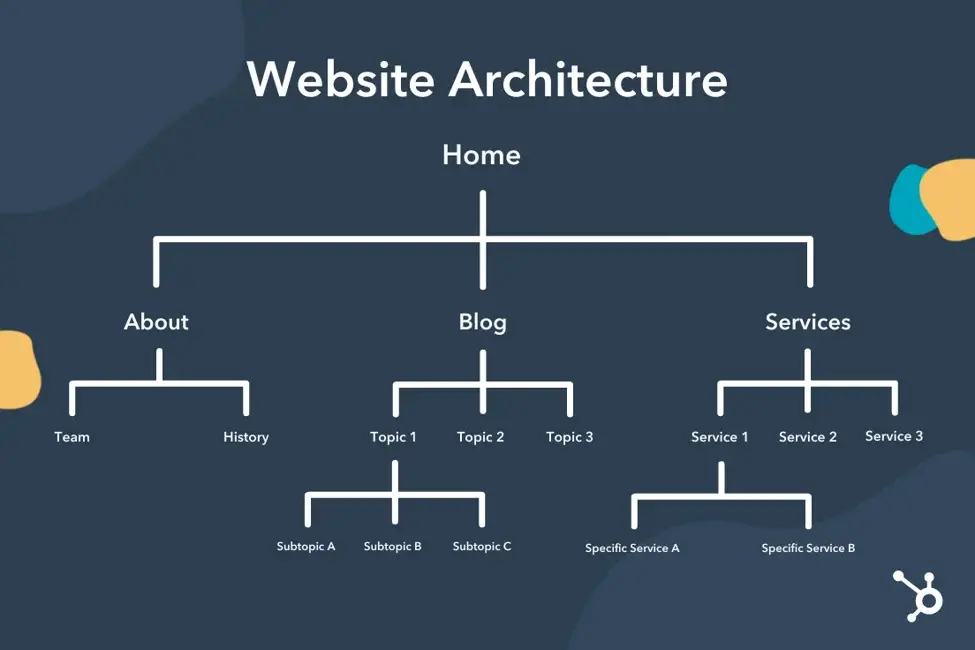
Source: HubSpot
So, for example, if you have multiple cities and branches, your location hierarchy can look like this: Locations > New York > Brooklyn.
But it goes beyond just location-specific content. Everything needs a clear path. For example:
- Your blog posts: resources > blog > category > topic,
- Your services: services > exact service > subservice (if it makes sense), etc.
5. Security
You’ve probably seen a sign like this next to some website:
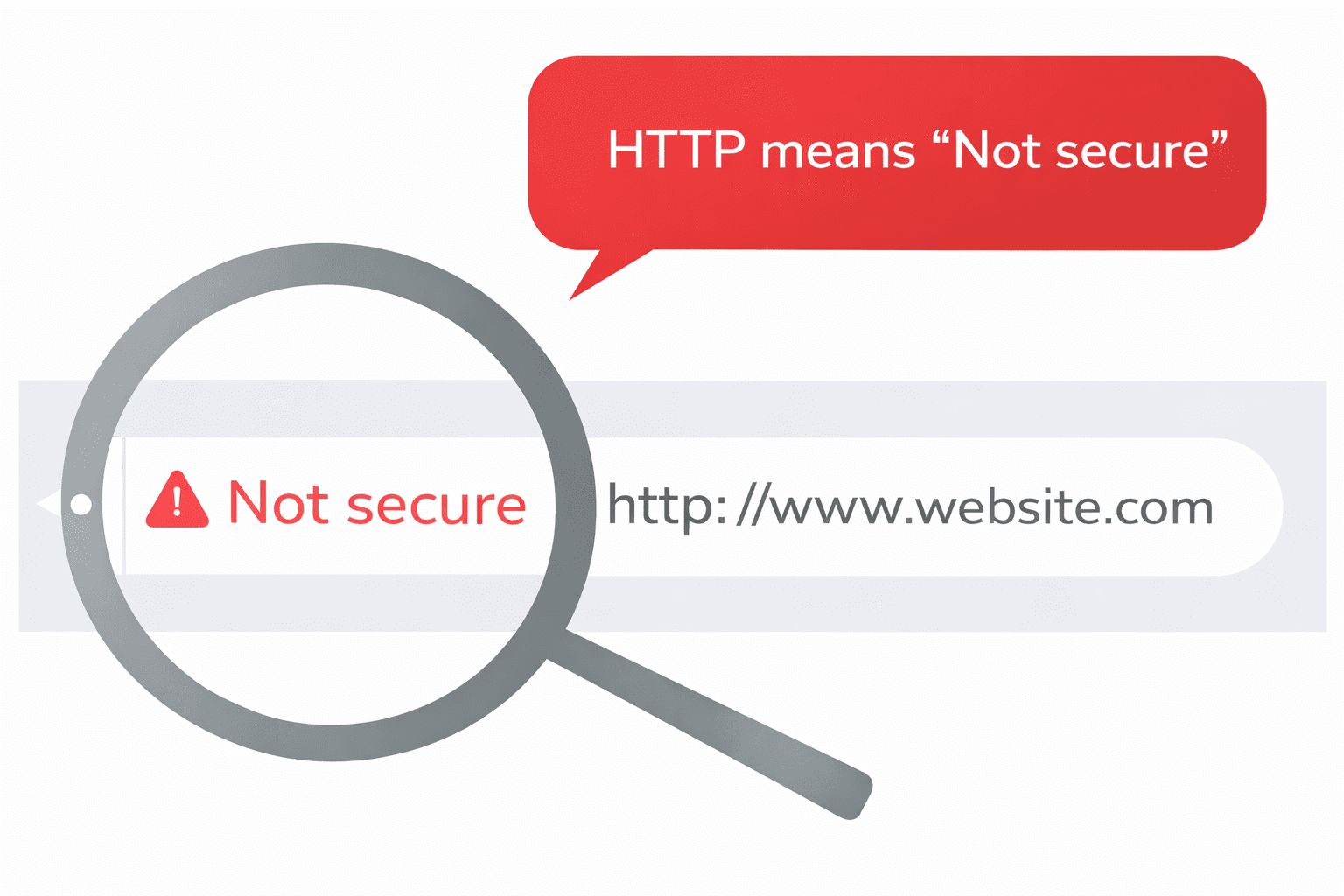
Well, even if you don’t care about SEO, this doesn’t really look good. Your website security is one of the most basic things you can do to improve the overall image of your page.
These days, you’ll likely get your SSL certificate installed by default with your CMS. Still, it's worth checking just in case.
If you have HTTPS next to your website address and no warning signs, you’re doing fine.
Use Local Business schema
This sounds very technical. But in reality, it isn’t that complex.
First, let’s figure out what a schema is. Basically, it’s a code that helps search engines understand your website better. As a result, you can:
- Improve your local search visibility (you might show up for some keywords that aren’t even included in your actual listing).
- Help you get rich results, like ratings, photos, etc. (schema doesn’t guarantee that the rich results will show up, but it makes you eligible for them).
- Boost AI visibility (according to several studies, websites that have schema tend to show up in AI search results more often).
You can add almost any information in your Local Business Schema, from basics (name, opening hours, phone, and address) to more specific details (the currencies or payment methods you accept).
What does the process itself look like? Essentially, you have to follow these 4 steps:
- Generate your local schema by either using Google’s Structured Data Markup Helper or ChatGPT.
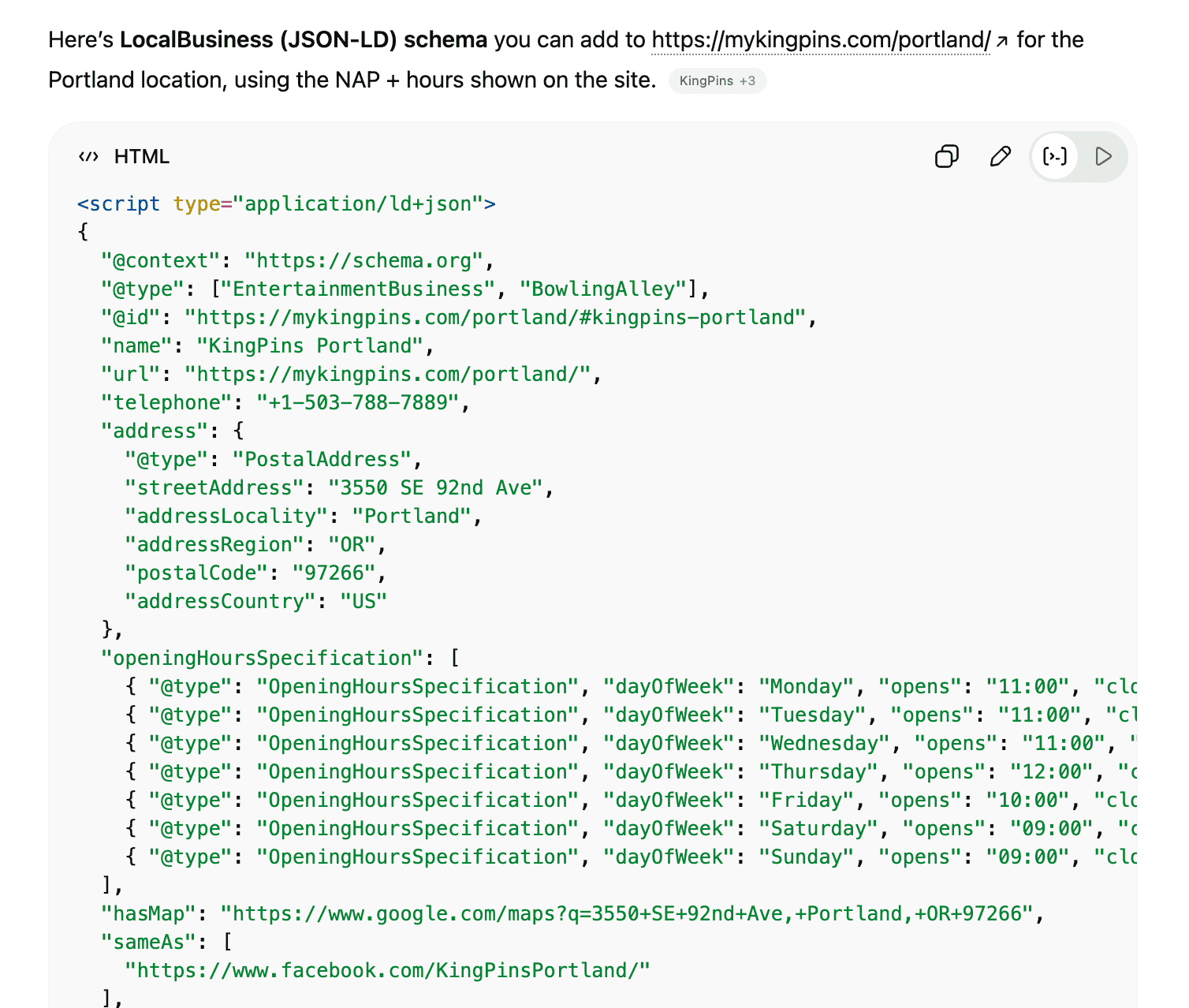
- Add this code to your website's <head> section.
- If you have multiple locations, create a separate schema for each city, branch, etc.
- Use Schema Markup Validator to make sure that everything works properly.
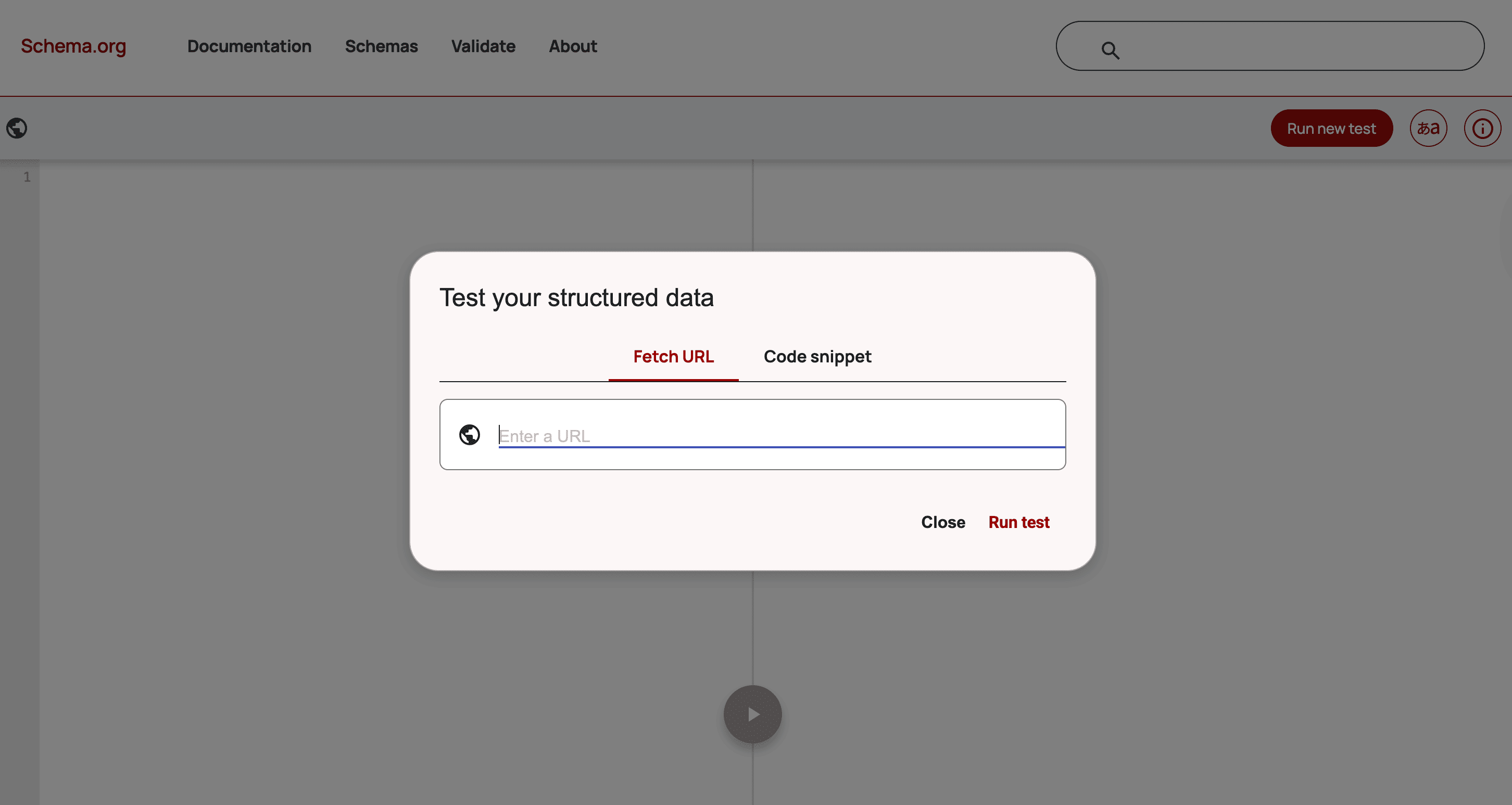
Source: Schema Markup Validator
Create Google Business Profile
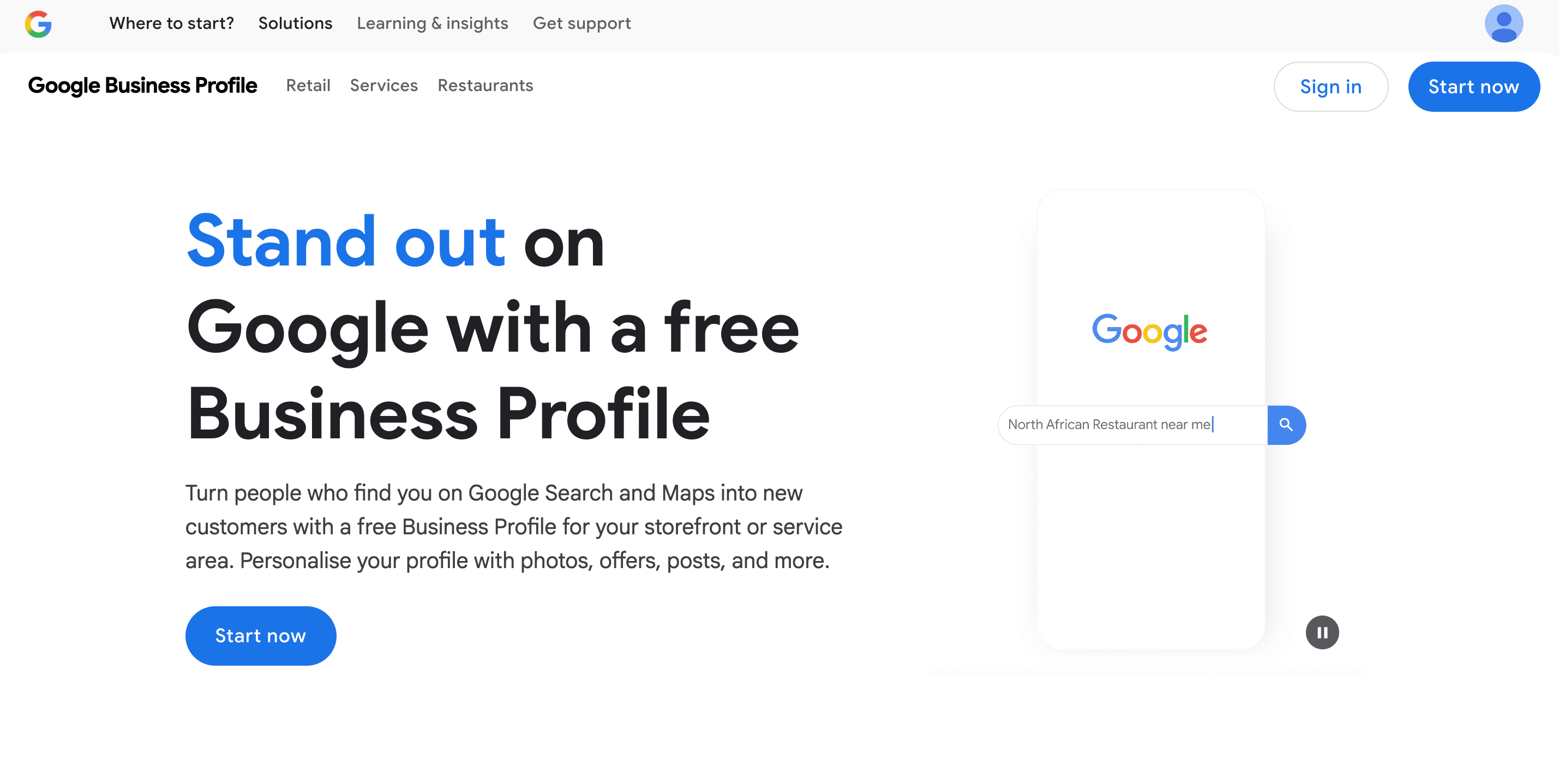
Google Business Profile (aka GBP) doesn’t directly influence your rankings in search engines.
But it helps you show up in local search results through Google Maps and the Local Pack (map-based results you get when googling).
83% of consumers use Google to find reviews of local businesses. And for you, as a local business, one of the first “review platforms” they’ll see will be your Google Business Profile.
A well-optimized profile helps you:
- Show up more for “near me” searches,
- Build trust through your customers’ reviews,
- Display accurate working hours, address, etc.,
- Get more website visits.
Source: Google
How to create content for local landing pages for SEO (with examples)
We’ve already discussed the most important SEO tactics, but there is more to it. Most of the optimization is usually done for search engines.
While it’s absolutely crucial to build visibility in local search, you also need to make sure that your landing pages convert and make sense for your local audiences. That’s where content comes into play.
When you start creating local landing pages, keep the following elements in mind.
Optimize for conversions, not just SEO
While it is important to do your on-page and technical SEO, your content has to convert. Otherwise, all the optimization makes literally no sense.
And it isn’t some sort of riddle. There are clear strategies that help you improve your conversions.
A classic structure you could start with is as follows:
- Hero section that clearly explains what your customers will get.

- Social proof (can be anything, from reviews and media mentions to some stats about your business).

- Pain points or desired outcomes (depending on your type of service, you want to explain what problems you solve)
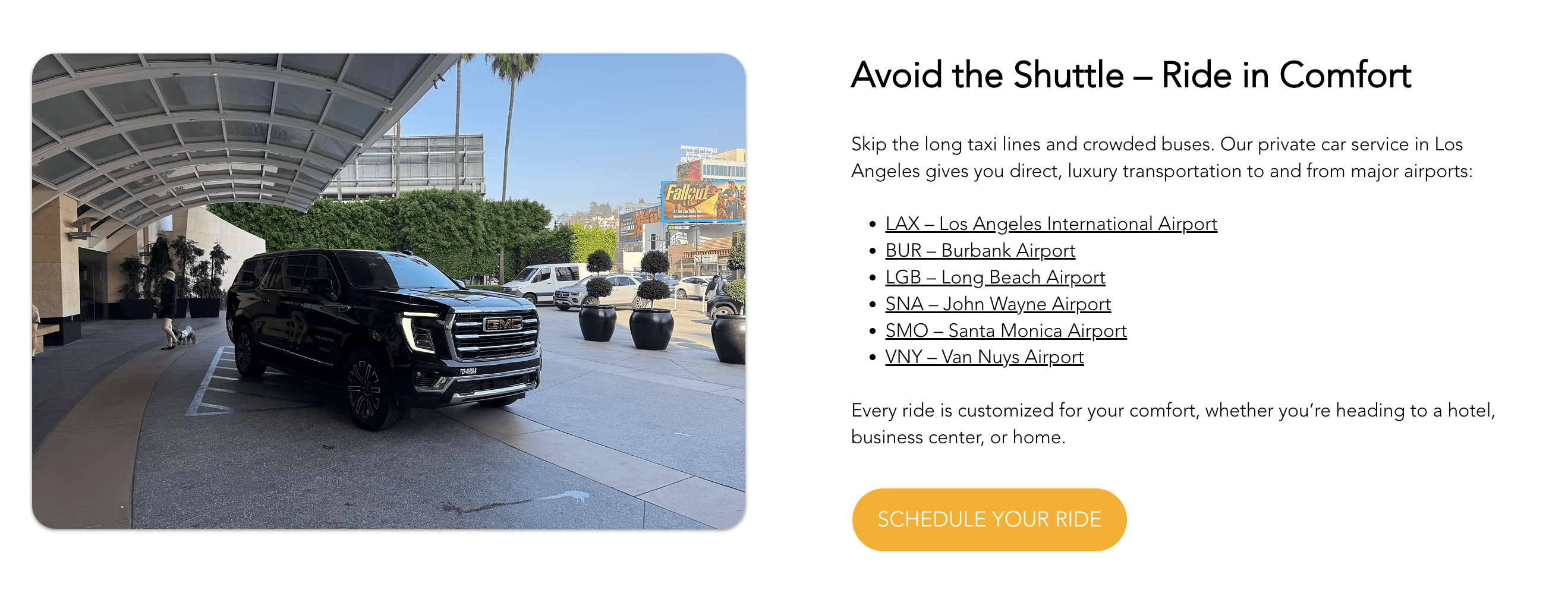
- Benefits (of course, you need to show why you’re a good choice).

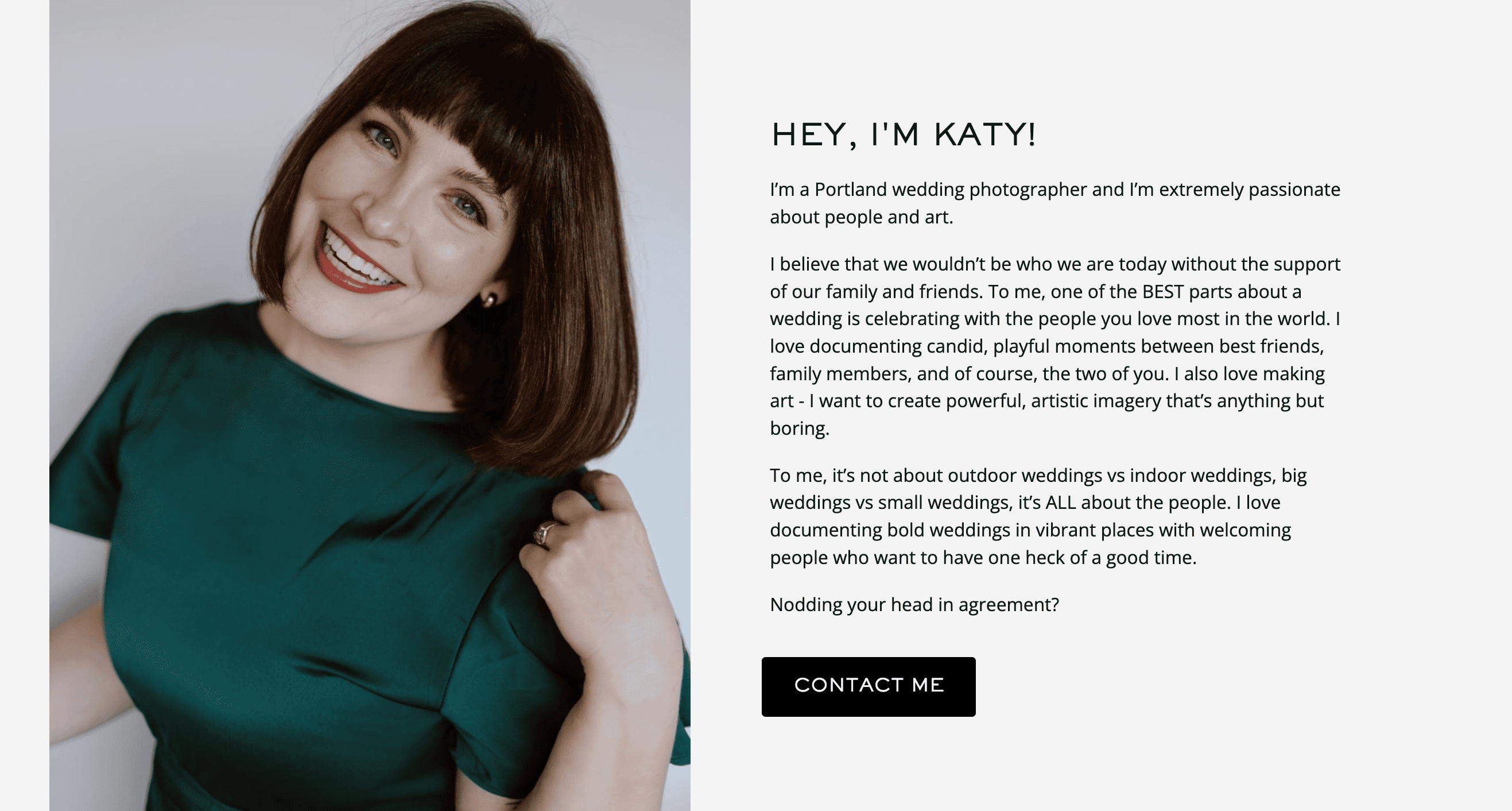
- About section (this is optional, but to achieve a personal connection, you might want to show your personality or tell your story).
- Clear CTA (if you want conversions, you have to make it clear).

Use customer testimonials and social proof
People trust other people. We bet it wasn’t the first time you've heard this:) But it’s actually true.
You can talk about how great your product/service is, but unless you have your clients’ words to back it up, it won’t bring you the results you hope for.
That’s why it’s important to add testimonials to your local landing pages.
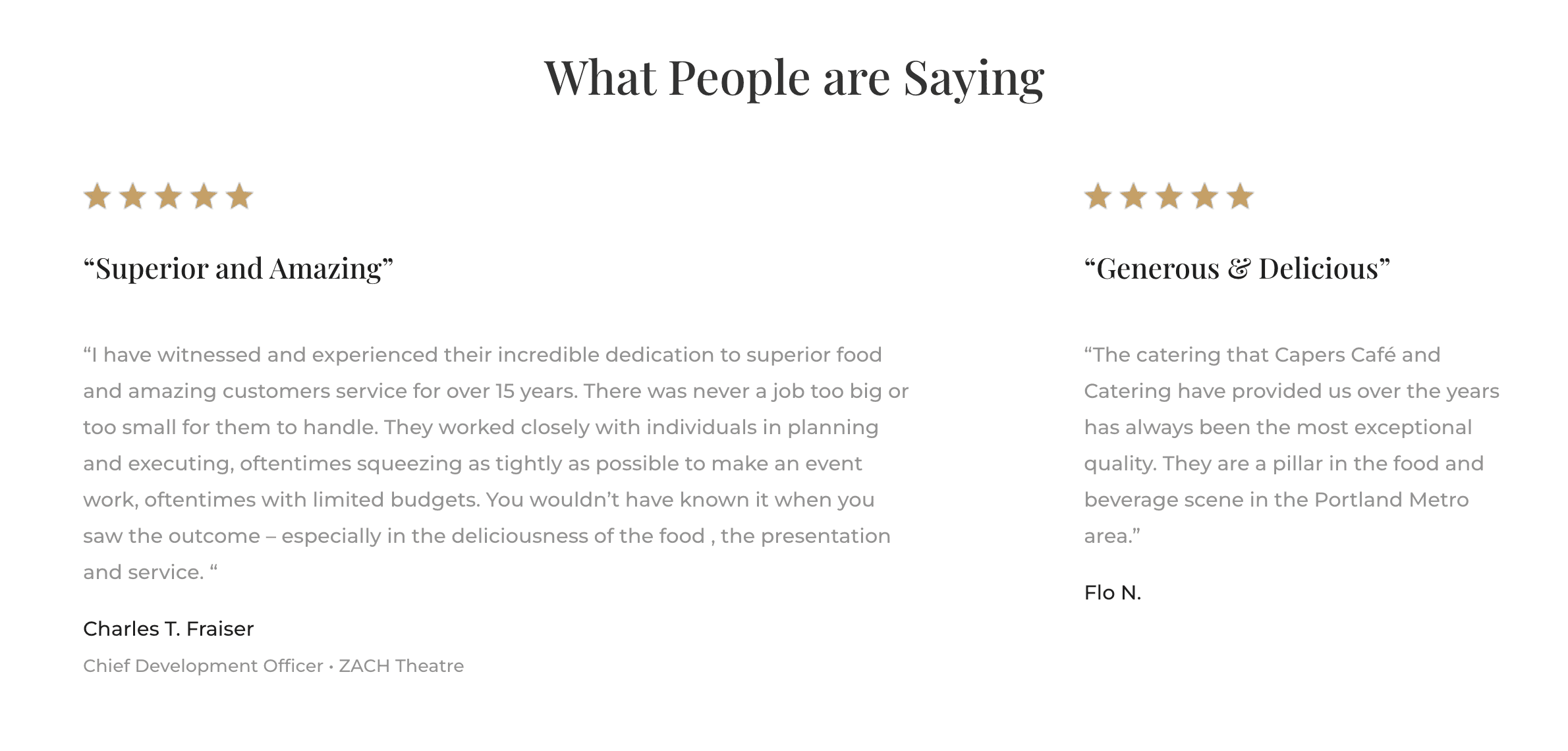
If you can, make them more trustworthy:
- Use video testimonials, as they are harder to fake.
- Add links to your customers’ social media (e.g., LinkedIn),
- Add actual videos from socials where people try your products,
- Add your reviews/ratings from trusted listing platforms (Capterra, TrustRadius, etc.)
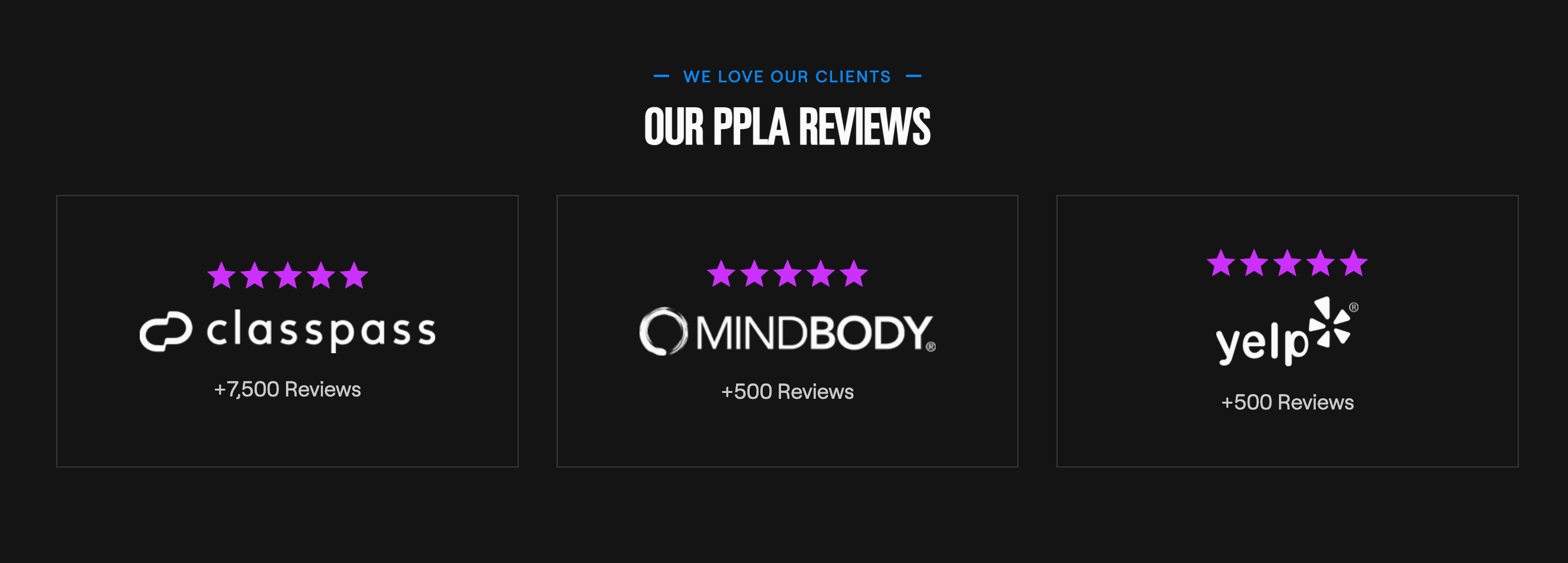
But if you wish, you can also add additional social proof.
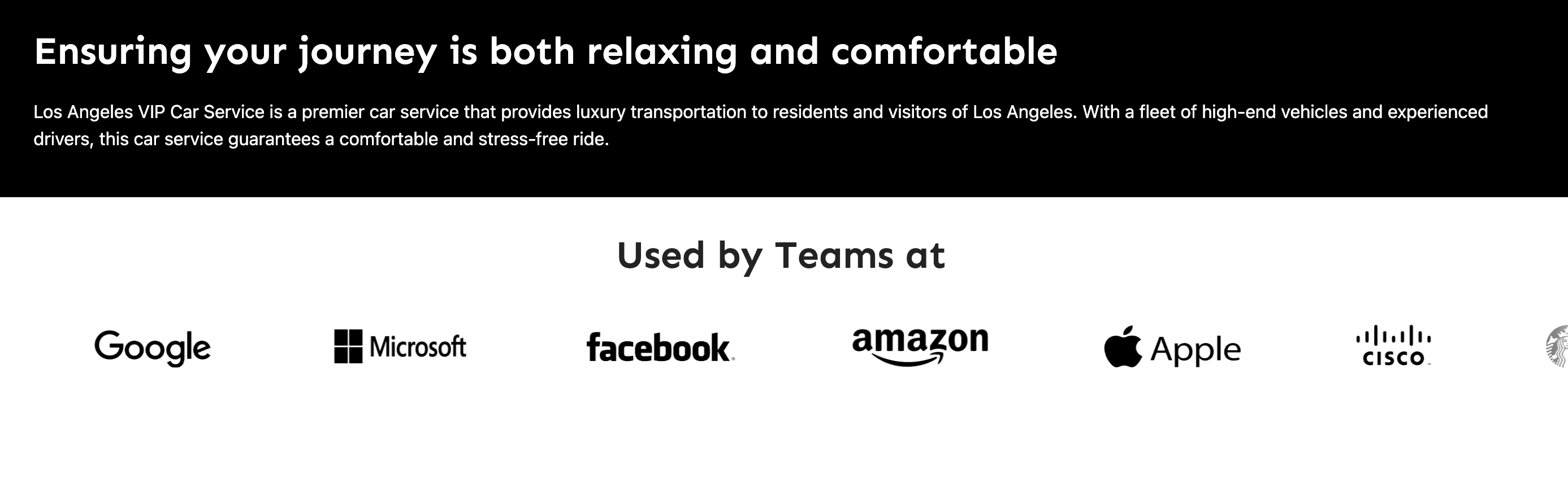
It can be, for example, media that mentioned you, specific rewards, relevant certifications, your big clients, etc. Ideally, though, you shouldn’t use too much space to talk about this. One narrow line with logos is more than enough.
Focus on “why,” not “what”
This is a classic mistake many local businesses make (global, too, for that matter).
Many companies start focusing on what they do, instead of writing more about why their target local audience actually needs them.
Let’s look at the practical example. Here is a page that focuses purely on “what”:
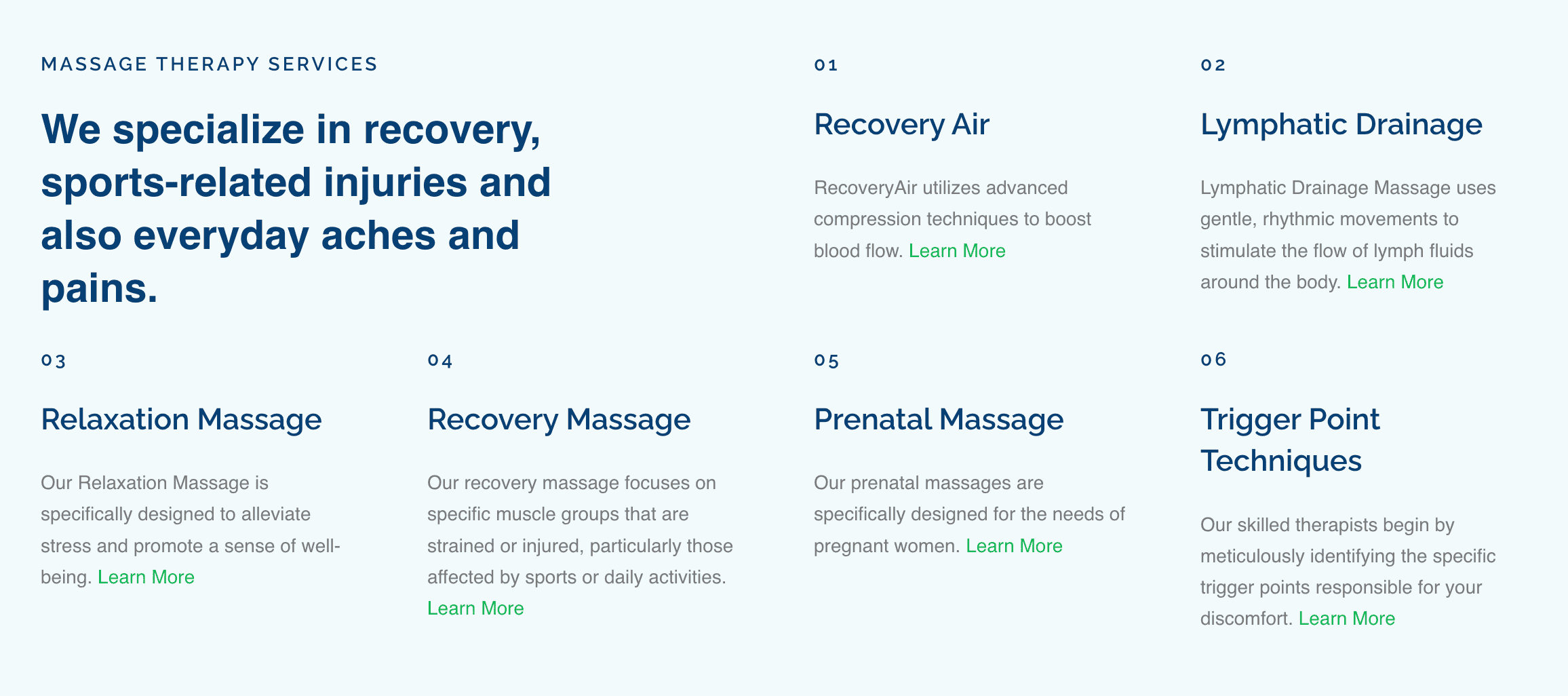
And here is the one that also adds at least a bit of “why” you should choose their services:
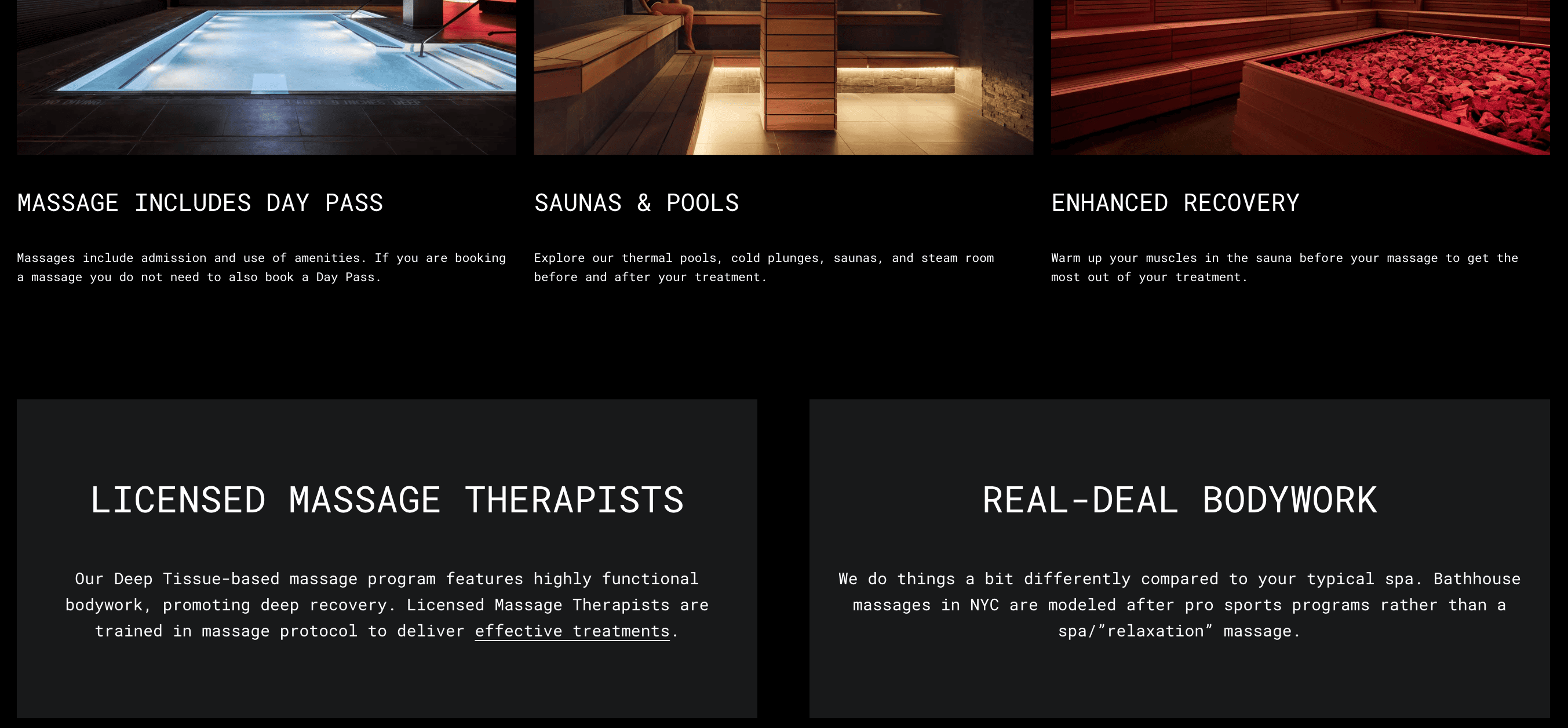
Which one do you think is more likely to convert? Exactly.
The “what” is mostly reserved for educational content. But when it comes to landing pages, you have to make it clear why your landing page visitors should even listen to you.
Make sure your CTAs are clear
If there is one point that conversion can’t happen without, it’s your CTA. But it doesn’t mean that you have to go all in with this one. More is definitely not better here. So, at all costs, try to avoid:
- Being vague. People have to clearly understand what you want from them.
- Using many different CTAs. It’s okay to have some related ones (e.g., “buy now” and “talk to our team if you have more questions”). But trying to get people to subscribe to your newsletter, book a call, and buy something, all at once, will just dilute your efforts.
- Being creative for the sake of it. You can be creative in your copy, but your CTAs have to be straightforward.
The main goal of your local SEO landing page is to convert people, to sell. So, your call-to-action needs to be easy to understand.
Here is, for example, a CTA on a website that organizes kids' birthdays:

And here is the one on the garden maintenance website:

See how direct they are?
That’s exactly what you want to get from your CTA. A generic “Contact us” also works, but try to make it more precise where possible.
Add an informative FAQ section
Let’s be honest, most of us add FAQs only as a way to add more target keywords that we didn’t fit through the copy. We get you:)
But when it comes to local landing pages, they can actually be useful for your audience. Here is a good example. These questions actually respond to the common doubts:
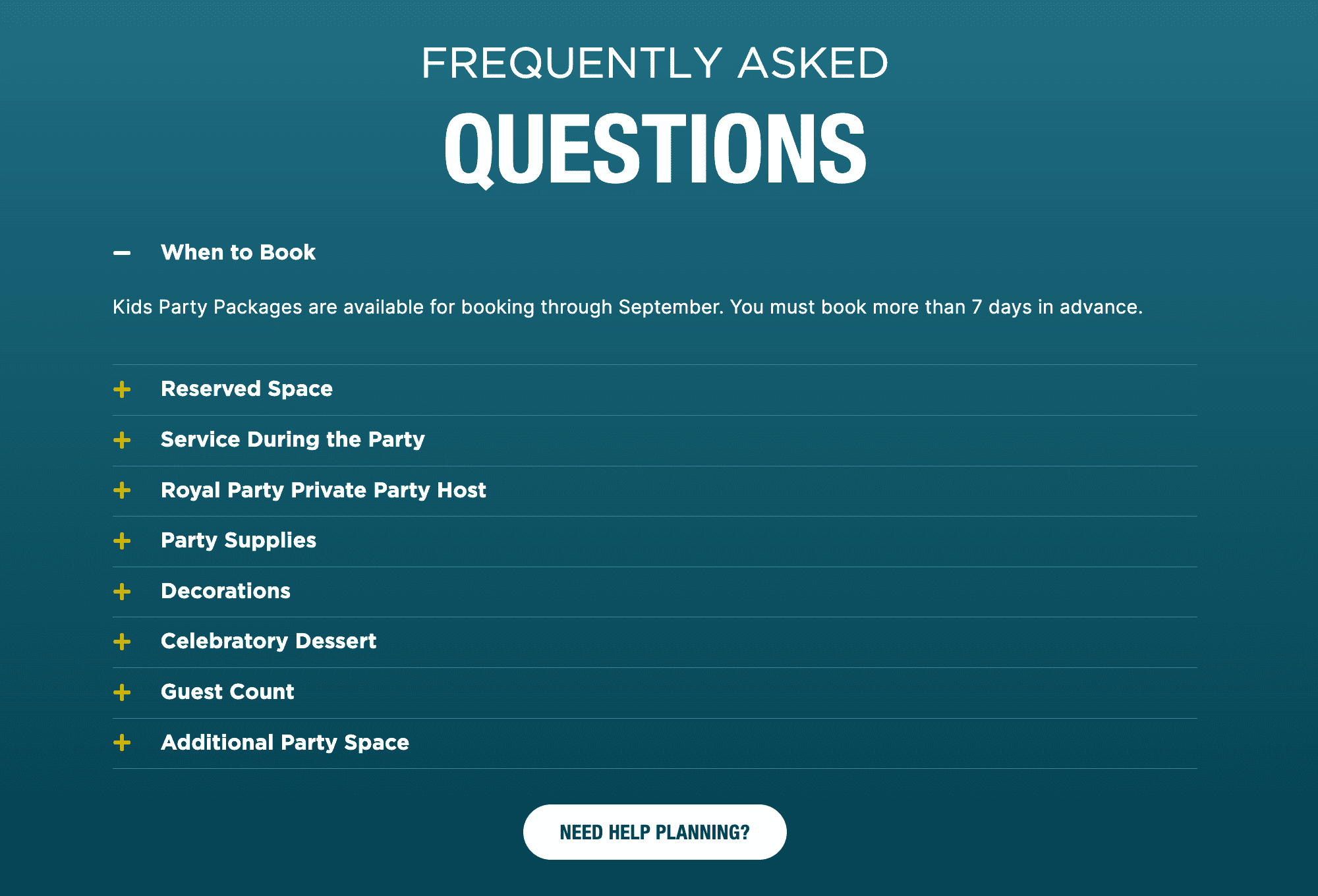
Some of the best things to add to your FAQ section are:
- Details on how to book your services,
- Where exactly you operate,
- Payment methods,
- And other doubts, questions your customers typically have.
BONUS: Consider adding a lead magnet (for non-urgent services/products)
Once your landing page is optimized, you’ll see some organic traffic coming in.
Some of that traffic will turn into conversions. But not all of it will. So, what you can do is use a lead magnet that can help you first build a connection with people, and sell whatever you’re selling later on.
What is a lead magnet?
It’s any asset (video, tutorial, checklist, etc.) that is really valuable for your target audience and that you offer for them to download.
When they download it, they use their email, and from there, you can help them move down the funnel with a smart email marketing sequence.
Here is, for example, how a dental clinic in Portland offers a free video consultation:
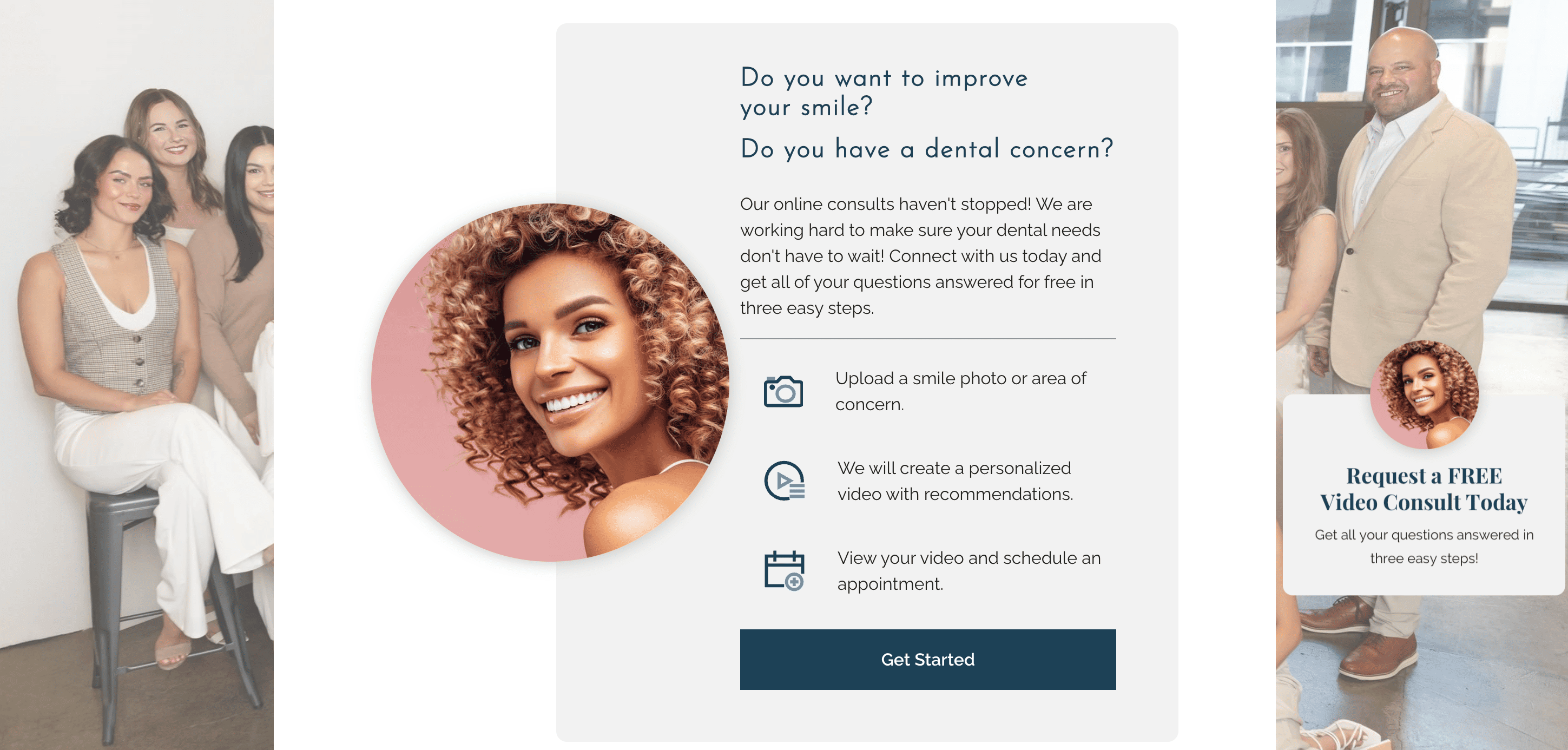
Before we get into the details, there is one thing you need to remember.
Look:
- If you’re a dentist and a person has unbearable tooth pain,
- Or if you’re a plumber and someone has a flooding emergency, ...
… your potential customers couldn't care less about your lead magnets. So, feel free to skip this step.
But if you’re a wedding photographer, a pilates trainer, a musician giving piano lessons, or a wellness retreat organizer, the local customers who visit your website have time.
And they usually use that time to explore their options. This is where your lead magnet could work and help you positively influence their purchase decisions.
What could it look like?
Ideally, you want your lead magnet to be so good that you could sell it for a small fee. So, it shouldn’t be just something random ChatGPT generates. It needs to be valuable.
When people see your expertise and all that value for free, they understand that your paid offering must be truly something. So, for example:
- If you’re a pilates trainer, you can offer a free video lesson,
- If you’re a wedding photographer, you can offer an e-book with wedding photography inspiration (with locations, poses, etc.)
- If you’re giving piano lessons, you could give a guide on the piano mistakes beginners make or film a tutorial with simplified popular songs.
There are tons of opportunities here. Just make it something your local audiences really need.
Conclusion
Now, you know that a local SEO landing page isn’t only about the name of a particular location. Effective local landing pages have many components.
But once you understand these basics, you’ll become almost unstoppable because these simple best practices will serve you for years to come.
All trademarks, logos, images, and materials are the property of their respective rights holders.
They are used solely for informational, analytical, and review purposes in accordance with applicable copyright law.

 Sign Up
 Sign Up