






SEO for Travel Website: 10 Proven Strategies to Increase Organic Bookings

The biggest paradox with travel websites is that they spend years helping people choose destinations, but rarely analyze how those same people arrive on their own pages. Digital discovery precedes the physical one, as before users book a trip, they go on another journey — through search results, comparisons, and content.
This article will help professional physical world guides tap into the full potential of digital discovery by using SEO for travel websites. From keyword optimization to Google AI Overviews optimization — only proven and conversion-focused strategies to increase organic booking and bring you more high-value customers.
What makes SEO for travel websites different from other niches
At first glance, it may seem like SEO for websites in the travel niche is not different from SEO in any other market niche. But that is just the first impression. The moment you start analyzing how traffic flows to and across a travel website, things begin to drift away from that expectation.
The main issue is how people behave. In travel, decisions don’t happen fast. People scroll, compare, open ten tabs, close eight, then come back a week later. Sometimes they don’t even know what they’re looking for at the beginning.
That changes how search works. It’s not just “find → click → convert.” It’s more like wandering. One query leads to another, and another, and suddenly the user is somewhere completely different.
So your website can’t just answer one question. It has to support that movement and keep people engaged. Otherwise, visitors just leave.
This is where SEO blends into marketing, whether you like it or not. You’re not just optimizing pages — you’re shaping how people move.
A few things that make this niche noticeably harder:
- Users change intent mid-journey, often more than once.
- One topic can branch into dozens of related searches.
- Seasonality constantly reshapes demand.
- Visual expectations are higher than in most niches.
- Big players dominate transactional queries.
If you treat it like a standard niche, you’ll probably still get traffic. But it won’t be enough to stand out in the intense competition of the travel industry, certainly not to outperform the big players that dominate transactional queries.
10 Key SEO strategies to improve travel website search performance
The following ten strategies stand out not because they promise quick wins on paper, but because they reflect how things actually work in practice. In SEO, especially in travel, execution matters far more than theory.
1. Optimize for high-intent travel and booking keywords
There’s always that temptation to go after the biggest keywords first. Feels logical. More traffic, more opportunities.
Except it rarely works like that. Keyword stuffing worked once, but it doesn’t work anymore. In fact, it can even harm your travel SEO, as search engines, and increasingly their more modern competitors — answer engines or AI chatbots — are becoming smarter and “understand” content the way the human brain does.
Moreover, a huge chunk of people using search in this niche are not ready to do anything yet. They’re browsing, comparing, sometimes just procrastinating in a productive way.
High-intent keywords sit on the other side of that behavior. Less noise, more clarity.
They usually look like:
- Queries that include some kind of action.
- More detailed destination searches.
- “A vs B” comparisons.
- Searches with dates, budgets, or limits.
- Slightly messy long-tail phrases.
Not the prettiest keywords. Not the biggest ones either. But the ones that perfectly align with what a user is currently looking for. Additionally, high-intent keywords always come with something useful — direction.
And direction tends to convert better than curiosity. It helps those users who hesitate to make a choice, ponder less, and act faster.
2. Earn backlinks from travel blogs and media publications
Just because everyone is talking about AI doesn’t mean we should abandon backlinks in SEO. On the contrary, their value remains strong, if not stronger than ever.
Why is that?
To drive visibility, boost authority, and rankings, travel websites still need backlinks. They need links from real articles that people read. And in the abundance of AI-generated fluff (content), high-quality texts with strategically positioned backlinks are more important than ever.
One of the most effective link-building tools available for everyone is blog posting. Publishing useful content on relevant travel blogs gives two benefits at once: a backlink that helps SEO, and exposure to an audience that already cares about the topic.
In other words, it’s not just a technical win — it’s a visibility win too.
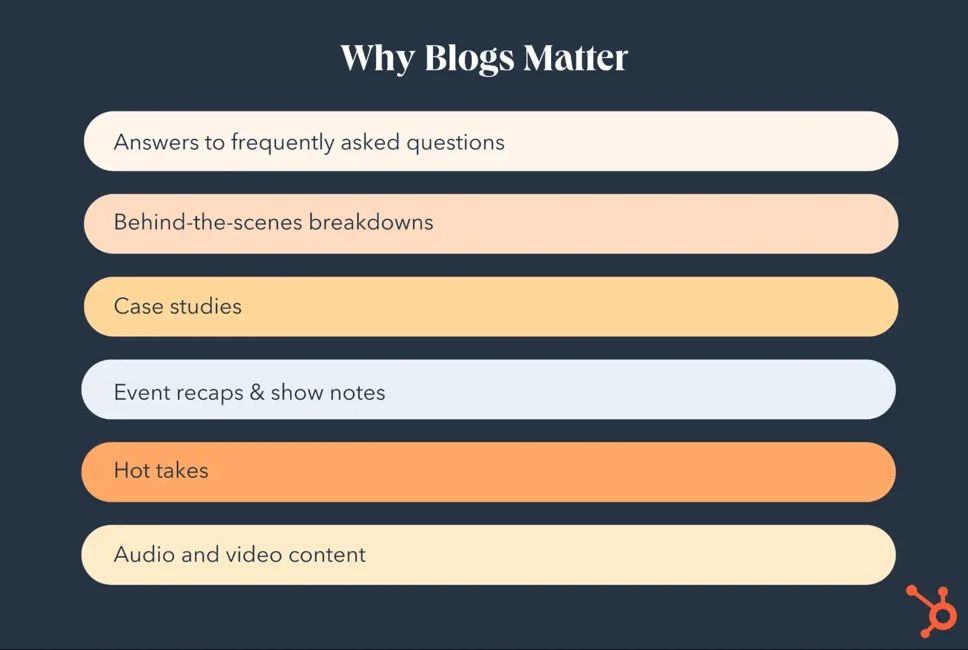
Additionally, you should consider running a blog on your travel website, as it has its unique advantages:
Source: Hubspot
The most efficient routine for earning backlinks is this:
- Cherry-pick blogs that already rank in the travel niche.
- Conduct thoughtful outreach (pitch topics that fit their audience, not just your brand).
- Include one or two natural links to helpful pages on your website.
When doing link-building, seek quality over quantity. For instance, prioritize relevance.
A link from a random website won’t do much in terms of boosting organic booking for a travel website. However, a link from a highly relevant, niche publication with real authority and trust among travel-minded visitors — that’s a totally different story. Positive for the travel resource that knows how to leverage it.
3. Create evergreen and seasonal travel marketing content balance
To stay visible and drive traffic, a travel website needs continuous content publishing. Everyone in the travel business understands that intuitively, but not everyone acknowledges and maintains a balance in published content types.
In reality, seasonal content usually dominates over the universal, or evergreen content. Travel blog editors and publishers tend to be highly active at seasonal traveling peaks, but when this seasonal buzz is over, they become too passive, i.e., rarely publish anything.
That’s why most travel blogs miss out on those customers who plan their holiday/vacation trips well in advance. They like to carefully weigh all the options and book trips long before the seasonal price spikes happen. Or they simply save money and go on a trip when the prices remain at their lowest.
Either way, the winning strategy for a travel website is to maintain a fair balance between seasonal and evergreen travelmarketing content. This can be achieved through:
- Building evergreen guides to core destinations.
- Adding those guides and articles around peak travel periods.
- Linking seasonal pages back to evergreen ones.
🎯 Pro tip: Oftentimes, simply updating old content does miracles to a travel website’s visibility. Update your old seasonal post with the current prices, tourist destinations, new photos, videos, etc. This helps ranking and keeps your audience engagement high.
4. Build location-based content marketing clusters around destinations
If you check out five random travel websites, you’ll notice that most of them emphasize standalone pages. That is, one destination, one article. Popular destinations get covered first, while anything that is located at the outskirts of them becomes covered only sporadically, at best.
This approach works… but only to a point. The problem is depth. Travel decisions are rarely based on one question.
Modern travelers are finicky; they’ve seen it all and want something extra, something that naturally adds up to their favorite destination. But popular tourist websites don’t give that to them.
Clusters are a way to fix this discrepancy and to expand that topical coverage within your marketing efforts. Instead of one page, the content is grouped around a location. Different topics, same destination, or slightly different destination, but all linked together.

Source: Lifeinnorway
This captures more prospects and brings more clients. They cannot find this topical depth on the websites of your competitors; thus, they come to you and most likely stay on your site and become your long-term clients.
Here is a simple setup for a location-based content cluster:
- Create a core destination page.
- Add several activity guides.
- Make sure to split by budget and itinerary content.
- Publish seasonal posts to capture seasonal demand peaks.
- Grow and expand to encompass nearby alternative destinations.
Each page adds more context, and search engines pick up on that. Users always follow. And instead of bouncing, people keep clicking. Their activity on your site becomes visible, and it's the best sign that your topical structure is working.
5. Leverage user-generated content for trust and freshness
People trust people. Not websites, marketing campaigns, or ads. That’s especially true in travel.
A guide can say a destination is amazing. An AI-generated text can be several times more vivid and detailed than one written by a human writer.
But readers always spot the differences, and they rarely trust promotional posts. Picky readers would scroll down to check reviews, comments, or someone’s actual experience.
That’s where user-generated content (UGC) becomes useful. It adds an additional layer that polished content can’t fully replicate. It’s authentic and more engaging than any promotional text could ever be.
Take this simple UGC setup that always works well:
- Add real traveler reviews to destination pages (not one or two, but ten or twenty, at least).
- Include short user tips in your website texts.
- Use real photos from visitors in each major destination and all connected posts.
- Allow feedback or comments under each article.
- Keep updating content with new user input (reviews, photos).
This builds trust naturally. And it keeps content fresh without constant effort. With a proper UGC system in place, brands often get significant visibility boosts without ever taking any direct action or spending a cent on ads.
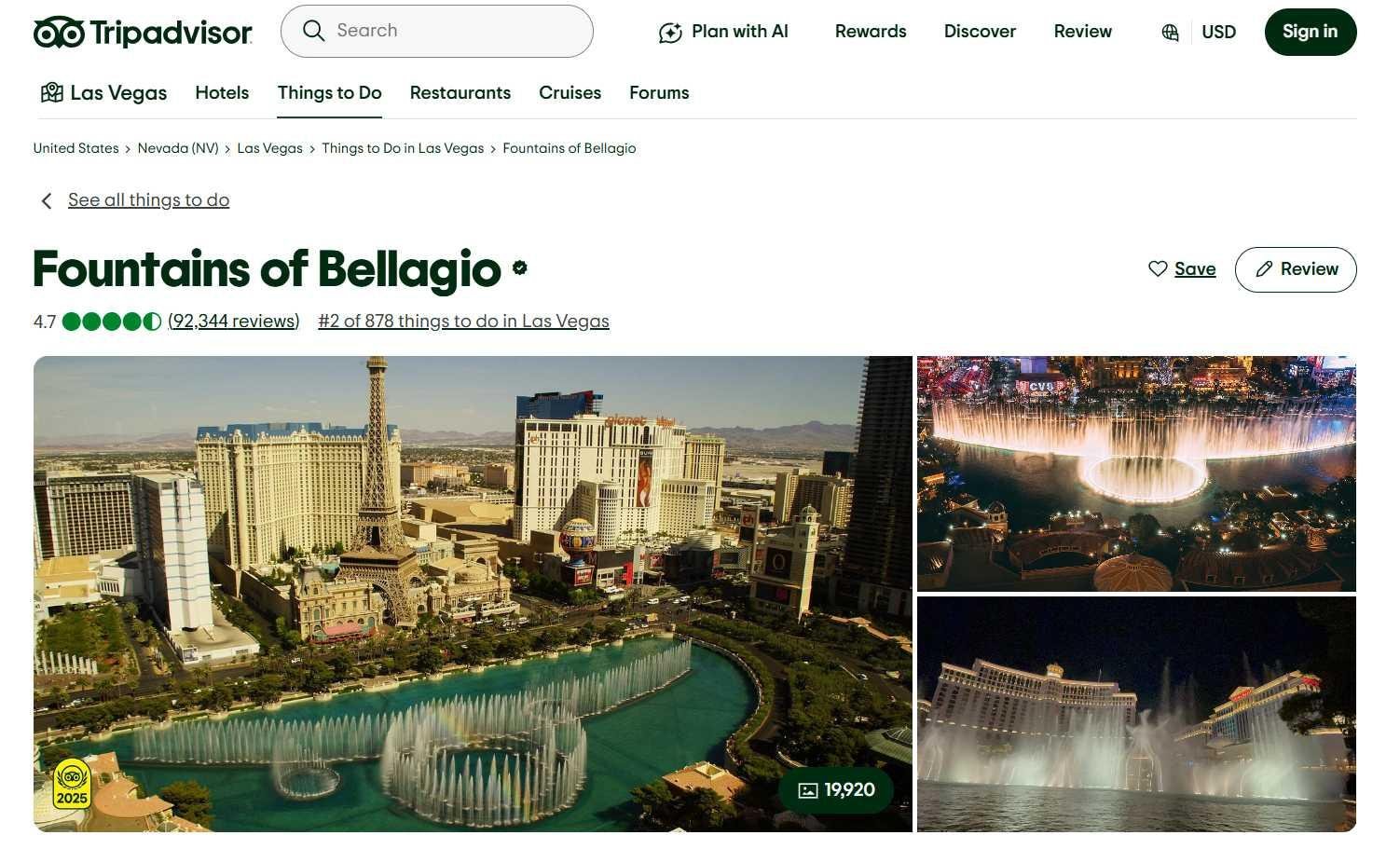
For instance, simply placing a link to a popular user review resource, e.g., TripAdvisor, next to a tourist destination on your website, will give users an opportunity to explore places on their own and get inspired by what other people enjoyed seeing:
Source: Tripadvisor
With UGC, instead of static pages, the website starts to feel more “alive.” And that’s usually a good SEO signal for search engines, and users as well, who always follow after search rankings increase.
6. Implement structured data for travel-specific entities
Structured data is one of those things that many travel websites ignore. Not because it’s useless, but because it’s not obvious.
Users don’t notice it directly. You don’t “see” it, since most travel website owners and administrators are not technical or SEO people; they are creators, artists, and visionaries.
So structured data gets pushed aside. But search engines do notice it. Or to be more precise, they notice the absence of such data when your site appears to their search algorithms as disorganized and lacking clear signals about what your content actually represents.
A travel site is full of specific things — destinations, hotels, tours, and reviews. To a person, it’s clear. To a search engine, it’s just text unless you help it.
Structured data helps define that. With it, you basically explain to search engines like Google what each element is.
Structured data on a travel website typically includes:
- Destinations and locations.
- Hotels and accommodation details.
- Tours and activities.
- Ratings and reviews.
- FAQ sections.
Nothing complicated here. The goal is clarity for people and for search engines. When Google better understands your pages, it handles them differently. Sometimes it shows in richer results. Sometimes, just a better interpretation.
The most common difficulty is that you won’t see instant results from implementing a certain element of structured data. But over time, when you ensure all of your website is well-structured and organized, this setup removes confusion. And that alone is already useful.
7. Strengthen internal linking across destinations and services
Internal linking is one of the essential on-page SEO elements, helping connect topically relevant content within a single website.
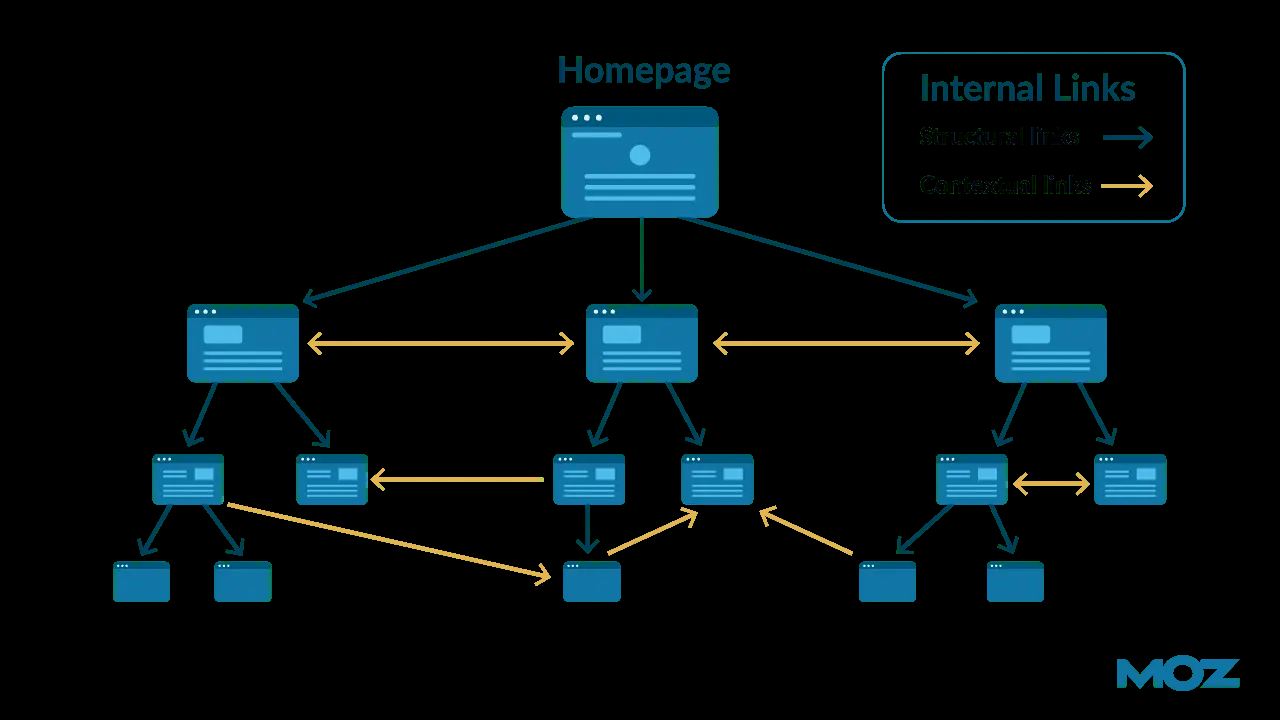
In the tourism niche, it’s when you interlink several posts on a common destination. SEO practitioners distinguish two large groups of internal links: structural and contextual.
The first helps connect topics hierarchically, while the second is responsible for horizontal, or contextual interconnections between related topics (e.g., tourist destinations).
This illustration by Moz helps to understand how these two types of links coexist:
Source: Moz
Among other things, Internal links help websites organize content clusters that we have discussed earlier, in strategy #4.
That’s an ideal picture, favorable for SEO and online discovery.
In reality, most website pages exist on their own. You open one, read it, and… that’s it. Nothing really pulls you further.
That’s not how people explore travel, though. They jump between options. Compare places. Places they’ve been to and places they’ve never visited. People look for something nearby. Something better. Something easier. Or cheaper.
If your pages don’t guide that, users go back to search on the open web. And that’s usually the end of their session on your website.
You can easily fix this by linking destinations to nearby locations and connecting guides with itineraries and services.
One key success factor is to add links inside the text, not just at the bottom. Another one is to keep links relevant, not forced. And don’t turn pages into link dumps, with too many links (which looks artificial and forced, scaring visitors away).
The result? Instead of leaving, the user keeps moving inside your site. They discover more related destinations until they find an ideal option.
8. Optimize for Google AI Overviews and answer engines
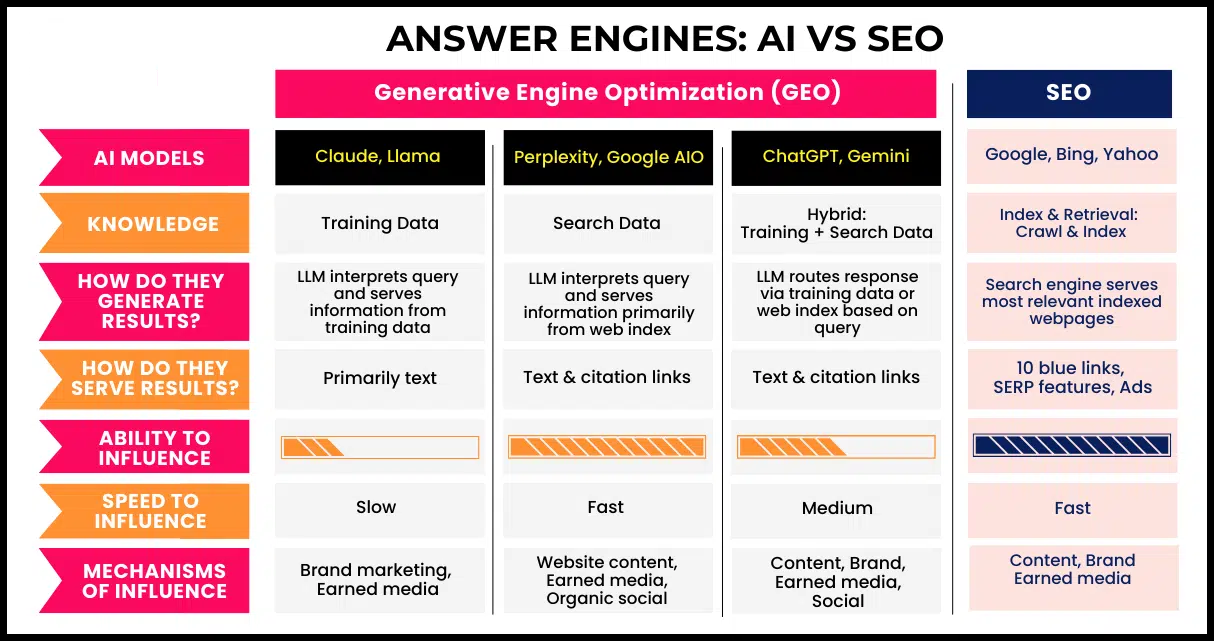
Have you noticed? Search is changing. More and more people prefer writing their queries in conversational style to the so-called answer engine, i.e., AI-powered chatbots like Gemini, ChatGPT, and Claude.
Experts talk about zero-click search experience, when, instead of analyzing multiple search results in a conventional search engine, users opt for AI answers. In Google, for example, this is called AI Overviews.
Source: Searchengineland
Recently, Google has begun testing its new, enhanced AI feature called “Dive deeper in AI mode”, giving users the option to continue a conversation with their most advanced AI model.
And yes, this affects SEO.
Because now it’s not just about ranking. It’s about being used in the AI-generated answer.
That changes how content should be written.
If you want your travelwebsite content to be featured in chatbot answers, you should ensure the following:
- Clear, direct explanations.
- Short paragraphs that are easy to extract.
- Lists and structured answers.
- Simple language, no overcomplication.
- Content that actually answers the query.
AI pulls content that is easy to understand and easy to reuse. Long and vague paragraphs usually get ignored by AI models.
This doesn’t mean rewriting everything. It means adjusting how information is presented. Focus on entity information (like brand and people’s names, locations and places, concepts, etc.), which generative answer engines use to understand your content.
Everything mentioned above contributes to one common goal. And this goal is not just to appear in search results, as it was the norm for the past several decades. It’s to be selected by AI algorithms. The task is more difficult now, but it’s doable.
9. Improve page speed and mobile experience for travelers
The speed of navigation is commonly taken for granted by modern users. When a website opens instantly, nobody really notices. However, when a page lags, freezes, or worse — doesn’t respond for a few seconds — visitors leave.
That’s the reality of the modern web. And it's especially true for mobile, where, as a rule, mobile processors are more advanced than their stationary counterparts, RAM is also faster than on laptops, so mobile users are spoiled. They expect an instant response to their taps on website elements.
Your primary goal is to ensure the top speed of your travel website. Without it, even great content and an award-winning design won’t matter.
Here are a few basics that make a difference:
- Optimize images (travel photos are heavy), as they attract more attention than text.
- Reduce unnecessary scripts and elements that overcomplicate your pages.
- Make buttons easy to tap (ensure the size is right for mobile users).
- Avoid pop-ups that block content (users hate pop-ups; use them only when absolutely necessary).
🎯 Pro tip: Test every website element. The time you spend now will save you lots of clients. Ideally, if you can involve a small team, ask them to use the site for a day or two. Also, tap every button yourself — if it feels slightly off, users will notice it too.
10. Localize content for different regions and languages
In SEO, this procedure is called translation and localization. While translation doesn’t normally cause any questions (translating content into the world’s languages), the second part — localization — is usually less understood, and less practiced.
Localization is the process of adapting content to different regions and countries so that it actually makes sense to search engines and users alike. It’s not only about adapting words, as many mistakenly believe, but much more.
Here are the typical content elements that require localization on travel websites:
- Language, phrasing, idioms, etc. (not literal translation, but cultural adaptation, as the same words can be taken differently in different countries and nations).
- The keywords people search for (people search differently in each country).
- Currency, pricing, units (km, miles, €, $).
- Cultural elements (jokes, anecdotes, national heroes).
- Images and visuals (yes, even these).
- Date and time formats.
In 2010, Walmart entered the German market with its standard US-made marketing campaign. However, what worked well on the local US market turned out to be a disaster in Germany.
Walmart personnel present in local German groceries were instructed to smile at all visitors at all times, they greeted people on entrance, and packed grocery bags for them.
These behaviors were met with frustration by the local customers. Small talks in German grocery stores are rare; people smile much less often than in the US, and packing bags is the responsibility of customers (Germans are pedants by nature — if there is a widely accepted rule/responsibility, they follow it strictly).
As a result, Walmart's marketing campaign failed, and the company’s reputation was seriously damaged, followed by reduced sales and profits.

Source: Medium
Conclusion
Travel websites require SEO as much as any other business niche. Perhaps even more so, because travel is the kind of niche that depends heavily on the trust of picky customers. This is especially true at the startup stage, when initial sales often determine the success of the business model for years to come.
Effective SEO helps travel businesses boost online visibility, drive more high-quality traffic, and increase organic bookings. A good SEO strategy also indirectly sustains a website’s positive reputation by building authority and enhancing user experience, consistently meeting their expectations on the website’s speed, responsiveness, and mobile optimization.
Keyword optimization, link-building, evergreen content, and other traditional SEO strategies are important here, but in the age of smart answer engines like Claude and ChatGPT, ensuring easily retrievable, reusable, and entity-rich content is paramount.
The implications? Instead of competing for a higher position in SERPs, your website should aim for a spot in AI-generated answers. This is a new, zero-click search reality, where users prefer long-form conversations with chatbots to browsing search results.
All trademarks, logos, images, and materials are the property of their respective rights holders.
They are used solely for informational, analytical, and review purposes in accordance with applicable copyright law.



 Sign Up
 Sign Up