






Tom Demers Interview: “Don’t Chase Clicks Lost to Zero-Click Search”
This interview is one of the most useful reads for any business that is:
- Losing traffic to zero-click search,
- Unsure which content is still worth creating,
- Or struggling to turn SEO into actual leads.
Tom doesn’t just explain what’s changing.
He shares the frameworks he uses to improve content and strengthen conversion paths.
It’s especially valuable for B2B SaaS companies that want to generate more than just clicks and build a stronger SEO and AI visibility strategy.
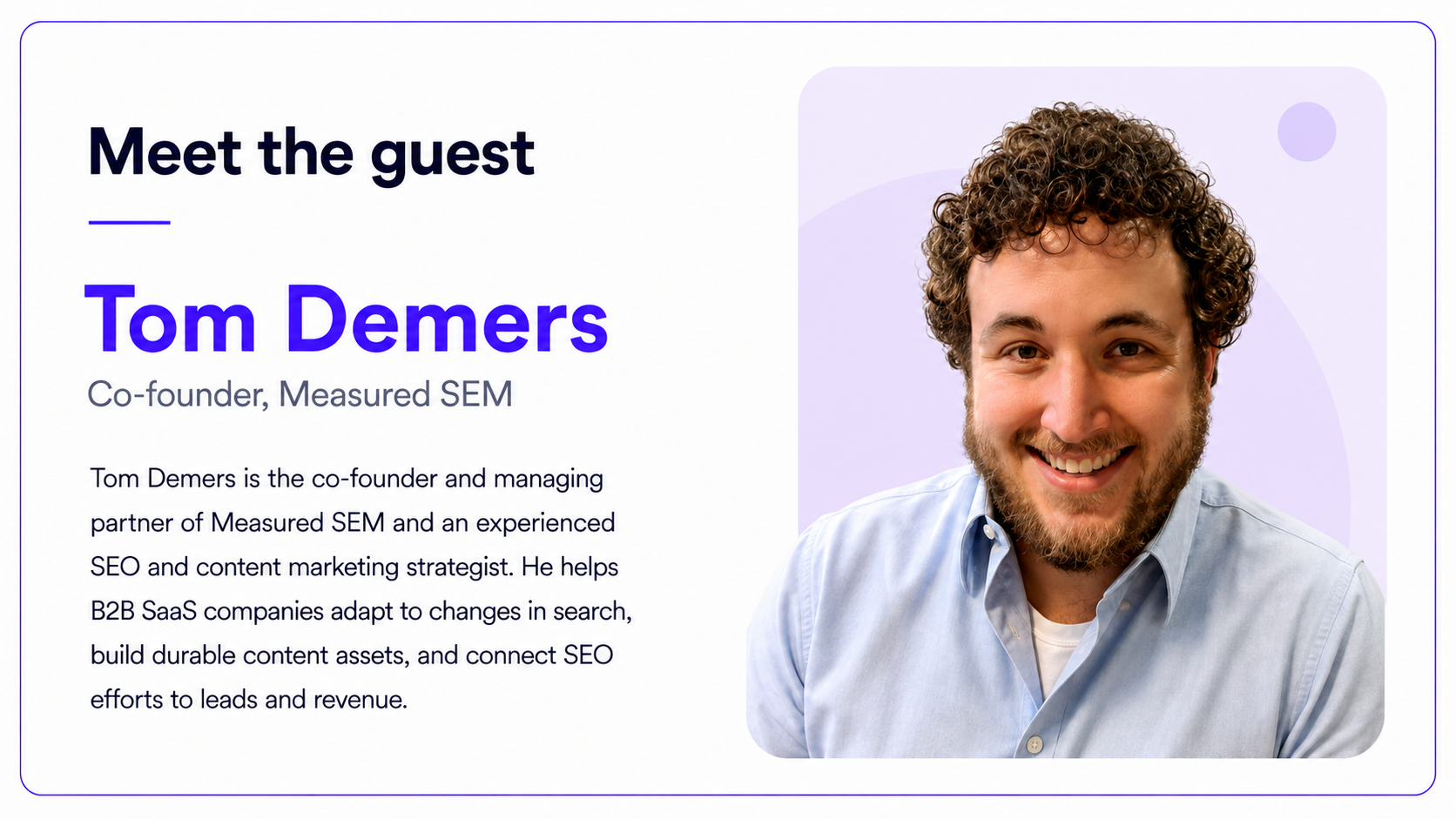
You can learn more about Tom’s work on Measured SEM or connect with him on LinkedIn.
AI search impact on SEO
AI search itself hasn’t changed SEO that much.
The approach to SEO has changed because of the way Google has changed:
- The things that are ranking,
- The amount of search real estate available to you now with AI Overviews,
- The way Google has emphasized information gain, content effort, site radius, and topical authority.
But one real change is the way businesses should approach AI optimization.
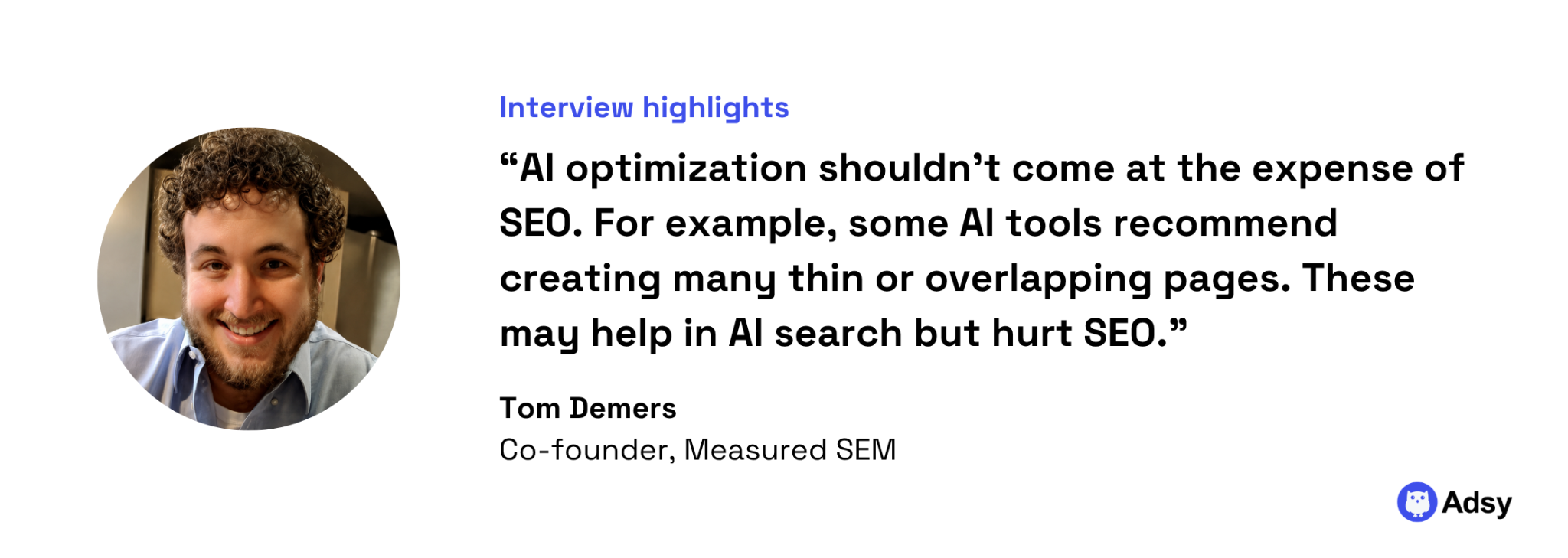
AI optimization shouldn’t come at the expense of SEO.
For example, some AI tools recommend creating many thin or overlapping pages. These may help in AI search but hurt SEO.
So, it’s important to be thoughtful about what content you're creating and how you're allowing it to be crawled and indexed.
AI search impact on content
With AI search, many content types require you to think differently about what you put on the page.
'Best software’ posts, comparison pages, and alternatives content may not lead to direct AI recommendations, especially for smaller brands. But they can still shape how LLMs describe your company, earn citations, and sometimes position you as a recommended option.
That’s why even though they might not influence AI recommendations, it’s still useful to publish them both on your own website and on relevant third-party sites.
Original research and statistics are also becoming more important.
This is not new. These things have always helped content earn citations and visibility.
But there is now much more emphasis on them, especially because they are also becoming more valuable for SEO.
Another thing that matters more is documentation.
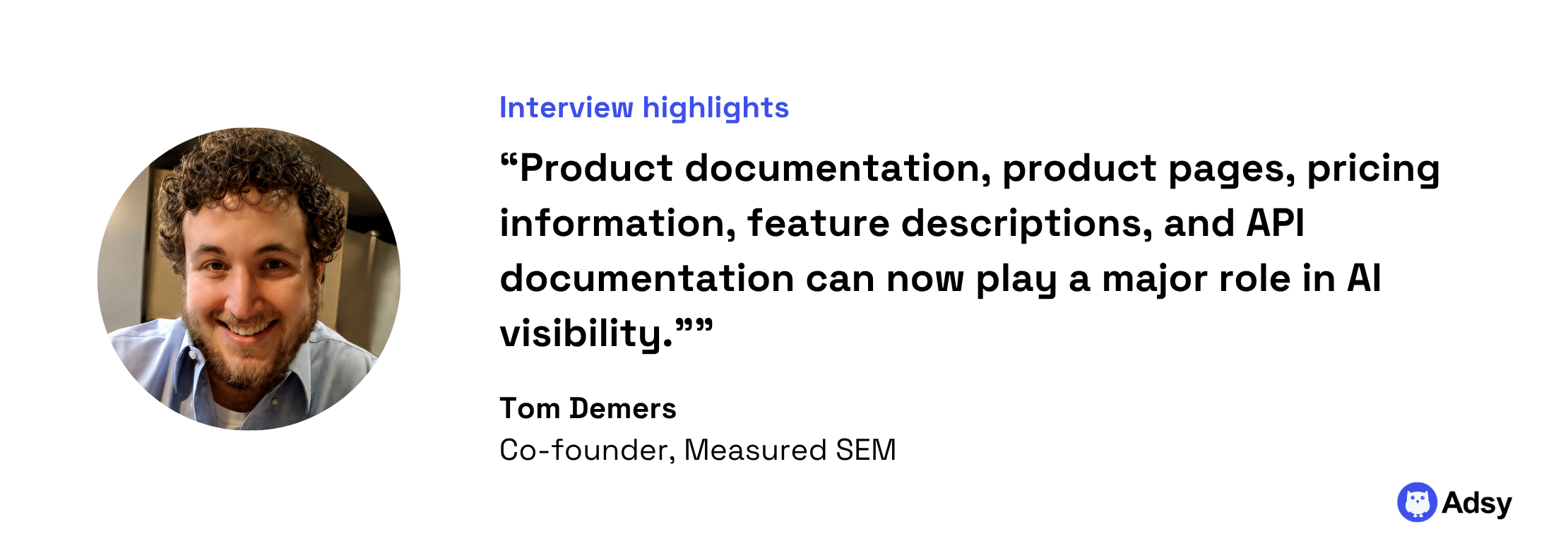
AI search has made some B2B content types far more important than they were in traditional SEO. This is especially true for technical B2B companies. Product documentation, product pages, pricing information, feature descriptions, and API documentation can now play a major role in visibility.
For example, someone using Claude Code or Claude in a work setting may ask, “What is the best keyword research API that costs less than $99 per month?”
This means that:
- Your pricing, features, and API details must be clear and easy to understand.
- You should explain exactly what your product does, who it is for, and what it costs.
- Your content should also answer the related questions that may appear during the search process.
- The structure should be clear, divided into useful sections, and easy for AI systems to interpret.
Most common SEO challenges B2B companies face (+ their fixes)
SEO traffic is flatlining or dropping
The B2B companies that had previously done the best with SEO are often the ones getting hit the hardest now. Because they'd been thriving with top-funnel pages that were comprehensive and covered the subject, but were commodity content.
For example, imagine a company writes a "what is a CRM?" article.
They talk a lot about CRMs, comparing CRMs, maybe even the history of CRMs, but they don't necessarily add any unique data points. They don't add interactive elements on the page. They don't add custom visualizations. They might use stock photography.
It's content that isn't differentiated from their competitors or from what AI could crank out.
If your traffic has dropped because you were publishing commodity content, the solution is to build in proprietary data and expertise, have a subject-matter expert be the author of that content, weave in your stories, write from a first-person perspective, and build custom tools.
So, we often use things like scorecards, evaluations, and interactive tables that are all based on the client's expert perspective and their own process.
AI visibility and impact tracking
A ton of B2B companies have the same problem: not knowing how to get more visibility in AI responses.
But there are a couple of core challenges underneath this larger problem:
- It's difficult to determine the specific prompts you should be tracking: There are a lot of AI visibility tools. And they can be misleading. If you track only prompts where your brand already performs well, the dashboard may look great. But you might be making no progress in the new areas you actually want to grow.
- Traffic fluctuates based on what LLMs do, not necessarily on your visibility. You might see a traffic surge or a traffic drop and think, "I guess we're getting a lot more or a lot less visibility." But actually, it's just that ChatGPT stopped including links in branded mentions as much, or stopped linking to specific page types that used to drive traffic for you.
- There's a visibility and a branding component to AI search that wasn't as important with SEO. If I ask an AI tool to make a recommendation, it could recommend my product but not link to me directly, and pick me as the winner and recommend that someone use my product. That person then goes to Google, types in my brand name, and gets to my site. So direct or organic traffic is getting the credit, but not AI search.
To be honest, there's no clean and perfect solution to track AI search yet.
The best approach is to combine several methods:
- Track relevant prompts that reflect your priorities and the ICP you're trying to reach.
- Set up tracking that captures traffic and leads coming directly from ChatGPT, Claude, Perplexity, and other AI tools.
- Add a “Where did you hear about us?” dropdown to your forms (yes, what's old is new again). If they choose one of the LLMs, follow up with "What prompt did you use?"
- Review leads who found you through LLMs, as well as qualified leads from direct traffic. Then contact them and ask which prompt they used.
It's imperfect data, but unfortunately it's the best we have right now.
What type of B2B content is still worth creating
I think the most valuable content types now are:
- In-depth studies, "State of" content. So if you're in the CRM space, the "State of CRM" type of content: deep-dive studies, surveys, proprietary data you can expose.
- "Best X for Y" content, "X versus Y" content, and "X alternatives." Even if it won’t get you recommended directly, it’s still useful.
- Specific-problem content, like "how to solve X problem.” This is especially useful if you can find problems within your core competency and answer the question with expertise and some interactive elements.
- Video content. It's getting picked up a lot in AI search.
- Templates, tools, and sample reports. If you can build templates, tools, and sample reports that are based on your expertise and your personal process, those are still really valuable and very effective.
One of the things we're doing a lot, and finding a lot of success with, is building out individual tools for almost every page. We'll also try to find some proprietary data point that our site (or our client's site) has, which again adds that information gain.
Almost every content piece we create has some interactive elements, some custom visualizations. Then we'll aggregate those tools, which are hosted across a bunch of different pages, onto a free-tools page.
And the same types of content off-site are still really valuable too.
Links are important. Citations are even more important than ever. So finding ways to get your content distributed in lots of places is a must.
Driving traffic vs. improving AI visibility
I can definitely tell you that the focus of most C-suite executives right now in B2B is more on AI visibility.
And of those two, I'd probably answer AI visibility as well.
I never would have said that historically.
I'm kind of an old-school SEO and search marketing practitioner. I’m someone who ignored metrics like impressions and view-through conversions for a long time.
I never would have thought I'd hear myself say, ‘AI visibility over traffic.’ But right now, a lot of the traffic numbers you're seeing for SEO and AI aren't super helpful.
A lot of the SEO traffic losses are for top-funnel terms glossary-style "what is X" terms that don't convert as well as low-to-mid-funnel terms.
And a lot of the traffic numbers from AI tools are almost irrelevant, because the landscape is changing so quickly.
You might have had a ton of traffic two months ago, lost all of it this month, and get a bunch back in two months. All that just because ChatGPT changed the way it links to sites.
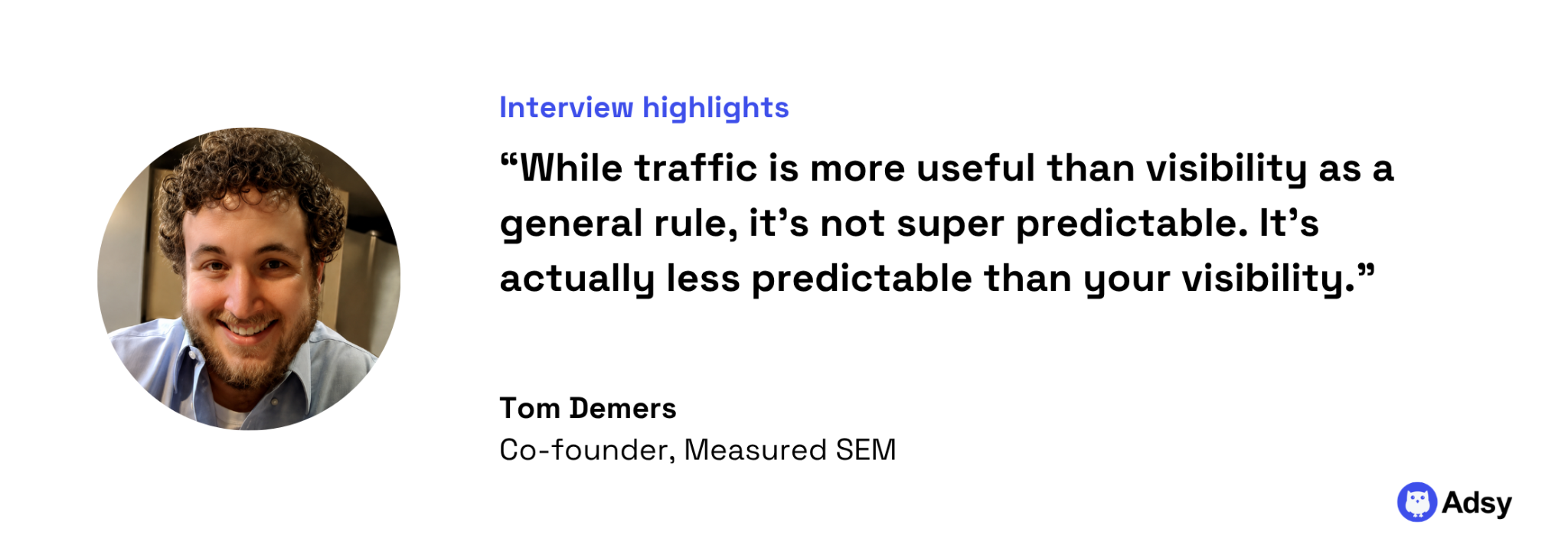
While traffic is more useful than visibility as a general rule, it's not super predictable. It's actually less predictable than your visibility.
Even though visibility is pretty swingy too and can change significantly from prompt to prompt and user to user.
So if I had to pick between the two, I'd actually say AI visibility.
But I'll add a caveat and cheat on this question again by saying the real answer is C: leads and sales.
A big challenge for companies is getting good at measuring leads and sales from AI specifically. But getting better at it is going to be an incredibly important thing for marketers to stay on top of.
Losing organic traffic to zero-click searches: Fix it or shift focus?
You shouldn't chase lost traffic where the loss is the result of zero-click searches and your content getting shoved down the page. In most of those instances, that traffic just isn't coming back.
What we frequently find is that the sites where this was a big pain point are sites that had a lot of top-funnel informational content that was performing really well and is now performing much worse.
Often, these sites weren't creating a lot of mid-to-lower-funnel content. And they weren't optimizing that content for search engines and certainly not for LLMs or AI tools.
So, they actually have a great opportunity to drive more leads by optimizing that mid-to-lower-funnel content.
But here is another thing: a lot of times right now, sites are writing off traffic losses as, "Well, we're just losing traffic to AI Overviews."
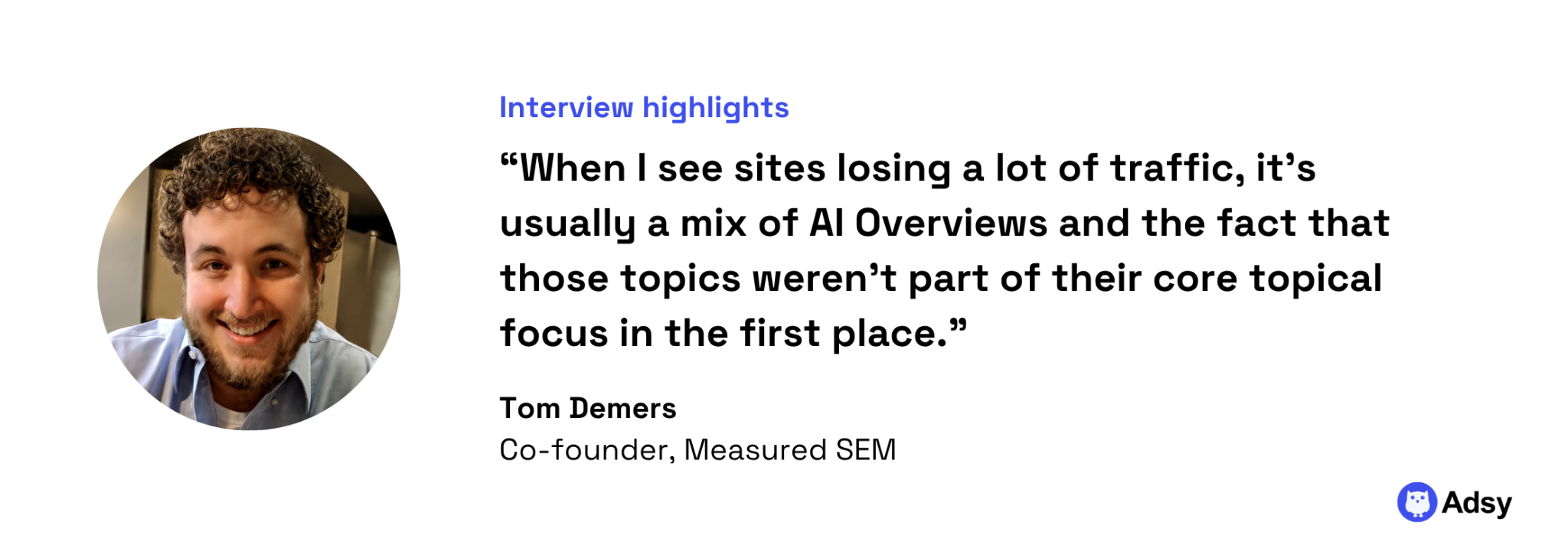
When I see sites losing a lot of traffic, it’s usually a mix of AI Overviews and the fact that those topics weren’t part of their core topical focus in the first place.
If you're losing traffic because the content is outside your core topical area, I’d recommend this:
- Avoid chasing that traffic by saying, "We're going to spend a ton of time updating this page and trying to get it to rank." You'd often be better off spending that time elsewhere.
- Pivot those articles into your core topical area by almost pinning a core topical focus onto that broader, off-topic content.
Content refresh vs. creating new content
One of our core focuses right now is that:
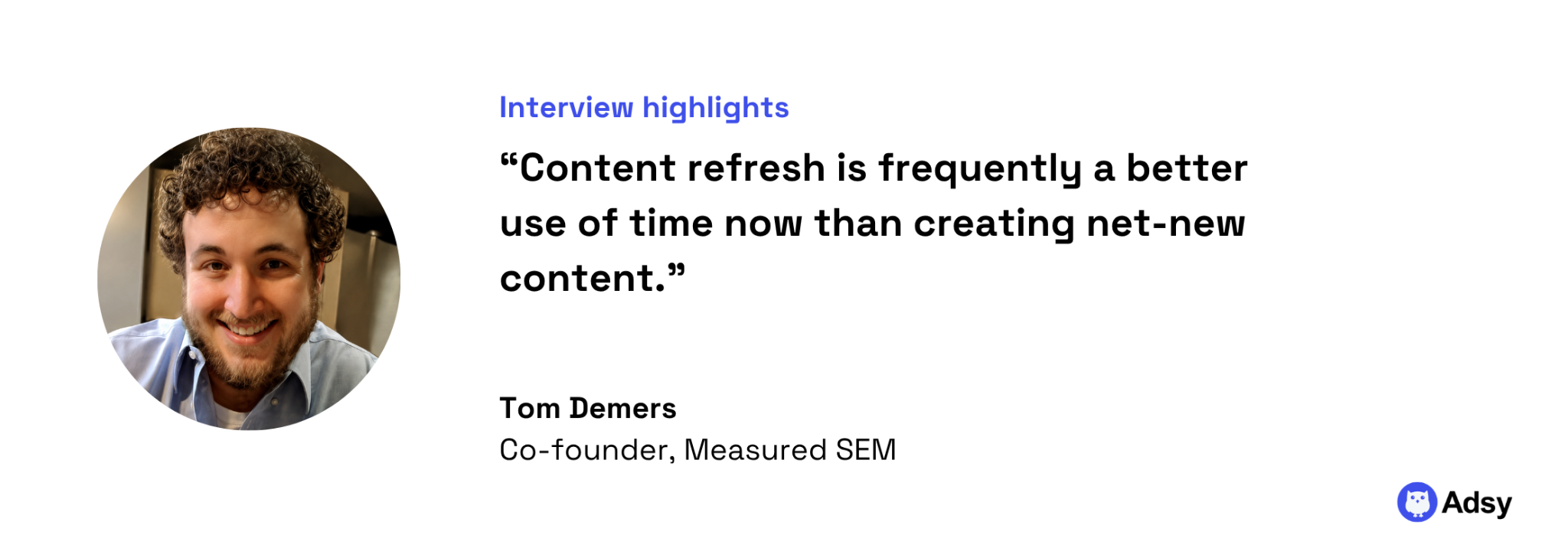
Every page that's important should be on as aggressive a refresh cadence as you can possibly manage. And you should probably be creating less net-new content, for most B2B sites.
Where we might have refreshed a page every three to six months previously, some of those pages we might now do monthly or even more frequently.
We’re constantly updating information, scanning for facts, and coming up with different ideas to make the page stickier, more interactive, and more useful for visitors.
Essential vs. useless SEO tactics in the AI search era
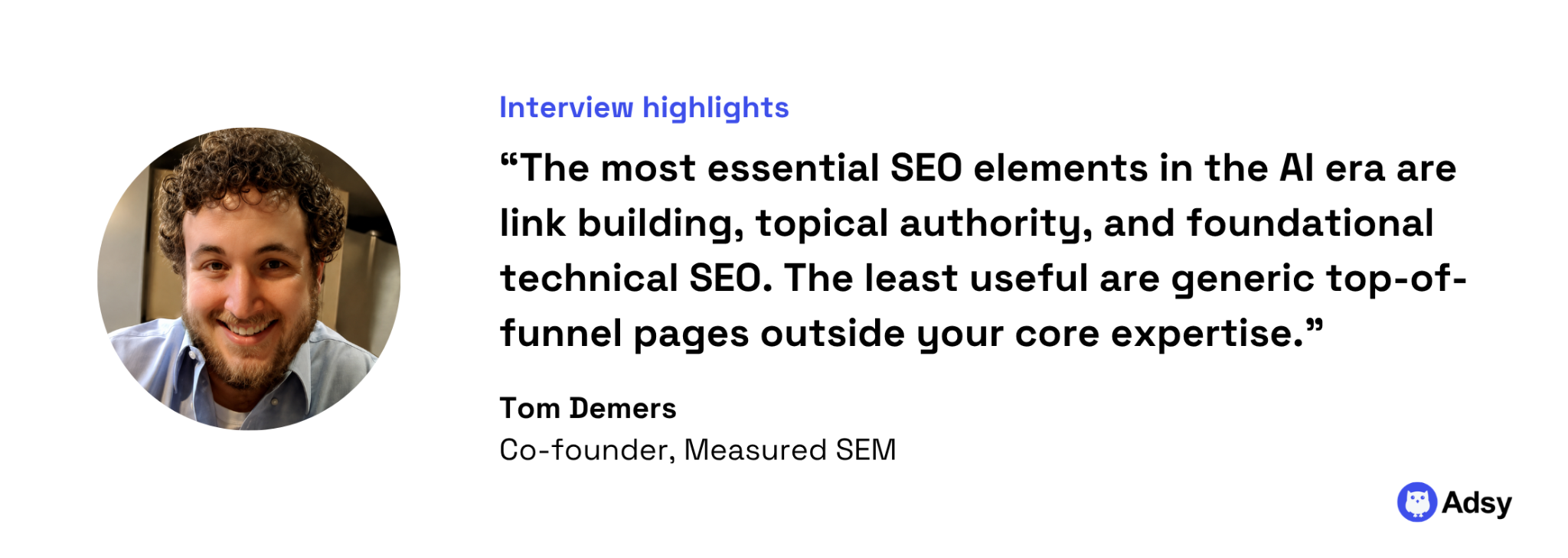
My top essentials are:
- Link building,
- Content quality and topical authority,
- Basic technical SEO.
For essential SEO tactics in the AI search era, link building is super important. Getting lots of links, getting high-quality links. It’s still massively important, arguably even more important now.
Now, content quality.
I sound like a broken record on this, but…
If you want AI visibility, focus on building content within your site radius, your site's core topical area where you have topical authority. And make sure you have deep coverage of those topics.
Start by:
- Building assets that you consistently refresh and update with new information.
- Finding proprietary statistics and data you can add that nobody else has.
- Building interactive elements that are interesting and useful to visitors, to improve engagement and also to show content effort and information gain.
Also, a lot of basic technical SEO still applies.
Make sure you're using redirects properly and that your content is crawlable and loads quickly. And build smart internal linking and smart information architecture.
For me, the most useless SEO tactics are:
- Not staying in your lane in terms of topical authority.
- Posting content that's really basic and really top-funnel.
Things that are outdated and not as useful for SEO now are off-topic informational content and top-funnel content like the ‘what is X’ stuff.
I think that's not worth the effort anymore and not a worthwhile focus for your resources, for most companies.
What to fix when SaaS SEO isn’t driving leads
If your SaaS SEO isn’t driving leads, look at the following four things:
Step 1: Check your targeting and traffic
First, you'd want to check your actual targeting and the shape of the traffic you're driving.
- Is the traffic coming in primarily branded?
- Is it top-funnel and informational, or is it mid-to-lower funnel?
- What are the actual queries and pages driving your organic traffic?
Look for gaps there. If you're not getting traffic around mid-to-lower-funnel terms, or if all your traffic is branded, then the first check is:
- Do you have the right types of assets targeting those terms?
- Do you have a content asset targeting that term?
- Is it the right type of asset based on what's ranking in Google?
Step 2: Check your content quality and link equity
If the answer to those questions is “yes” and you still don't see traffic for those terms or pages, then the second step is to check these two:
- Double-check that you have the right content type at a quality level that's likely to rank.
- Check whether you need to build links to those assets. Does your domain have enough link equity? Do those individual pages have enough link equity to rank for the terms you want to target?
Step 3: Map the right offers to the right content
The next thing I'd look at is whether you have the right offers mapped to the right content types.
There are two things I frequently see:
- One is that sites have no offers at all. Maybe there's a subtle CTA in the navigation for a demo or trial. But there's no offer specific to the pages driving the most organic traffic.
- The other is that the offer mapped to those pages doesn't fit the intent of the person visiting. Instead of having an informational, checklist-style offer that maps to the specific intent of the page's topical focus, you have offers that are forced into that topic area.
Step 4: Create free assets that match the page intent
It might seem small.
But here is a story of how we went from five SQLs a month to 20.
We've had a client with traffic across a basket of pages that generated a few SQLs a month.
We blanketed those pages with timed popovers and inline offers for very specific free informational assets. Checklists do really well for this, and free assessments delivered through a tool can also work well.
Once we mapped an offer customized to the client's specific process and expertise to those pages, we saw a 4x lift across that group of pages.
B2B metrics to drive leads, not just traffic
There are two pieces that are underappreciated when it comes to measurement for content, particularly around SEO and AEO for B2B companies right now:
- Doing a deep dive on leads generated from content. Tie MQLs, SQLs, and ultimately pipeline and sales to specific content assets. You need a three-dimensional view where you're looking at last-touch, source, and time-based cohorts for each of those lead buckets. This way, you can tell which pieces are doing the heavy lifting at the back of the funnel.
- Measuring visibility in the places you know people are finding you. Measuring visibility is hard now. We’ve already talked about it. But the important part is to look beyond traffic and understand how visible you are across sources.
But it isn’t just about where leads came from or what they saw last. It’s really important to track changes month to month, so you can see how those things are changing.
Because organic results, AEO visibility, and traffic are changing faster than ever.
Sometimes you can get fooled:
Last-touch attribution can make performance look healthy even when the top of the funnel is shrinking. That’s why looking at both lead sources and monthly cohorts helps you spot problems before they show up in overall lead numbers.
How to create “durable digital assets” for AI visibility
The approach here is to really focus on two things:
- What LLMs and AI tools are looking for: That's a lot of what we've talked about here: topical authority, information gain, and expertise. Something the visitor to your page can only get from this page and only get from you, based on your experience. Something that takes effort to create and build. And something that has quick, instant application and value for the user, so they can extract something valuable out of it quickly.
- What’s truly useful for your prospects and clients: There’s a good question you can use to check whether an asset is genuinely valuable: If you handed it to the product team, the person running email, or the person running paid campaigns, would they jump up and say, “Oh my gosh, that’s something we could really use”?
These are more durable assets, as opposed to just a commoditized article.
A lot of these articles are comprehensive and pretty well done, but they're not as durable, because they don't check all those boxes.
A more authoritative site could come in and crank out an article that's 95% as good as yours, and they're going to jump over it.
Qualities that will help companies stay competitive in the AI age
If you want to stay competitive in the AI age, you need pattern recognition. Understanding the patterns that are influencing people and influencing algorithms and applying it to your own specific situation is huge.
Being really nimble is another one.
Understanding how to balance being nimble without having shiny-object syndrome is going to be one of the hardest things in this AI era. Because there's just too much information coming at you.
You're being asked to both keep up with Google's algorithmic updates and to show up in responses across a variety of platforms and LLMs.
For a long time, SEO was really just a focus on Google. Now, you have to focus on AI Overviews, ChatGPT, Claude, Gemini, Perplexity, and this list goes on. So, there are a lot of different systems, platforms, and algorithms you have to stay on top of and understand.
You also have to keep up with the development of agentic search and understand the tooling.
We always had software that helped us create content, do outreach, optimize websites, drive more conversions and leads, and do research and analytics.
But this field was fairly static. For multiple years, you had Ahrefs and Semrush, and there weren't a ton of new tools popping up. But that's going to be at an all-time high now.
When it comes to AI tools, the most important part is to figure out how to sort the signal from the noise. It’s easy to get into a trap where you spend your whole day switching models and tools instead of actually executing work.
Quick-fire questions
Should B2B companies still create informational blog content?
Yes. The blog content they create should be different, but they should still be creating it.
Is AI visibility a separate strategy from SEO, or part of the same strategy?
It's a separate strategy that has strategic points of overlap.
Should companies refresh old pages before creating new content?
It depends on the company. But by and large, most B2B companies are spending too much time creating new content right now and not enough time refreshing existing content.
What’s the clearest sign that SEO traffic won’t turn into qualified leads?
The pages and topics driving the traffic aren't sufficiently relevant to the site's core offering.
If you had to choose one: better content or better conversion paths?
Better conversion paths. You can find ways other than content to bring people to your site and fill the top of the funnel.
But if the bottom of the funnel and your conversion are broken, then not only will better content not drive qualified leads and sales, nothing else will either.
All trademarks, logos, images, and materials are the property of their respective rights holders.
They are used solely for informational, analytical, and review purposes in accordance with applicable copyright law.

 Sign Up
 Sign Up