






AI Content Optimization in 2026: We Asked SEO Experts What Gets Cited
Maybe it’s just us, but we’re pretty much rolling our eyes every time people mention generative engine optimization. Again.
Everyone seems to be tired of hearing about AI content optimization. Yet, somehow, most still don’t know what they’re actually supposed to do.
There are just so many opinions online. And so few actual facts.
- So, how do AI citations work exactly?
- And how can you help your business show up in AI search more often?
These were the questions we asked dozens of experts. Below, you can read some of the most interesting insights we discovered.
What do we know about AI content optimization so far?
We’ll get into the expert advice and tips in just a second. But before that, let’s summarize the credible research on this topic.
Basically, here is what we know about AI website optimization so far:
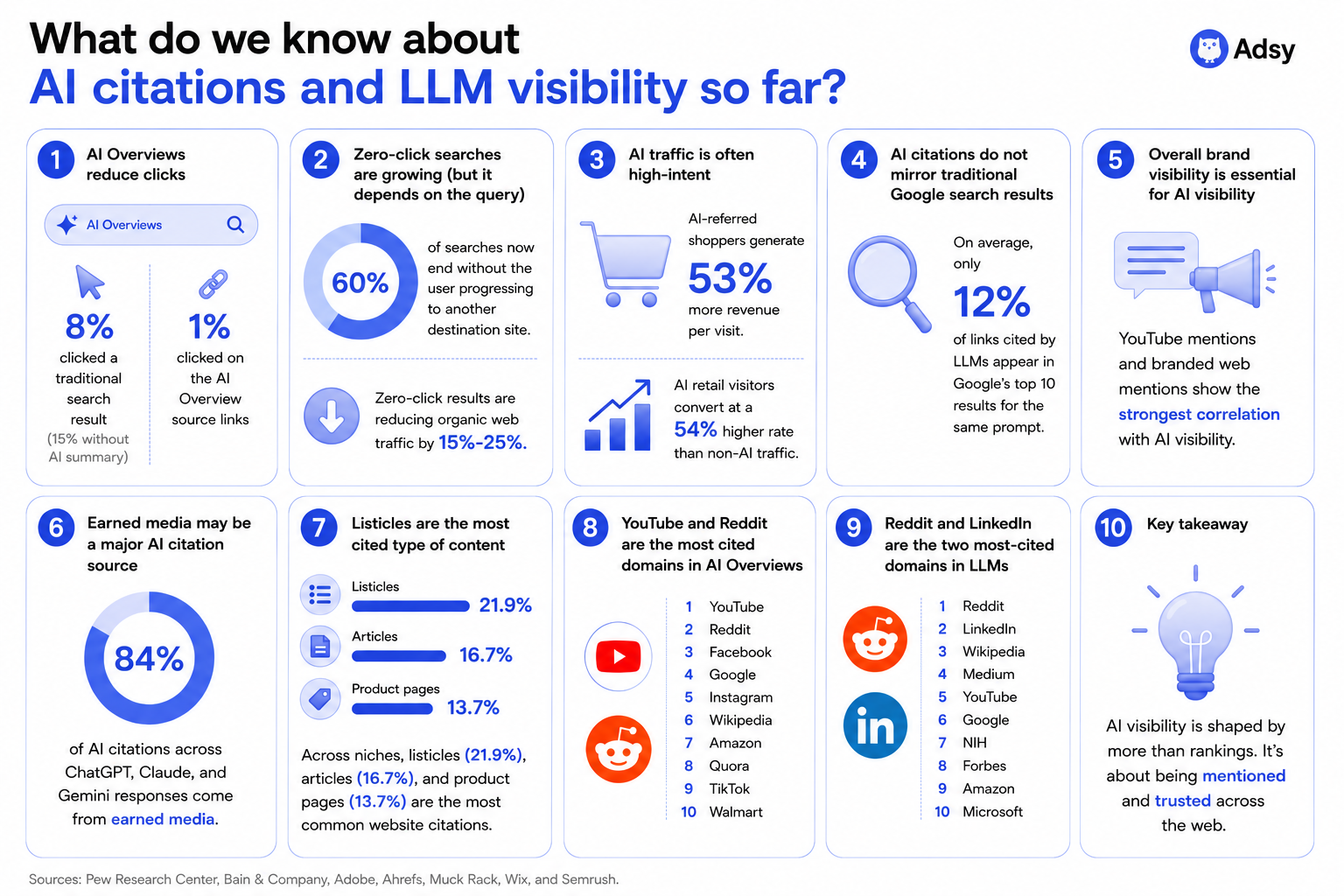
- AI Overviews reduce clicks (of course). When a query triggers AI Overviews, only 8% of users click a traditional search result (15% when there are no AIOs). On top of this, typically, only 1% clicks on the AI Overview source links.
- Zero-click searches are growing (but it depends on the query). About 60% of searches now end without the user checking any web page. Overall, zero-click results might be reducing organic traffic by 15%-25%.
- AI traffic is often more conversion-ready. Users who come from AI sources convert at a 54% higher rate than non-AI traffic. Besides, they generate 53% more revenue per visit.
- AI citations differ from traditional Google search results (a lot). On average, only 12% of links cited by LLMs rank in the top 10 search results for the same search query.
- Overall brand visibility influences AI citations. YouTube mentions and branded web mentions show the strongest correlation with AI visibility.
- AI systems trust earned media. In fact, it’s one of the most-cited sources, with 84% of AI citations across different LLMs.
- Listicles are the most cited type of content. Across niches, listicles (21.9%), articles (16.7%), and product pages (13.7%) are the most cited formats.
- YouTube and Reddit are the most cited domains in AI Overviews. The top 10 also includes Facebook, Instagram, Wikipedia, Amazon, Quora, etc.
- Reddit and LinkedIn are the two most-cited domains in LLMs. Other websites in the top 10 include Wikipedia, Medium, YouTube, NIH, Forbes, etc.
What does Google say about AI content optimization? The main takeaway is that traditional SEO still matters as the foundation.
Essentially, Google’s AI features are still based on its “core search ranking and quality systems.” That’s why it’s important to:
- Create valuable content for your audience,
- Build and maintain a clear technical structure,
- Optimize your local business and e-commerce details (if relevant).
The main challenges with AI visibility
The tricky thing with AI isn’t just that it’s a relatively new SEO direction. The real challenges are much more “serious”:
- AI search visibility isn’t like traditional rankings, where you clearly see your position. Yes, SEO tools estimate your AI visibility. But well… Let’s just say, you can’t know whether it’s actually accurate across all queries and LLMs.
- It’s inconsistent and really hard to track. AI answers can change depending on the prompt, LLM, location, and even the same query run multiple times. In fact, there’s less than a 2 in 100 chance that the same AI system (if asked 100 times) will give you the same list of brands in any two responses.
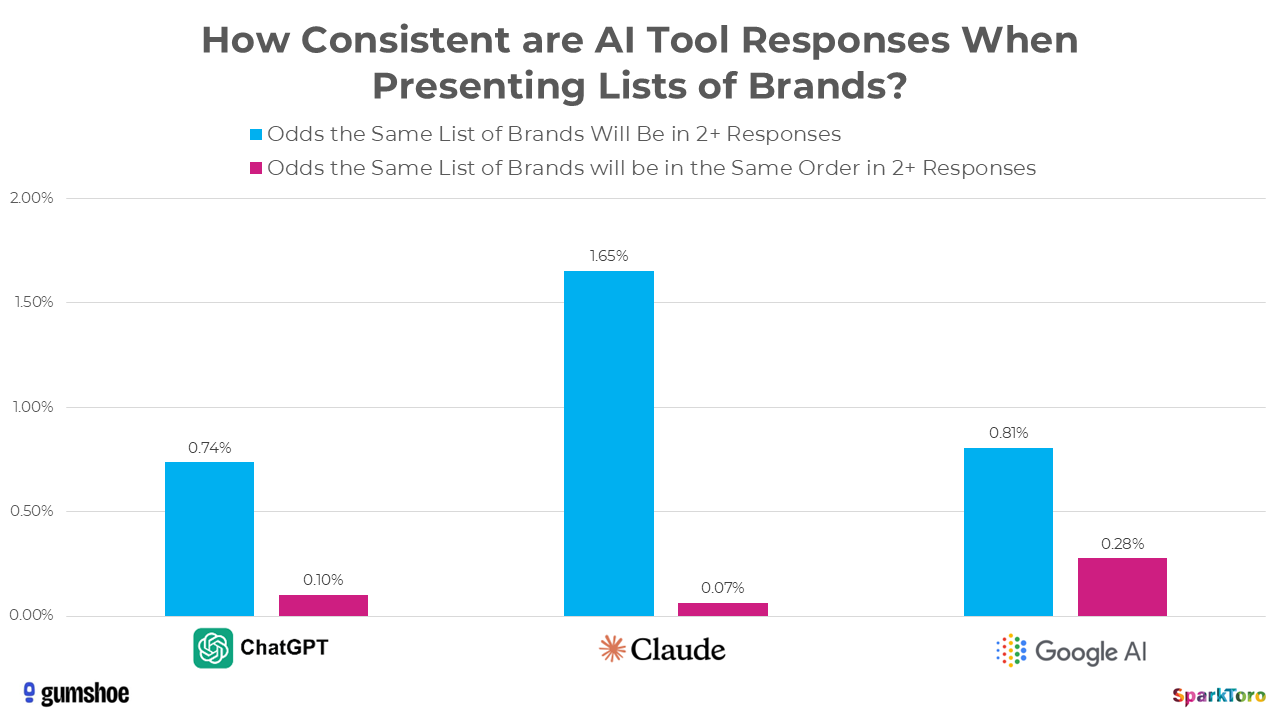
Source: SparkToro
- Understanding your actual progress is also more complicated. With traditional SEO, you can usually see who ranks above you, compare your pages, improve content, build more links, and so on. But with AI visibility, it’s harder to know whether your efforts are really paying off. Especially because more citations don’t always mean more brand visibility.
So, what do experts think about this?
Now, let’s see what SEO specialists recommend doing to optimize your content for AI Overviews and LLM visibility.
Shift from “ultimate guides” to experience-led content – Liam Quirk
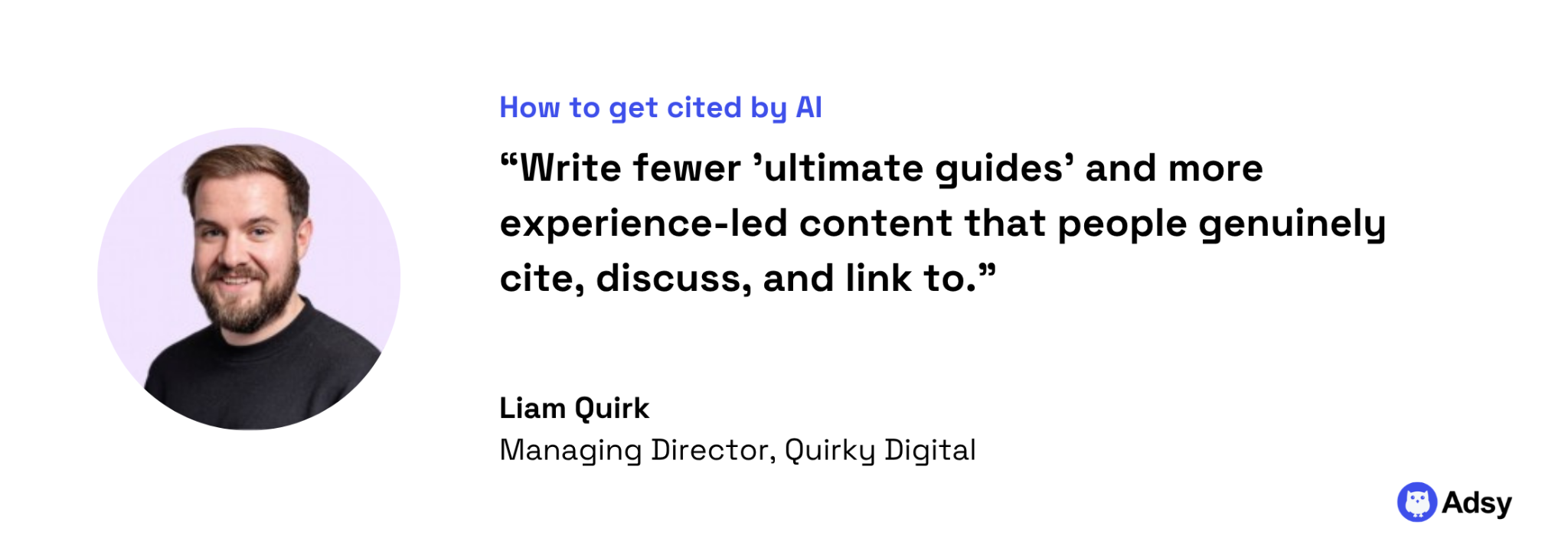
For Liam Quirk (Managing Director at Quirky Digital), there are two major points to pay attention to when optimizing for AI citations:
- Stop writing blog posts that only target keywords and start creating content that contributes something worth referencing.
- Make sure other people are referencing your content across the web.
Why do these matter?
Content shift
The problem with traditional “SEO-friendly” content is that it’s easy to replicate, especially with all the AI tools these days.
What’s much harder to replicate is actual expertise.
Take a look at the blogs that often show up in AI answers. You’ll see that they publish unique content. It could have a strong point of view, insights that aren’t mentioned elsewhere online, or other pieces that are different.
Overall, LLMs are much more likely to cite content that contains:
- Clear opinions and original observations,
- Original data and statistics,
- Specific, real-life frameworks,
- Expert analysis.
In practice, AI content optimization means fewer “ultimate guides” and more real-life content that people want to discuss and link to.
Cross-web references
Beyond the content itself, one of the strongest signals for AI visibility is whether others are referencing your content across the web.
It isn’t just about backlinks in the traditional SEO sense. It also includes citations, mentions, discussions, and references across:
- Blogs,
- Forums,
- Newsletters,
- Reddit threads, etc.
You might have heard that LLMs look for patterns of credibility and association. And that is exactly what all this exposure creates.
So, if your brand consistently appears in relevant conversations, it becomes more associated with that topic.
That is why digital PR, expert commentary, founder visibility, and original research matter far more now than they did a few years ago.
After all, AI search doesn't just analyze your website.
It looks at whether your brand is recognized and mentioned (over and over) as a credible source within your industry.
Get contextual brand mentions & avoid sloppy AI-generated content – Nicholas Rubright
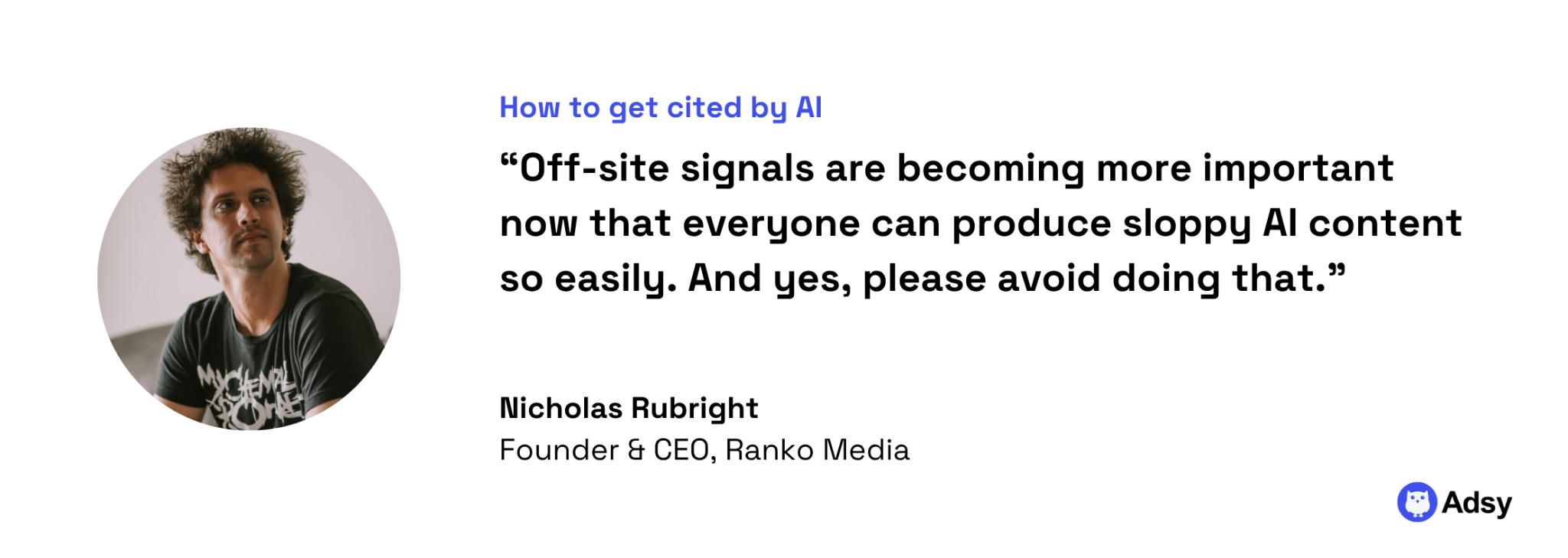
Nicholas Rubright (Founder & CEO at Ranko Media) approaches AI website optimization from two angles:
- Content you produce: AI likes pieces that are fresh, unique, authoritative, and engaging. That’s why using AI content for SEO without adding any real value makes no sense. You can implement AI in your copywriting process, but what you write has to be valuable, not just another sloppy article. The content that really works these days is research, newly uncovered data, and lived experiences.
- Authority you create around your brand: In Nicholas’ experience, contextual brand mentions are the biggest driver of AI visibility. That’s why digital PR that gets your brand topically relevant mentions is so powerful. Because quality off-site signals are much harder to gain than just posting some AI content on your own website.
Once you combine these two elements, you’ll see the results of generative engine optimization in action. Because when your brand has authority in a particular niche, and the content you post is actually unique and valuable, sooner or later, you will get citations.
Don’t panic: AI Overviews actually help you get "oven-ready" customers – Phil Gregory
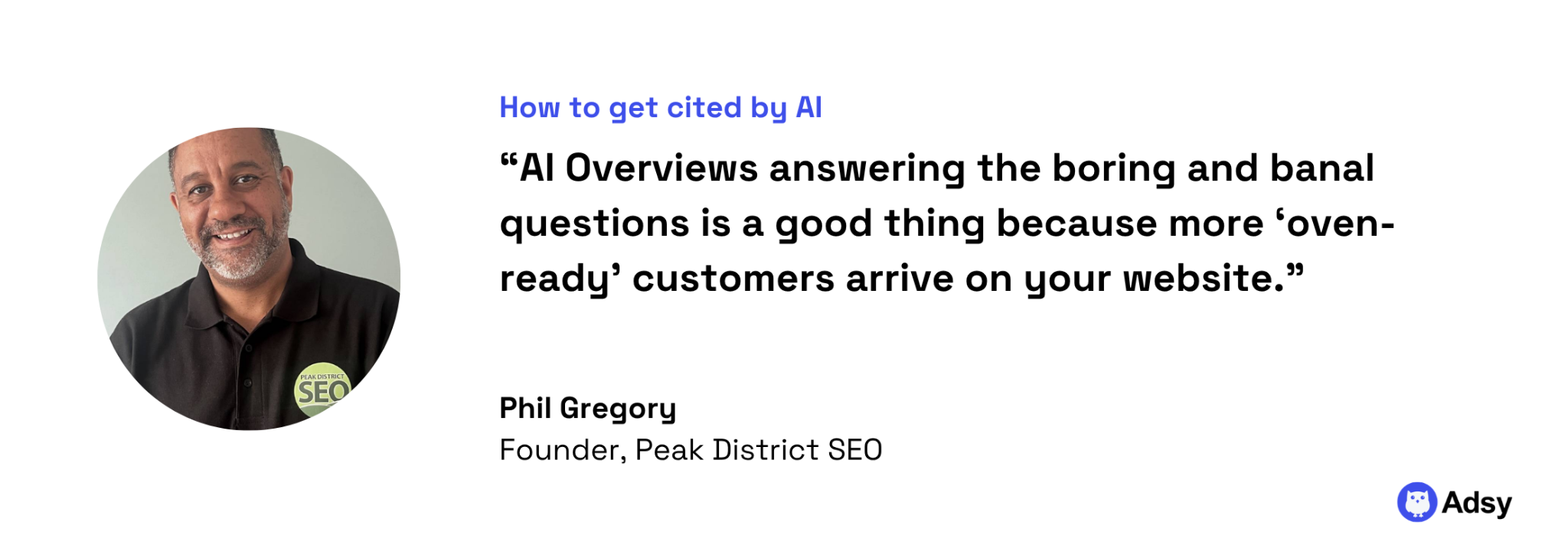
Phil Gregory (Founder of Peak District SEO) has one of the most reassuring (and refreshingly laid-back) takes on the whole AI SEO question.
While it's certainly true that search behavior is changing, Phil encourages us to look at the situation realistically.
Users are getting a detailed answer in AI Overviews before even thinking of visiting individual websites. It’s true. But most of those questions are boring, banal, and top-of-the-funnel.
So, AI answering them is actually a good thing.
Because more "oven-ready" customers arrive on your website. And a lot of the traffic marketers are so afraid of losing is simply “a curious horde who barge in and then melt away, not even leaving meaningful user data.”
According to Phil, the market has become flooded with "trust me, bro" hustlers who want to convince us all of the effects of llms.txt or the benefits of chunking text.
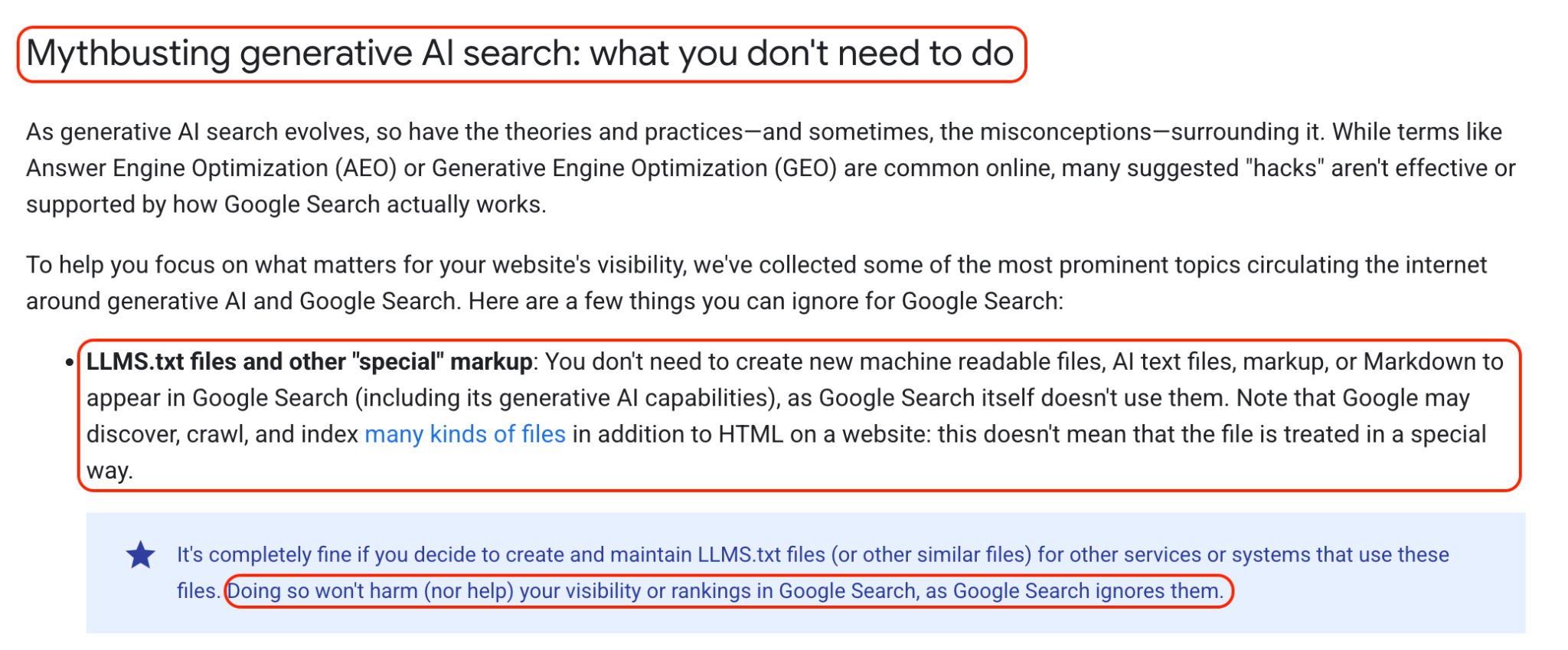
Source: Google
But in reality, nothing has changed substantially. You still need to:
- Write for the user,
- Show your expertise, authoritativeness, and trustworthiness,
- Include FAQs on your pages,
- Be clear about the benefits of your products/services.
- Make it easy to check out or enquire,
- Make sure the website loads properly, especially on a mobile device.
So, it's important to take all SEO trends with a pinch of salt.
We've seen all these supposed "SEO is dead" prophecies before, and yet here we are, still standing.
In May 2026, Google basically announced that AI search is "still SEO" (at least it’s still based on SEO). It’s because the AI Overviews are essentially looking at websites’ optimization to make decisions about what to show.
The evidence Phil has seen is that, yes, things are changing.
Traffic is dropping, but actual conversions are improving. Still, of course, it only works for websites that are well-built and actually help the user.
Refresh your most important pages – Yamon Y.
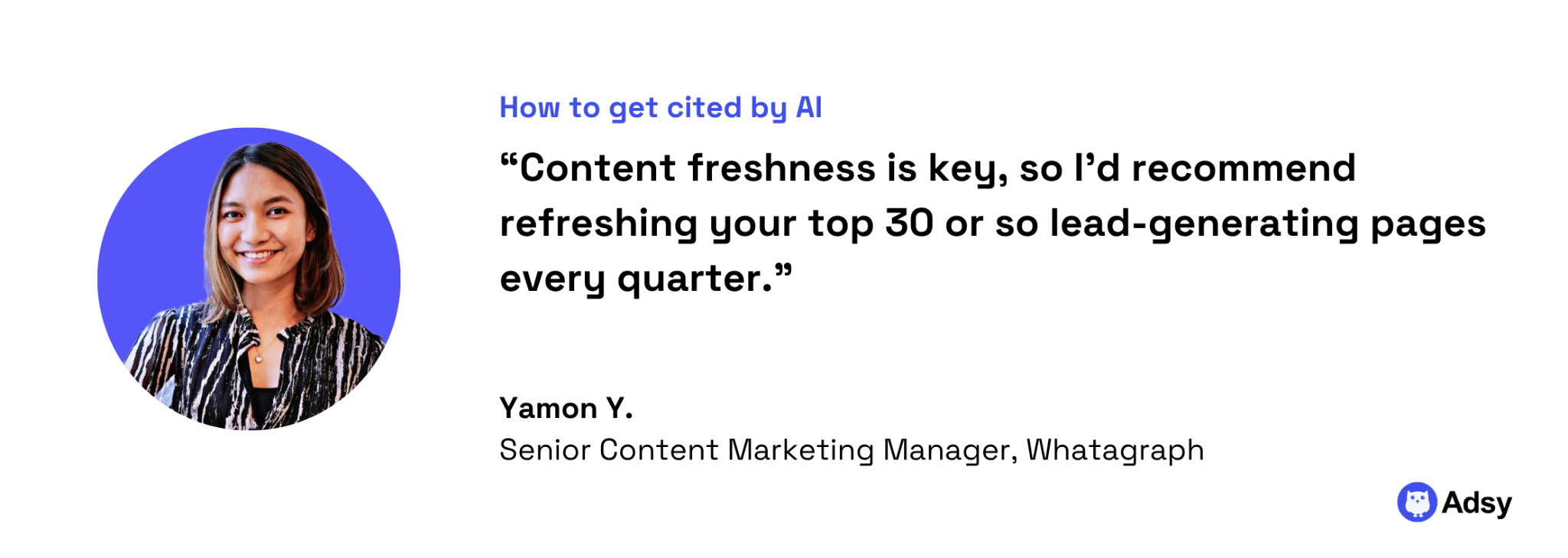
Yamon Y. (Senior Content Marketing Manager at Whatagraph) says that one of the things they focus on is content freshness.
To do effective content optimization for AI, she specifically recommends refreshing around 30 of your most important lead-generating pages every quarter.
This is the exact content refresh checklist their team uses:
- At least one new named statistic added with source and year.
- At least one expert quote added (internal team member or external industry voice).
- Intro paragraph rewritten to answer the main query in 40-60 words (This approach uses BLUF format (aka inverted pyramid) that puts the most important message first with background info after.).
- All sections checked to be 120-180 words (split or merge sections that fall outside this range).
- Comparison tables updated to reflect the current product state and competitors.
- 'Last updated' date updated in page meta and visible on the page.
- An FAQ section added or updated with 3-5 questions that mirror natural language AI prompts.
Focus on on-page SEO and "non-commodity" content – Curtis Chappell
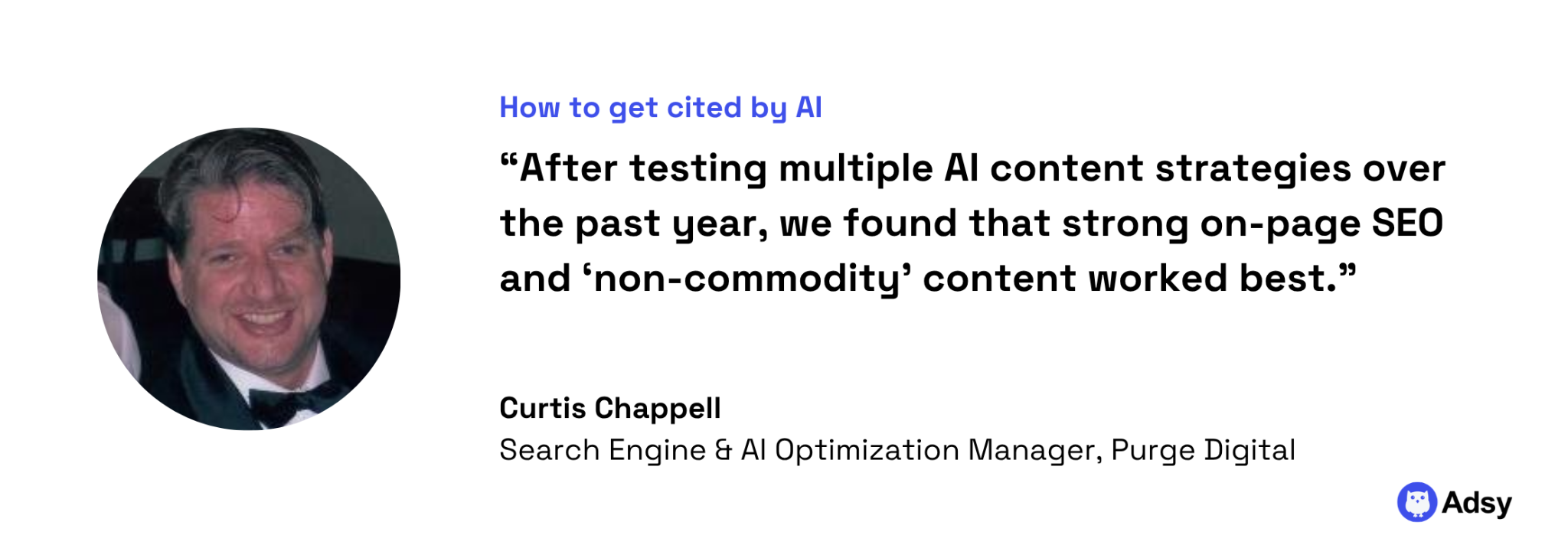
Curtis Chappell (Search Engine & AI Optimization Manager at Purge Digital) swears by doing proper on-page SEO and writing “non-commodity” content for AI website optimization.
"Non-commodity" content is a relatively new term introduced by Google in 2026.
Essentially, non-commodity content means unique information that might include specific case studies, personal experiences, or proven results that could only come from an individual's experience.
While commodity content can be generated by any LLM based on the currently available data, non-commodity pieces hold real value.

Source: Google
But writing unique content isn’t the only tip Curtis shared.
After testing multiple AI content strategies for the past year, his team found the following on-page suggestions worked very well (despite some being debunked by Google):
- Implement relevant schema code on all pages.
- Use H2-H3 tags to identify specific answers.
- Answer the target question in the first paragraph of the page.
- Create an FAQ page with 10+ frequently asked questions.
- Use internal linking.
- Use authorship and E-E-A-T as part of your content strategy and include exact statistics, screenshots, or other specific and unique data points.
- Search for related content to check if there are any AI results. If so, identify the main question they answer and address that question clearly in the opening paragraph of your own content.
According to Curtis, these were the things that helped their clients get cited in the AI results and rank organically.
Get mentions on pages that are already cited – James Berry
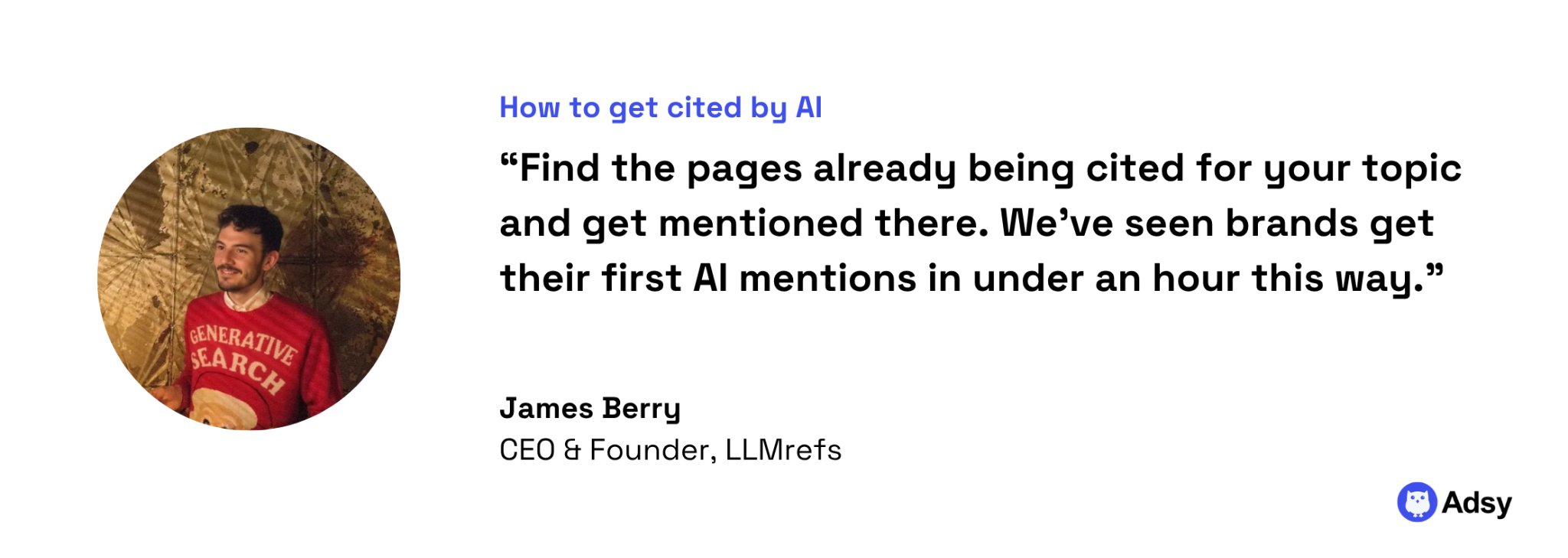
James Berry (CEO & Founder at LLMrefs) believes that being mentioned on pages that already show up in AI search is one of the most effective tactics.
He basically recommends finding the pages and threads already being cited for your topic and getting your brand into them.
You can do that by commenting in a Reddit thread or emailing an author to be added to their post. He says they’ve seen brands go from invisible to their first AI mentions in under an hour this way.
James also mentioned several other components that can help you optimize for AI Overviews and LLMs:
- Link building: It isn’t just about brand mentions. Backlinks are still one of the most important optimization factors that pass authority. Besides, they help search systems discover and understand your pages. And the easier your content is to find and crawl, the better its chances of being picked up by search and AI systems.
- Leveraging query fan-out: Query fan-out is an approach that AI systems use to split one question into several related queries. So, when you write deeper content that directly answers the smaller sub-queries, your chances of getting cited are generally higher.
- Accessible content: Your content needs to be crawlable, indexable, and available in the rendered HTML. That’s a must for search engines and AI systems to access it.
- Regular updates: Keep your content fresh. As James puts it, citations to a page “drop off a cliff” once it is more than three months old.
- Content formats: As for the content formats, include listicles and comparison-style posts that directly answer a question. They map cleanly to the sub-queries AI pulls out from a prompt, which makes them easy to quote.
Go more niche-specific with your content – Michael Baker
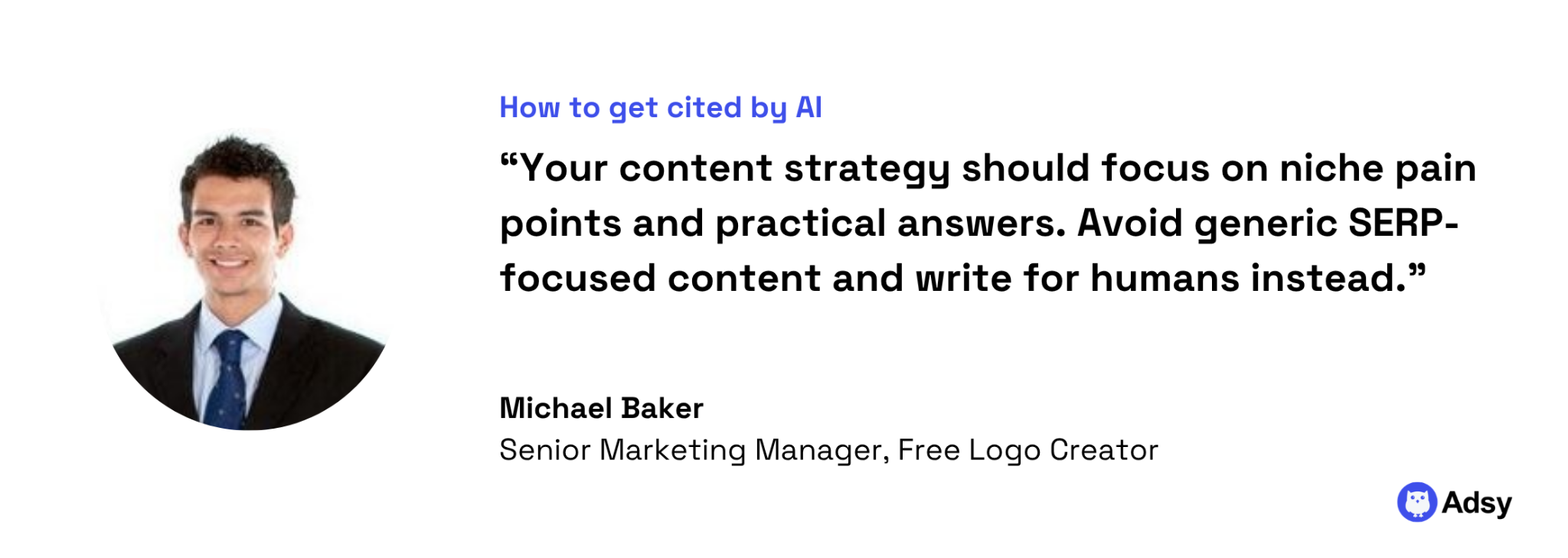
Michael Baker (Senior Marketing Manager at Free Logo Creator) believes that one of the best strategies for AI content optimization is making your content more niche-specific.
The issue is that many businesses tend to create content based on keywords alone. They choose search terms based on volume and keyword difficulty and write blog posts.
But these pieces are often too generic, so it’s nearly impossible to gain any real visibility in ChatGPT and other LLMs.
So, when instead, you focus on niche questions and real pain points, everything changes:
- You make your content actually useful for humans,
- You start building solid authority and industry recognition,
- Your content has more value, as it’s actually practical,
- The combination of niche authority and practical content gives you more visibility in AI search.
According to Michael, there are two other important things you can do:
- Work on cross-platform visibility: This includes socials (e.g., LinkedIn articles and posts), practical guides (e.g., how-to), visuals (e.g., infographics on Pinterest), videos (e.g., tutorials on YouTube), citations (e.g., industry niche listings on G2), and community (e.g., get mentioned on Reddit).
- Make your content more substantial: In your articles, cite facts, statistics, quotes from experts, or data from authoritative sources. Besides, invest in original data collection, analysis, and reports. These will not only get you cited but also bring you backlinks.
Work on your structure – Hansjan Kamerling
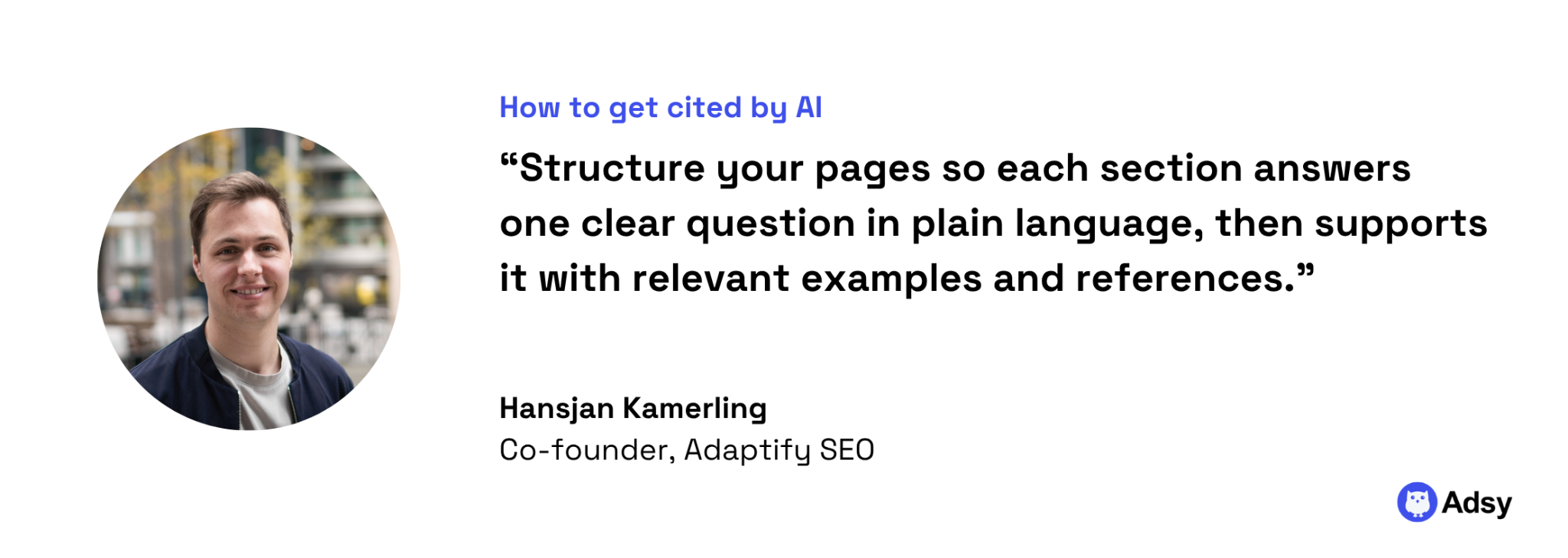
The biggest shift Hansjan Kamerling (Co-founder at Adaptify SEO) sees is that content for AI search needs to be easy to extract, not just nice to read.
For this, websites need to improve their structure, implementing the following changes:
- Make sure each section cleanly answers one intent in plain language. Ideally, back it up with tightly related examples and useful references. For example, you can pull trusted viewpoints from places like Reddit, Quora, Yelp, and Twitter. AI systems tend to prefer content that reflects real-world consensus, not just polished brand copy.
- Create “citation blocks” inside your article. This means short, standalone answers, definitions, comparisons, and step-by-step bullets that can be cited without extra rewriting. The lesson here is simple: if information is fragmented or buried, retrieval drops.
- Connect each article to a clear pillar page and related supporting pages. This isn’t an absolute must. But Hansjan recommends doing it for the most important articles because citations often follow topical clarity. AI is more likely to cite a source that looks like it truly owns the topic, not a one-off post chasing a keyword.
Fix crawlability before anything else – Alex Rostovtsev
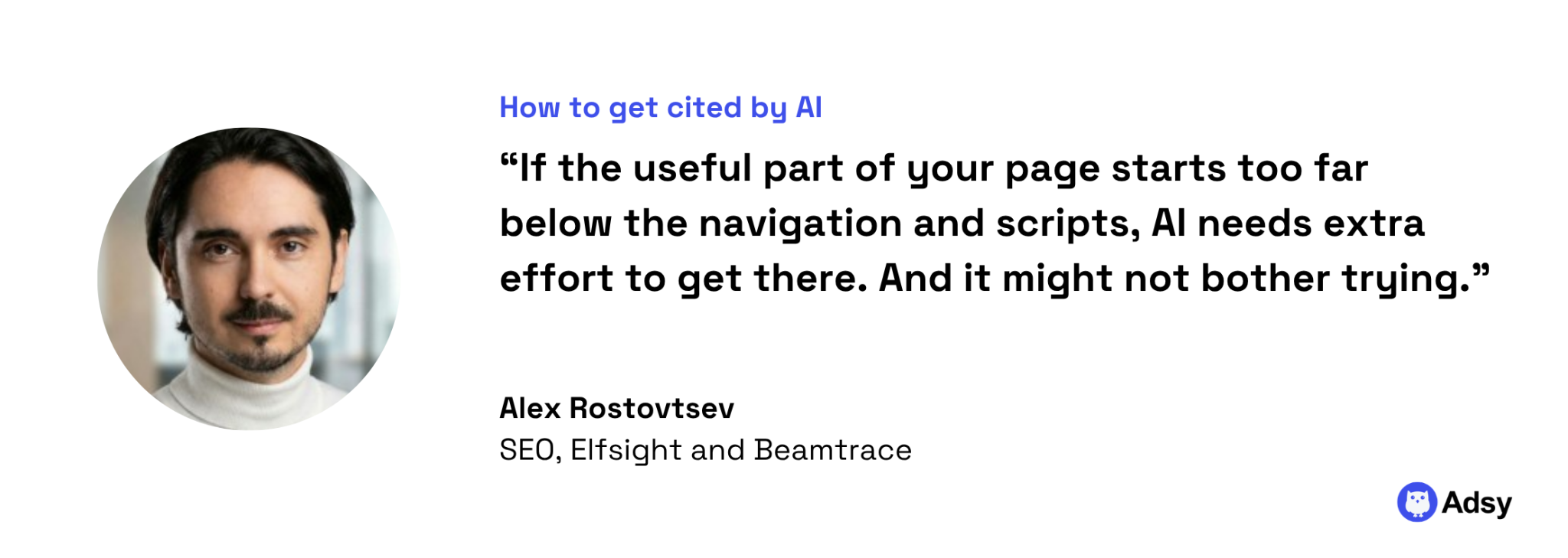
Alex Rostovtsev (SEO at Elfsight and Beamtrace) says that often our priorities are off. He believes that for many brands, content isn’t the problem. What they really need to be seen and cited is some boring technical SEO.
There is one major tension in AI visibility: people publish more and more content, while AI systems are doing everything to be efficient.
You’ve probably heard that computing power is expensive. So AI’s goal isn’t to go through as many sources as possible. Its goal is to give you a decent answer with minimal resources used.
This is exactly why your priority shouldn’t be to post more content. Your priority should be to fix the readability problem first.
Modern sites are packed with JavaScript, oversized navigation, and other unnecessary elements. They look fine in a browser but crowd out the main content when the page is processed in a simpler, machine-readable format.
This is especially true in the age of AI coding: you can implement almost anything on a page, but will AI ever reach it?
In many AI retrieval workflows, the first pass is limited. AI won’t necessarily keep “scrolling” just because there is more content on the page.
You can test it yourself: pick your key pages and ask your AI assistant to fetch them as raw HTML in one pass. Does it see the content you want cited?
Here is a screenshot from one of Alex’s personal sessions. You can see Claude admitting its default fetch limit and also its laziness:
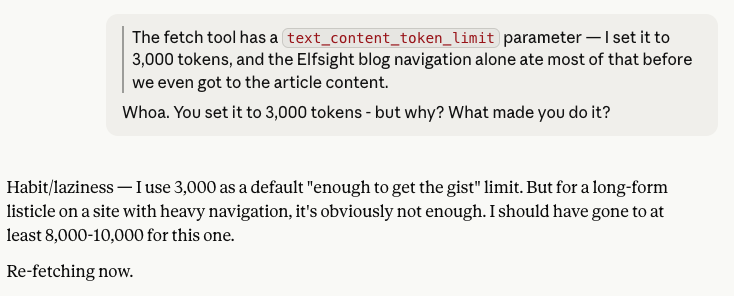
According to Alex, a lot of teams jump straight into LLM tricks. And it’s understandable: these are exciting, shiny strategies that aren't that hard to implement (especially with AI).
But chances are, those tactics won’t bring real results if you don’t fix crawlability first.
Publish clear, unique, and answer-focused content – James Allsopp
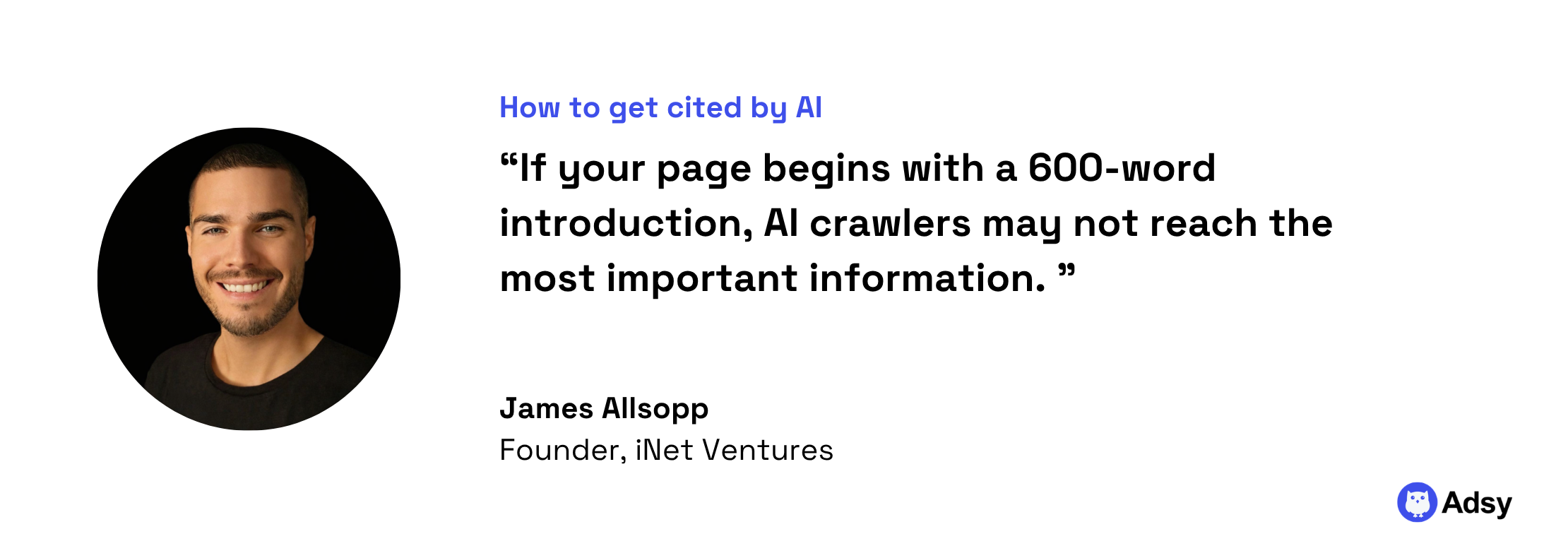
James Allsopp (founder of iNet Ventures) has three practical rules that can help you get your content cited in AI search:
- Optimize for "token efficiency": For LLMs, saving computing power and delivering immediate value are their core goals. If a page begins with a 600-word introduction, AI crawlers may not reach the most important information. That’s why content creators have to adapt. One of the ways is to use the inverted-pyramid writing format. The idea is simple: start with the core information and add secondary details below.
- Publish "uncopyable" data and original insights: LLMs can already generate basic definitions and general descriptions. That’s why they’re much more likely to cite pages when they contain new information. So, the more you focus on proprietary data, exclusive industry cases, dedicated expert quotations, and so on, the more you improve your chances of being visible in AI search.
- Build clear entity structures: LLMs process information by mapping connections between entities such as people, locations, concepts, brands, etc. That’s why it’s so important to make sure that your business descriptions are identical and up-to-date across the web. Similarly, all the content you post has to be clear and include accurate schema markup (if applicable). The more unambiguous your publications are, the better.
These days, optimization isn’t just about driving clicks or adding keywords to your content. Today, we have to focus on answer-focused writing, unique data, and clear entity authority.
What are the most effective tactics for AI content optimization
Let’s summarize everything we’ve just covered and include other things that worked for us and other SEO experts:
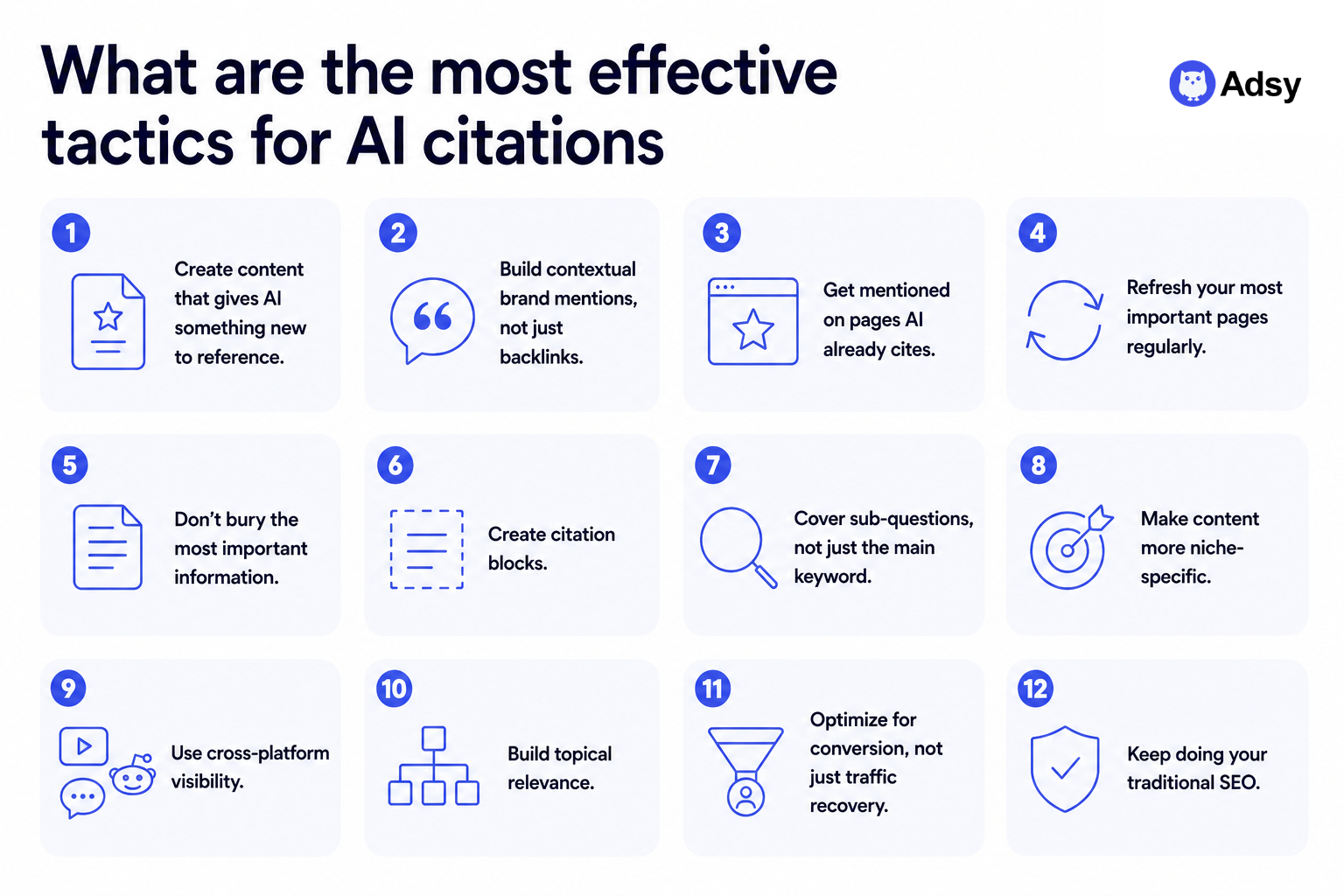
- Create content that gives AI something new to reference. Not another generic “ultimate guide,” but original observations, research, expert commentary, first-hand experience, case studies, examples, etc.
- Build contextual brand mentions, not just backlinks. Several studies and experts make the same point. AI website optimization depends on how visible your brand is across the web and whether it appears in the right context.
- Get mentioned on pages AI already cites. This is one of the most practical tactics. Find the articles, Reddit threads, listicles, comparison pages, industry roundups, etc., that are already showing up in AI answers. Then, reach out to them and try to get your brand included there.
- Refresh your most important pages regularly. This is especially true for pages that generate leads. Add up-to-date statistics, update comparisons, make your intro relevant, refresh FAQs, add expert quotes, and make sure the “last updated” date is visible (you can also add it to your schema).
- Don’t bury the most important information. If you have a question to answer, respond right away and add context later.
- Create “citation blocks.” Add short standalone definitions, comparisons, mini summaries, etc. that AI can easily lift or reference without needing to rewrite the whole page.
- Cover sub-questions, not just the main keyword. AI systems often use query fan-out to break one big prompt into smaller related questions. So, making your content deeper by answering supporting questions is generally a good move.
- Make content more niche-specific. Getting citations with generic content is harder because it says what everyone else has already said. That’s why it’s important to make your content practical and grounded in real-life experience.
- Use cross-platform visibility. Your own website isn’t usually enough for AI visibility. So, make sure you’re active on social media, YouTube, Reddit and other forums, review platforms, etc.
- Build topical relevance. Building topical authority is essential. But for this, you need to own your topic, not just post one random article. So, use keyword clusters and pillar pages and focus on one niche, instead of spreading yourself thin.
- Optimize for conversion, not just traffic recovery. Losing some low-intent traffic to AI isn’t always the disaster people think it is. The real disaster usually comes when businesses prioritize traffic over conversions.
- Keep doing your traditional SEO. It still matters. So, you still need all those SEO best practices (speed, security, mobile optimization, etc.)
Final words
To sum up this guide, we’d really like to say that AI content optimization is still a work in progress. And most of the “tips and tricks” you see online are observations and correlations.
So, it’s important to keep testing what works best for your brand and industry.
That’s exactly why we’ve collected different perspectives and tactics above. Now, the next step is to actually implement them and track what actually moves the needle for you.
Besides, make sure you’re keeping an eye on any relevant updates. Because AI search will likely evolve. And so will the optimization strategies.
FAQ
Is AI content optimization different from traditional tactics?
Not completely. It still partially relies on traditional SEO (e.g., technical optimization and helpful content). But it also puts more focus on brand mentions and visibility beyond your own website.
What are the main AI search ranking factors?
There are multiple things that can influence AI visibility and citations. But these are some of the most important things to keep in mind:
- Topical relevance and trustworthiness of your brand (i.e., clear niche and trust signals).
- External visibility across the web, including social media, YouTube, Reddit, Quora, review websites, etc.
- Unique content with insights that weren’t mentioned before.
- Strong structure of the entire website and each page.
- Content freshness (update at least your best-performing and most important pages).
How do you get cited by AI tools like ChatGPT, Gemini, and Perplexity?
First, make sure your SEO fundamentals are doing fine (technical SEO, on-page optimization, backlink profile, etc.)
Next, you can significantly increase your chances by focusing on these two elements:
- Unique content (e.g., expert commentary, original data, proprietary research, first-hand experience, etc.).
- Brand visibility beyond your own website (relevant brand mentions from credible sources).
Do backlinks matter for AI website optimization?
Yes, traditional SEO tactics still matter, including link building. Backlinks help discover and understand your pages. Besides, they also make your brand more visible across the web.
What type of content is most likely to get cited by AI?
Clear, unique, well-structured, relevant, fresh, and actually useful for your target audience. If there was one single factor to highlight, it’d be uniqueness. So, if you can get any original data, it’s a good format to add to your content marketing strategy.
As for the format, listicles (21.9%), articles (16.7%), and product pages (13.7%) get the most citations.
All trademarks, logos, images, and materials are the property of their respective rights holders.
They are used solely for informational, analytical, and review purposes in accordance with applicable copyright law.

 Sign Up
 Sign Up