






SEO Sales That Close: How to Pitch and Sign Local & Global Businesses

You don’t have to be a mind reader to know that most business owners don’t wake up thinking, “I need to invest in long-term organic growth through search engine optimization.”
They think, “I need more leads this week.”
Plain, simple, and on-point.
But when selling SEO services, you can’t really promise X leads by the end of the week.
- How, in that case, can you make your offer appealing to business owners?
- Why does pitching often fail?
- And how do you convince businesses that they actually need your services?
We'll answer these and many more questions in this article.
5 fundamentals you must have for selling SEO (successfully)
Obviously, before you get to pitching, you need to have your basics sorted out. They are technical and substantial things in your toolkit. Let's find out what those are.
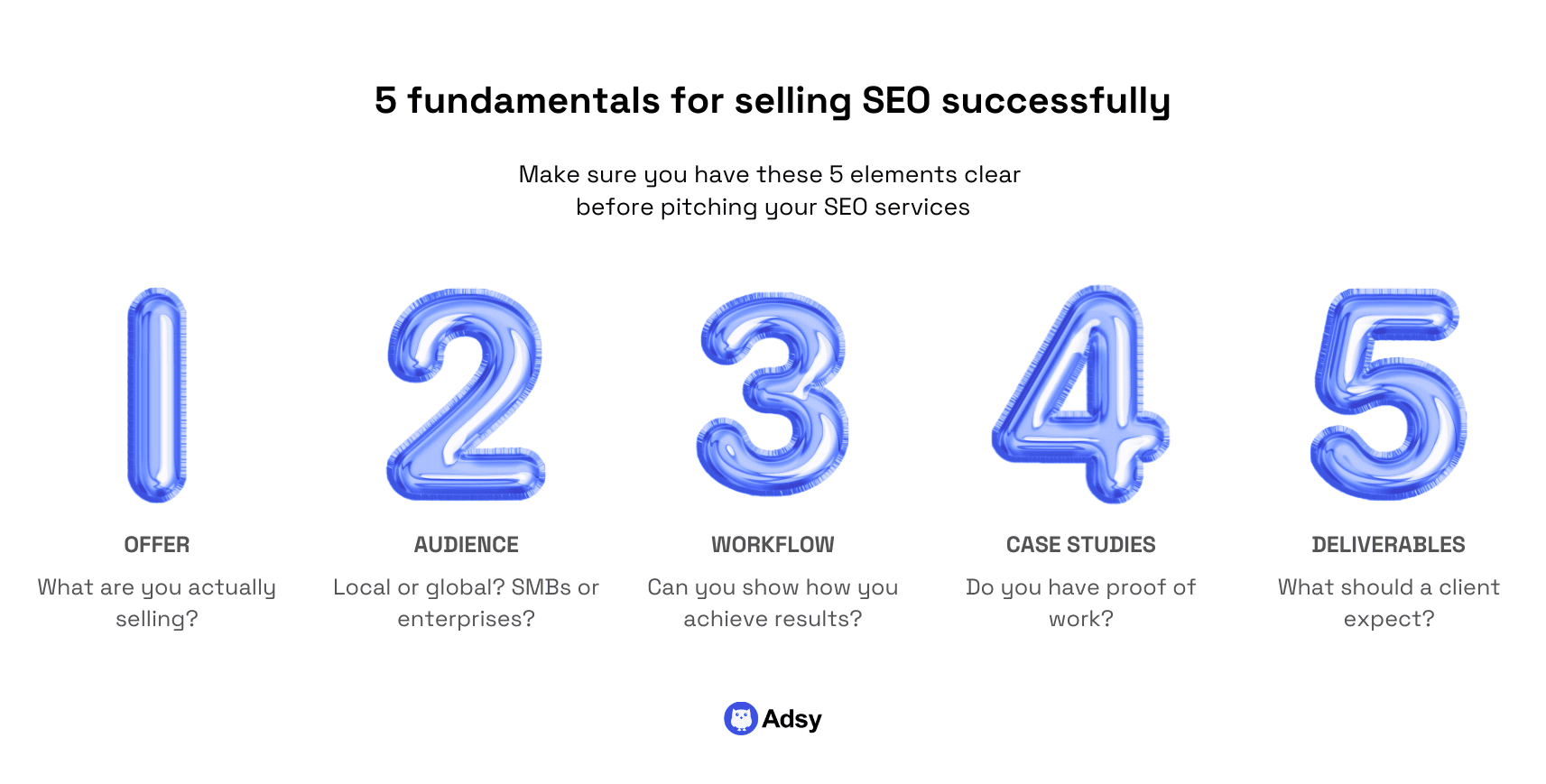
1. Offer: What are you actually selling?
Ask ten SEO providers what they sell, and nine will start listing tasks:
“Keyword research, technical optimization, backlinks, monthly reports, etc., etc.”
That may sound like professional jargon to most businesses, but nothing more. Let’s just say that's not a convincing offer.
An effective offer tells the client what they’ll get and when.
So, essentially, it should answer the following questions:
- What problem do you solve?
- What results will the client get?
- What’s the timeline for those results?
If you can’t answer those, it's probably better to take some time before selling. Because without a proper offer, you're not really ready to pitch your services effectively.
2. Audience: Local or global?
One of the biggest mistakes in search engine optimization sales is trying to sell to everyone who owns a domain.
To put it differently, it's like a shoe brand trying to sell “to everyone with feet.”
Just like with many other things, when selling, find your focus. It makes you more credible, and your pitch becomes way sharper, because you talk to a specific audience in their specific language.
- If you’re selling SEO services to local businesses, your offer should revolve around Google Business optimization, local citations, etc.
- If you’re working with global clients, focus on regional domains (if needed), culture-adjusted content creation, diverse link building, and international keyword research.
It isn’t just about the differences in the scope of work. Their pain points will differ as well:
- A gym owner doesn’t care about their GBP details. They just want to sell more memberships.
- And a SaaS founder doesn’t want another “blog strategy,” but they want higher MQL volume and better attribution data.
That’s why the best thing you can do to understand your audience is research, lots of it.
And when you have enough data, create a buyer persona and a negative persona to document your target audience.

3. Workflow: Show how you achieve results
You can tell a lot about a service provider by how they describe what happens after a client says “yes.”
If you ask, “What’s your process like?” and they say something like, “Well, first we check your keywords and then start optimizing,”... that’s not what a client wants to hear.
Most customers don’t even read your full proposal (surprise-surprise). They just want to know:
- What happens first,
- When they’ll see something move,
- And whether you’ll keep them in the loop or not.
Sure, some businesses might want to know the technicalities later on. But generally speaking, people just want things done. That’s it.
So, what is a framework, then? Two things:
- Your toolkit.
- Your original approaches.
1. Toolkit
Of course, most of your SEO clients won’t care about the exact tools you use for competitor analysis, keyword tracking, or backlink audits.
But if during your call/pitch, you show a clear example of what you do for another client, it will be a great advantage. It simply gives your potential customer an idea of what to expect.
If you’re using white-label software where you can create a custom dashboard, even better.
All this shows that you have transparent systems, which is what everyone values. And it’s also a way to convince your leads with something real and tangible.
2. Original approaches
As for the “original approaches,” it refers to your ecosystem. It’s just a fancy way to name your workflow.
Sure, every SEO agency and specialist will do on-page, off-page, and technical optimization. But your goal is to explain the “why” behind the bigger picture.
This is a perfect moment to:
- Give examples of your past experience (cases).
- Explain why some things don’t work anymore.
- Show that you’re interested in current trends.
- Prove that you understand your client’s niche.

Source: LinkedIn
4. Case studies: Proof of work
When a prospect asks, “Can you bring me results that look like this and this?” Don't expect that your wall of text will convince them. But real-life proof will.
That’s where case studies come into play.
Look, you don’t need massive enterprise projects to build credibility. Even a tiny local success story can do more than a thousand claims or AI-generated words about your coolness.
The main idea is to present it in a way that mirrors their business.
If you have your own tested and developed case study structure, go for it. But if you're still searching for it, try these tactics:
- Describe your approach/workflow. You can say that you are following a certain framework developed after a series of trials. Or whatever you have to say, but it is important to show what you are using.
- Give context. What kind of business was it? Small business with low visibility or an eCommerce store stuck at 5K monthly visitors? Maybe something completely unique that we can't even think of!
- Describe the problem. What was costing them money or reach? Broken links, poor meta descriptions, no content strategy, etc.
- Explain the solution. What did you do? Link building, on-page fixes, content optimization, a unique widget, proper clustering, etc.
- Show the outcome. What has changed? “+45% in organic traffic,” “ranked for 3 new high-value keywords,” or “closed 12 new local leads in 60 days.”
And if you want to get some inspiration, you can check customer success stories in other niches as well. They might have some interesting formatting or structures that could work for you.
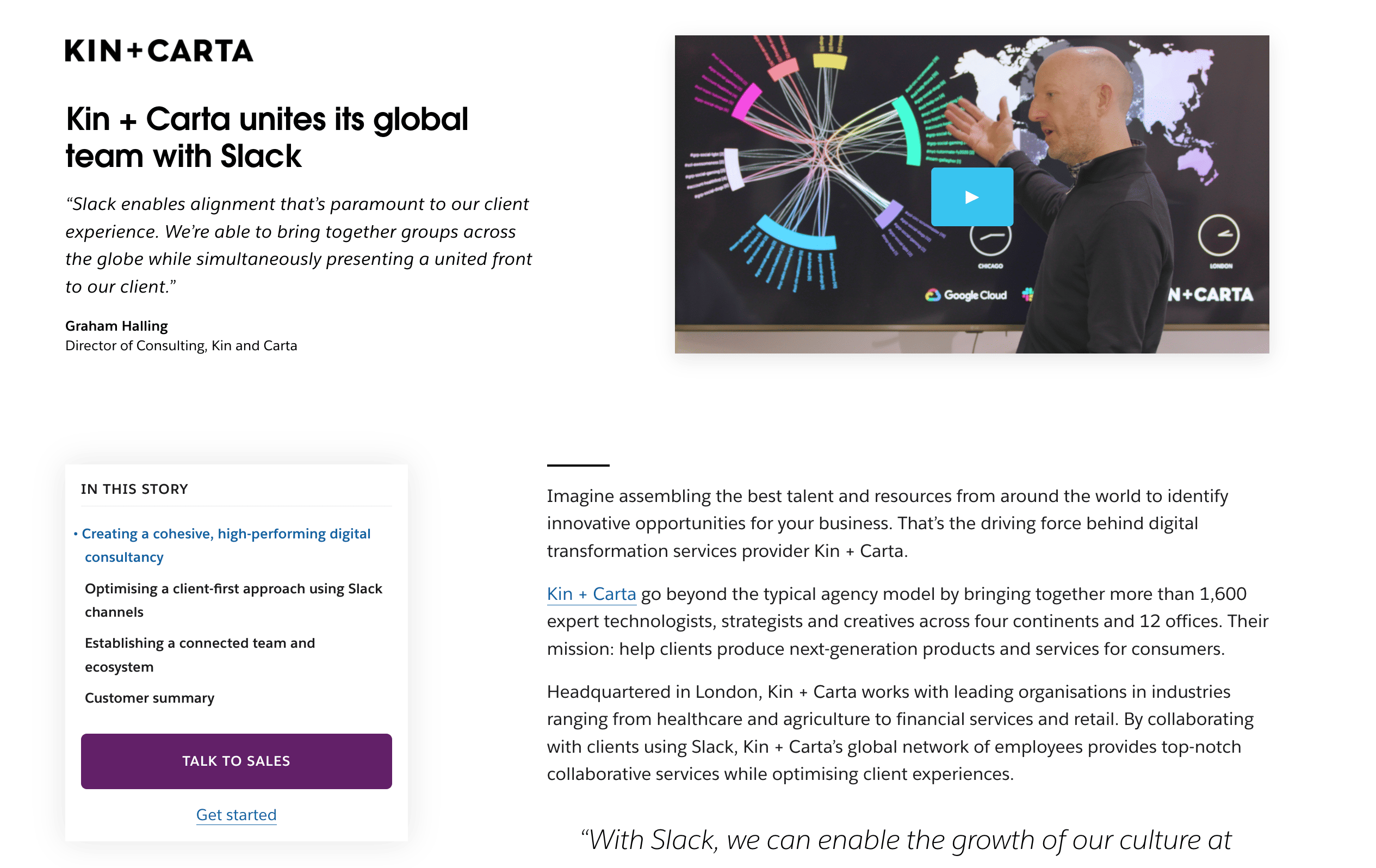
Source: Slack
You can add this to your website or create a simple PDF one-pager. Either way, it is one of the most effective and easy-to-comprehend formats that shows what you did and what approach you used.
If you’re just starting out and don’t have any previous clients, run optimization campaigns for your own projects. There is nothing unethical about that. Simply work on your own website, document the process, chart the results, and use that as early proof.
Of course, be careful and don’t over-polish the numbers.
You don’t need to deliver some unrealistic results in order to sell. Authenticity is always better. A real “47% traffic growth” will impress more than a made-up “300%”.
5. Deliverables: Explain what you’ll do
When pitching, the worst thing you can do is sound like a “marketing technician”:
- “I’ll improve your meta descriptions.”
- “I’ll fix canonical tags.”
Most business owners don't know much about these things, and they couldn't care less. So, you'll have to translate.
After all, no one ever signed a contract over a canonical tag:)
Clients care about what happens after you fix those things. They care about the extra leads, sales, or visibility. That’s what your pitch should be all about.
So, how to pitch your SEO services successfully? Translate your work into revenue or efficiency terms.
Don't say things like:
“We’ll build high-quality backlinks.”
Instead, say something more tangible:
“We’ll get your website mentioned in high-quality resources, like XYZ, to drive referral traffic and let Google know that you can be trusted. We’ll also focus on your high-priority selling pages to improve their positions in search results.”
Note: Of course, this will depend on who you’re talking to. If you’re on a call with a marketing lead, they’re likely quite proficient in search engine optimization. So, it’s one thing. But if you talk to an average business owner, they won’t know most of the terms.
But whoever you speak with, try to stay away from generic and meaningless promises.
For example, instead of saying:
“We’ll optimize your content.”
Put it this way:
“We need to target XYZ keywords that are low competition but can help you sell more. Plus, we can change XYZ posts into lead magnets to get people to sign up, engage, etc. We also found that your competitors don’t do any local SEO, so we can benefit from XYZ queries.”
That’s how you prove you understand what your potential client’s website needs and what can move their business forward.
Why does pitching often fail, and what can you do about it?
Here is one thing about the sales process you need to understand. People only buy what they understand.
Your pitches usually fail:
- Not because your SEO strategy is weak.
- Not because your keyword research missed a few high-value keywords.
- And definitely not because your pricing model scared your potential customers.
Pitching often doesn’t work because the client’s brain never made it to the moment of clarity. To the revelatory “yes, this could actually work for me” or “yes, I see an actual value in this for my business.”
That's the major reason. But let’s break it down:
Reason 1: You're talking to the wrong people
Many service providers waste hours sending decks to random inboxes because they assume every local business “needs optimization.”
Sure, they probably do. But not every business owner is ready to buy it.
Look, if your potential client doesn’t already spend money on paid search or other marketing channels, they’re likely not ready for SEO as well.
You’ll spend the whole call explaining what search engine optimization is, and why they need any online promotion at all.
Could this work? In theory, yes.
But would it be worth the effort? Probably not.
So, ideally, your new clients have to be interested in what you offer.
Reason 2: Clients don’t understand the real value of SEO
The more you talk about fixing schema markup and improving search rankings, the further you get from your potential customer.
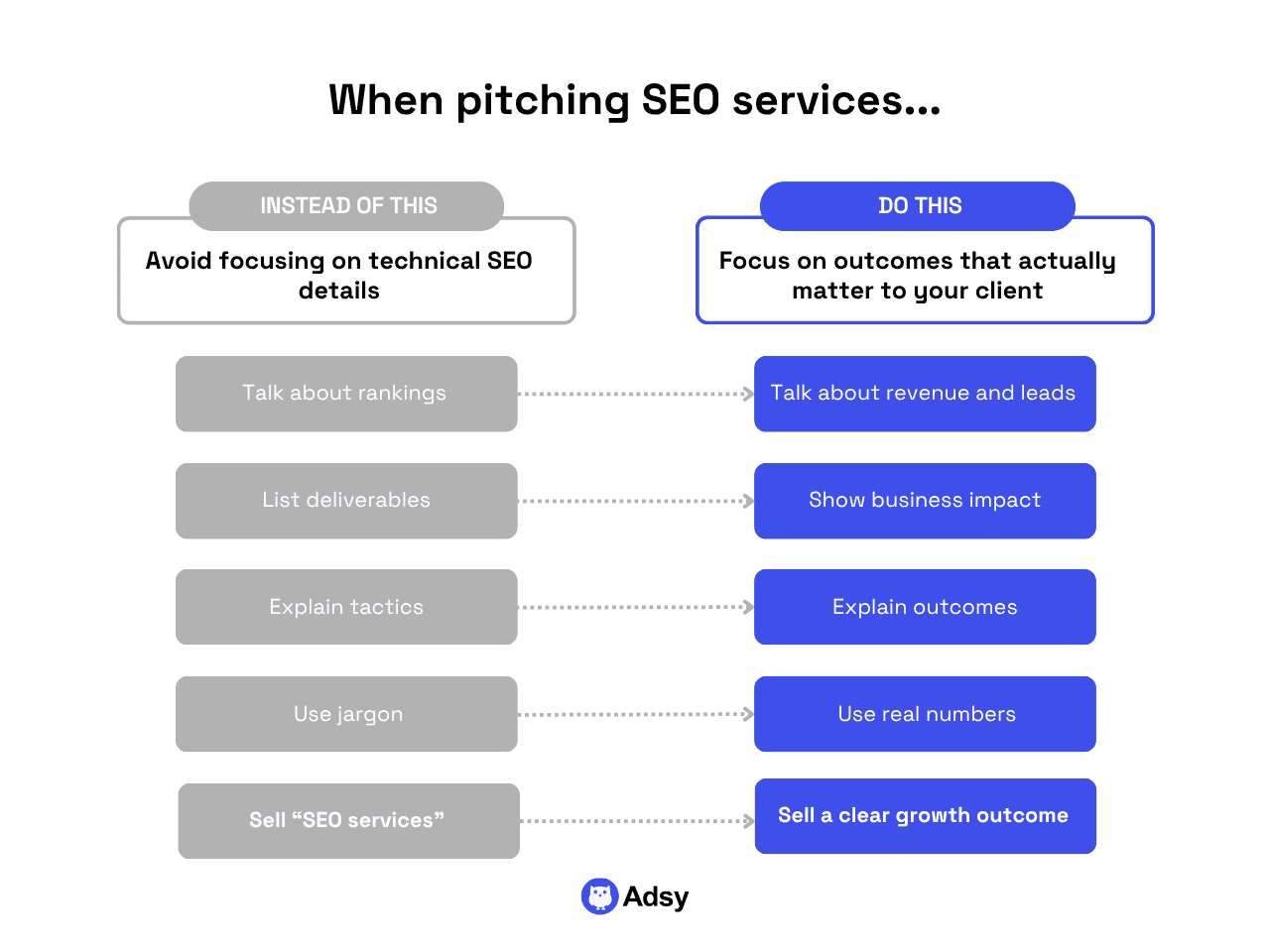
Your clients care about the outcomes.
So, focus on realistic outcomes that are tied to your customer’s goals (revenue, visibility, leads, etc.). Here is a little cheatsheet to help you:
Reason 3: You assume logic sells (nope)
Search engine optimization is logical, right? But we all know that buying often doesn't follow the same curve.
Your potential clients have their own reasons to buy from you:
- Local businesses buy because their competitor is outranking them.
- A marketing director buys because the board keeps asking about “organic search growth.”
- An enterprise does SEO because everyone else does it, and they can’t afford not to be out there.
They’ll rationalize it later with your slide deck, though.
What can you do?
Understand why your lead wants website optimization in the first place and appeal to that.
When you talk about your process, talk in your clients' language.
Don’t try to make your pitch universal. You have to feel the customer and then just explain how you can get them what they want.
Note: To do this properly, you have to research the niche well. And find some relevant examples in your portfolio. If you don’t have anything similar in your previous cases, go the extra mile in your research and find some cool examples of what you could do (beyond the basics).
How to sell SEO services: 7 proven tactics
There is no single, universal idea about how you have to sell SEO services “correctly.”
There’s only an understanding of what people really buy. And what makes them believe you’re the right one to deliver it.
1. Don’t pitch SEO
It might sound controversial, but it is actually not at all.
Many people think that selling optimization services comes down to perfecting their pitch. Yet, it’s not the best approach.
It’s more about learning to talk about SEO without even saying the word “SEO” for the first five minutes.
How do you do that?
Well, you can always say something like:
“Right now, you pay for every click. SEO means that 6 months from now, you’ll get half of those clicks for free. Besides, you’ll keep that advantage as long as your competitors don’t catch up.”
This works for several reasons. You:
- Don’t sell a “black box”.
- Don’t try to outsmart other people in a meeting.
- Talk about tangible business outcomes, rather than the process itself.
It’s also a great approach because many people have been burned by “SEO” before.
The acronym itself carries baggage.
You don’t want to be another SEO specialist who always seems busy yet doesn’t deliver.
For many businesses, search engine optimization is associated with slow results, shady reports, and too much jargon.
When you stop leading with the label, you let them see your logic before they attach it to their old disappointments.
You can watch this shift happen in real time on a sales call. When the client goes from polite nodding (“Yeah, we’ve done SEO before…”) to curiosity (“Wait, so we’d actually start paying less for traffic over time?”).
Sure, not everyone had that bad experience. But if they did, be careful with that.
2. Sell the journey
…because SEO is not about instant results.
One of the fastest ways to lose a client is to act like SEO is a switch you can flip. And bam, everything changes.
Every SEO professional knows it’s a gradual process. But a few explain the realistic timeline and the reasons behind it.
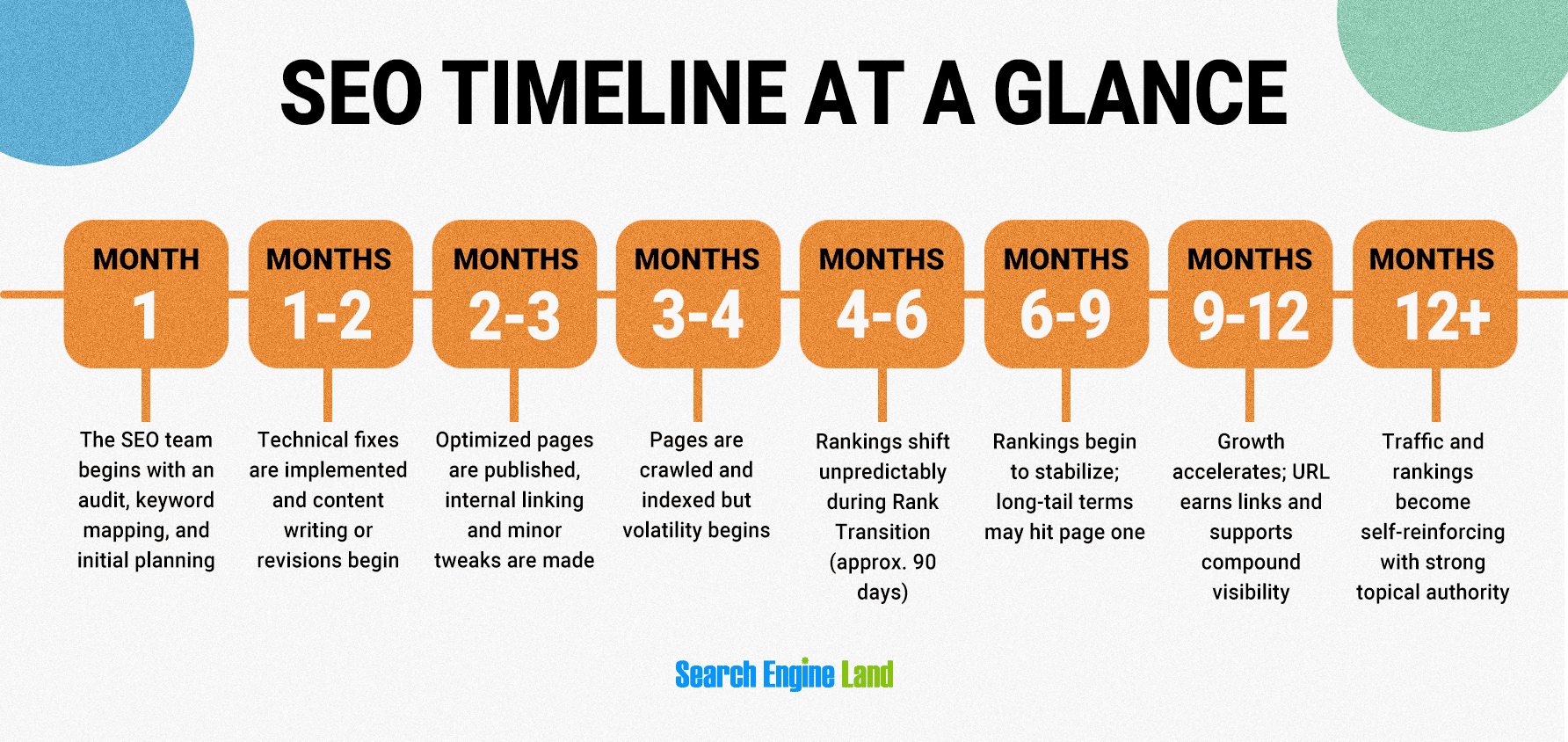
Source: Search Engine Land
Here’s the thing:
- If your pitch makes results sound instant, you’ll close impatient clients who will leave in three months.
- If your pitch feels like an investment roadmap, you’ll close committed ones who understand the journey.
But how can you do it?
One of the effective ways is to create a simple “3-to-12-month plan” visual/presentation/PDF. There, you can clearly show:
- What will be done at each stage.
- What budget each activity requires.
- What results can clients expect at any given moment.
- How every single step is connected, making it impossible to skip anything for long-term results.
You can also mention quick wins here, for sure. But frame them as early indicators, making it clear that you have to focus on broader SEO KPIs for great outcomes.
Note: You can also end your proposal by showing how SEO compounds. Demonstrate that the same content optimization efforts from month 1 will still drive organic traffic in month 12.
3. Make your offer impossible to compare
Most SEO agencies think competition is a bad thing. But when it comes to the sales process, you can't really hide from it.
Every potential buyer already has at least three other SEO proposals in their inbox.
So, what can you do?
Once your offer is built on outcomes and ownership, the comparison game ends.
A typical offer is similar to this one:
“$3,000/month for full SEO management,”
But what we’d recommend instead is to say something like:
“We help you dominate your niche’s search results, focusing on your highest-value keywords within 6 months.”
See the difference? It's huge!
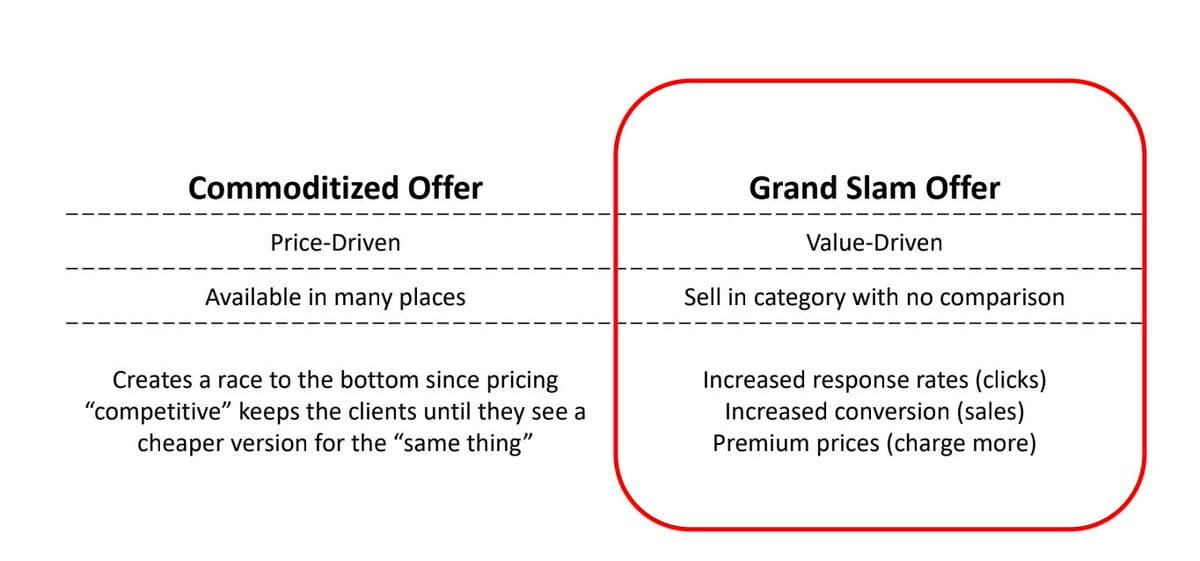
You’ve definitely heard about Alex Hormozi at some point. He has this concept of a “grand-slam offer,” an offer that’s so valuable people have to buy it.
Source: X
And the thing is that SEO has become very commoditized (“get X backlinks,” “get X optimized blog posts,” etc.).
But you don’t have to go that way.
Turn your offer into something your potential clients actually care about (leads, subscriptions, sales, etc.).
For this, you’ll likely have to combine your optimization tactics with selling content and other strategies. But it will make a world of difference.
You know, selling the Maldives is much more effective than selling an 18-hour flight to the Maldives.
Here's the anatomy of a great offer:
- Show your result window: Calculate when something tangible will likely happen (“expect first organic traffic growth in X weeks”).
- Define your ownership model: Clarify what they keep if they pause or leave. That could be content, links, tracking setup, keyword research, etc.
- State your reporting system: Simply explain how often you’ll report on your progress.
This makes your service offerings feel structured and predictable. And these are the things that help buyers make a decision.
If you can afford it, add a “success insurance” layer.
That's just something small but reassuring. It could be an extended onboarding audit or an extra round of optimization if the first one underperforms.
Note: Avoid making any empty promises in your offer. Focus on your strength, instead of just trying to make your offer as shiny as possible. Overpromising and underdelivering will never work well for your reputation.
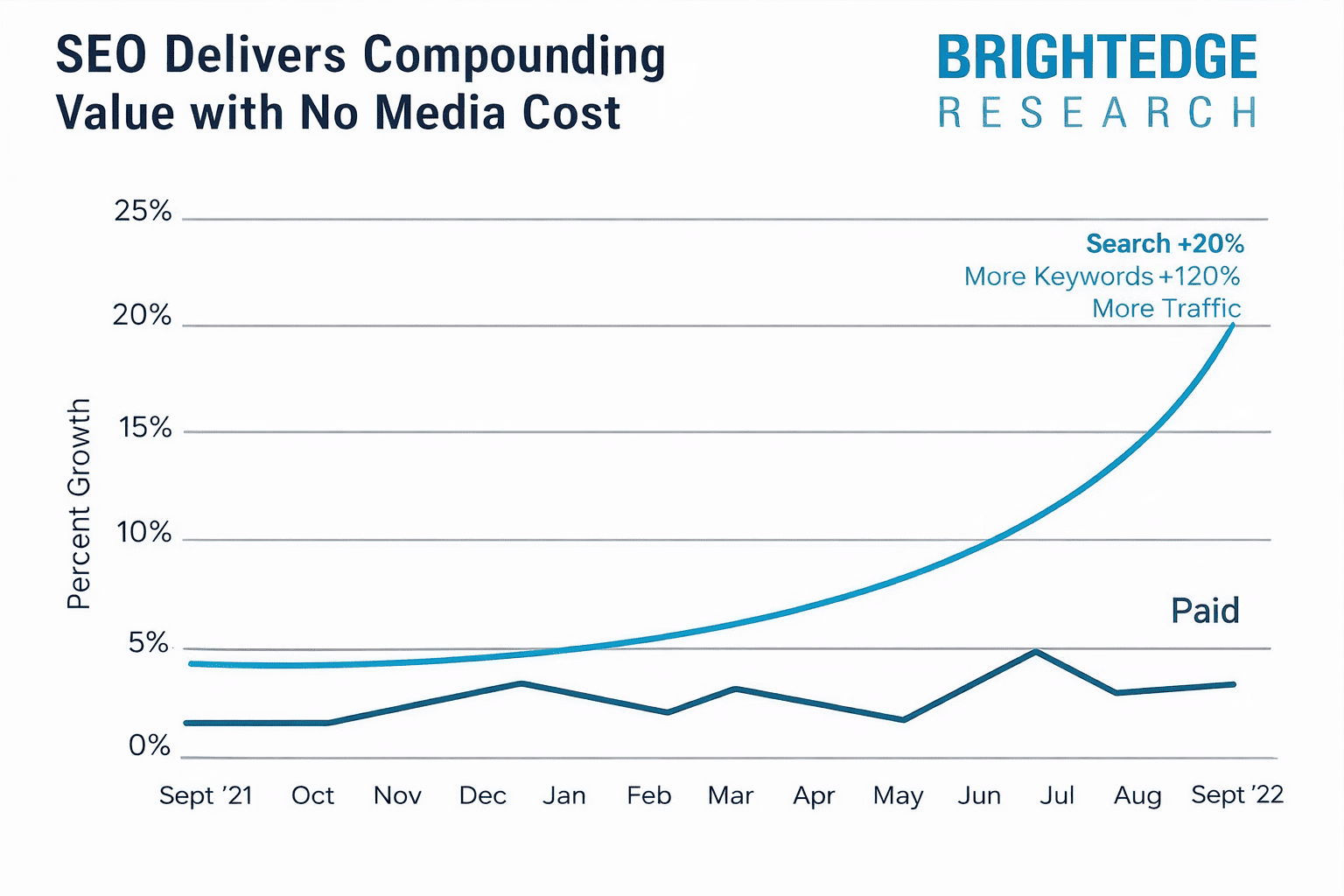
4. Frame SEO as a system that pays for itself
SEO actually pays for itself. So, you just have to communicate this properly.
Source: Search Engine Land
But let’s step back for a moment.
Every business owner and CEO is asking one single question all the time:
“Does this make financial sense?”
That’s your cue to move from cost to structure. Don’t go bluntly saying something like, “Our SEO services cost $2,000 a month.” That’s a bad approach.
Especially, when instead, you can say:
“Here’s how our structure compounds. Each month, your content optimization, local citations, and link building make the next month cheaper to grow.”
The idea is to reframe SEO as a compounding asset.
Essentially, that's what search engine optimization is. A flywheel that, once spinning, could replace paid advertising and positively affect every marketing channel.
Even better: quantify it.
Show that if a business wins one client a month through organic search, that covers the retainer. That alone!
This is how you can sell SEO packages without pressure.
Just make it clear that your offer is not an expense. It’s an investment.
5. Show HOW exactly you worked with other clients
We have already mentioned the importance of case studies. But there’s more you can do.
When you show a result, don’t start with the outcome. Start with the moment of insight that changed the trajectory. In other words, show the decision trail.
Here's an example:
“When we ran a comprehensive SEO audit, we realized most of the client’s high-traffic pages were targeting the wrong intent. They were ranking, but converting at 0.3%.
We rebuilt those around mid-funnel keywords and integrated conversion rate optimization into their blog flow. Within 60 days, the same traffic produced 3x the leads.”
Why is this narrative effective?
- Shows depth: You didn’t “get lucky,” you understood what was broken and acted based on that.
- Builds empathy: The client sees you’ve noticed what they’ve been missing.
- Makes the result believable: That's not like you bragging about the results. You’re just showing an actual work process.
Proof becomes much stronger when it follows a diagnosis > decision > outcome structure. It mirrors how search engine optimization actually works.
6. Layer proof around the client’s worldview
Not every potential customer cares about traffic. And if you forget about this, your pitching will likely fail.
Your prospective clients often care much more about leads, conversions, brand reputation, visibility, efficiency, etc.
That means you need more than one “proof.” Otherwise, you might focus on the "wrong" one or lose entire customer segments.
You can start with small things, showing the outcomes your target audience actually values:
- Local SEO improvements for small regional businesses.
- Search visibility and keyword research wins for eCommerce.
- Technical SEO and organic search strategy for SaaS.
What you need to show here is not another proof of your capabilities. But specific things that “worked for someone like them.”
Show that you met a similar client’s specific needs.
Proof tied to identity does more to close new customers than any slide deck design ever will.
7. Let clients do the selling for you
That's the oldest trick in the book. Good old social proof, but in its raw form. What you have to do here is collect reactions to your work.
Take Slack messages, Loom clips, LinkedIn comments, and reviews on Trustpilot or elsewhere. Even an email saying, “We just had our best month yet, didn’t expect that after Google’s update,” will do.
Collect these tiny human moments. And when the time is right, use them in your social media posts, landing pages, presentations, and maybe even DMs, intro calls, or proposals.
You can store them in a folder or add them to a Notion or Miro board.
Is it any different for global and local SEO services?
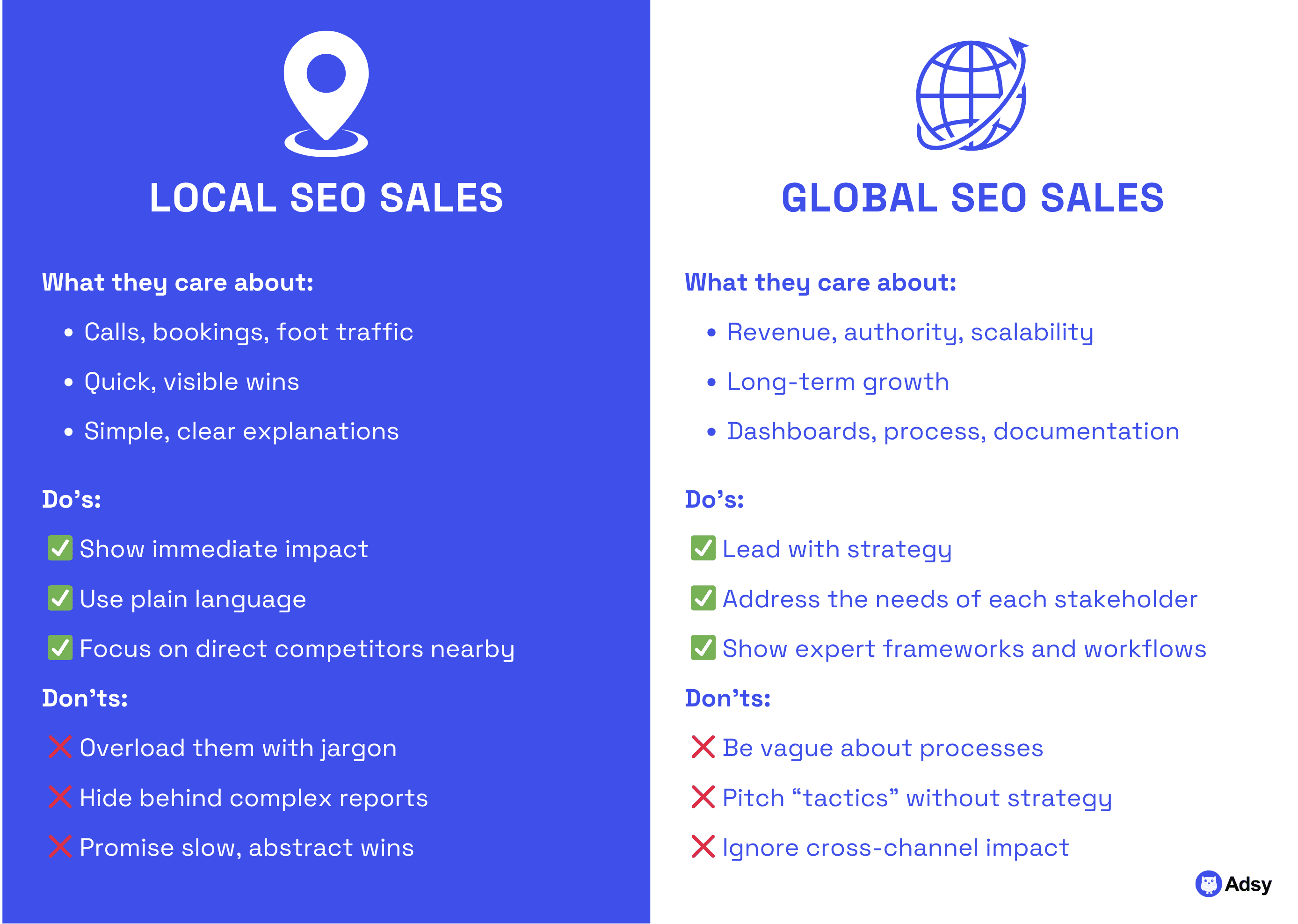
When many SEO experts start thinking about selling their services, they treat every client the same. But it shouldn’t be like this. This is especially true for local and global cases.
Look, we know that you understand the difference between local and global optimization. Sure.
But the issue is that these clients are looking for very different things. And sometimes, when pitching, we forget this, simply because it seems “obvious.” But it isn’t “obvious” for most businesses.
That’s why if you want to sell SEO packages effectively, first, study your target client. And only focus on what they value.
Local SEO: Hyper-focused and relational
... And immediate.
If you’re selling local SEO services, you’re usually talking to small business owners. That's your typical restaurant, coffee shop, dental clinic, or pet store. These companies often rely on foot traffic and local awareness.
So, when these clients decide they need your service, they have very specific expectations.
They want results that feel tangible quickly. They don’t care about traffic from another city or “national rankings.”
But they do care about control and communication. If you make them feel out of the loop, normally, they’ll just ghost you. Even if your strategy is pure gold.
They evaluate ROI in customer actions, and don't think much about your metrics. How many calls, reservations, bookings, or walk-ins? That’s what you should pitch.
Overall, your pitch here should lean into practicality and speed:
- Quick wins are huge. Fixing business listings, cleaning local citations, correcting broken links, and updating meta descriptions. Why? Because these are visible, easy wins that make a business owner feel progress before you fully spin your SEO machine😁
- Relate to the competitive landscape. Show them the direct competitors who are at the top of the local search results. Then, explain why the competition achieved that and how a few strategic adjustments can do the same for them.
- Use language they understand. Avoid technical jargon. We keep mentioning this throughout the article, but that's specifically important for local businesses. Don’t say, “We’ll optimize your schema markup.” What the heck does that even mean?:) Go with, “We’ll make sure customers nearby see your store on Google Maps and search.”
Local optimization is fully relational. So, you have to sell confidence and clarity above anything else.
Global SEO: Strategic and risk-aware
SaaS companies, e-commerce platforms, or enterprises are usually global clients. And they think differently.
Their stakes are higher, budgets are bigger, and decision-making involves more layers.
Often, you have to appeal to their in-house marketers, finance, and other departments, depending on the structure of your target company.
What do you need to keep in mind when it comes to global SEO?
- They are focused on long-term growth and brand authority, and not immediate foot traffic.
- ROI is measured in scalable metrics. Monthly organic revenue, share of voice, and organic traffic that feeds other marketing channels.
- They require documentation and process clarity. Dashboards, timelines, and reporting protocols are very important to show your work.
So, when pitching global optimization services:
- Lead with strategy. Show that you have a hyperorganized framework and workflows. Besides, make sure to study their industry, and show that you understand their challenges.
- Highlight systemic value. Explain how organic search integrates with paid advertising and other marketing efforts. And how you can help them grow steadily.
How to follow up and handle objections effectively?
Once you’ve pitched, the real battle begins: follow-up and objection handling. Unfortunately, this is where most sales die.
Even the most polished SEO proposal can go cold if your follow-up strategy is weak.
1. Understand the psychology of delay
Objections often aren’t objections. They are delays. "Always reject the first offer," as Michael Scott put it once:)
But all jokes aside, clients are often busy, skeptical, cautious, and have several doubts. Maybe because of the reasons we already mentioned above. Or maybe because they’ve been burned by previous SEO providers.
Either way, your job is to “decode” the reason behind the objection, and then address it:
- “Your pricing is too high”: Maybe they don’t see tangible value yet.
- “We’re not ready for optimization”: Maybe they fear the long-term commitment to services they are not sure about.
- “We need to think about it”: Maybe they’re stuck in analysis paralysis or, again, too many people participate in the decision-making process (almost always the case with big companies).
But sometimes, an objection is just a fact. If your pricing is actually high for a particular company, it’s okay. You don’t have to chase every single lead.
Just make sure to look at each situation and decide whether it’s even worth continuing the negotiation.
2. Follow up with value instead of annoying reminders
One of the most common mistakes is when SEO agencies follow up with messages that sound like an annoying calendar reminder:
“Just checking if you had a chance to review the proposal.”
This is boring and easy to ignore. And mostly, your potential clients will ignore that.
What can you do instead? Follow up with something the client can’t swipe away:
- Some industry insights,
- Mini-audits,
- Competitor updates, etc.
Here is an example for a local business:
“We checked your Google Business profile this morning and noticed two duplicate listings. Also, some missing local citations. Fixing them could immediately improve your visibility in Maps searches. What do you say if we outline a quick plan?”
That's actionable intelligence. That's quite personal. And that's... right, hard to ignore.
Note: Again, only do this when it makes sense. It shouldn’t be anything you spend hours on, especially when it comes to a cold lead.
3. Every objection is a chance for collaborative problem-solving
Stop treating objections as roadblocks. Treat them as signals to co-create solutions.
For instance, if a prospective client says:
“We can’t commit to 6 months upfront.”
You could respond:
“I get that. Here’s how we can structure a project-based pricing approach for the first three months. We’ll focus on technical SEO fixes and quick wins, then expand once you see tangible results.”
Notice how this reframes a hard objection into a shared plan. You don't compromise your authority and sound truly collaborative.
4. Anticipate common objections in your pitch
You don’t have to wait for a pushback. Just add answers to all the typical objections to your pitch. And your chances of selling SEO services will get much higher.
Of course, you don’t have to call them “objections.” It could simply be an “FAQ” section.
And it’s always better to give some real-life cases as proof of your words. For example:
- Pricing objections: Show average customer value or ROI calculations upfront. Add some of your previous clients who invested X in SEO and got 10x more.
- Skepticism about results: Introduce a proof wall with past clients and quick wins. Ideally, these should be as relevant to your prospect’s goals as possible.
- Timeline worries: Show short-term wins and how they amplify in the long term. You can also explain what results they can expect in 30 or 60 days.
Look, you already know well what most of your prospects can say.
So, just spend time anticipating objections from a particular type of client. That's a great way to reduce the energy spent convincing (which often goes in vain).
It’s very handy to create a Notion board or any doc to store all the objections.
Ask your sales team, customer support, marketing, and whoever else is involved to add every single objection that you can address later on.

Source: Notion
5. Use intelligent persistence
Follow-ups have a reputation for being spammy. For a good reason.
That's why you have to think over your strategy here:
- Use different channels (but not all of them): Use what works best for your customers. But don’t try to spam them everywhere.
- Time your follow-ups strategically: Not too fast (annoying), not too slow (forgotten). It sounds like a riddle. But in reality, just try to be reasonable and find your middle ground.
- Keep each touchpoint valuable: Even small insights count: a competitor analysis, some missed low-competition keywords, or a quick insight from your audit.
No one likes being sold to. So, don’t be a pushy vendor who’s aggressively selling their services. Instead, try to be a useful resource in your follow-up strategy.
Conclusion
Now you know how to sell SEO services effectively and what pitfalls to avoid. In reality, it’s a lot of trial-and-error.
But what you should always focus on is what makes you special (your unique approach) and how to create the best, most personalized offer for each client.
All trademarks, logos, images, and materials are the property of their respective rights holders.
They are used solely for informational, analytical, and review purposes in accordance with applicable copyright law.




 Sign Up
 Sign Up