






SEO Link Audit Guide: Spot Weak Links Before Google Does
Links can significantly improve one’s search engine visibility and rankings. However, only a few of us fully understand what is required to unlock the full potential of backlinks.
One crucial SEO tool is a link audit. Not as a one-time action, but as a routine, systemic process that helps websites identify and eliminate weak backlinks (before Google does) and spot link-building opportunities.
Curious to know more? Welcome to the SEO link audit guide. Below, we break down how to audit links methodically, spot early risks, and make confident cleanup decisions.
The real job of an SEO link audit
Thinking of SEO link audit as a one-time and pure technical checkup of one’s link health is a common misconception. Links are not static assets; they gain or lose weight depending on context, placement, and surrounding content. A proper audit measures those dynamics instead of just counting URLs.
What a link audit actually evaluates
If your website had a medical chart, the links would be the bloodwork. A backlink assessment tells you whether things are healthy, trending weird, or already on fire (politely, without alarms).
A good review checks where authority is coming from and whether it makes sense. Getting mentioned on random, irrelevant sites might look “busy,” but it rarely helps long-term.
It also checks your site’s internal pathways, including an internal link audit to find pages that are hard to reach or impossible to discover. If your best content is buried, it doesn’t matter how great it is — it’s basically wearing an invisibility cloak.
Here’s what you’re actually measuring in a link profile inspection:
- Relevance of referring pages to your topics.
- Indexation status of linking pages and domains.
- Redirect chains and broken destination URLs.
- Anchor patterns that look unnatural or repetitive.
- Link placement context (footer, body, author bio).
- Internal pages with no links pointing to them.
After that, a good link audit should lead to clear actions: some links to delete, some to improve with minor fixes, and some reclaim, or disavow (when it’s truly needed). It also helps to identify which pages deserve more support, because not every URL should be a “main character.”
Regular checkups make your link-building efforts more efficient. You’ll stop feeding energy into pages that can’t rank, and you’ll start reinforcing the ones that can.
📌 The bottom line: So no, an audit of a link profile isn’t just a technical chore. It’s how you keep your site’s credibility from turning into a messy drawer of random receipts.
Why weak links are more dangerous than missing links
Not having enough links feels scary. However, having the wrong ones is worse.
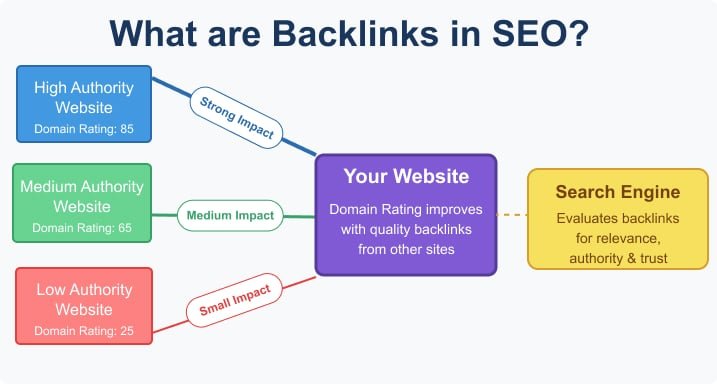
A weak link fails to help and introduces doubt. It suggests relevance that doesn’t hold up under inspection. Google doesn’t take it as a convincing authority signal and will not rank your page high in SERPs.
All search engines use links to understand trust. When those signals come from unstable or mismatched sources, SEO signals become inconsistent.
Weak links also outlive their usefulness. The site degrades, the content thins out, but the association remains.
Typical signs of weak links include:
- Pages with no real audience.
- Content created only to host links.
- Repetitive or generic anchor text.
- Irrelevant topics forced together.
- Linking pages losing indexation.
Another problem is pattern visibility. Weak links tend to cluster and repeat. Those clusters stand out much more than a clean profile with fewer links.
But don’t despair if you find those issues on your website. Missing links simply mean opportunity, while weak links will require you to do some work — removals, and finding better linking options. Remember, fewer strong links age better than many fragile ones.
Protecting link quality first gives you freedom later. Growth is easier when you’re not dragging baggage behind you.
Source: Outrightcrm
When a link audit becomes a ranking safeguard
A link audit turns into a ranking safeguard at the exact moment you stop using it as a repair tool. If you only look at links when traffic drops, you’re already late.
Search visibility usually slips slowly. Not dramatically. Small changes pile up until something finally goes horribly wrong. It’s already too late to make small corrections.
Regular link reviews help you notice bad signals while they’re still boring. And boring is good — boring means fixable.
You usually see protection kick in when:
- Rankings flatten instead of growing.
- Link growth doesn’t match content priorities.
- Old assets (articles, posts) quietly lose support, i.e., are not updated.
- Internal paths no longer reflect importance.
- External links feel random rather than earned.
Leaving these emerging problems as is, especially individually, doens’t seem like a big deal. But eventually, when they compile, they may cost you online visibility.
When you review links early, decisions stay simple. Essentially, you play a prevention game that saves you from expensive damage repair.
Preparing your backlink data for auditing
To evaluate something, you must get it ready for the evaluation procedure. With link auditing, you need to consolidate the available links, break them down into external and internal links, and, when the audit is complete, filter noise before making important decisions.
Choosing reliable backlink data sources
Before you can audit anything, you need to agree on one thing: not all backlink data deserves your trust. The links that come from unreliable data sources must be the first candidates for exclusion from auditing.
Furthermore, most SEO mistakes at this stage come from blind faith in a single tool. Tools are useful, but they don’t see the web the same way, and they definitely don’t miss links equally.
That’s why your task is less about finding an ideal tool (nothing is perfect) and more about leveraging their cumulative strength. Basically, you need to run several tools (e.g., SEMrush+Ahrefs+Moz Link Explorer) together and analyze their findings holistically.
At a minimum, your findings should cover:
- Which links are new, old, or already gone.
- Where exactly the links live, page by page.
- How those pages describe your site via anchors.
- Whether links pass value or just exist.
- Pages that Google can still crawl and index.
- Conflicting data points between tools.
Search Console belongs in the service mix too, even if it feels limited. It shows which links Google actually processes, which adds context to everything else.
The trick is overlap. When multiple sources report the same link, confidence increases. When only one reports it, you slow down and inspect.
This isn’t wasted time. It’s risk control. You minimize the chances of missing something important by combining the intelligence potential of several top tools. You should do so even if it costs you pro-level subscriptions (in fact, it almost always does).
Consolidating and deduplicating link lists
Backlink lists love to exaggerate. Not maliciously — just mechanically. The same link gets counted again and again, dressed up in slightly different URLs and metrics.
During an SEO link audit, consolidation is how you take that exaggeration away. It’s the necessary step, provided you want to get meaningful and measurable outcomes from your audit.
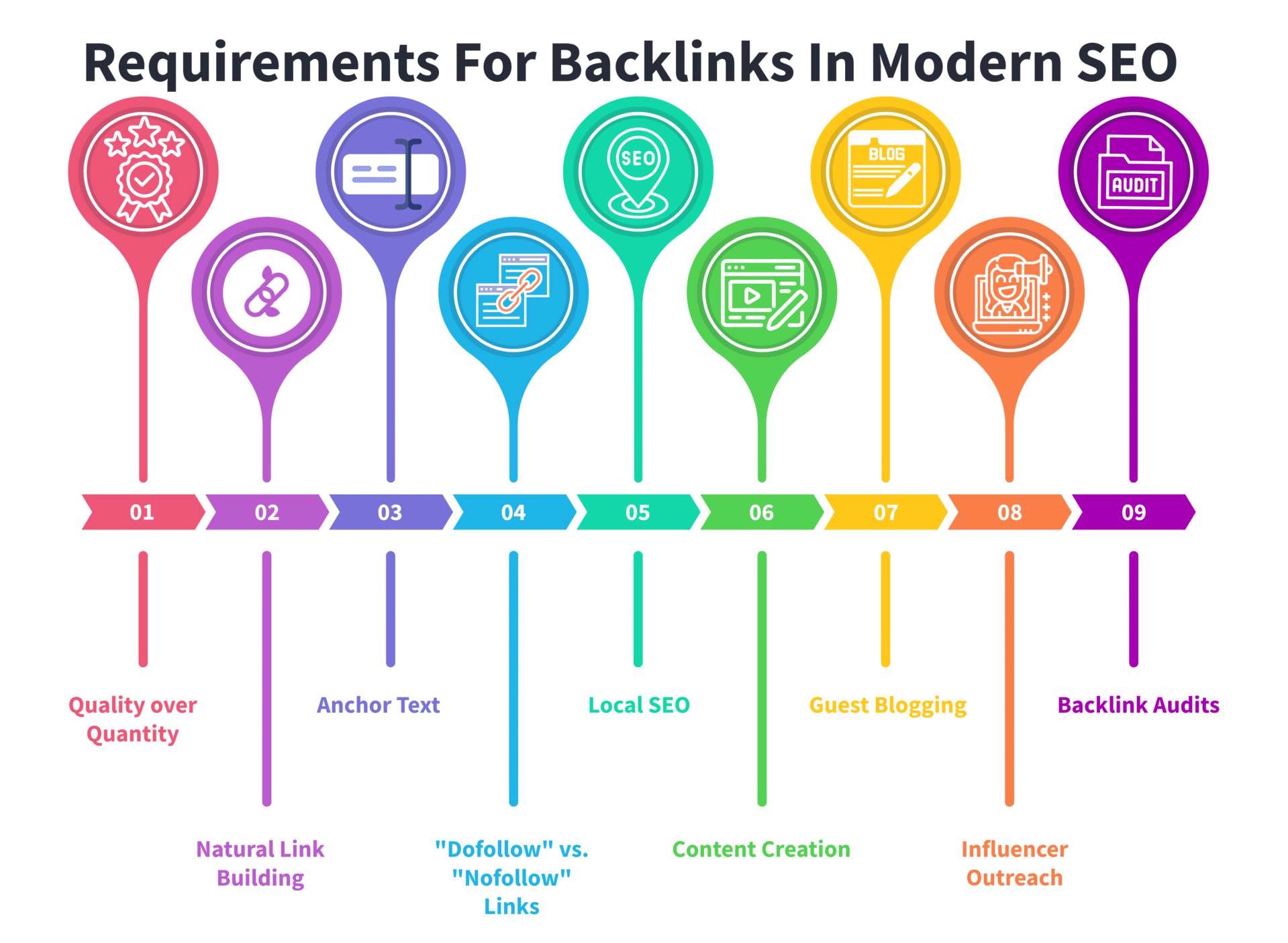
This step usually involves:
- Merging multiple tool exports (at least the three ones discussed in the earlier chapter).
- Normalizing URL variations to have several groups that exhibit the same qualities.
- Removing repeated links to the same page.
- Grouping links by actual source.
- Identifying overlaps across multiple datasets.
Once duplicates disappear, something interesting happens: the profile looks smaller, but clearer.
That clarity is powerful. You can see where links cluster, where support is thin, and where risk concentrates.
More importantly, you stop making decisions based on inflated totals.
From here, the audit becomes thoughtful instead of reactive. And that’s exactly where you want to be before making any real calls.
Source: Emerginssoftware
Filtering noise before making decisions
Noise is the enemy of good judgment. And backlink data produces a lot of it.
Once everything is merged, the instinct is to fix everything at once. That instinct is understandable, but it’s wrong.
Filtering is about deciding what deserves your attention today — and what can be ignored safely. Your energy is not unlimited, and your time costs money. So, be very deliberate about what you choose to work on.
That said, common noise candidates include:
- Links that never passed value to begin with.
- Pages clearly created for automation.
- Minor URL variants pointing to the same source.
- Links that don’t align with ranking goals.
- Data points that appear in only one tool.
Filtering doesn’t mean deleting rows blindly. It means tagging, grouping, and deprioritizing.
After this step, the list becomes readable. You can scan it and actually understand what’s happening. The decisions you make will be based on things that are really important, and the people or organizational capabilities invested will be applied with a maximum return.
Evaluating link quality beyond basic metrics
Looking deeper than the basic metrics can give is no longer a nice-to-have practice; it’s an essential competitive advantage one can get in a world where everyone runs basic link audits and fixes the same (or even more) errors than you.
Assessing topical relevance and context
Not all links are endorsements. Some are just decorations. A high-metric link in the wrong place is still the wrong link. Numbers don’t fix a mismatch.
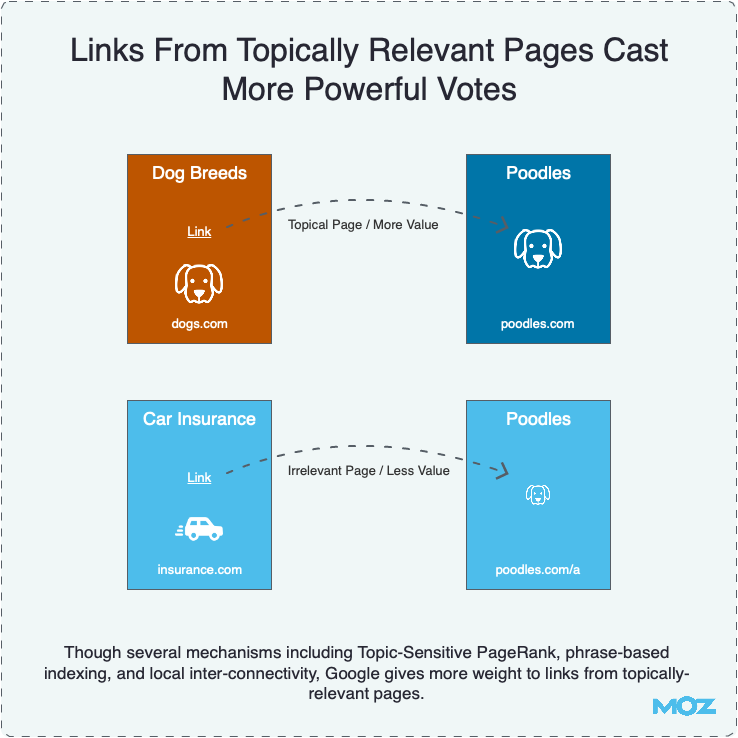
Two important metrics stand out here: topical relevance and context.
- Topical relevance separates meaningful connections from filler. It’s the difference between “this helps” and “this is here.” If your backlink doesn’t fit the current copy’s topic, it won’t deliver any link juice, regardless of how relevant it is or how appropriate the anchor text is. Even the authority of the connected source won’t save your day.
- Context tells search engines why a link exists. A link surrounded by related ideas carries weight because it reinforces meaning, not because of a score. And it goes without saying — a link placed in the right topic and the right context is worth several other links that don’t share the same qualities.
Source: Moz
This is where an internal link audit becomes useful beyond structure. It shows whether pages connect because they’re related, or just because someone needed a place to put a link.
When assessing relevance and context, you usually look at:
- The topic of the linking page, not the domain.
- The paragraph where the link appears.
- Whether the surrounding content supports the destination.
- How naturally the anchor fits the sentence.
- If similar pages link in similar ways (if other links also live up to the same high standards).
Links that feel forced rarely improve understanding. They just sit there, tolerated at best.
Once you train yourself to see relevance and context, weak links stand out immediately. And removing or fixing them becomes an easy decision. It should become a routine process, a seemingly insignificant duty that, nevertheless, has immense potential to make your backlink profile stand out from your rivals.
Identifying natural vs forced link placements
If a link needs explanation, it’s probably not the best link or not the best context for this type of link. You shouldn’t add extra paragraphs or even sentences to accommodate a link in your text; it should fit there naturally, just by highlighting a certain part (anchor text) of the existing text.
Natural placements come easily, while the forced ones may take loads of time and still look artificial.
SEO benefits the most when links provide real value to real users. Modern search engines use smart algorithms that “understand” that logic and rank backlinks accordingly.
You can usually spot forced placements by checking:
- Whether the paragraph loses meaning without the link.
- If the anchor explains the destination clearly.
- Whether similar links appear unnaturally often.
- If the link serves the reader or the page.
- How the sentence sounds when read aloud.
Furthermore, natural links survive editing. Forced ones get cut first. Here is a useful test you can borrow: would this link survive a ruthless editor, a hard-nosed one?
When you start asking that question, or better, give it to a real editor for proofreading, link quality improves fast. Not because of rules, but because of proper link hygiene, which becomes a self-fulfilling ritual, the one that brings a sense of accomplishment.
Recognizing links that age poorly over time
Links age the same way content does. They come from pages that once made sense but slowly drifted away from your space. No penalty, no warning, just diminishing value. They age, just like humans do. Consider that a natural process.
You should run link diagnostics to identify age-related problems and take corrective measures (medicine) to revive and make the links healthy again. Time-based audits are one type of diagnostics that prove their worth. You’re no longer judging links in isolation, but in context.
Links that age poorly often show up as:
- Pages frozen in time.
- Sites that stopped publishing quality content.
- References surrounded by irrelevant updates.
- Domains repurposed for unrelated topics.
- Content that no longer earns attention.
Nothing here looks dramatic. That’s the problem. You need to know what to look for and which questions to ask to understand if your link profile is underperforming.
Bad links quietly dilute relevance rather than destroying it outright. Catching them early gives you breathing room. You can decide what to keep, what to reinforce, and what to let go.
And that breathing room is what keeps link management from turning into crisis work. It’s about affordable risk mitigation, not costly damage repairs. You simply diagnose link problems well before Google does that for your site and ranks it poorly in SERPs.
Spotting weak links before they become liabilities
If Google spots weak links first, it will automatically translate into lower rankings for your pages. And Google does monitor link quality daily, so what can you do to be faster than its restless crawlers? You can watch for and identify early signs of link quality decline: patterns of diminishing link value, links with hidden risks, and bad-performing anchor texts.
Patterns that signal declining link value
Most link problems aren’t sudden, nor do they happen once. They’re repetitive, and, for that toke, can be anticipated in advance.
Declining value shows up when links start to look similar in the wrong ways. Same types of pages, same quality level, same lack of engagement.
A proper SEO link audit looks for those repetitions before they turn into Google’s assumptions about your site. When that happens, it’s already too late to do the risk management; it would be high time for costly damage repair.
Common early patterns include:
- Links clustering around low-effort content.
- Referring pages losing topical focus.
- Sites adding more ads than substance.
- Links remaining live but losing relevance.
- Authority concentrating in the wrong places.
Individually, these links seem harmless. Together, even if only two or three of them are present, they change the link profile’s tone. That tone shift is what search engines pick up on.
Spotting it early lets you rebalance before anything breaks. You strengthen what still works and reduce exposure elsewhere. That’s how audits become preventative instead of reactive.
As Benjamin Franklin once famously put it, “An ounce of prevention is worth a pound of cure.”
Links that look fine but carry hidden risk
Some links survive purely because nobody touches them.
They aren’t broken. They don’t throw warnings. They just sit there, doing what they’ve always done — which might not be what you need anymore.
That’s where hidden risk lives. In links that still function but no longer mean anything. It’s like investing in a training or skill that is no longer relevant. You are still proud of your computer science diploma, but in the rapidly changing world, where tech knowledge becomes outdated annually, that education is no longer useful.
This happens a lot with internal links added during earlier content phases. Back when the site had different priorities, different goals, different logic.
You usually know it’s happening with your links by observing the following signs:
- Old articles keep getting attention they no longer deserve.
- Important pages rely only on navigation.
- Links exist without a clear reason.
- Nobody remembers why the link was added.
Drift doesn’t trigger penalties. It triggers underperformance. And underperformance is harder to diagnose than failure. But search engines don’t care why your links underperform; they just treat that as a sign of a weak link profile and rank your website accordingly. It doesn’t show up in the first positions in SERPs, nor in the Featured Snippets, or AI Overviews.
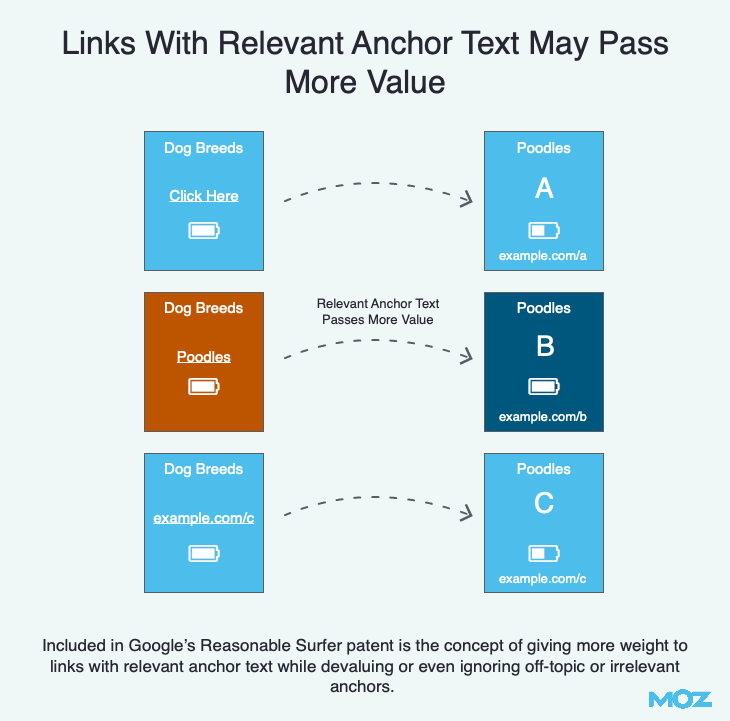
Early warning signs in anchor text and placement
Good anchor text feels invisible. Bad anchor text makes you reread the sentence. That second read is the signal. It’s similar to a properly functioning mechanism (or organism, e.g., a human body) — when everything is fine, works as expected, we don’t notice it. But when something breaks, it gets our attention immediately.
Source: Moz
Placement works the same way. If the link interrupts the thought, it’s already asking for too much attention.
Early warnings often come from scattered patterns, not single mistakes:
- Anchors that sound identical everywhere.
- Links clustered near headers or footers, in the intros and conclusions.
- Awkward-looking keywords, replacing natural phrasing.
- Multiple links fighting for attention inside one paragraph.
- Links added where examples should be.
These don’t look aggressive. They look lazy. Lazy linking doesn’t kill rankings. It erodes clarity.
Fixing it early is mostly editorial work. You rewrite a sentence. You move a link. You remove one that doesn’t earn its spot. Small changes. Big difference over time.
Deciding what to keep, fix, or remove
Not all even low-performing links deserve a trash bin. Some might just need a little fix to resume pumping link juice. The decision in each particular case must be grounded in data and your SEO plans. When to use what is an inquisitive ambition of the current chapter.
Links worth preserving despite low metrics
Some links survive audits because nobody notices them. Others should survive because removing them would make the content worse.
That distinction gets lost when metrics drive decisions. It’s easy to remove a link because the data tells you so, and it’s much harder to analyze the data and keep the link, perhaps, with some minor tweaks. After all, a low-scoring link can still be correct. It can still belong exactly where it is.
This comes up a lot in link auditing, especially when the goal changes from “evaluate” to “reduce.”
How do you know when a link is worth keeping? Links worth keeping usually exhibit the following qualities/behavior:
- Read naturally when you encounter them.
- Don’t interrupt the sentence/paragraph.
- Point to something that still fits the context very well.
- Don’t feel like they were added later with relevant (and awkward) changes to the content.
As a saying goes, “It’s easier to run something than to build.” The same is with backlinks — removing is as easy as a single click, but connecting the scattered pieces of your content together takes much more time. And there is another saying that says, “Don’t try to improve what's already working fine.”
When outreach and edits make sense
Outreach is a highly effective link-building tool that enables you to connect with publishers within your niche to share and contribute to your content, ideally positioned for readers who already engage with related topics and benefit from the reference.
But just because a link could be improved doesn’t mean someone on the other end wants to hear from you. Or should. You need to make an effort to convince them to do so by pitching your link-building ideas that perfectly align with their topics and audiences.
Edits, on the other hand, make sense when the relationship already exists in some form — topical, editorial, or historical. Cold requests for “small fixes” rarely land well.
You usually consider doing outreach seriously when:
- You need visibility across many relevant publishers.
- Your current, mostly manual outreach no longer scales with content volume.
- Internal teams lack time to manage publisher research and follow-ups.
- Campaign timelines require faster, controlled placements.
The hardest skill here isn’t writing emails. It’s knowing how to persuade without sounding annoying and how to scale your efforts.
This is where using a professional content distribution service can help, not only because it scales messages, but also because it helps you cover more publishers with higher-quality content.
Your outreach must be repeatable and predictable, not a one-time and ad hoc action, no matter how successful it may be.
When disavowal is the least risky option
Disavowal is what you do when a link refuses to improve.
You use it when a link can’t be fixed, can’t be explained, and definitely can’t be trusted. Not because it looks bad in a tool, but because it keeps showing up in the wrong patterns.
This usually happens when links come from places that no longer behave like real sites. No editorial intent, no audience, no consistency.
At that point, outreach doesn’t help. There’s nobody reasonable to talk to.
Disavowal becomes the least risky option when leaving the link creates more uncertainty than removing its influence. You’re not trying to be aggressive — you’re trying to be clear.
It’s not about volume. It’s about drawing a boundary. And once that boundary is drawn, the rest of the profile becomes easier to judge.
Turning audit findings into a long-term SEO strategy
SEO link audit will flood you with expected and unexpected findings, but how do you make sure you don’t use them for reporting only?
Good results are often used by marketing teams to celebrate and… do nothing. It’s easy, but that's not the main point of a proper audit. It typically uncovers plenty of opportunities for development as well, but those opportunities stay theoretical unless they shape what you do next.
Building feedback loops between audits and link building
An audit without follow-up is just a snapshot. Useful once. Useless long-term.
The real shift happens when audit findings start influencing what links you pursue next. Not abstractly. Practically.
If weak links keep showing up from a certain type of site, you stop targeting similar ones. If strong links cluster around a specific content format, you produce more of it.
That’s the feedback loop. Usually, it goes like this: Audit → adjust link targets → build → audit again. Simple in theory. Rare in practice.
In practice, that means:
- Stopping replication of links that aged poorly.
- Doubling down on placements that stayed relevant.
- Adjusting anchor strategy based on real outcomes.
- Rethinking formats that consistently underperform.
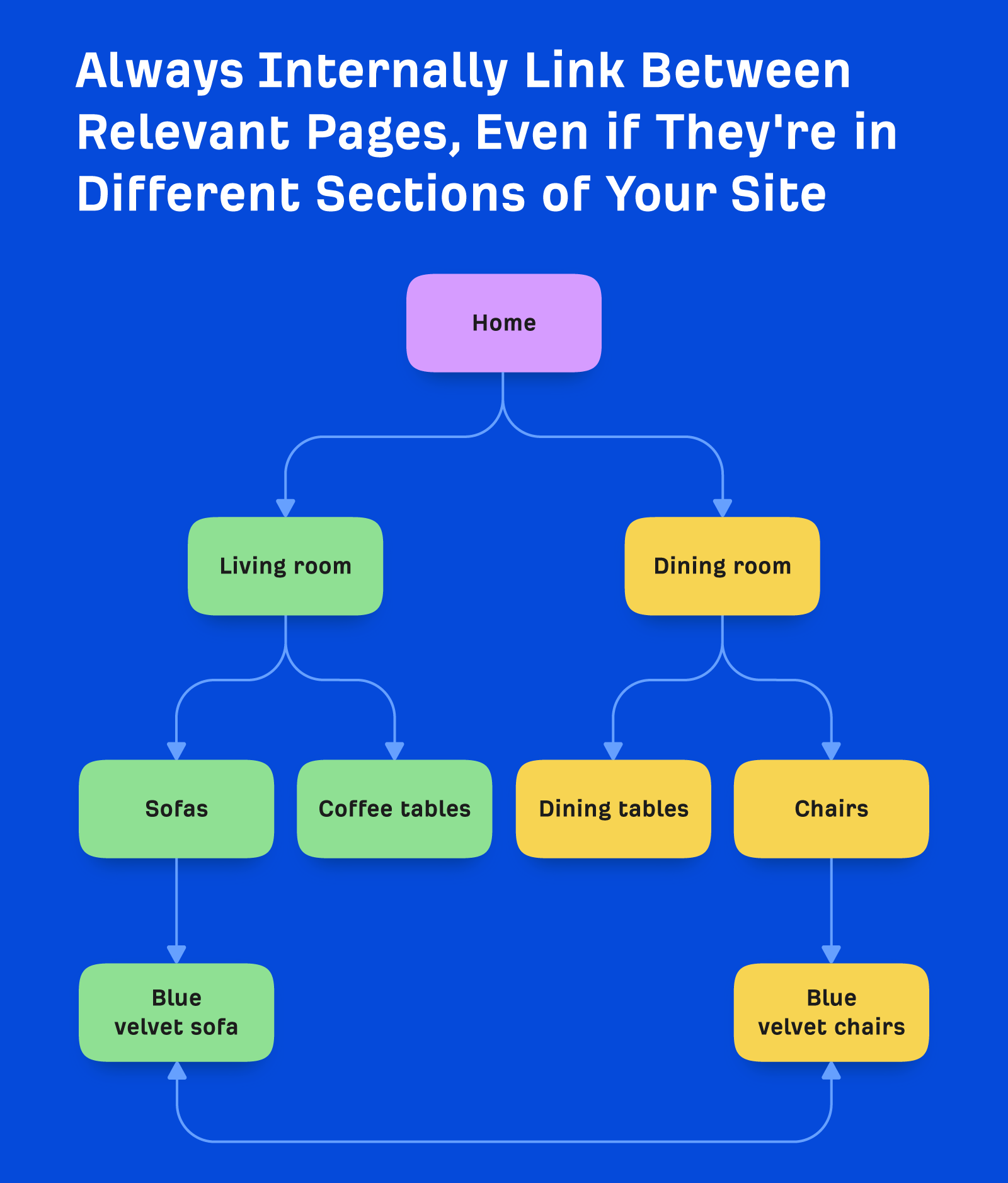
- Strengthening the internal relevance of your pages by linking them together.
Source: Ahrefs
Without this loop, teams repeat the same mistakes with better documentation.
Most teams separate auditing and link building into different workflows. That way, audit results have their own life, completely detached from the action embedded in the marketing plans.
When the two talk to each other regularly, real development happens. Action planning upon audit findings takes time and team effort, but it’s the only mechanism of progress.
Adjusting acquisition tactics based on audit results
Audit results are only useful if they motivate you enough to change something.
Most teams read them, nod, and go back to the same acquisition habits. Same sites. Same formats. Same assumptions.
That’s auditing for the sake of auditing, not improvement and progress.
Acting upon results means making some real changes, sometimes uncomfortable ones. If certain link types decay faster, you stop chasing them. If some placements stay relevant longer, you lean in. This is where SEO gains start to show up.
Changes don’t have to be dramatic to bring measurable improvements. Usually, these actions suffice:
- You tighten the rules for selecting link-building prospects.
- Simplify your content formats (focus more on those that drive results).
- Same for outreach targets — fewer, but better quality.
Oftentimes, real adjustment looks boring from the outside. Internally, it saves time and risk. Small changes compound, and it's the repetitive action planning and improvement process that matters, as opposed to a one-time undertaking.
Scheduling future audits without overcorrecting
The easiest mistake after an audit is doing another one too soon.
Seeing issues creates momentum and motivation. That often quickly translates into the desire to repeat the assessment to confirm findings. Over time, this may turn into a self-fulfilling ritual when companies run audits weekly, monthly, or bimonthly, but they come poorly prepared (with no lessons learnt from the previous audits).
The key problem with that pace is that links take time to adjust. They don’t change meaning overnight. Most signals need time to settle before they tell you anything useful.
Audits should be scheduled to observe trends, not chase fluctuations.
That usually means:
- Giving changes time to take effect.
- Letting new links age before judging them.
- Avoiding cleanup cycles triggered by short-term noise.
- Reviewing patterns, not single outcomes.
Over-auditing creates false urgency. Every small movement starts looking like a problem.
Spacing audits properly keeps decisions grounded. You’re checking direction, not micromanaging.
Besides, over-auditing tends to involve more and more people doing data collection, analysis, and reporting. Either this, or you hire an external SEO agency that runs the audits for you, but that is a serious additional budget drain you need to be worried about.
Conclusion
SEO link audit is an effective tool available for all marketing teams that enables them to quickly spot and fix major link problems. When done regularly, it can have a serious performance-boosting effect and greatly improve key SEO metrics.
However, the key in this process is not the audit itself, but what you do with the findings. Some teams celebrate good results and do nothing with the bad ones. Others act upon discovered weak areas and explore uncovered opportunities.
It’s not hard to tell which team gets the upper hand in the long-term competition for search visibility and authority.
Other key takeaways from this guide include:
- Links act as dynamic assets; they change over time and rarely retain the same value for long.
- Catching issues early keeps SEO calm instead of reactive.
- One tool is never enough to understand backlinks properly.
- Without cleaning the data first, you’re basically guessing.
- Relevance and placement tell you far more than scores ever will.
- Some links fade slowly and quietly, which is why they’re easy to miss.
- Not every low-performing link needs to be removed — some just need care.
- An audit is only useful if it changes how you build links going forward.
Link auditing should be an ongoing process, creating a cycle, or the so-called feedback loops between identified problems and relevant SEO fixes. The latter often involves guest blogging, disavowal, and adjusting link acquisition tactics.
The key is to plan a further audit, not sooner than all the action planning upon the previous one has been fully implemented and given enough time to show a measurable impact.
All trademarks, logos, images, and materials are the property of their respective rights holders.
They are used solely for informational, analytical, and review purposes in accordance with applicable copyright law.




 Sign Up
 Sign Up