






Recent Content Marketing Examples: Dissecting 3 Brand Strategies That Got It Right
Each year, the number of brands grows across every industry. And with that, competition grows too.
Some brands survive and even become dominant. Others disappear before they even get a chance to grow.
One of the key differences between these two is their content marketing strategy.
There is no simple template that works for every brand.
To succeed, you need to find a unique approach. A focus that can become the core of your strategy.
In this article, we’ll examine three examples of content marketing strategies that helped these brands grow significantly in recent years.
We’ll dive into the following businesses:
- K18 (beauty & haircare industry): A brand that began scaling its content marketing strategy to reach a wider audience only one year after launch.
- Miro (B2B collaboration software): Users themselves showed the brand how to turn the platform into something much bigger.
- Wanderlog (travel planning app): A brand that stopped doing their own socials completely. But still grows and attracts new users through UGC.
We’ll look at each strategy in depth, from start to finish.
This will help you understand how different content marketing strategies work. You’ll also find the exact tactics you can implement in your own content marketing strategy.
K18 content marketing strategy: Influencer & social media marketing focus
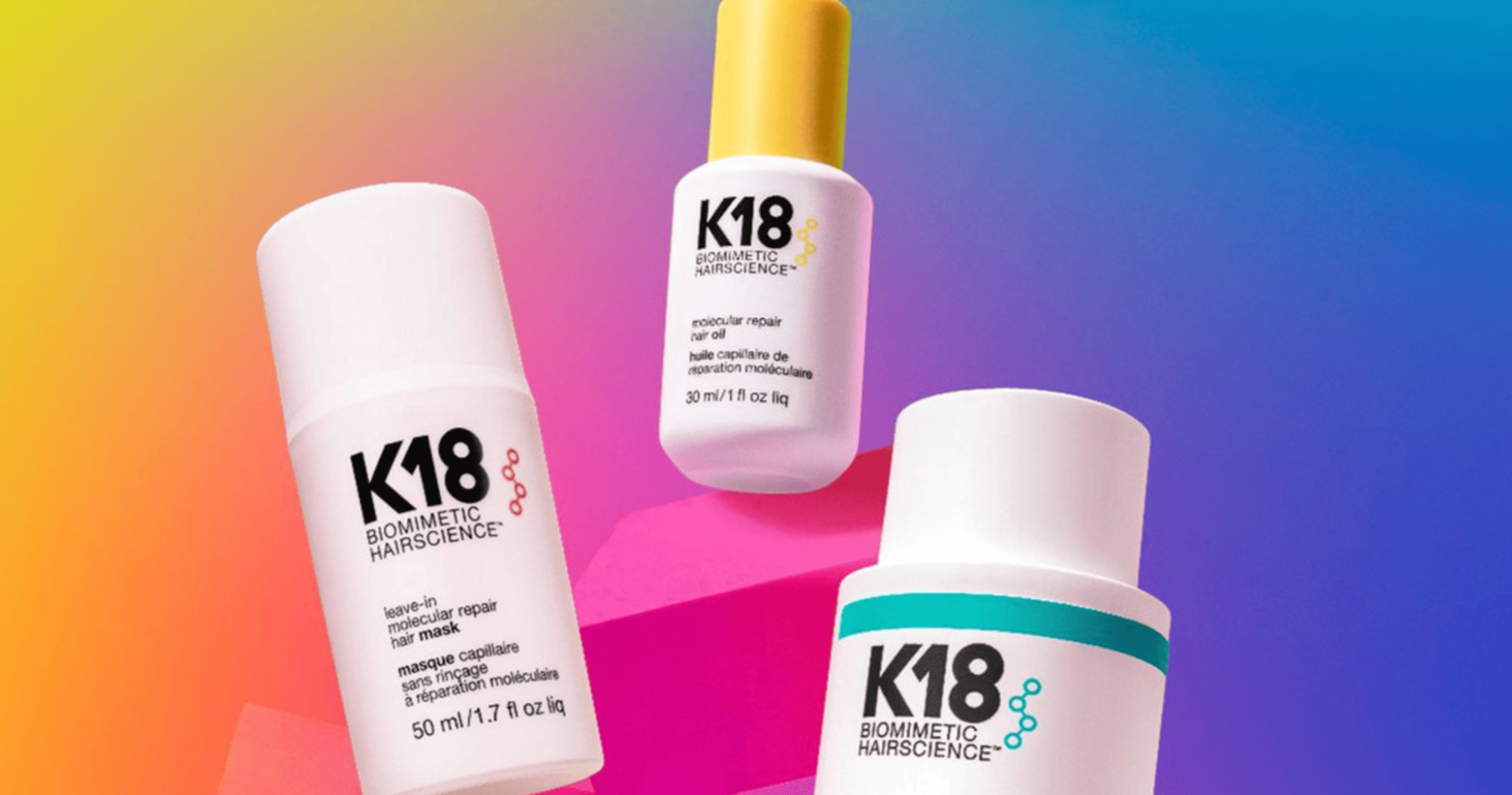
Source: K18
Key lessons
- Try to find or build a unique element of your brand’s story.
- Focus on niche experts and communities first. Build your presence there before reaching a wider audience.
- Educate people across channels and show how your product solves their problem.
- Don’t just create content for the platform. Create content people can participate in.
- Choose creators who can make your product part of their story. Not just creators who can put your product in front of more people.
- Don’t use your website only to sell. Use it to show your expertise and to build trust around your brand.
- Use emails to reinforce the story that makes your brand different. Then support that story with real proof.
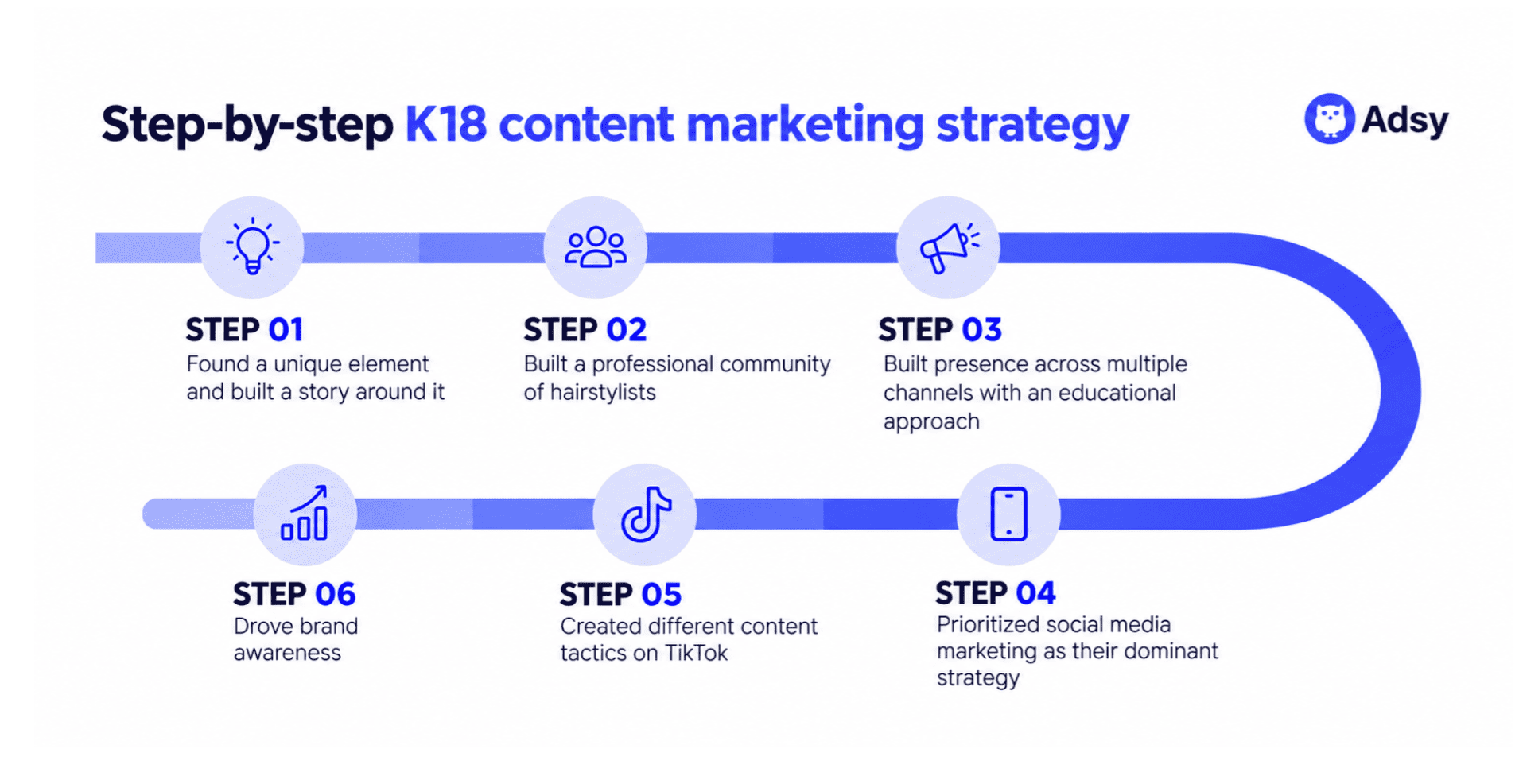
Here is how K18 implemented this step by step:
About the brand
K18 was founded in 2020 by Suveen Sahib and Britta Cox. Within just a few years, it became one of the most recognizable names in premium haircare.
And as you may know, the haircare industry is huge. There are thousands of brands competing for people’s attention. That’s exactly why K18 is such a great digital marketing content example.
But how did a relatively young brand build so much awareness and demand in such a short time?
- K18 didn’t start with millions of followers. Or become successful just because one of its videos went viral.
- It also didn’t have decades of heritage like L’Oréal or an established luxury status.
There was a strategy behind it.
In fact, K18’s SVP of Global Marketing, Michelle Miller, says that the brand mainly prioritized top-of-funnel brand marketing over paid advertising from the beginning.
They focused on building a strong professional and social community around the brand.
But how exactly did they do that?
Positioning
Key lesson: Try to find or build a unique element of your brand’s story.
Instead of competing with traditional beauty brands on packaging and ingredients, K18 found a different way to stand out.
It positioned itself around biotechnology and molecular hair repair.
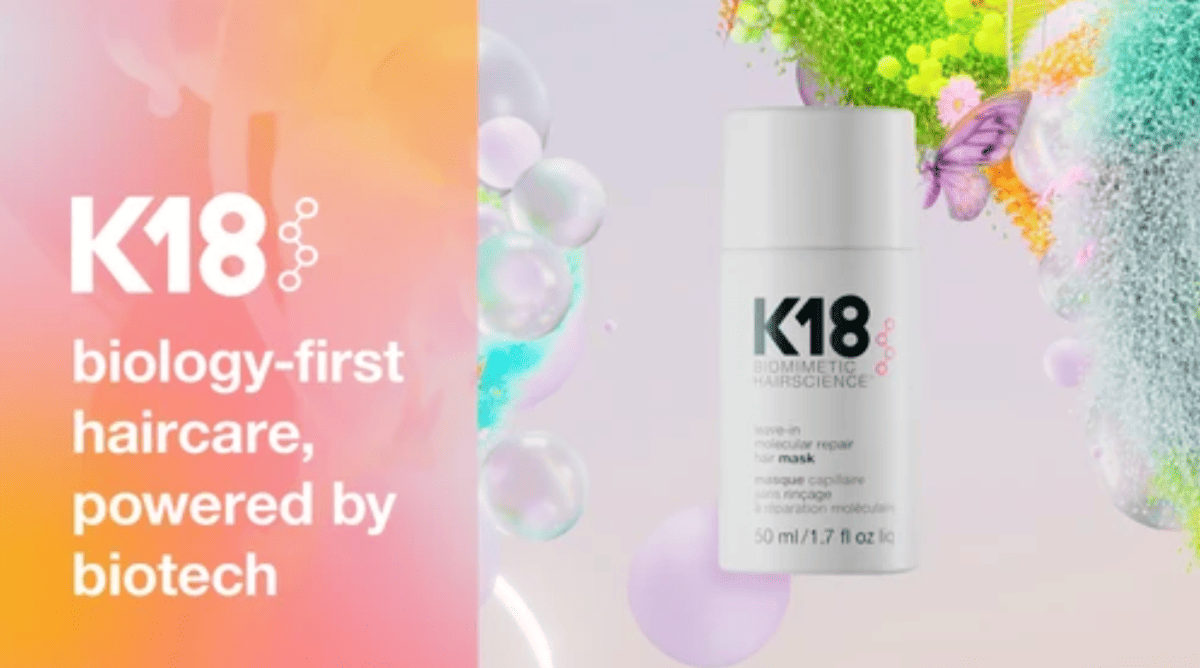
Source: K18
This became the foundation of the brand’s story.
Britni Bird, Director of editorial content at K18, says that they wanted to be seen as a biotech company with applications in haircare. Not as a haircare company that simply uses biotechnology.
This unique element gave them a lot of content to share.
K18 turned its science into storytelling.
Across its campaigns, the brand talks about:
- What happens to hair when it becomes damaged
- What happens at a molecular level
- Why chemical services affect the hair
- How K18’s technology works
- How the product fits into a haircare routine
This gave the brand a much stronger story than simply saying: “Our product makes your hair healthier.”
Professional community
Key lesson: Focus on niche experts and communities first. Build your presence there before reaching a wider audience.
Even though K18 had a strong story foundation from the beginning, the brand was still unknown.
And it’s the sad truth: no matter how good your product is, it’s still nothing to the majority of people if they don’t know about it.
To change that, you need some kind of distribution.
At this stage, K18 started differently than many other brands.
Instead of spreading its content everywhere, it primarily focused on a specific niche: hair stylists.
Michelle Miller explained that K18 first focused on finding professional hairstylists who would try the product first. And eventually fall in love with it and become advocates for the brand.
This became a major part of K18’s early marketing.
The brand entered the market as a professional-first company. It first built its reputation among haircare professionals and experts. Then, it expanded into consumer marketing.
According to Miller, the brand’s core hairstylist community eventually drove around 40% of K18’s earned media value.
K18 also created K18 Hair Pro.
It is a dedicated platform for professionals. There, hairstylists could access resources, education, certification, and industry information.
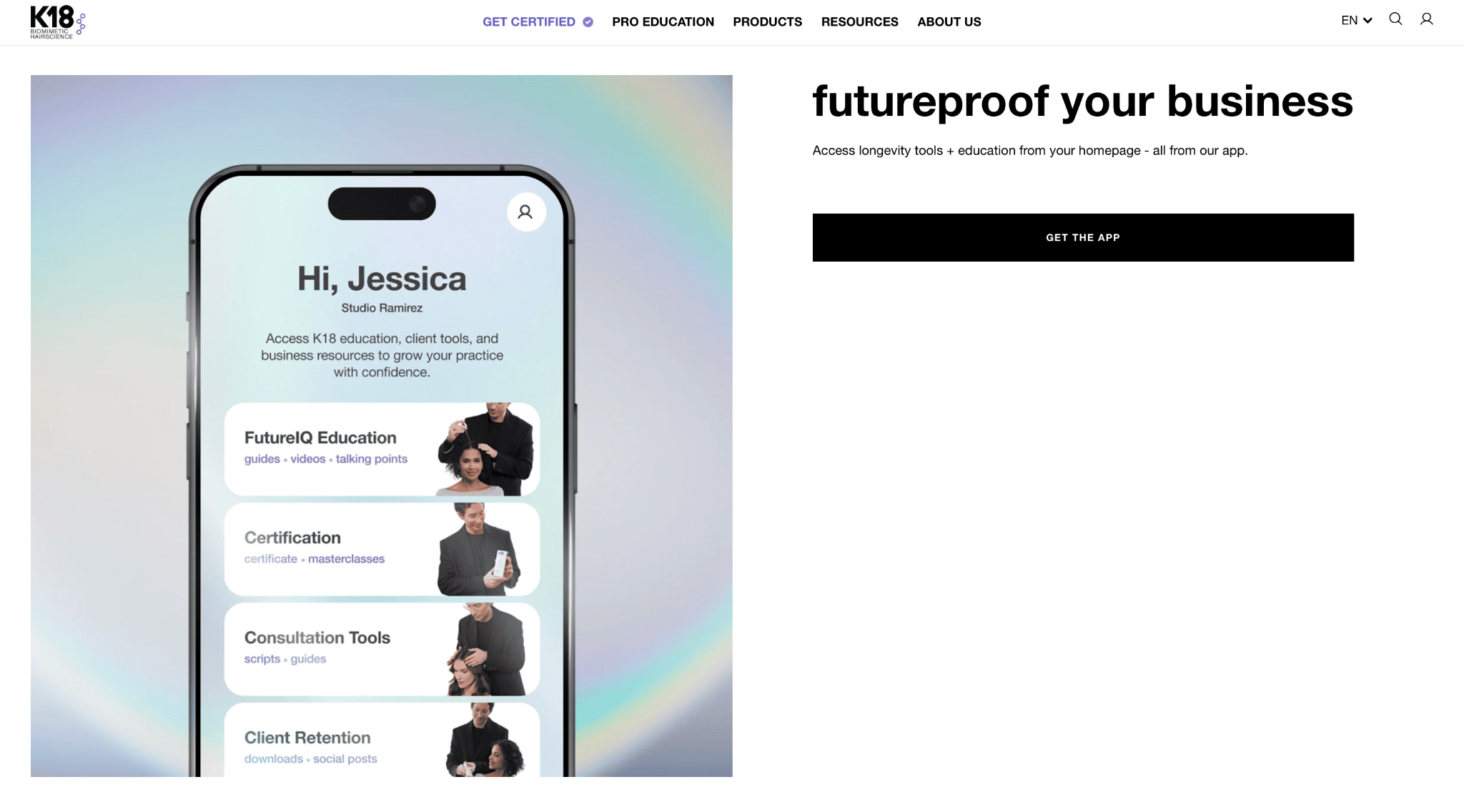
Source: K18 Pro
So, K18’s first “influencers” weren’t celebrities.
They were professionals who actually worked with hair.
Those hairstylists could share the brand on their social media. Or simply tell their customers about the product.
The brand started building its marketing strategy to reach everyday consumers only a year later. When the brand launched at Sephora for the first time.
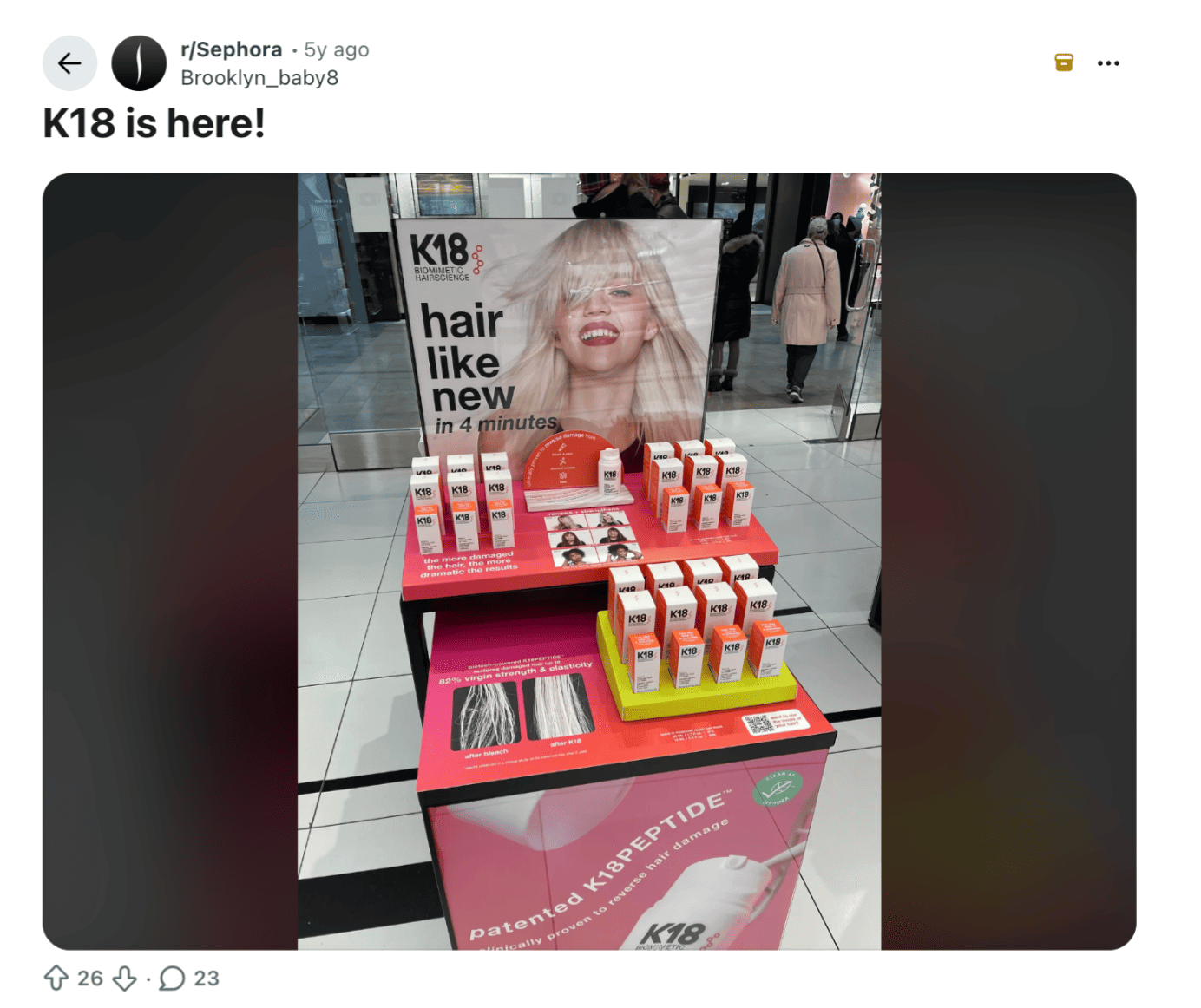
Source: Reddit
Multichannel presence to educate first, then promote
Key lesson: Educate people across channels and show how your product solves their problem.
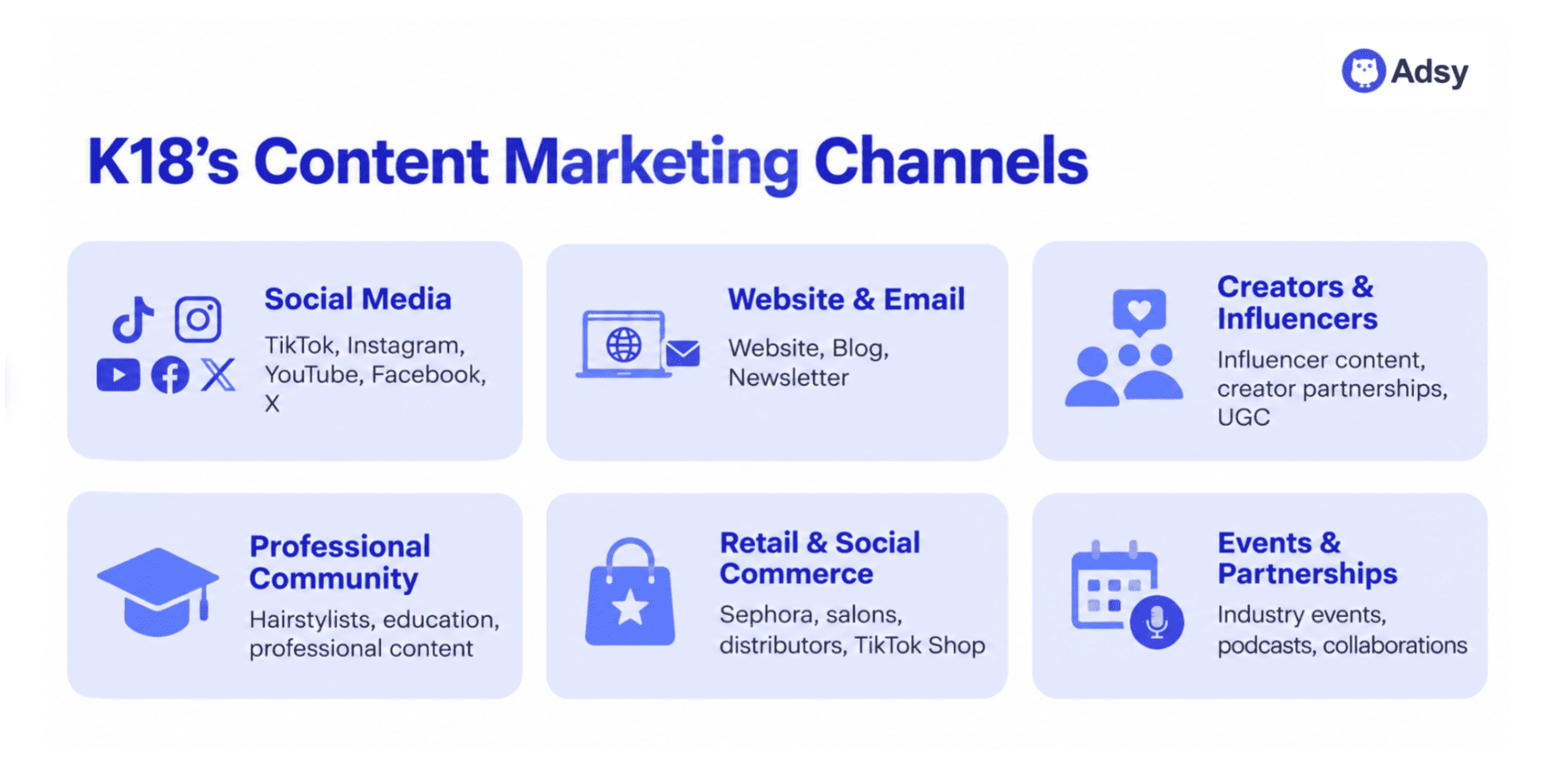
Education is the major element of K18's content marketing strategy.
One of the key pillars of K18’s content is the science behind hair and haircare products. No matter the platform or channel, the goal is to teach first.
The brand spreads this approach across multiple channels:
- Social media: Instagram, TikTok, YouTube, Facebook
- Website & blog: educational content, hair science, SEO
- Email marketing: educational, promotional, and product-focused campaigns
- Influencer & creator marketing: creator partnerships, product demonstrations, UGC
- Podcasts & long-form video:podcasts, interviews, educational videos
- Professional community: hairstylists, salons, hair professionals, professional education
The format changes depending on the channel.
But the main message stays the same: educate people about hair science and show them how K18’s technology can solve their hair problems.
Social media marketing
Key lesson: Don’t just create content for the platform. Create content people can participate in.
K18 went deeper into social media marketing when the brand realized it was ready to introduce itself to a much larger audience.
By that point, it had already built credibility among professional hairstylists and salons.
But even though it wasn’t their primary focus, their socials became one of their dominant digital marketing content strategies later on.
TikTok
K18 was especially early to TikTok.
For the brand, this platform became one of the primary places where users could discover them.
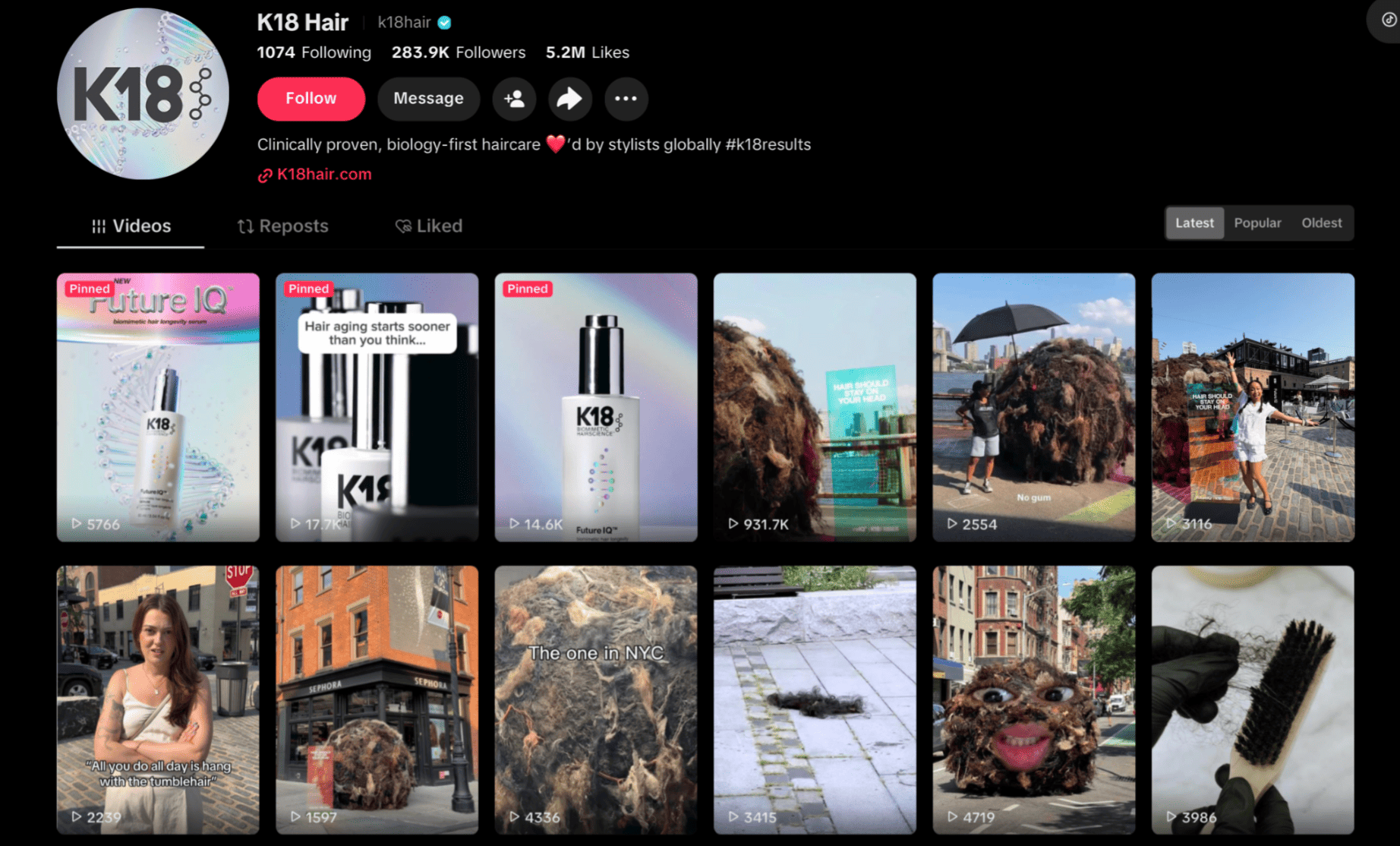
K18’s CMO Michelle Miller said the company was “doubling down on TikTok when none of the other hair-care brands were doing it.”
They didn’t just start posting tons of random videos and hope that one would go viral.
Instead, they thought carefully about their strategy.
They created multiple campaigns with one main goal: to encourage people to participate.
Here is one of the early K18’s TikTok campaigns:
First, the brand decided to create demand and awareness for its hero product, the Leave-In Molecular Repair Hair Mask.
Instead of simply following existing trends, they created their own TikTok challenge: #K18HairFlip. K18 also created an original song and invited TikTok users to show off their hair flips using the sound.
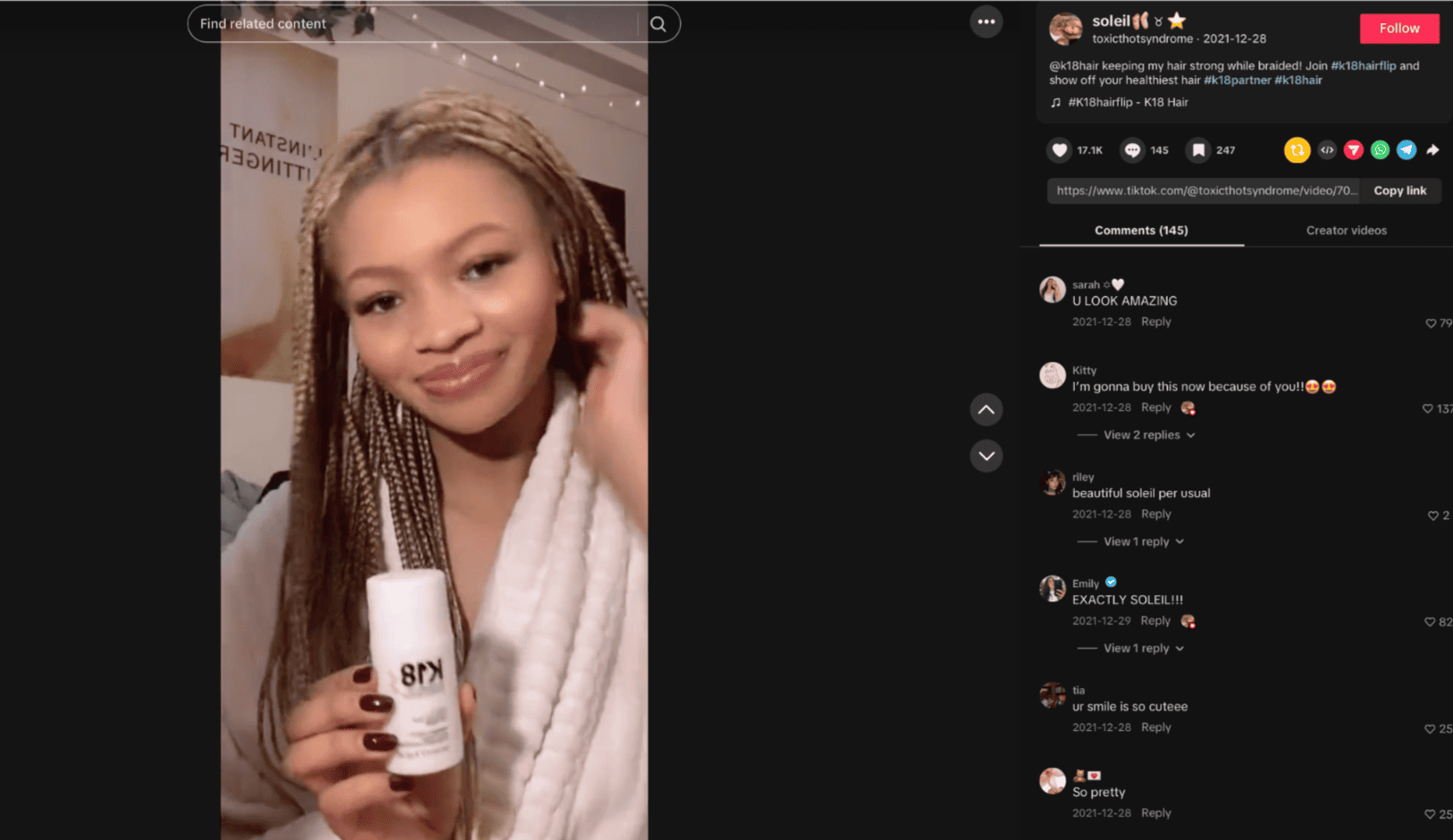
People who participated also had a chance to win a $1,000 Sephora gift card and a K18 salon service.
The campaign ran for only one month, from January to February 2022.
But during that time, it generated significant results:
- 11.2 billion TikTok views
- 1,600+ UGC videos
- $16 million in Earned Media Value
The important part wasn’t only the number of views.
K18 created a format that made it easy for TikTok users to film content using the brand's products. And that gave them something much more valuable than another ad: lots of UGC.
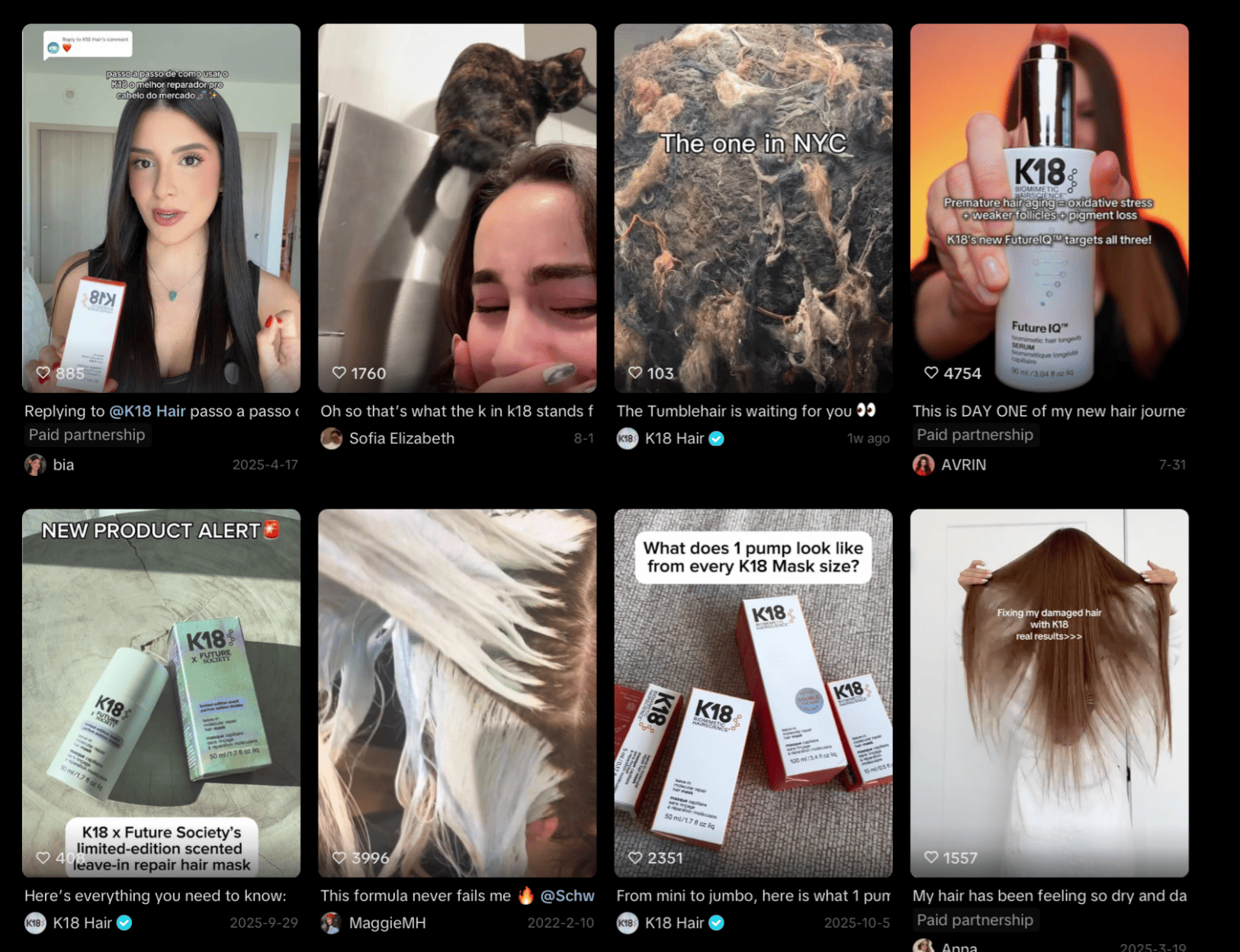
After #K18HairFlip, the brand continued experimenting with TikTok challenges.
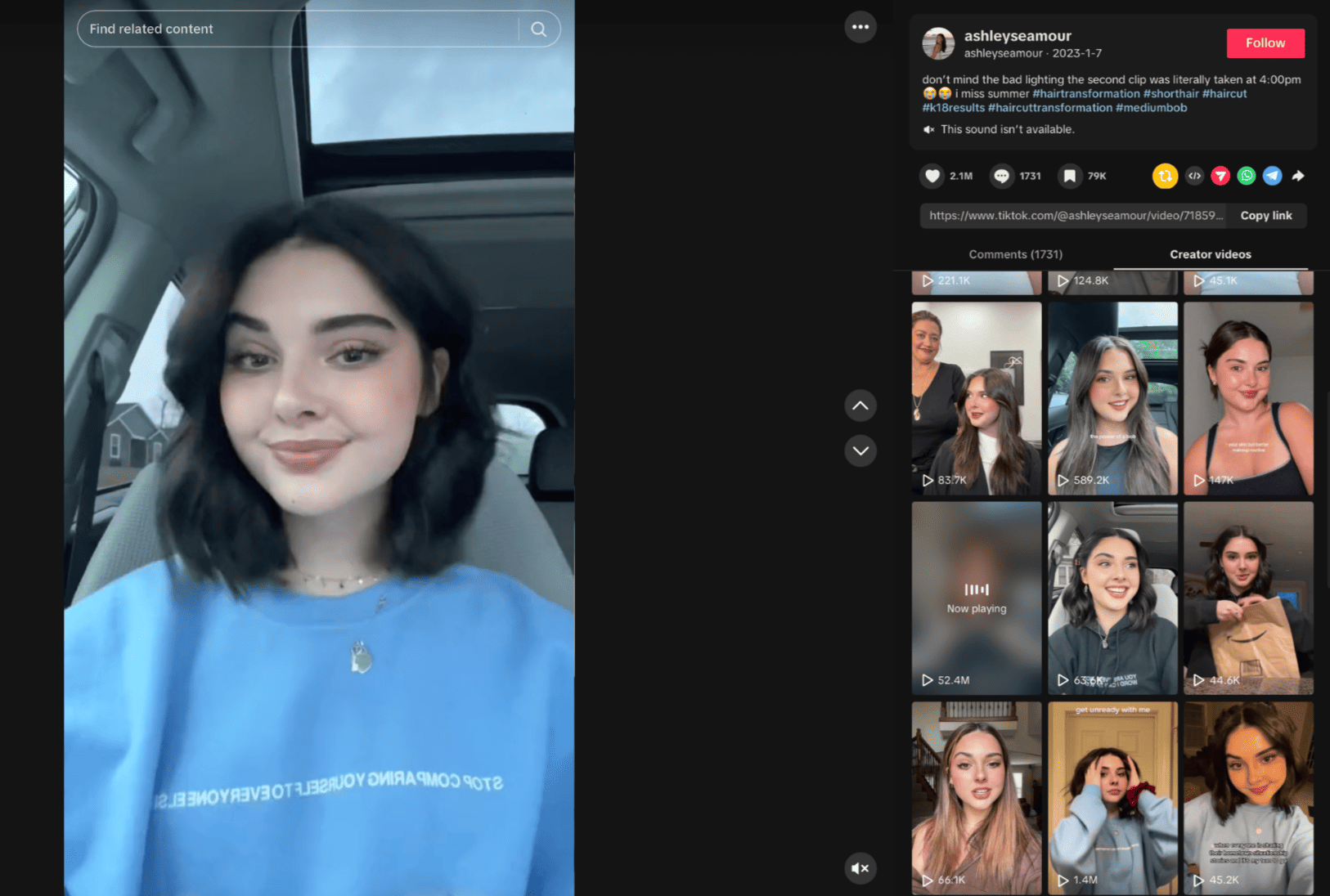
One of them was #K18Results, which focused more directly on showing hair transformations.
Source: TikTok
The brand used custom audio with a transition designed around the before-and-after.
The campaign generated more than 2,900 UGC videos and helped K18 grow its TikTok community to more than 160,000 followers.
K18 also pays close attention to TikTok culture and trends.
The brand’s team repeatedly mentioned that they don’t expect every idea to work. If something is funny and relevant, they experiment with it. If it doesn’t work, they can move on and try something else.
Another popular channel for K18 is Instagram.
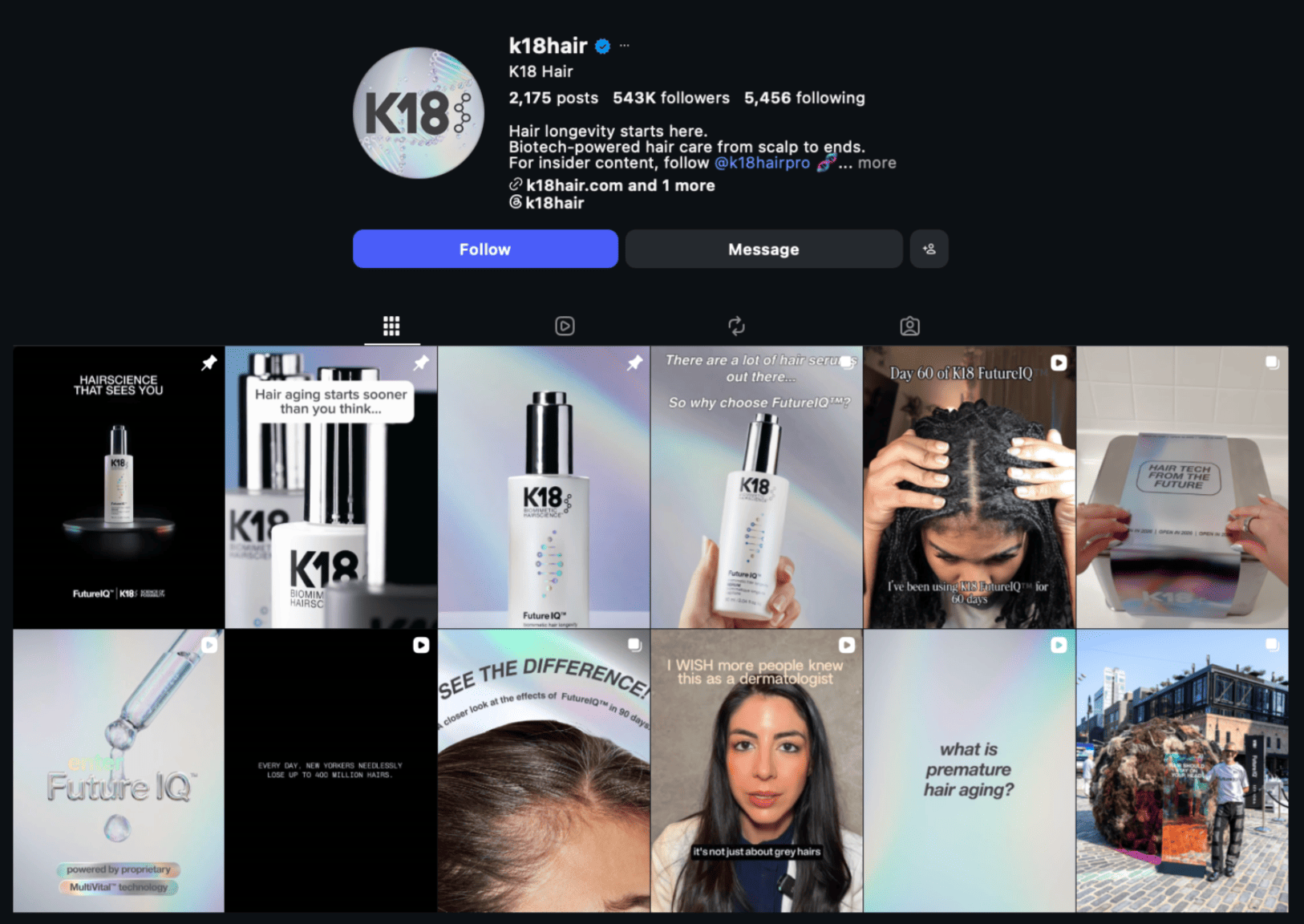
The brand uses this platform for quick, visual content. It helps people understand an idea without a long explanation.
Here are just some of the things they share:
- Before-and-afters
- Product demonstrations
- Educational content
- Creator and UGC content
- Hair transformations
A major focus is showing results rather than simply talking about them. Before-and-after content makes K18's product promise immediately visible.
Influencer Strategy
Key lesson: Choose creators who can make your product part of their story. Not just creators who can put your product in front of more people.
Influencer marketing has also been a major part of K18’s growth.
Their strategy includes:
- Professional hairstylists
- Small creators
- Culturally relevant personalities
- And other major influencers
According to Michelle Miller, professional stylists are especially important for education. Other influencers help the brand reach new audiences.
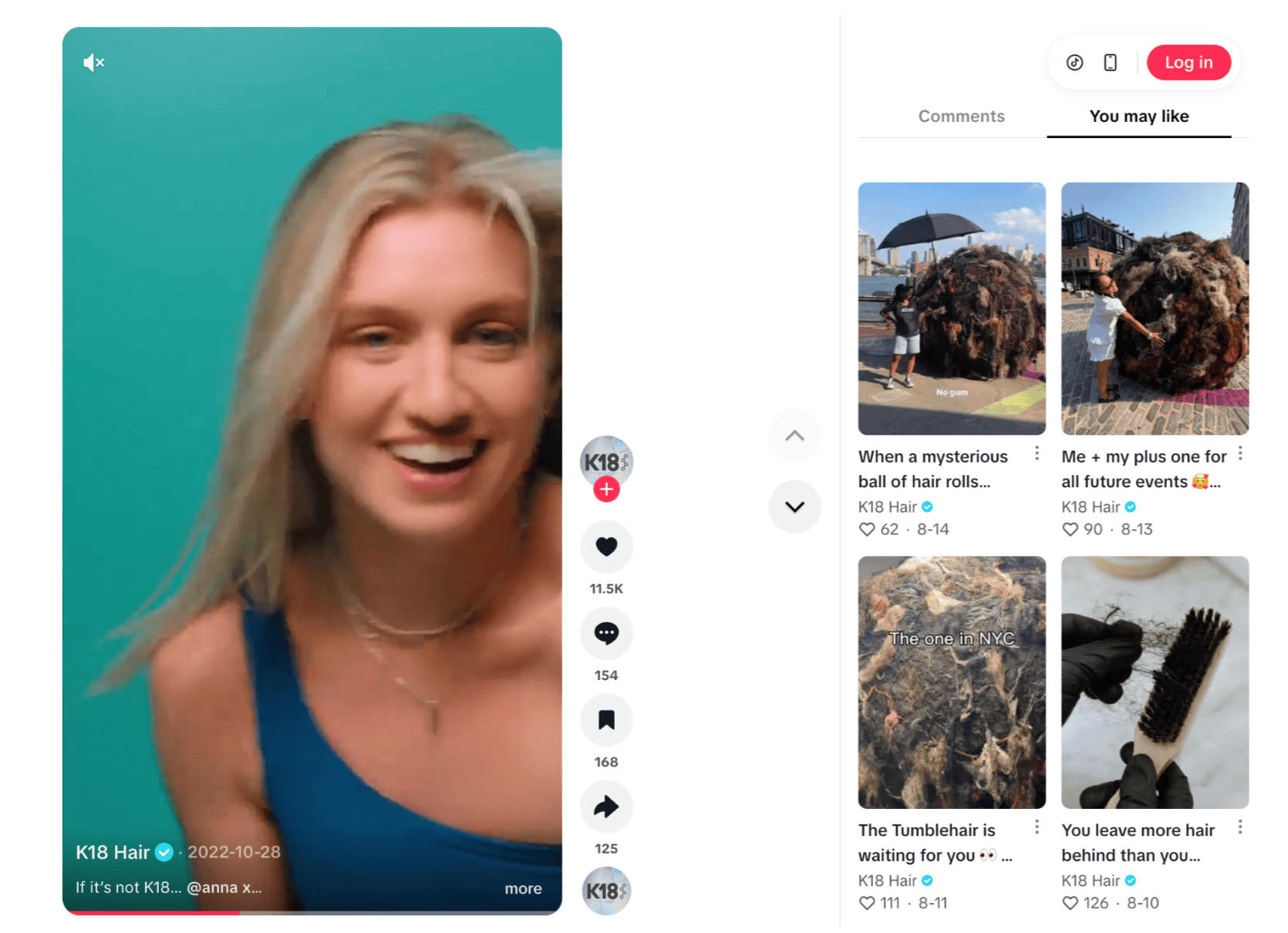
K18 also looks for creators who already have a genuine connection with the brand.
For example, TikTok creator Anna Sitar originally posted about K18 organically. Only after that did the brand approach her for a partnership.
Source: TikTok
This makes the content feel less like a traditional ad.
K18 has also started working with culturally relevant creators and celebrities. For example, Simone Biles and Nara Smith. And many other bloggers who can bring the brand into new conversations and audiences.
Recent 2026 data shows K18 worked with around 13,000 influencers across Instagram, TikTok, and YouTube. And Instagram is slightly ahead in sponsored content volume.
The brand also features viral videos with influencers testing their products on their website: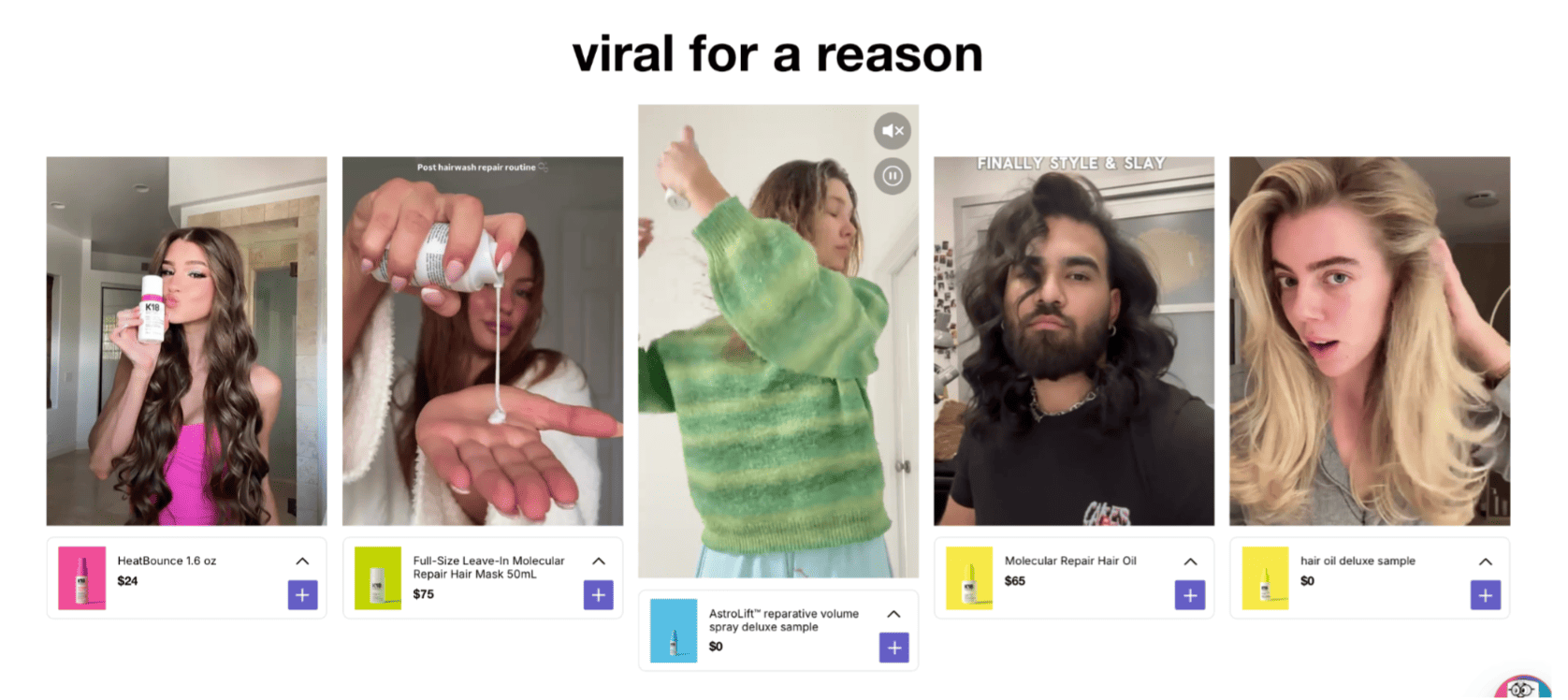
Source: K18
Besides, you can buy the product directly from the video.
The creator doesn’t just promote the product. They make it part of their own content.
That makes the brand feel more natural. At the same time, it gives K18 more content to use across its wider marketing.
Website focused on science
Key lesson: Don’t use your website only to sell. Use it to show your expertise and to build trust around your brand.
The brand’s website is not only a place where visitors can buy the product. It is a place where people can:
- Discover the brand
- Check real results
- Learn more about the products
- Find more details about other projects, events, and so on
Besides great content, K18 also focuses on visual elements as part of their content marketing strategy.
They use different infographics, videos, animations, etc., to tell their story on their website.
Take a look at how they have designed their website for hair professionals.
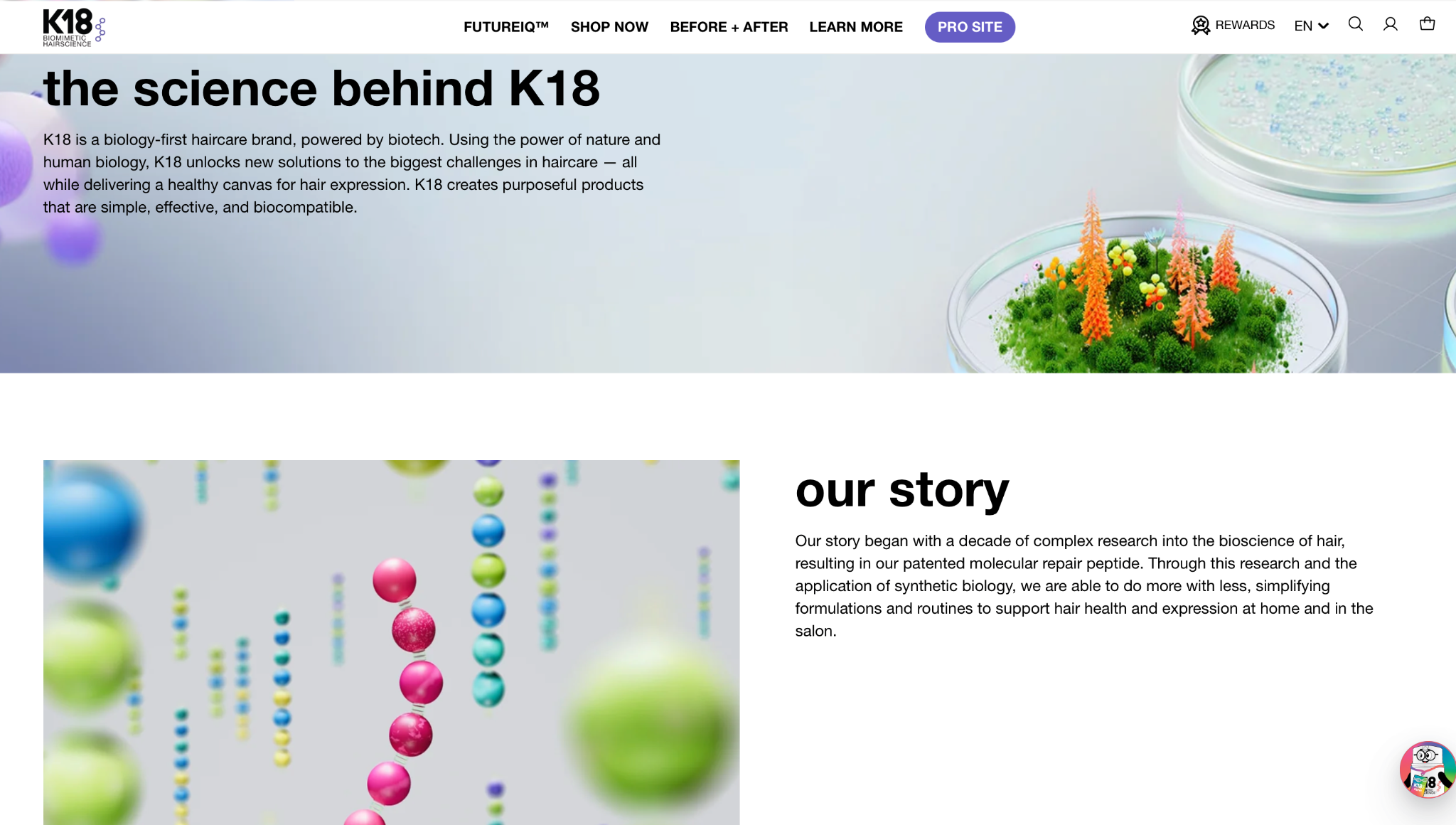
You’ll find several educational infographics that can both teach and attract attention.
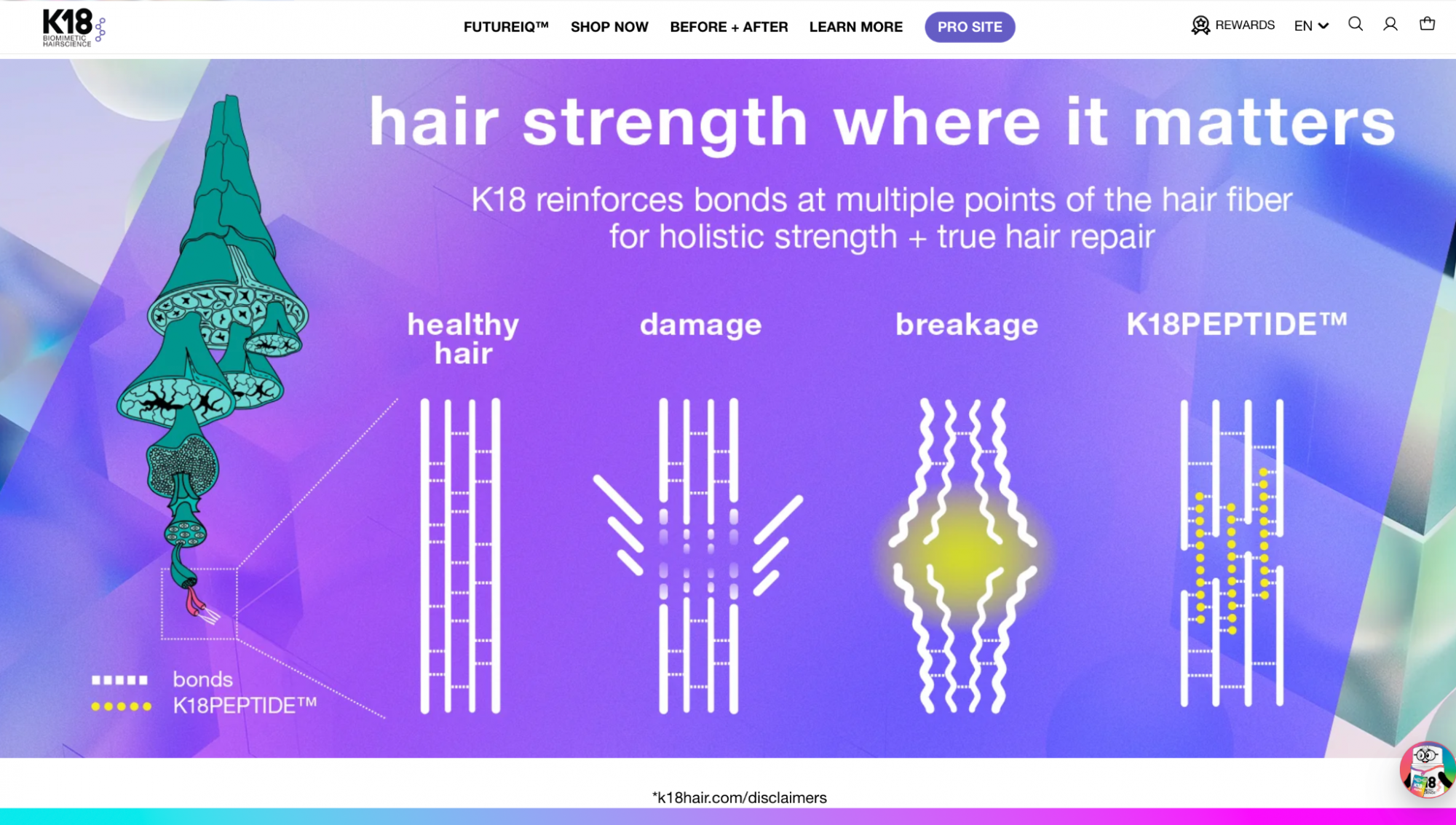
But where K18 educates most is through its blog posts.
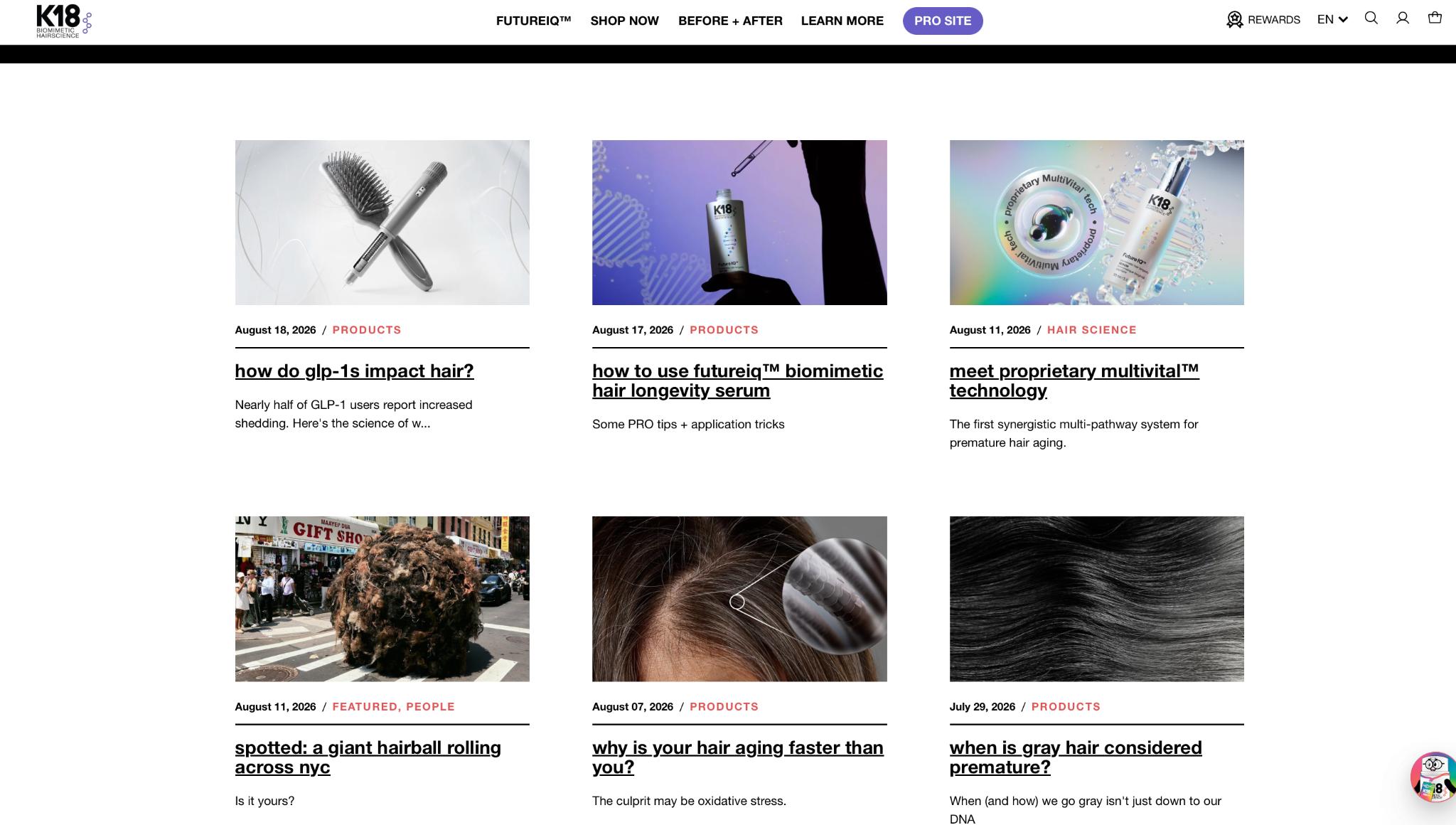
Source: K18
Through this format, the brand turns its scientific positioning into something people can actually understand.
Instead of only talking about its products, its team creates articles around hair science, damage, biology, and common haircare questions.
Take a look at one of its blog posts, “Biomimetics 101,” which was published at the beginning of the brand’s evolution:
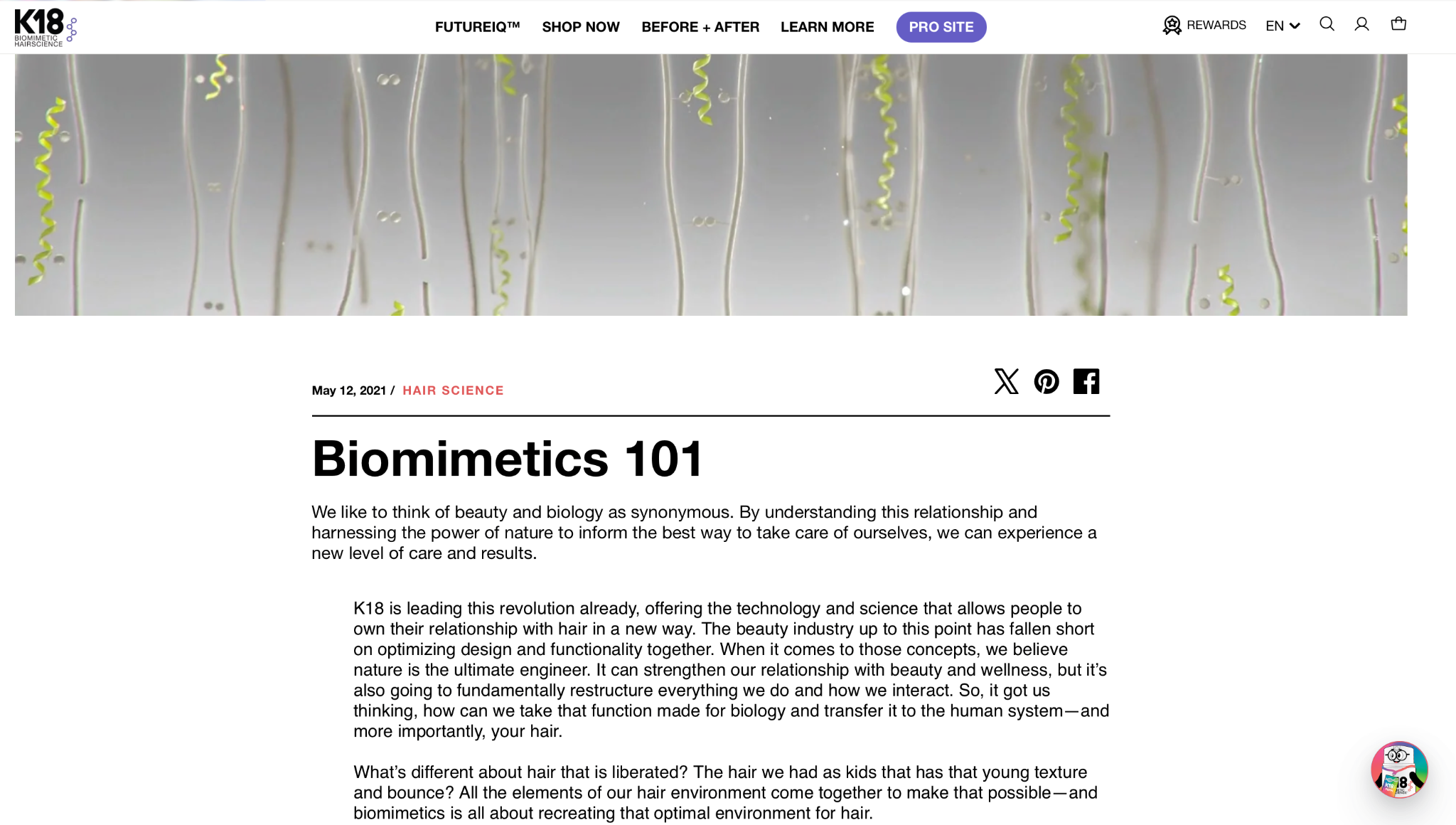
Source: K18
K18 explains how it uses biology and nature to approach haircare and why biology can help us understand how hair should be cared for.
Today, the brand continues to educate its audience through blog posts. Even when the content doesn't directly mention the brand.
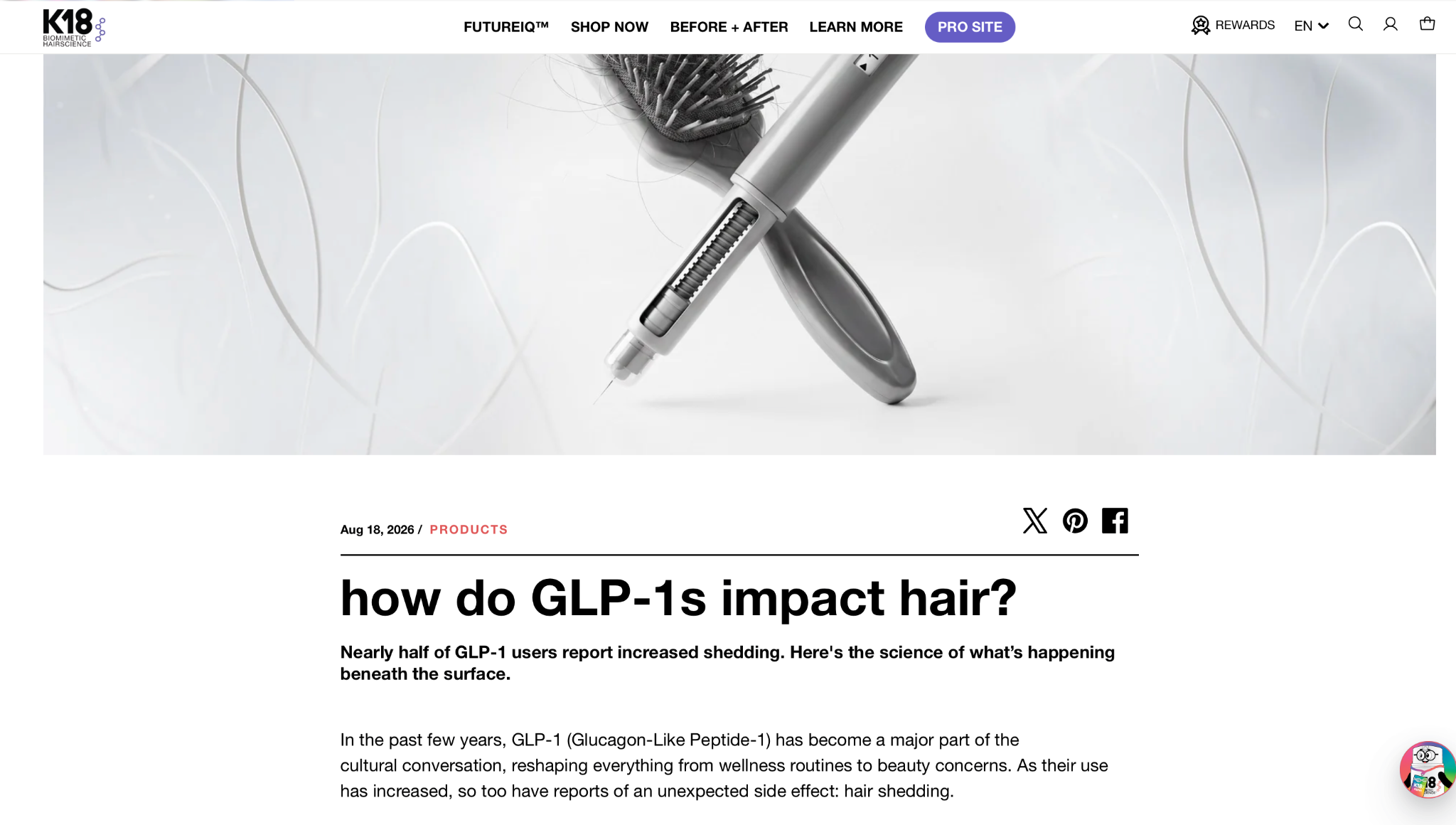
Source: K18
Even when their product is the main topic, the content is still educational.
This allows K18 to promote its products without changing the main purpose of its blog: teaching the audience.
The most important part is that K18’s team makes scientific topics digestible.
They talk about molecular repair, hair damage, and its technology without over complicating the information. The science builds credibility, while the simple benefit tells people why they should care.
Note: You can also share your expertise on other relevant websites that accept guest posts.
Email marketing campaigns
Key lesson: Use emails to reinforce the story that makes your brand different. Then support that story with real proof.
K18 doesn’t move away from its original scientific positioning in its email campaigns either.
Even when the science is complex, K18 keeps the main promise simple: molecular repair means restoring damaged hair.
Education is an important part of its emails. But it’s not the only thing K18 focuses on.
The brand sends up to four emails per week, with its messages generally falling into three categories:
- Benefits: explaining what the product can do. Here is an example:
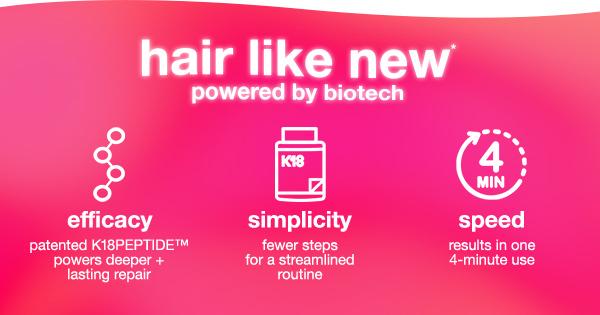
- Before-and-afters: showing visible results. Something like this:
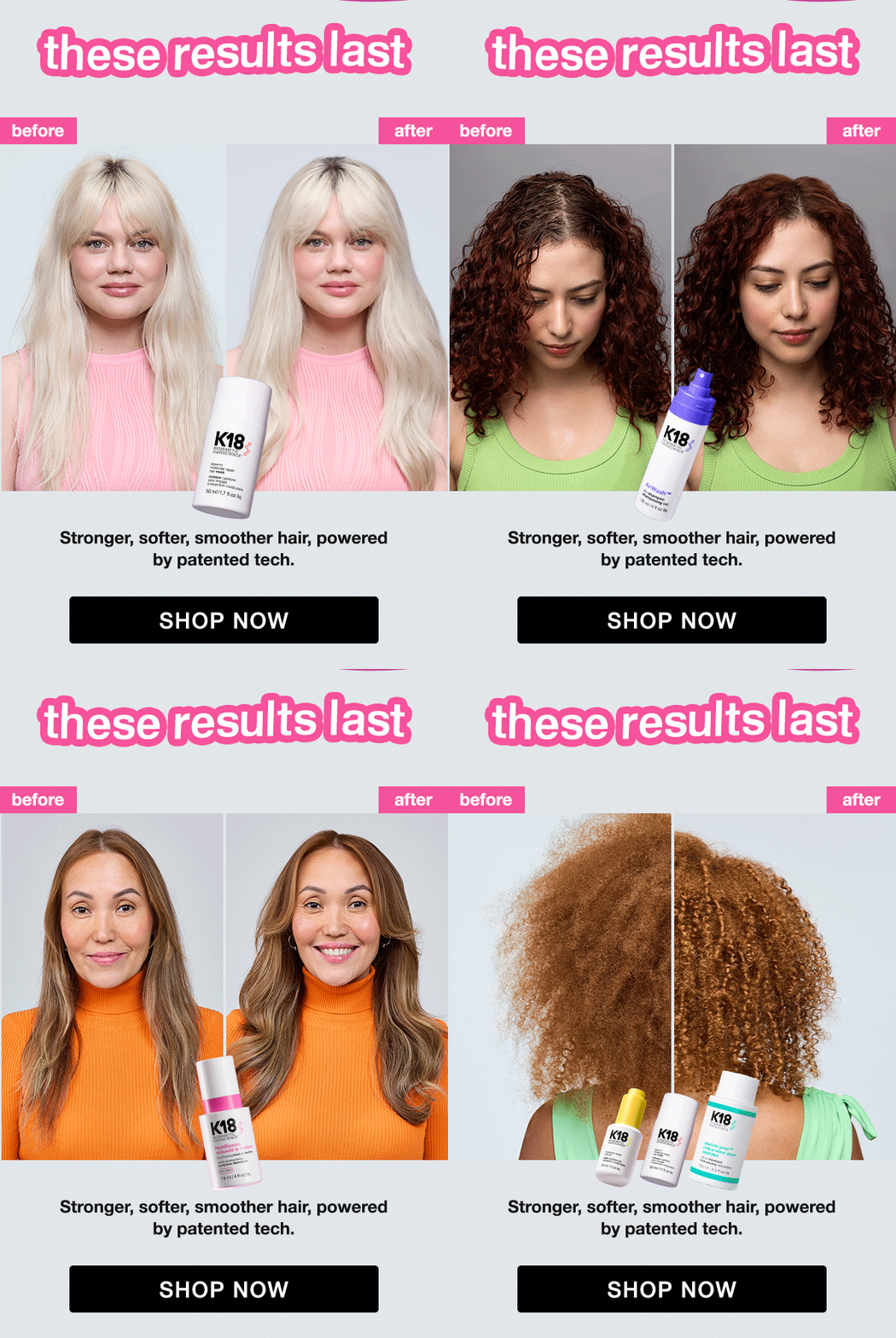
- Product-driven emails: putting the product itself at the center of the message. Here is one of the examples:
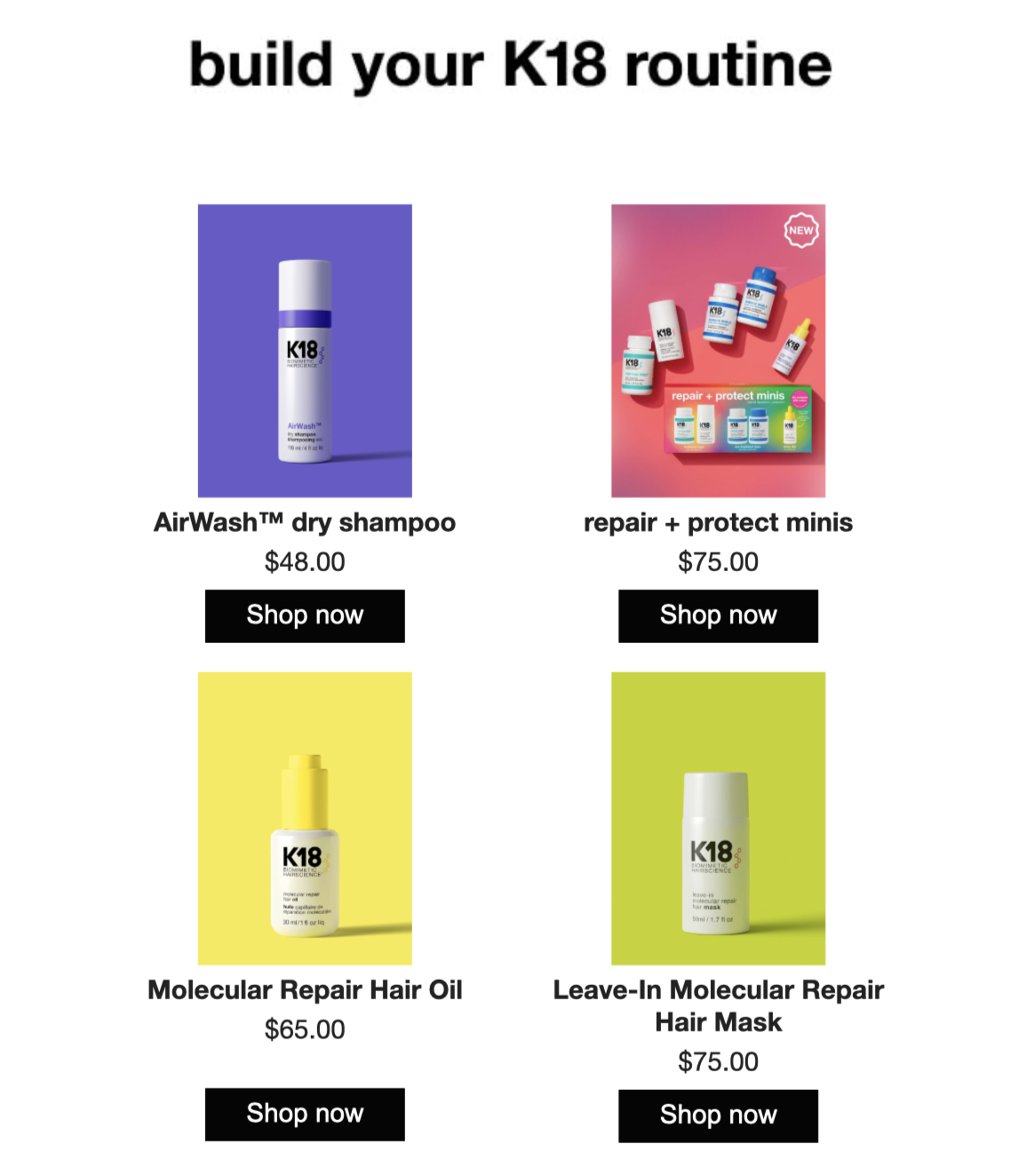
Source: EmailLove
Of course, they also use traditional email marketing strategies, including promotions and classic sequences. Here is, for example, their welcome message:
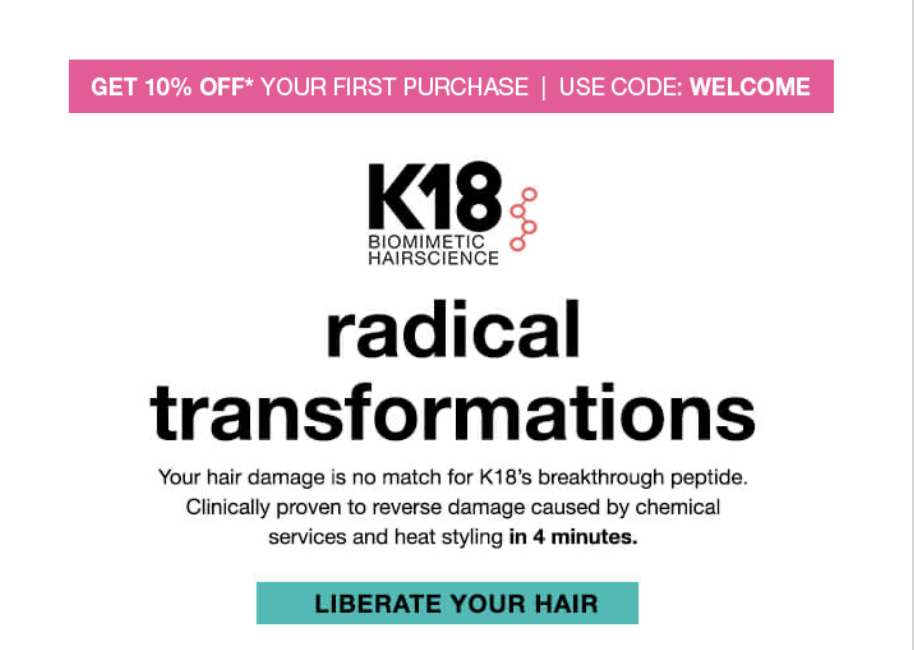
Source: EmailLove
Their emails also include UGC and customer reviews throughout their lifecycle flows. This means subscribers repeatedly see real people demonstrating that the product works.
So K18 doesn’t try to choose between educational content and sales content. It combines both:
- The educational content reinforces what makes K18 different, with proof making its claims more believable.
- And promotional content encourages people to take action.
Miro content marketing strategy: Product-led content, user-generated solutions & SEO focus
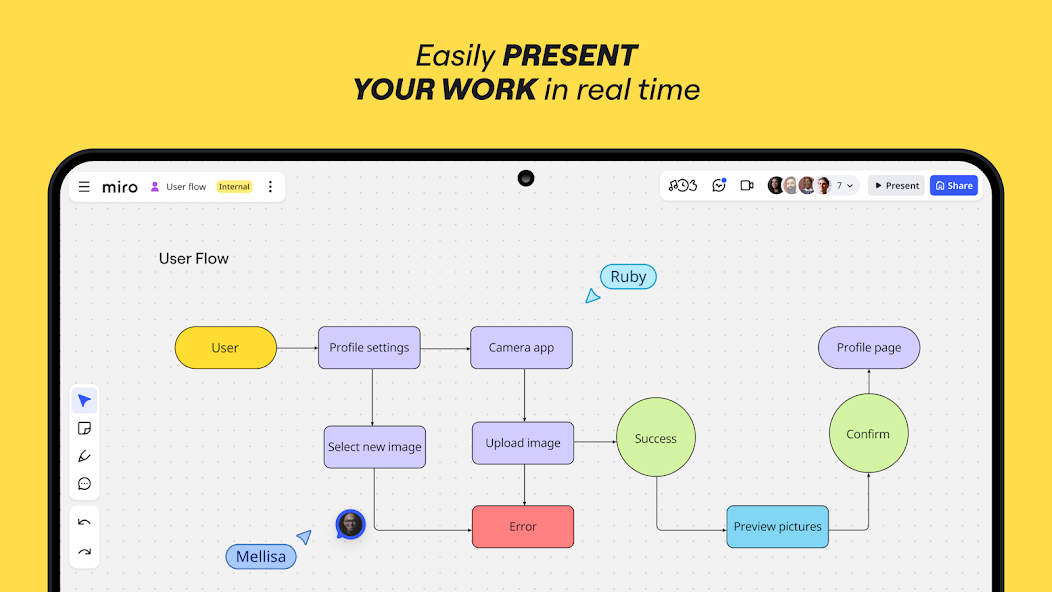
Source: Google Play
Key lessons
- Focus on what people use your product to achieve, not just what the product is. Build around their needs and create solutions that solve real problems.
- Describe as many use cases as possible to help different groups of users understand how you can solve their specific problem.
- Encourage your users to share their workflows with your community.
- Create comparison pages where you show your product's advantages over different competitors. This will help you become a favorable source in traditional and AI search.
- Don't just optimize content for keywords. Create pages that solve the problem behind the search.
About the brand
At first, Miro didn’t start as Miro.
It wasn’t even created with the goal of becoming a worldwide-known collaboration platform.
It was created to solve a specific problem.
In 2011, Andrey Khusid created RealtimeBoard for his design agency. He needed a better way to communicate visually with clients who weren’t in the same room.
The original product was a digital whiteboard.
But Khusid soon realized that the idea could work beyond his own agency. He started developing the platform and making it available to other users.
In 2012, he and his co-founder left the agency to focus on RealtimeBoard full-time.
From there, the platform continued to grow.
Positioning
Key lesson:Focus on what people use your product to achieve, not just what the product is. Build around their needs and create solutions that solve real problems.
Over time, people began using the visual workspace for:
- Brainstorming, workshops
- Project planning, product development
- UX research, customer journey mapping
- Agile processes, and much more
And that gave the platform something extremely valuable for its future content marketing strategy:
A huge number of problems it could help people solve.
Users started testing RealtimeBoard, shared it with others, and gradually brought it into their teams.
Word of mouth and team adoption helped the platform grow naturally.
Then, in 2019, RealtimeBoard officially became Miro.

The company was no longer positioning itself simply as a digital whiteboard. It was becoming a visual collaboration platform that teams could use across different types of work.
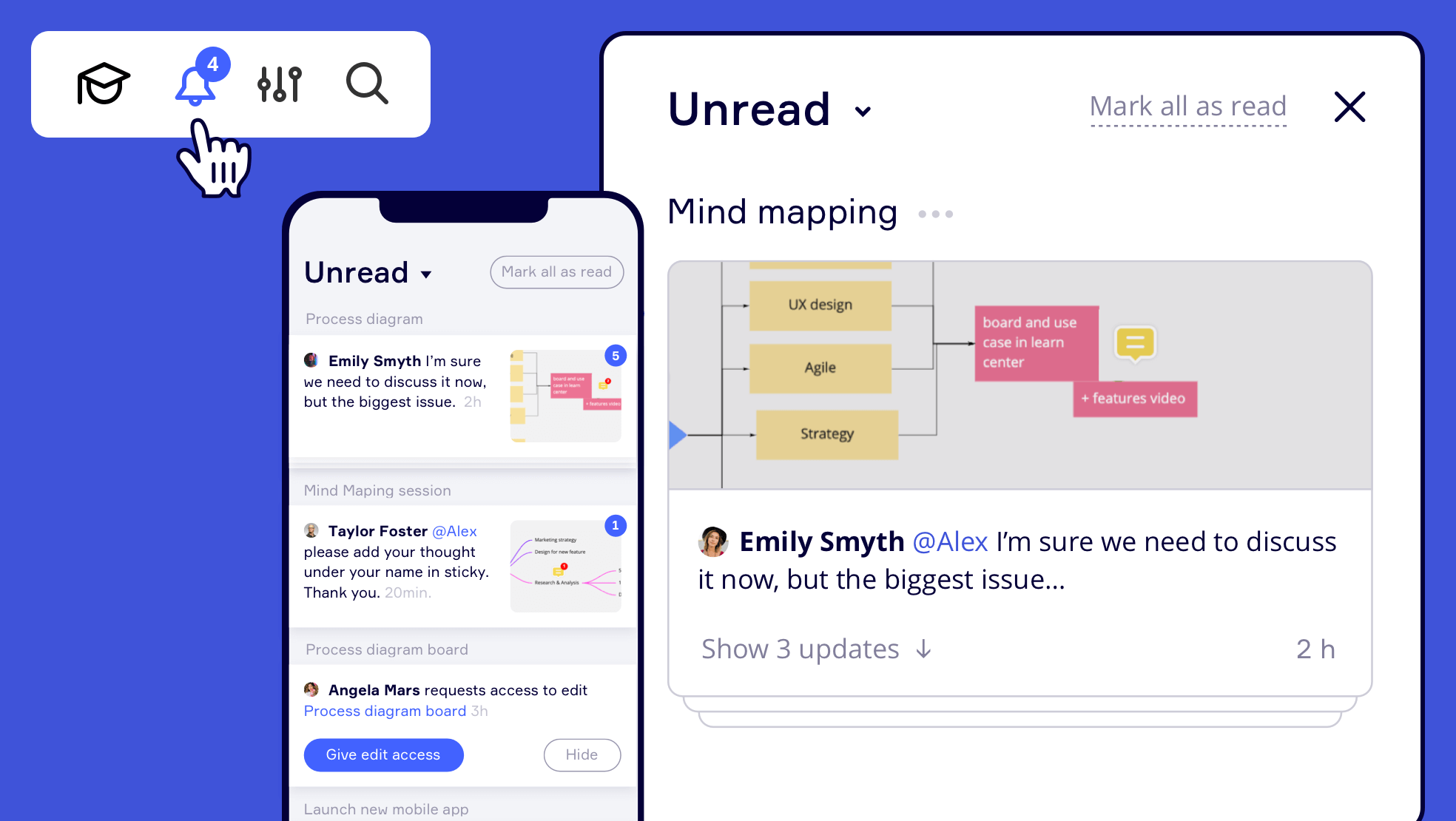
Source: Miro
That transformation gave Miro a much stronger position. Because:
- A whiteboard may have limited use cases.
- But a collaboration platform is a place teams can come back to every day.
This positioning also gave Miro more freedom to introduce new features. For example, video calls, voting, timers, and other integrations, while keeping the product’s purpose clear.
And this also changed how Miro approached content.
Website with clear use cases for the product
Key lesson: Describe as many use cases as possible to help different groups of users understand how you can solve their specific problem.
Miro’s content marketing strategy focuses on clear use cases for each team and giving them a direct application they can test immediately and for free.
And this is exactly where it stands out.
Miro’s website is built around:
- Multiple use cases for different business segments, industries, teams, and initiatives.
- All the necessary details each of those user groups need to solve their problems.
Take a look at how they structured the content on their website.
The amount of information they provide is huge. It can even seem overwhelming.
But with the right design, clear structure, and simple wording, Miro provides clear information for a wide range of problems and a variety of teams and industries.
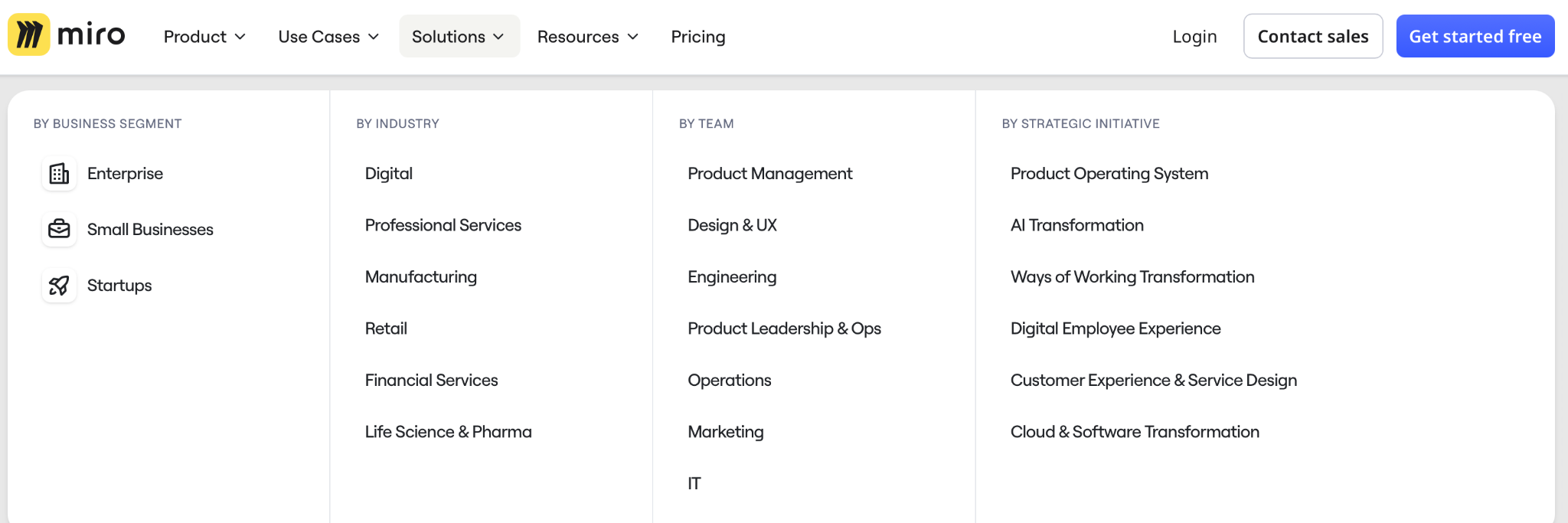
Source: Miro
And when users are looking for a solution, they don’t just end up on a page saying, “Here’s the solution. Buy it now.”
No. Instead, the brand explains everything in detail. It uses all the necessary information and infographics to make the content as clear and understandable as possible.
Take a look at the Flowchart Makerpage.
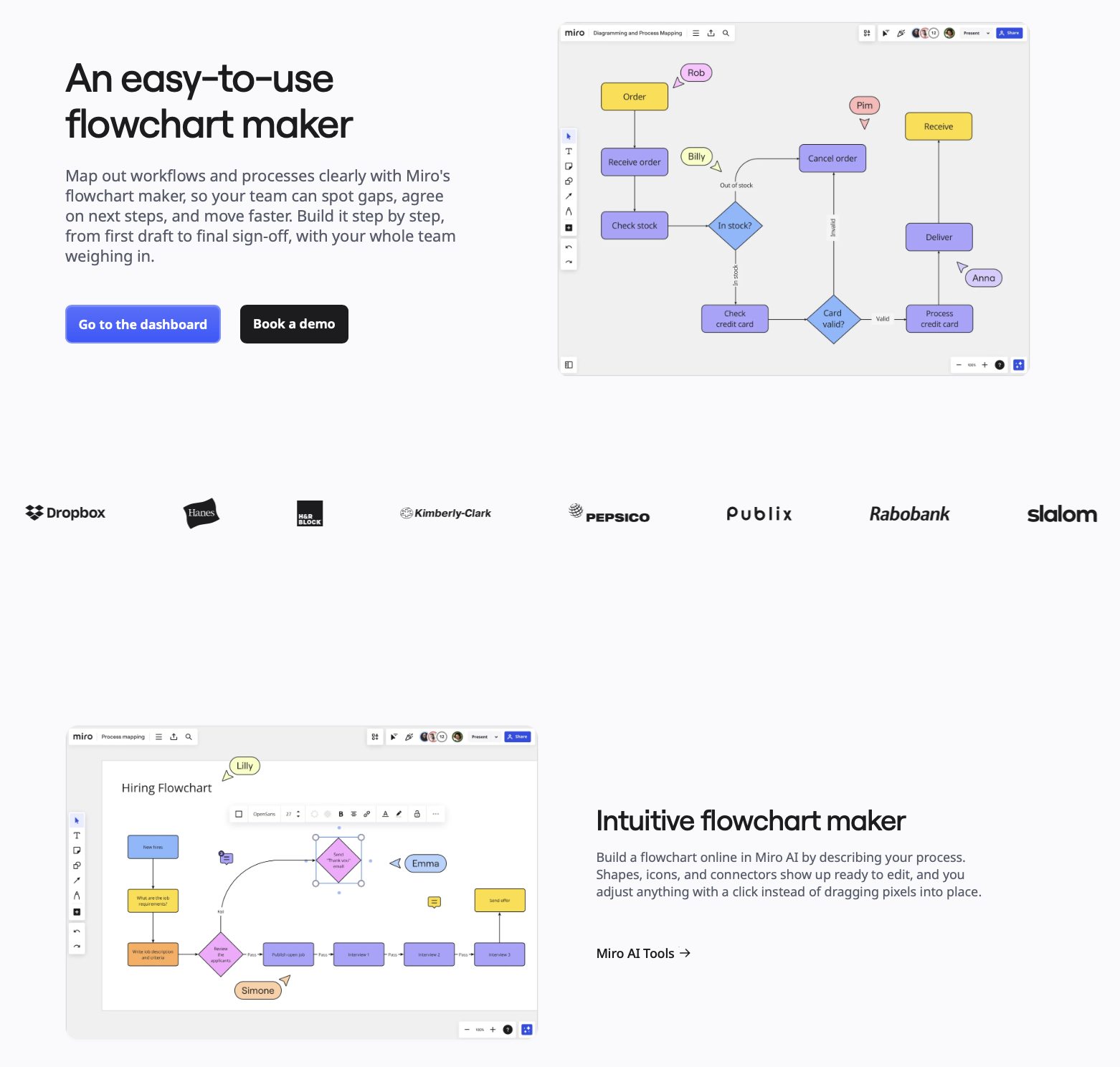
This page doesn’t just explain what a flowchart is or simply ask the user to try it without any explanation. It turns the page into a full interactive experience and lets users explore different examples.
Their content doesn’t stop at education. It moves users closer to the product.
It also allows people to learn not only from theory, but also from practice by trying the solution right away.
Take another look at Miro’s Customer Journey Map Template.
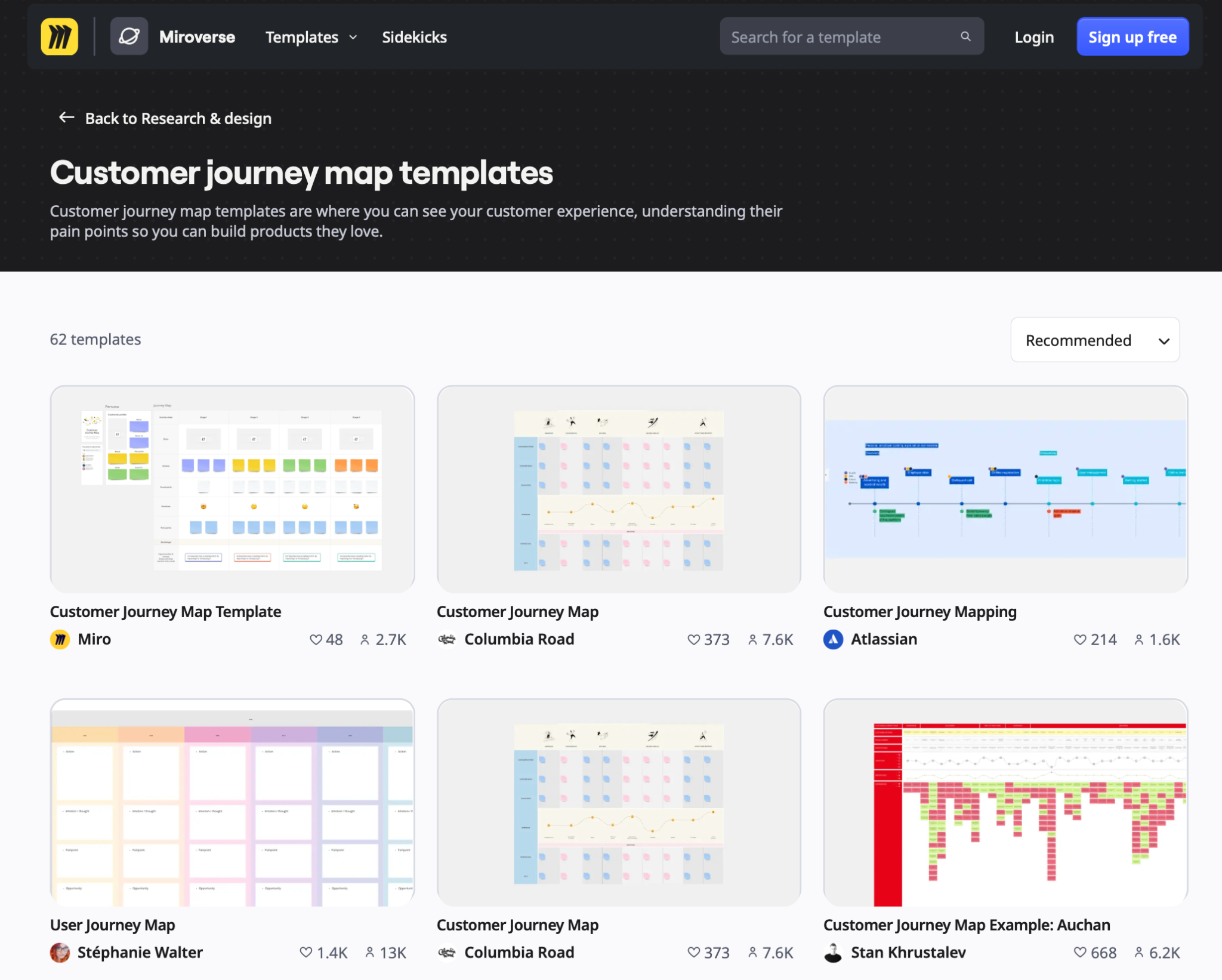
Instead of explaining how customer journey mapping works, Miro gives users several ready-made frameworks they can use immediately to map their own customer experience.
And one of the biggest differences from other brands is that Miro lets users try the product completely for free.
Users can try some features even without signing up. They can also access the freemium version. It offers enough features to create a satisfying user experience.
Miro does everything to make people fall in love with the product before making a purchase.
This is extremely important. Because Miro is a product that is much easier to understand by using it than by reading about it.
This creates a much shorter path from search to product.
Community content as a foundation of the marketing strategy
Key lesson: Encourage your users to share their workflows with your community.
Miro doesn't stop at templates created by their team.
It also has its Miroverse. There, users can share their own Miro boards, frameworks, workflows, templates, etc., with other people.
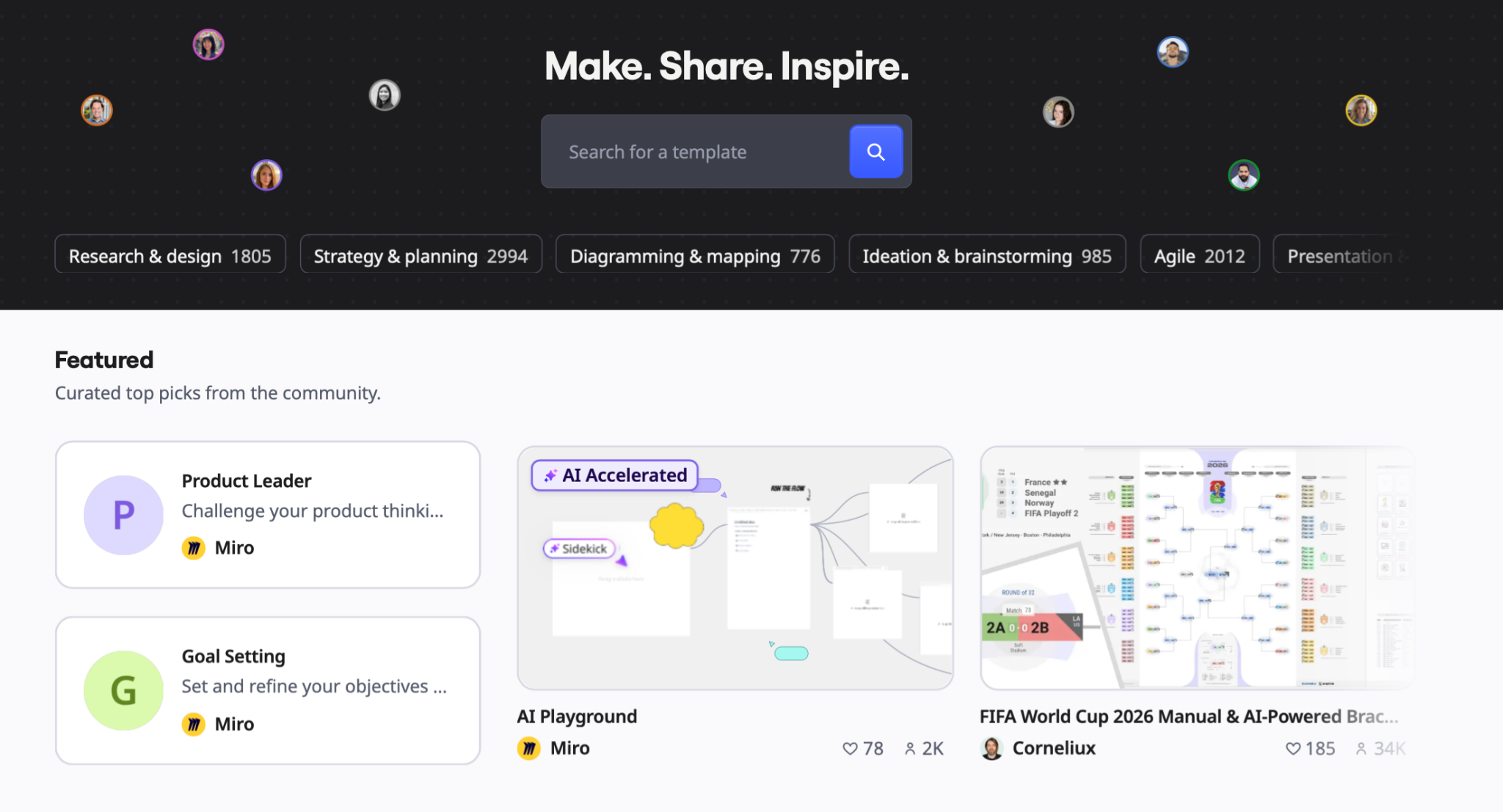
Source: Miro
This means Miro doesn't have to create every use case itself.
Its users are constantly showing other people how they use the product in the real world.
For example:
- A product manager can share a product discovery workflow.
- Designers can share their UX research board.
- The marketing team can share a campaign planning framework.
Other users can discover these resources and include them in their own work.
The product creates the content, and the content brings more people back to the product.
Comparison content
Key lesson: Create comparison pages where you show your product's advantages over different competitors. This will help you become a favorable source in traditional and AI search.
Miro is not the only workspace tool on the market.
And many users understand that. So, they’re naturally comparing different solutions to find the best one.
And Miro creates content specifically for these users.
For example, its Miro vs. Lucidchart page targets people who are already comparing these two products.

Instead of waiting for users to make a decision, Miro enters the decision-making process itself.
This type of content helps them become the source that shows their product in the best light.
And this helps them in both traditional and AI search. Because otherwise, users are more likely to get less favorable comparisons from competitors or third-party content.
SEO strategy
Key lesson: Don't just optimize content for keywords. Create pages that solve the problem behind the search.
Miro’s SEO strategy became much more deliberate as the company grew.
The brand built a connected content system around what people were actually searching for:
- The team looked at search volume, keyword difficulty, and product fit to decide which topics were worth creating content for.
- And the strategy focused on commercial keywords supported by long-tail informational content.
In simple words, Miro didn't only target broad searches like “online whiteboard.” It looked for the specific problems people were searching for.
Then, they matched the content format to the search intent.
- Blog posts answered questions.
- Guides covered broader topics and use cases.
- Landing pages targeted commercial searches.
- Templates gave people something they could immediately use.
This helped Miro connect informational searches with the product.
Their templates became one of the biggest opportunities.
Miro created 250+ templates aligned with their target keywords. These were not just additional resources. They were designed to rank for specific searches and give users a direct way to start using Miro.
For example, someone searching for “marketing strategy template” can land directly on Miro’s collection of marketing strategy templates. Rather than reading a general article about marketing strategy.
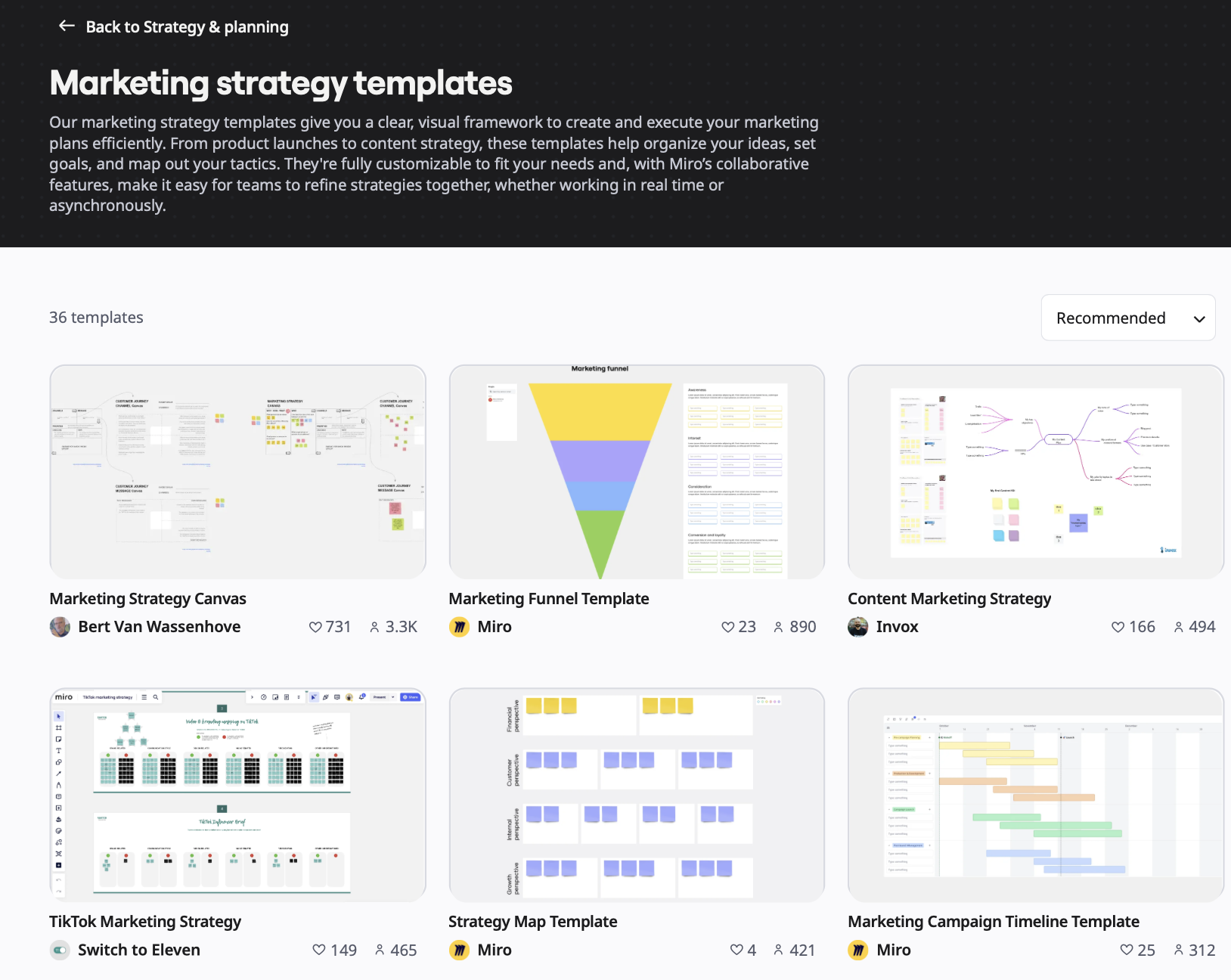
They’ve perfectly matched search intent and the product experience.
According to the former Miro content manager, templates increased organic traffic by 186%year over year in the first year, with an average conversion rate of 16%.
Miro also expanded its searchable content beyond company-created pages.
Miroverse became another part of the SEO and content ecosystem.
It allows the creation of a constantly growing library of content around different use cases.
The current Miro template library contains 7,000+ templates across many areas, such as research, strategy, diagramming, brainstorming, Agile, and workshops.
That makes Miro one of the best B2B content marketing examples of how product-led content, user-generated content, and SEO can work together.
Wanderlog creative marketing strategy: Content created by users
Source: Wanderlog
Key lessons
- You don’t necessarily need to create something completely new. Your product can simply combine many tools in one place.
- Position user-generated content as a dominant part of your website. Make sure it connects with your format, objectives, and audience.
- Make it easy for users to share useful publications around specific topics on your website. Every new piece creates another opportunity for search visibility and discovery.
- Brands don’t always need to build a strong and consistent presence on their own social media accounts. Instead, they can encourage users and micro-influencers to create content featuring the brand and its product.
About the brand
Wanderlog was created in 2019 by twin brothers Harry Yu and Peter Xu.
The idea behind the app came from a very simple problem. People love traveling. But planning a trip is often messy and complicated.
The founders wanted to create one place where people could gather everything they needed for a trip and plan it together.
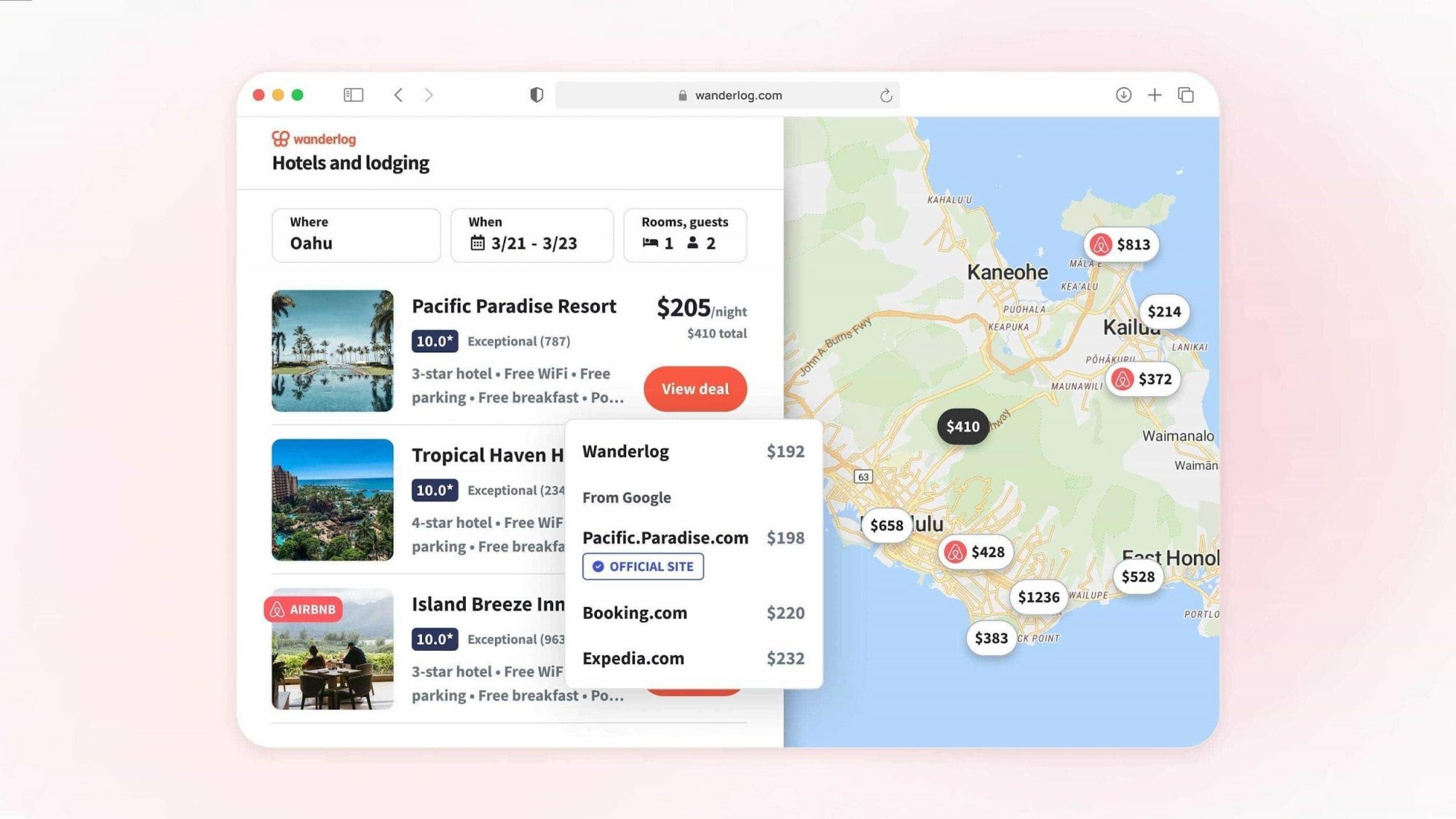
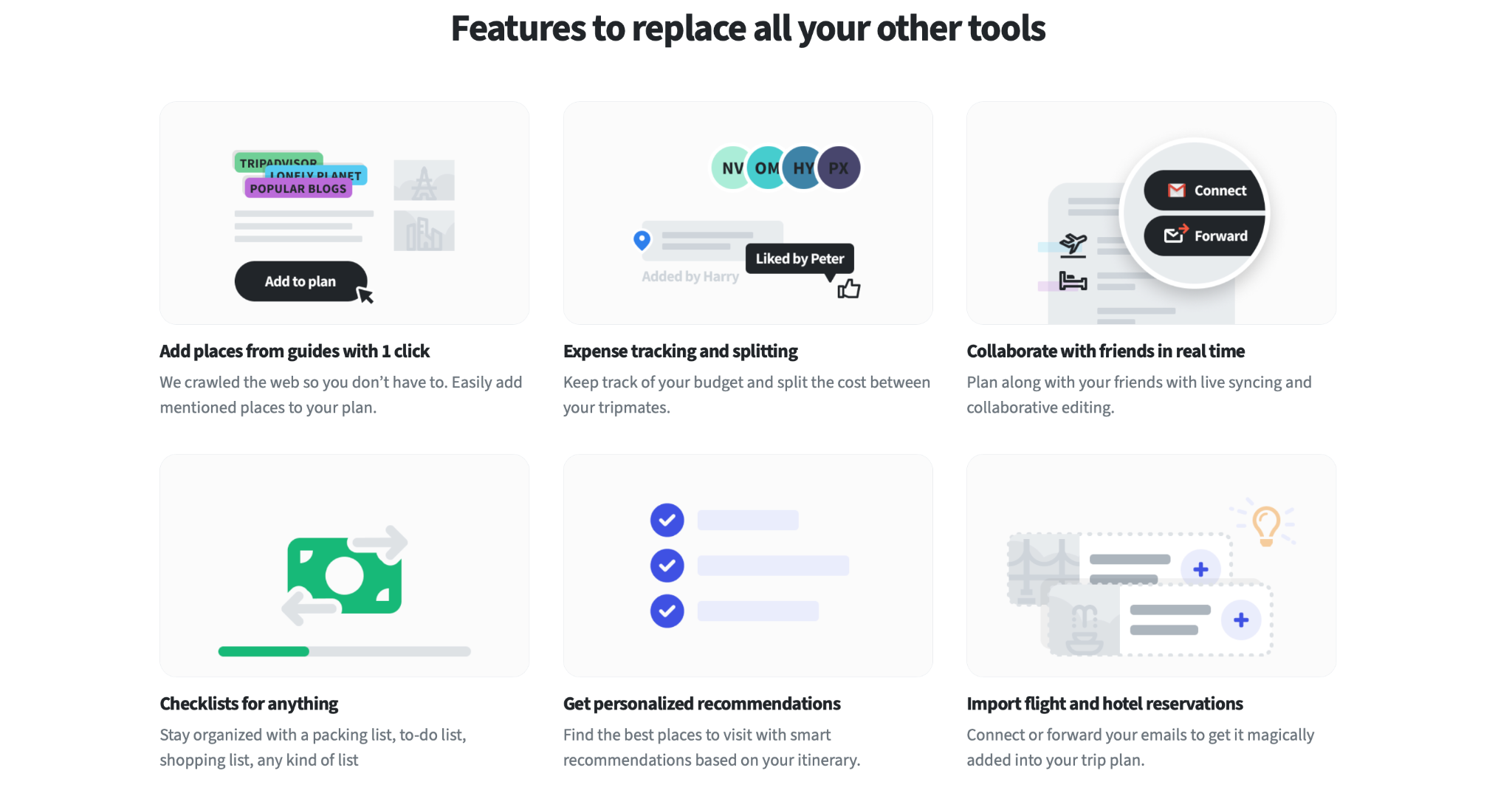
So, Wanderlog was created as a travel planning app that brings different tools in one place.
Source: Wanderlog
Today, users can create itineraries, organize reservations, find places to visit, manage their budget, and plan their routes from one platform.
Positioning
Key lesson: You don’t necessarily need to create something completely new. Your product can simply combine many tools in one place.
Wanderlog doesn’t position itself only as a tool for organizing trips. One of its biggest differences is its community-driven approach.
Users can discover travel guides, recommendations, routes, maps, and suggestions created by other travelers.
Wanderlog also makes the planning process collaborative.
Users can invite their travel companions and work on the same trip together.
This creates a positioning that is different from a traditional travel guide or booking platform. Wanderlog brings together travel discovery, community recommendations, and collaborative planning.
And this positioning naturally supports its content marketing strategy.
In fact, Wanderlog combines similar ideas we saw in K18 and Miro.
But it presents them in different ways and adds its own tactics, which make some strategies more dominant than others.
Let’s dive deeper into this brand. And look at each strategy, how they overlap with each other, and what Wanderlog does differently from the other brands.
Community content
Key lesson: Position user-generated content as a dominant part of your website. Make sure it connects with your format, objectives, and audience.
One of the major content marketing strategies of Wanderlog is its community content.
Users can create their own travel guides and share them with other travelers.
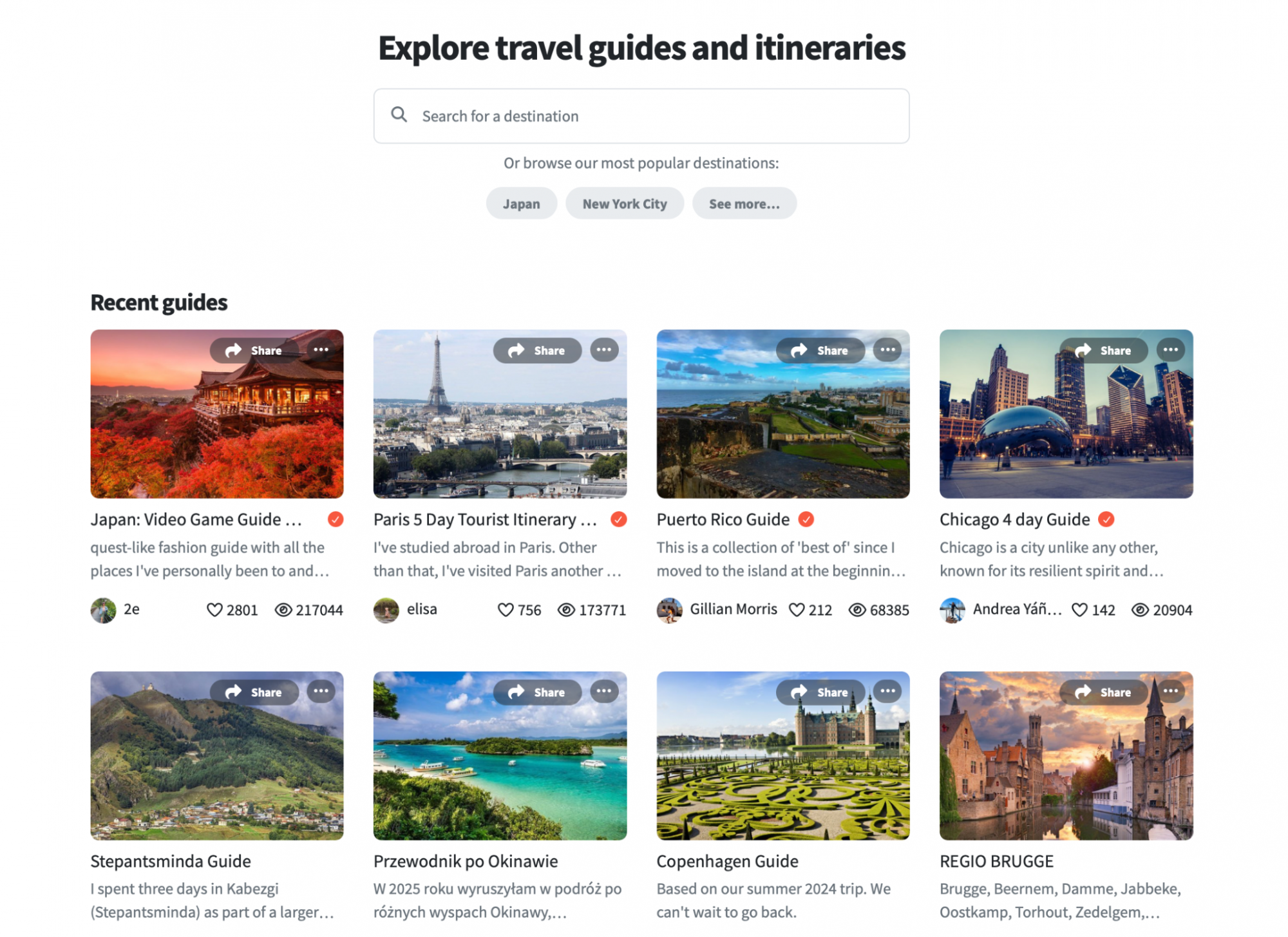
Take a look at Wanderlog’s travel guide page:
Source: Wanderlog
You can find itineraries such as “Japan: Video Game Guide,” “Paris 5 Day Tourist Itinerary + Recommendations,” and so on.
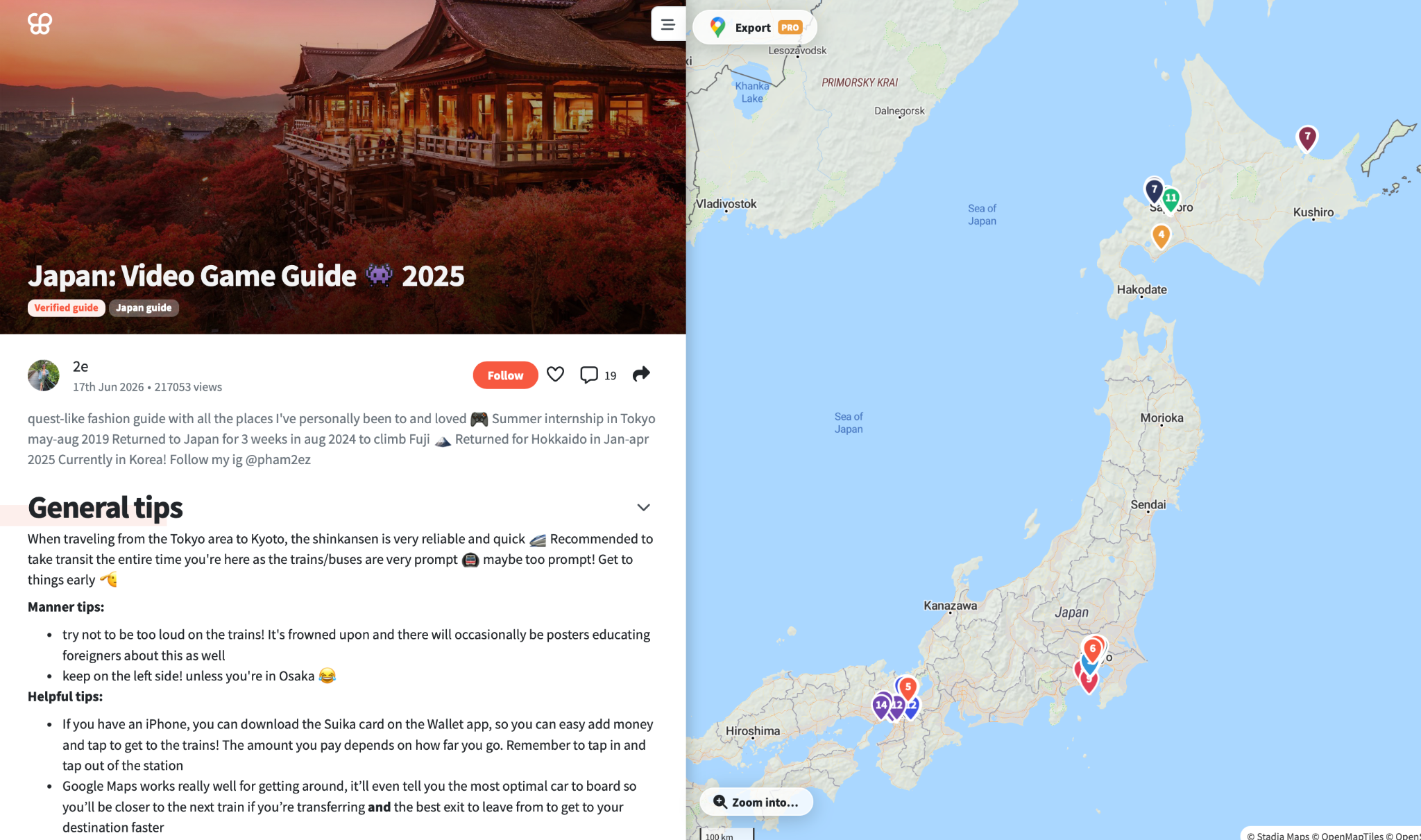
These guides usually include places users visited, recommendations, routes, maps, photos, and tips.
Source: Wanderlog
Other users can then use all this information when planning their own trips.
And one of the biggest advantages is that there isn’t just one guide for each destination.
You can find dozens of different itineraries for the same city, each created for a different purpose:
- Some people might visit the city for only five days.
- Others might stay for several months.
- While others might want a more detailed guide about museums or bars.
This creates a much more personal experience. Because users can find recommendations that match the type of trip they actually want.
But the content doesn’t stay separate from the product.
If users find a place they like in a guide, they can simply add it to their own trip.
And if they can’t find the guide they need, they can create their own and share it with other travelers.
That’s something we’ve already seen in Miro through Miroverse.
Both brands encourage their users to create more content around the product. But what people create and why they create it are completely different.
- For Miro, users create content to demonstrate how the product can be used.
- While Wanderlog users create content based on their own travel experiences.
And both approaches work because they match the product and its audience.
- For Miro, professionals need practical resources that can help them solve a specific work problem.
- For Wanderlog, travelers want real experiences and recommendations from people who have already visited a destination.
Wanderlog built this idea directly into the platform.
Note: Besides user-generated content, Wanderlog also has many of its own guides. But UGC remains the dominant type.
User content as an SEO and AEO tactic
Key lesson:Make it easy for users to share experience-based content around specific topics on your website. Every new piece creates another opportunity for search visibility and discovery.
Wanderlog created a non-stop flow of content by making it very easy for users to publish their own travel plans and guides.
The dozens of itineraries we have seen are not just an additional feature. They are one of the main ways people use the platform.

Source: Wanderlog
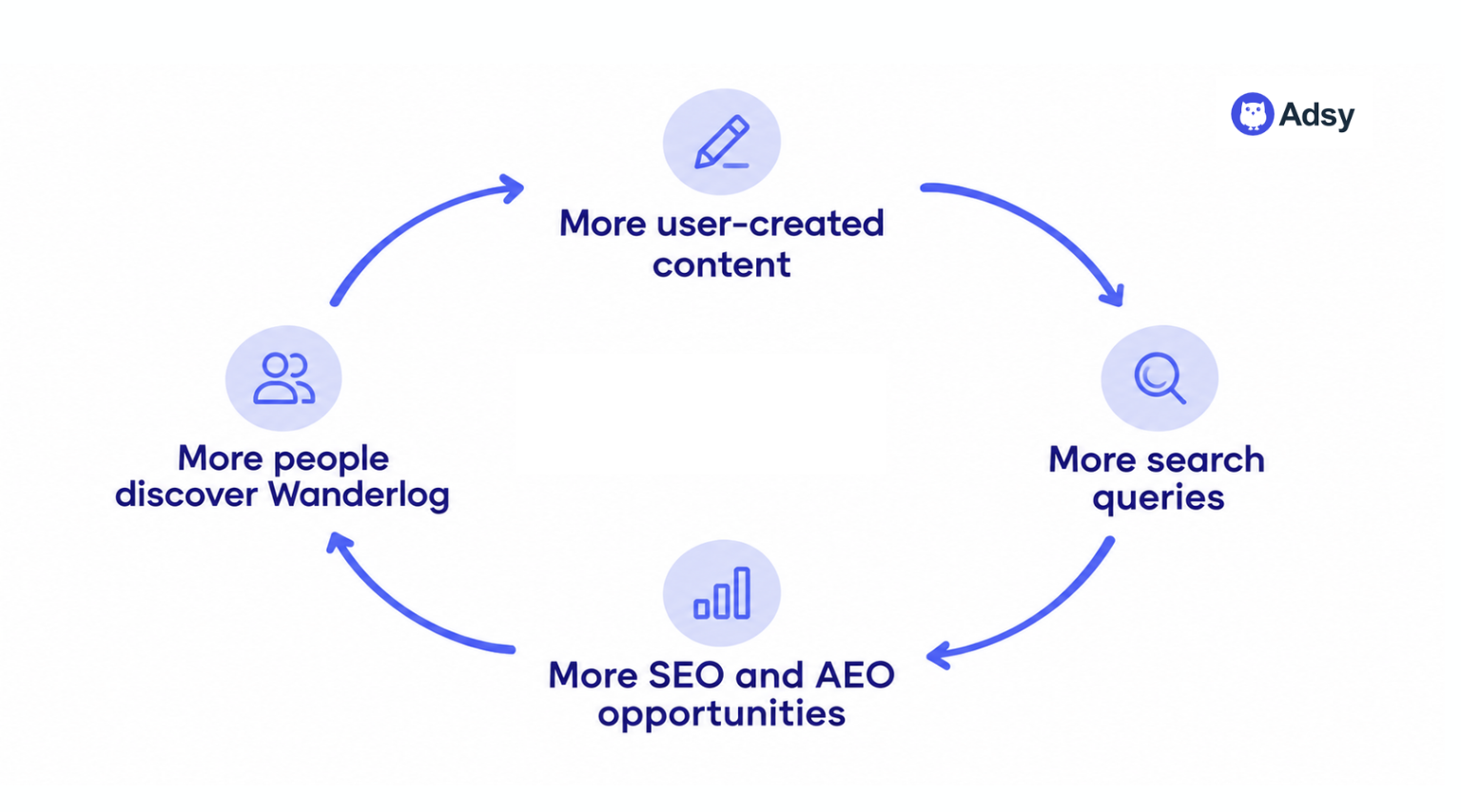
This creates a great variety of content for different search topics. And all these queries turn into a huge opportunity for SEO.
When one person writes about a topic, other people may later search for the same thing.
Every new itinerary, destination page, and user-created travel plan creates an additional opportunity to appear in search results.
It also works really well for AEO.
AI search is increasingly looking for specific, useful, and authentic information. User-created content fits this perfectly because it is based on real travel plans and experiences.
That creates a non-stop loop:
UGC as their main social media strategy
Key lesson: Brands don’t always need to build a strong and consistent presence on their own social media accounts. Instead, they can encourage users and micro-influencers to create content featuring the brand and its product.
One of the biggest differences between Wanderlog and other brands is that they don’t really do their own social media.
Wanderlog has social media accounts, but they barely post anything themselves.
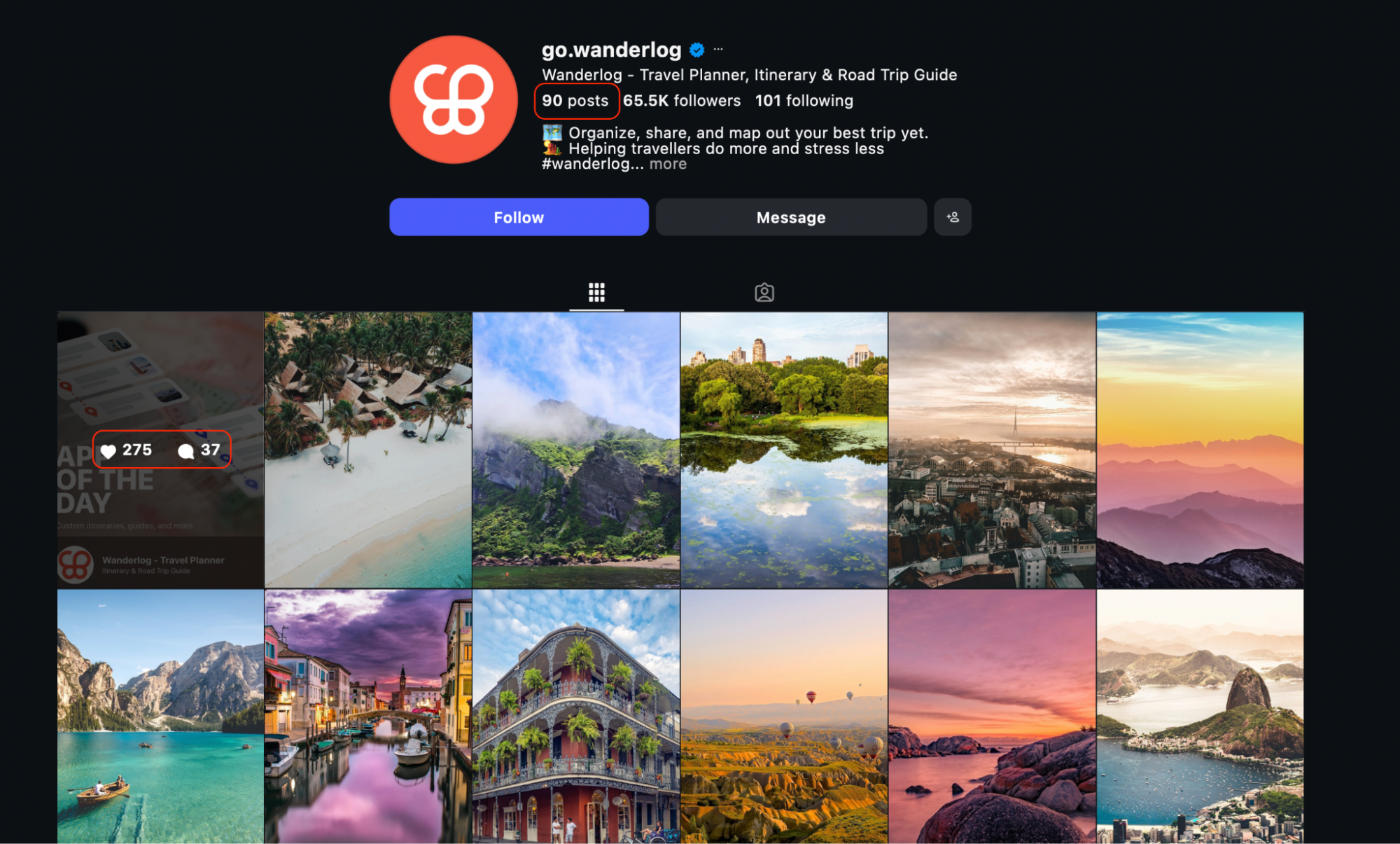
The last time they published anything was on January 17, 2025. And, as you can see, the majority of their posts don’t even relate to their products at all. Besides that, they don’t have any Reels, Highlights, and so on.
So, we can assume that social media is not their dominant way to find a new audience or engage with their current one.
But in fact, it’s not really true.
They follow almost the same strategy as they do on their website.
Instead of publishing content themselves, they encourage other people to publish it.
People pretty often use social media to search for travel apps and recommendations. There are many videos like “5 best travel apps,” “travel apps you need,” or other videos showing how people plan their trips.
Wanderlog can naturally appear in this type of content without creating the videos themselves.
That’s why the brand primarily targets UGC creators and micro-influencers.
And that is another tactic that makes this strategy different from many larger brands.
They don’t focus on experts.
For example, professional travel bloggers or journalists.
They target regular travelers and people who already create travel content for a similar audience.
Take a look at this Reel on Instagram:
It’s a micro-influencer with just slightly over 6K followers. She publishes lifestyle and travel content. She introduces the app naturally and authentically, showing how to use it, its features, etc.
And most importantly, she shows proof that she actually used the app to plan her trip.
And there are dozens of videos like that across Instagram and TikTok. Some influencers have only 500 followers, while others have thousands or more.
Every creator can post content around different destinations and in different formats. This gives Wanderlog more opportunities to be discovered through social search. It also creates more mentions and content around their brand online.
So, Wanderlog doesn’t even need to constantly create content itself.
It creates a product that people want to talk about. And then uses creators and its users to expand that content across different platforms.
Conclusion
Each brand got to where it is today through a lot of experiments and hard work.
Before building their content marketing strategies, they carefully analyzed their target audience, goals, budget, and more.
Then, they started small and grew over time.
Some brands focused on a single content marketing strategy. While others put more equal effort into several.
But all the brands we covered have one thing in common: they have a great product.
You can have an outstanding product from the beginning, like K18 or Wanderlog. Or you can develop it over time, like Miro.
But the better your product is, the more you have to talk about.
- If your product is similar to the ones we covered in this article, you can try using a similar marketing strategy.
- If you have something completely different, you can still take some of the insights we shared from each brand.
But remember, having one dominant strategy doesn’t mean it’s the only one.
Beyond social media, influencers, blog posts, and email, K18 also uses podcasts, webinars, and other types of content. Wanderlog also uses email and other channels beyond its website.
So, don’t limit yourself to just one tactic. But at the same time, don’t put too much pressure on yourself by trying to do everything at once either.
Your strategies should grow as your brand grows, step by step.
FAQ
How do you create a successful content marketing strategy?
To create your best content marketing strategy, follow these easy steps:
- Start by identifying your target audience. Think about who they are, where they are located, what they like, and what they need.
- Then, define your goals and objectives.
- Understand your product and what makes your brand different.
- The next step is choosing the channels and content formats that can help you reach these people.
You don’t need to start with everything at once. It can be better to choose one strategy first, test it, and gradually expand it or add more strategies as your brand grows.
What makes a good content marketing strategy?
A good content marketing strategy should:
- Give people a reason to pay attention to your brand.
- Be connected to your product and what makes your brand different.
- Solve a real issue, answer a question, educate or engage people, or give them something useful.
The best strategies also make it easy for people to move from discovering your content to actually interacting with your product.
Can I copy another brand’s content marketing strategy?
You can use another brand’s strategy as inspiration.
But simply copying it usually won’t work.
K18, Miro, and Wanderlog have very different products, audiences, and reasons why people use them.
So, look at what makes their strategies work and adapt those ideas to your own product and audience.
What is the most effective content marketing strategy?
There is no single content marketing strategy that works for every brand.
- For K18, social media and influencer marketing became major growth channels.
- Miro focused heavily on product-led content, templates, and SEO.
- Wanderlog combines community content, UGC, and SEO.
From these examples, we can see that the best strategy is usually the one that fits the product and the way its audience discovers and uses it.
Should a brand focus on one content marketing strategy?
Having one dominant strategy can help a brand focus its resources and get better at one channel before expanding.
But that doesn’t mean it should completely ignore other types of content.
As the brand grows, its content marketing strategy can grow with it. And gradually include more channels, formats, strategies, and tactics.
All trademarks, logos, images, and materials are the property of their respective rights holders.
They are used solely for informational, analytical, and review purposes in accordance with applicable copyright law.




 Sign Up
 Sign Up