






Why Holistic Marketing Works Better Than Isolated Campaigns

Marketing in the digital era has become so agile and volatile that using diverse, non-standard approaches seems like an obvious survival tactic and the new norm. While this view might be popular at the level of a single campaign, the overall approach to marketing doesn’t always repeat the same logic.
Today, we talk about holistic marketing and how it performs compared to isolated marketing campaigns.
In particular, this article claims that a holistic, unified marketing approach has an undeniable advantage over isolated campaigns, no matter how agile, innovative, or efficient the latter could be. But first, let’s look at the limits of an isolated marketing campaign.
The limits of isolated marketing campaigns
Marketing today rarely fails because of a lack of approaches. If anything, there are too many of them. New platforms, techniques, tools, and formats exist in quantities that exceed an individual’s team capacity to try them all.
Under these conditions, launching a focused, isolated initiative often feels efficient, even responsible. A short push can test ideas, generate signals, or capture attention quickly.
Problems start to accumulate later, when that mindset becomes the default mode. Over time, the brand stops acting like a system and starts behaving like a collection of experiments that never quite talk to each other, nor utilize feedback to improve themselves.
Furthermore, the biggest gap, the real problem, starts to grow outside. That’s because customers don’t experience marketing in episodes; they experience it as a continuous relationship. Put simply, customers demand continuity, which your hectic marketing philosophy and practice cannot give.
Isolated campaigns tend to struggle in multiple dimensions:
- Each initiative defines marketing success differently.
- Messaging adapts to platforms rather than brand strategy.
- Insights expire when the campaign ends.
- Audiences experience the brand as fragmented.
- Teams optimize locally and ad-hoc instead of globally and continuously.
These are apparent side effects of isolated campaigns. Such campaigns are built to solve specific problems, not to govern long-term consistency across concepts like trust, recognition, and perceived value.
Holistic digital marketing addresses this deficiency by connecting strategy, execution, and feedback into a single loop. Everything in the organization still works fast, but everyone is aligned on the common goals, and processes (including campaigns) move in the same direction.
How holistic marketing creates strategic alignment
Before diving into practicalities, let’s clarify the main thing: what is holistic marketing? It is the practice of connecting people, processes, and channels into a single, consistent marketing process. Essentially, it’s an end-to-end business process that ensures that marketing activities reinforce each other instead of fighting for resources and attention to results.
The key components of holistic marketing strategy include the brand itself, products, services, and their positioning, as well as marketing communication that ensures consistent messaging across the full customer journey, and the shared strategic framework that guides decisions across teams and channels.
More information about each component and how it helps to create a strategic alignment can be found in the three subchapters that follow.
Unifying brand, product, and communication
Unifying brand, product, and communication sounds obvious until you try to do it in real life. On paper, they usually live in the same slide deck. In practice, they often behave like distant relatives who only meet at annual planning sessions.
The brand answers “why.” The product answers “how.” Communication answers “what this means for you.” If any of these contradict each other, customers notice — even if analytics lag behind.
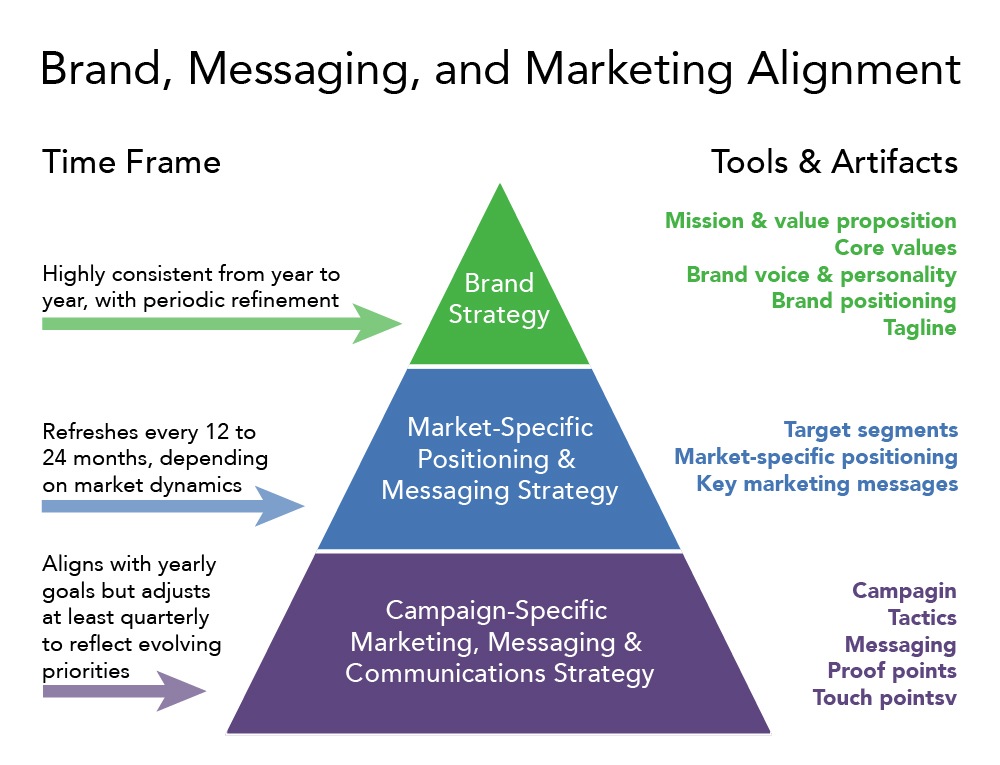
Here is one effective approach how you can achieve such alignment:
- Define your unique value proposition (UVP) in simple terms.
- Map the proposition to the product: what it needs to be (and not to be) to deliver the promise?
- Identify the five to ten most likely customer questions.
- Answer those questions in messaging and product UX.
- Align visuals and tone across marketing channels (web, social, store, etc.).
- Organize teams around common tone and objectives.
Alignment doesn’t mean slowing down innovation. It means innovation doesn’t force the brand to constantly reintroduce itself.
When brand, product, and communication operate as a unified system, strategic alignment stops being a goal and starts being a natural side effect of how marketing is run.
Consistent messaging across the full customer journey
Meaning and values get lost when teams assume each piece of complex marketing communication is a holistic approach to customers from the outside. They don’t. Customers don’t remember your previous page the way your PR or marketing manager does. It’s called inside-the-box thinking.
However, if the message repeats at every touchpoint and through different channels, customers are much more likely to remember it.
Consistency isn’t about sounding the same everywhere. It’s about meaning the same thing everywhere. The words can change. The logic shouldn’t.
Across the marketing funnel stages, messaging should move from awareness to understanding to confirmation. Each stage should add confidence without changing direction.
A usable strategy looks like this in practice:
- Define one core promise you can keep.
- Repeat that promise across all stages of the customer journey.
- Use the same value hierarchy, terms, and voice everywhere.
- Keep pricing and product language aligned.
- Match onboarding expectations to marketing claims.
- Review positive and churn feedback for messaging gaps.
Working as a system, such communication beats any isolated marketing campaign in efficiency and impact.
When messaging stays consistent, customers stop hesitating. They recognize the brand, trust the signals, and move forward with less doubt. Marketing becomes simpler, more confident, and far more effective.
The concept of shared goals between marketing, sales, and support
Most teams don’t disagree on priorities. They disagree on definitions. Marketing calls a lead “ready.” Sales calls it “early.” Support calls it “confused.” All three might be right, depending on where they sit.
The absence of shared goals doesn’t create conflict immediately. It creates inefficiency. Each team improves locally, while the overall experience stalls. It might be even pulling in different directions, each with local successes, but that multi-course development creates conflicts.
Shared goals change the conversation. Instead of asking “Did my team hit its numbers?”, teams start asking “Did the customer move forward?”
A practical way to align goals looks like this:
- Define success from the customer’s perspective first.
- Agree on what a “qualified” lead actually means.
- Align marketing KPIs across all teams.
- Use insights from the support team to refine products and messaging.
- Establish an improvement cycle to elevate future campaigns.
Holistic marketing doesn’t erase functional boundaries. It makes them permeable. Information flows instead of stopping at team borders.
When goals align, marketing stops overselling, sales stops overdoing unimportant things, and support stops apologizing for mismatched expectations. Teams move faster because they are aligned on goals and feel motivated to achieve them.
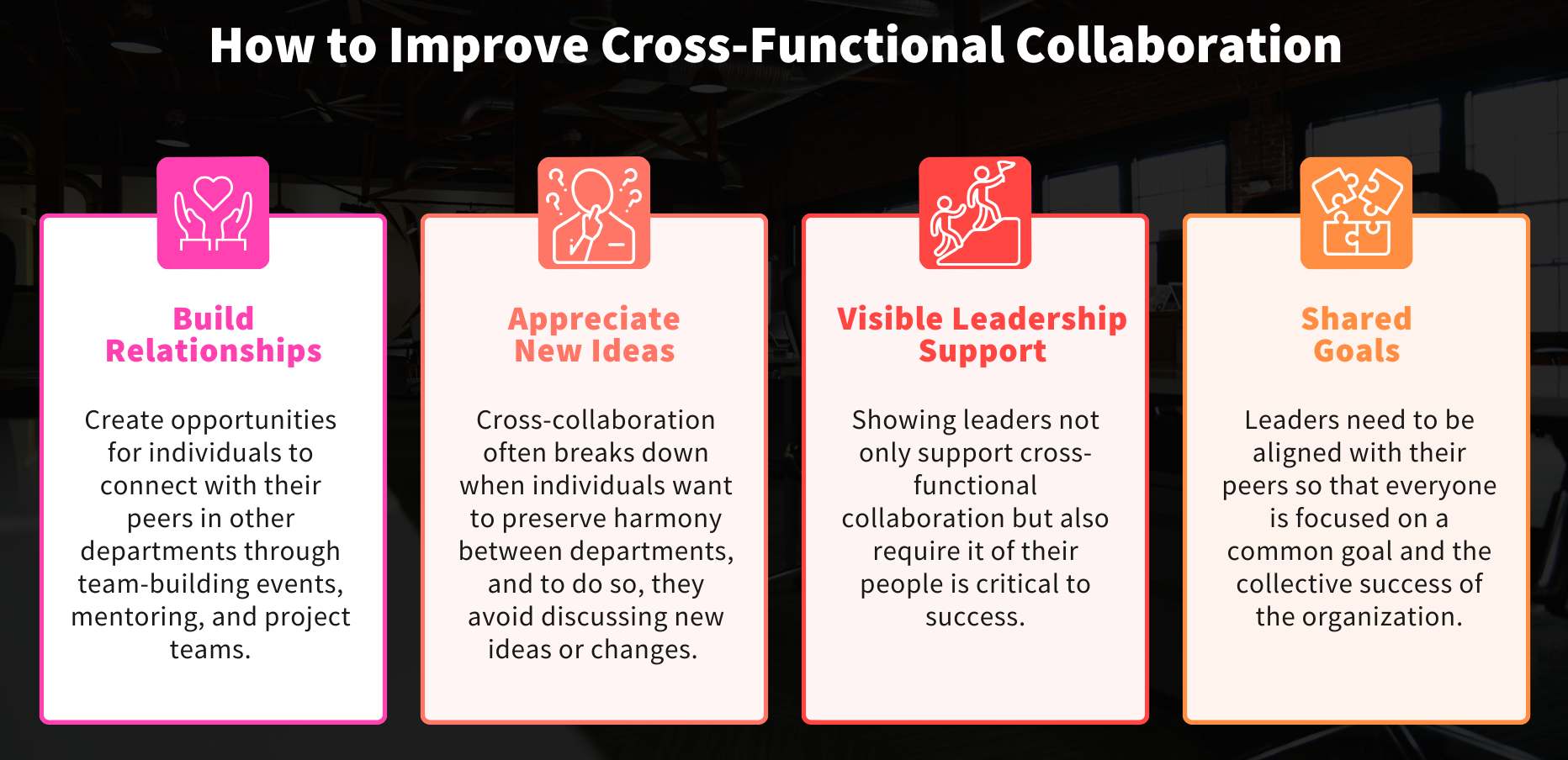
Here are a few additional ideas on how to improve cross-functional collaboration beyond goals:
The role of data and feedback in end-to-end marketing
For the end-to-end marketing approach with all its complexity and diversity of components to be effective, it has to rely on something that holds different pieces together, something that works like glue. Data fulfills that role brilliantly. It gives the whole process its meaning, enables the key marketing roles to take informed decisions, and turns fragmented activities into a measurable, digital feedback loop.
Connecting insights from multiple touchpoints
Every customer leaves a trail. The problem is that most teams look at only one footprint at a time. Ads measure clicks. Websites measure sessions. Sales measures the pipeline. Support measures tickets. Each metric is accurate — and incomplete.
Connecting insights from multiple touchpoints means stitching those fragments into a narrative. It’s not about collecting more data. It’s about letting existing data talk to each other.
Customers don’t experience channels. They experience transitions. What happens between first interest and first doubt. Between signup and first frustration. Between satisfaction and churn. Those transitions are where insights live.
A usable concept for this connection focuses on flow, not volume, and stipulates that you do the following:
- Track how users move, not just where they land.
- Link acquisition sources to long-term outcomes.
- Compare marketing promises with onboarding behavior.
- Use support data to audit brand promises.
- Review lifecycle data in sequence.
- Identify friction points that repeat.
When insights are connected, marketing becomes not so much about reacting to numbers, but more about understanding customer behavior. That’s how informed decisions are born, and that’s how isolated marketing campaigns work as a system to support overarching business ambitions.
And that’s exactly how data stops being just “information” and starts functioning as glue.
Using customer feedback to refine messaging and offers
Some companies only pretend they listen to what their customers say. They run fancy surveys, launch social media campaigns to understand the sentiment, but they never really implement customer feedback in their marketing processes to improve offers.
A big part of the problem is that most feedback doesn’t arrive neatly labeled as “actionable.” It arrives as hesitation, follow-up questions, or deals that stall for no obvious reason. Analyzing, making sense of, and implementing those signals is what separates successful marketing teams from the rest.
Holistic marketing also treats those signals as early correction points. However, not everything needs fixing; you need to be highly selective and cherry-pick your improvement opportunities.
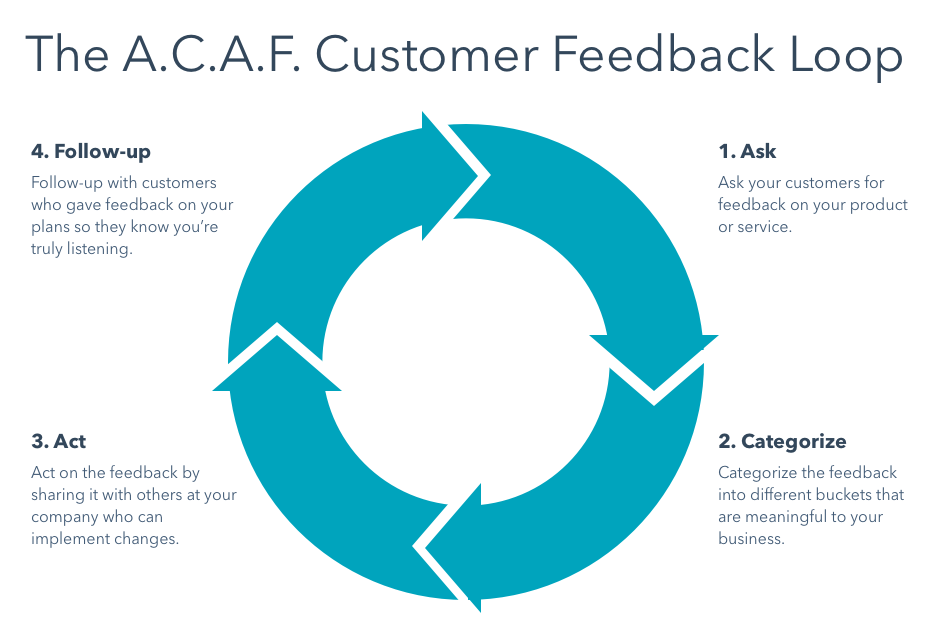
A practical refinement loop looks like this:
- Capture feedback wherever customers speak freely.
- Identify patterns instead of isolated/impulsive reactions.
- Match feedback timing to a relevant funnel stage.
- Identify which marketing communication elements slow buyer decisions.
- Take action: improve offers, messaging, and support efficiency.
This is how customer feedback becomes useful and helps to improve marketing processes. It also helps to track whether concerns decrease over time (the loop closes and repeats).
When data is abundant, it’s easy to get lost and misinterpret noise for useful information, and vice versa — overlook something really important. Struggling alone is a vestige of the past, pre-digital era. Today, you have lots of useful tools and AI to help you listen to your customers and interpret the information.
For instance, tools like Google Analytics 4 can enable you to track customer behavior across multiple touchpoints. Hotjar can visualize customer behavior via heatmaps and graphs. And Intercom can do what required several teams of human specialists just a decade ago — capture and analyze qualitative feedback from real-time customer conversations.
Turning performance data into cross-channel improvements
Performance data is honest, but it’s also indifferent. It doesn’t care what team you’re on or which channel you own. It just records what happened — and waits for someone to connect the dots.
Ironically, most teams don’t struggle with a lack of data. They struggle with interpretation. A channel performs well, so it gets more budget. Another underperforms, so it gets cut. Weeks later, something else breaks, and no one remembers why.
Genuine and lasting cross-channel improvement starts when you stop asking whether a channel “worked” and start asking what it caused. Very often, the answer shows up somewhere else.
Here’s how performance data becomes useful across channels:
- Follows outcomes beyond the original touchpoint.
- Identifies where users came from and where they linger.
- Looks beyond conversion volume to assess quality (e.g., duration).
- Helps to identify channels that simplify conversions and onboarding.
- Tells which campaign messages have led to desired onboarding behavior.
- Checks support load of high-performing pages and identifies the ones with less support required.
Moreover, quality performance data helps teams to reduce investment in underperforming channels. Why pour all or half of your budget into a channel that will not bring the desired outcome?
Armed with performance data and customer feedback collected and analyzed with the help of relevant IT tools, teams can focus on fixes that improve multiple stages at once. They often get 80% of results with just 20% of effort.
When teams work this way, optimization speeds up — and that’s a good thing. Fewer reactive changes. Fewer “quick wins” that create hidden costs.
Long-term growth advantages of a unified digital marketing strategy
The role of holistic marketing in overall business performance is not limited by its ability to align multi-functional teams on common goals. A much more interesting and important impact can be seen on long-term growth and overall organizational resilience. The latter is most commonly manifested as stronger brand recognition and sustainable economic gains.
Stronger brand recognition and trust over time
Brand recognition doesn’t come from being clever. It comes from being familiar — in a good way. People rarely remember the first time they see a brand. They remember the fifth or sixth time, when it feels recognizable without effort.
A unified digital marketing strategy solves a surprisingly simple problem: it helps the brand sound like the same entity every time. Not identical, but coherent.
The signals that build recognition and trust over time include:
- Repetition of core ideas without exaggeration.
- Stable positioning across different initiatives.
- Familiar vocabulary used consistently.
- Clear expectations that don’t require fine print.
- Continuity between acquisition and post-purchase experience.
- Measured evolution instead of abrupt changes.
Over time, this consistency lowers mental effort for customers. They recognize the brand faster. They trust it sooner. And they hesitate less.
From an agency perspective, this is often the most underrated advantage of a unified strategy. It doesn’t generate applause, but it creates memory. And memory, once established, becomes one of the strongest drivers of sustainable growth.
More efficient use of marketing resources and budgets
Most marketing budgets erode slowly, through duplication, misalignment, and work that looks useful but doesn’t carry forward. Organizations don’t realize that overnight, there is even inertia as they try to pursue old goals and improve what needs drastic changes. Marketers continue launching campaigns, tools, and experiments that make sense locally, yet don’t strengthen the system as a whole.
A unified digital marketing strategy changes how resources are spent by changing how decisions are made. Instead of asking, “Can we afford this campaign?”, teams start asking, “Will this help multiple stages of the journey?”
Efficiency doesn’t mean spending less. It means wasting less.
Here’s what that looks like in practice:
- Turning one strong idea into multiple executions.
- Reusing insights for maximum efficiency, instead of rediscovering occasionally in different channels
- Sharing the top-performing messaging and assets across teams.
- Cutting tools that duplicate the same function and drain the budget.
- Avoiding parallel experiments/projects that address the same challenge.
- Scaling what works instead of constantly testing from zero.
When everyone is aligned on these points, teams spend less time coordinating and syncing. The campaigns they launch talk to the customers in the same language, even when the active execution phrase is over. For the same token, content stays relevant because it works effectively for the achievement of multiple goals.
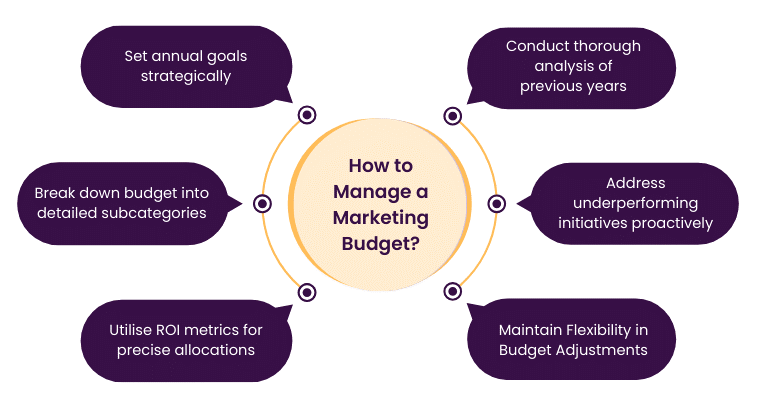
Over time, budgets stretch further not because they shrink, but because each dollar contributes to something cumulative. Marketing becomes easier to forecast, easier to defend, and easier to improve.
Common obstacles to adopting a holistic marketing approach
The paradox seen in real life is that most companies do realize the benefits that a holistic marketing approach brings, but they fail to implement it. Some try once, and after facing the first failure, they quit. Others try hard, but eventually lose dedication and abandon the whole undertaking halfway to the desired state.
Below, we list some of the most common obstacles that hold companies, organizations, and individuals back in implementing an end-to-end marketing approach. Try to avoid their mistakes at all costs, and see where your current efforts might resemble anything mentioned in the eight points below.
1. Siloed team structures
What it is. When humans work together, they tend to form groups. This is both beneficial and harmful. The harm can be seen in siloed operations, where functions like marketing, sales, finance, HR, and even top management all work in their informational bubbles, protecting what is theirs and rejecting what contradicts their interests. The bigger the organization, the more functional silos it has.
How to avoid it. Communicate cross-functionally, prioritize cross-functional project work, encourage collaboration and contribution to other departments, and implement an open space philosophy to organize physical space in teams.
2. Misaligned KPIs and incentives
What it is. One of the biggest obstacles to all-around marketing is inefficient goal allocation, which results in misaligned KPIs and incentives. Structural units are rewarded for achieving their own goals and doing nothing else that contributes to the success of their peers. The goals are not cascaded top down; they are reinvented at each hierarchical level.
How to avoid it. Set goals in a cascading fashion, where the top-level goals get supported (interpreted within their responsibilities) by all the underlying units, and all teams see how their work contributes to the greater good. For instance, SEO KPIs should align with the more general marketing KPIs. Also, reward for contributing to the achievement of corporate and cross-functional goals, not only personal ones.
3. Campaign-first mindset
What it is. It’s easier to see the rationale behind a short-term, discrete marketing campaign than a far-reaching, complex process. That’s because our minds are massively parallel, linear-thinking biological machines, and we struggle to grasp what’s beyond the near horizon.
How to avoid it. This obstacle can be avoided by actively involving team members in cross-departmental projects. Implementing a central project management office (PMO) with dedicated personnel also works against the campaign-first mindset.
4. Fragmented data and tooling
What it is. Over time, big teams tend to live in their own informational bubbles. They produce, organize, and analyze data that is only useful for their immediate unit, and use tools that are specifically configured to handle that type of data. As a result, the insights and improvement opportunities never get shared with others outside the immediate structural unit.
How to avoid it. Use dashboards and tools that are shared across teams. Make everyone involved able to contribute (modify, improve, refine) to the common databases and use shared tools for everyone's benefit.
5. Lack of shared definitions
What it is. This obstacle is similar to the data and tools mentioned above, but this time, it’s about isolated definitions and terms. Key terms like “qualified lead,” “success,” or “engagement” mean different things to different teams. Units argue about definitions and define success in their own terms.
How to avoid it. Work out common and shared documentation, and make internal communication work effectively across marketing and other departments to disseminate the commonly shared and accepted definitions. This will also help to arrive at common KPIs and speak the same business language in the entire organization.
6. Weak feedback loops
What it is. This relates to both internal and external feedback. The problem with the former prevents teams from improving projects process and moving forward with efficiency and performance. The latter aspect is manifested in the customer feedback being collected, but not systematically applied to improve messaging and offers.
How to avoid it. Implement an internal performance review process, where the results of each initiative, each project, are evaluated for the sake of making the next iteration better. On the external front, analyze customer feedback to find improvement opportunities and report findings to the management (with subsequent assignment of responsible people behind each improvement initiative).
7. Resistance to cross-functional collaboration
What it is. The bigger the organization/team, the higher the resistance to cross-functional collaboration. Teams become protective of their areas of responsibility, and they even form functional sub-cultures, e.g., content, social, SEO, ad/paid, project management, etc.
How to avoid it. Incentivize individual team members and smaller teams to participate in cross-functional collaboration. This can be done in the form of a monthly bonus paid for working (hours spent, meetings held, etc.) with members of other marketing teams on common projects.
8. Pressure for immediate results
What it is. Even if all the above obstacles get more or less successfully avoided, there is a common bias and the desire to achieve immediate results. Pressure can be high from the immediate and top management to gain quick wins, low-hanging fruits, etc., and to report on the success ASAP. This obstacle favors short-term campaigns and drains energy from more holistic marketing initiatives.
How to avoid it. Set clear milestones and interim goals, working incrementally towards achieving greater, more strategic ambitions. Everyone in the team should see that achieving a particular milestone is not the end goal; it’s only a stepping stone towards a more important objective.
Conclusion
Modern marketing can be most accurately described as a fluid, running, and constantly evolving process that adapts to the ever-changing market and customer demands. This requires all business units to work as a coordinated whole, sharing context, insights, and responsibility across functions.
For the sake of achieving common goals, marketing can operate in isolated campaigns or in a project-based pace, but the effectiveness of this work is limited by the ability of the organization to utilize and expand the results achieved.
It’s for that very reason that isolated campaigns can never beat the scale and impact of full-fledged, holistic marketing. The latter have the unique ability to organize and motivate individuals under the auspices of unified goals and common direction, which allows individual efforts to compound.
All trademarks, logos, images, and materials are the property of their respective rights holders.
They are used solely for informational, analytical, and review purposes in accordance with applicable copyright law.




 Sign Up
 Sign Up