




Michael King: “SEO Is Deprecated” & Other Interview Highlights
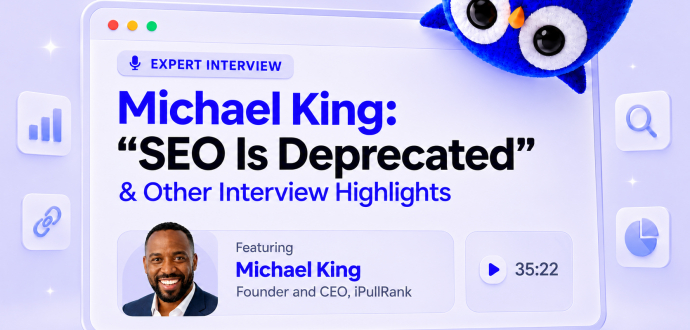
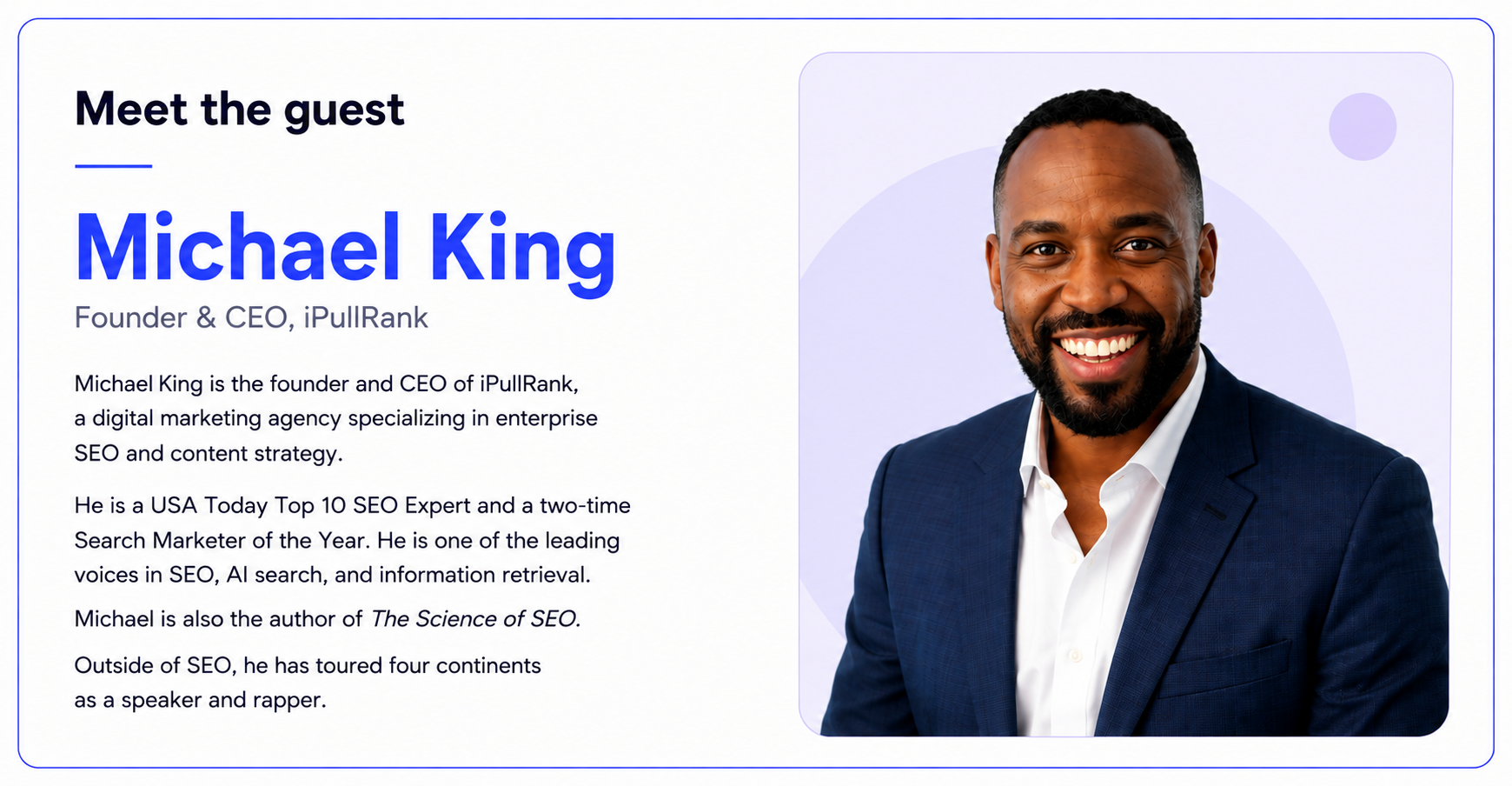
These are highlights from our interview with Michael King. You can learn more about Michael’s work on iPullRank or connect with him on LinkedIn.
How is SEO evolving?
SEO is deprecated. If you keep doing what you've always done, you won't get the same results.
That’s because two things have changed:
- Users interact with search differently.
- Search engines evaluate content differently.
But on the bright side, we have much greater visibility into how search systems work.
Today, SEO isn’t just a game of guessing and checking. Thanks to research papers, patents, and open-source AI projects, we have a much better understanding of how search systems work and can optimize accordingly.
We can even build environments that replicate how these systems work.
Are traditional SEO tactics still working?
Many classic SEO tactics still work in the age of AI search. But best practices shouldn't be treated as fixed rules.
Take, for example, the famous 60-character title tag recommendation.
In reality, there is no character limit in Google. It processes the entire title. Longer titles may simply be shortened in search results.
But in some cases, a 200-character title can even outperform a shorter one, as Google rewrites it using the most relevant section.
And there are dozens of tactics like this.
Instead of blindly following SEO best practices, continuously test what works for your website.The strongest results come from experimentation, not from copying the same "30 SEO tips" everyone else is using.
What is relevance engineering?
Relevance Engineering is a framework that helps improve visibility across traditional and AI search by combining five disciplines:
- Information Retrieval,
- Artificial Intelligence,
- Content Strategy,
- User Experience (UX),
- and Digital PR.
SEO isn't on that list intentionally.
Because by only using traditional SEO tactics, you won’t necessarily appear in AI search results. Several studies prove it now.
Traditional SEO knowledge alone is no longer enough to show up in AI search. You need to optimize for the broader set of related queries AI systems generate.
AI search systems don't evaluate pages as a whole.
They analyze individual passages and generate synthetic queries behind the scenes.
AI search: Are we losing traffic?
AI search is primarily becoming a branding channel, not a traffic channel.
It can still drive performance. But not on the same scale as classic search.
If you're expecting AI search to recover all of your lost traffic, you're going to be disappointed. Referral traffic from AI platforms is only a fraction of what classic search used to deliver.
However, the people who do click tend to have much stronger intent. Traffic is lower, but its quality is much higher.
As a result, conversion rates often increase. That's why…
Businesses should focus more on mid-funnel and bottom-funnel queries in AI search. Those visitors are closer to making a decision and are more likely to convert.
Even if AI becomes the default search experience, I don't think the classic list of blue links will disappear completely.
But businesses shouldn't expect traffic to return to previous levels.
The value of impressions in AI search
One thing the SEO industry has consistently underestimated is the value of impressions.
In AI search, impressions are especially valuable. Because users are actively looking for information. They're already in a decision-making mindset.
Imagine someone searches for shoes for a night out. The AI recommends a specific brand.
That visibility has value. Even if the user never clicks a website.
They may simply go to the store and make a purchase.
That's why…
We shouldn't measure SEO by traffic alone. Search influences decisions long before a click happens. If we judge SEO only by the visits it generates, we'll overlook much of its real business impact.
The most important SEO skill in the age of AI
Today, one of the most important SEO skills is content engineering. AI systems favor information that's easy to extract, understand, and recombine. They also evaluate each passage for relevance and authority.
Appearing in AI-generated answers depends on more than just good content. It depends on how that content is structured.
That's one of the biggest differences between traditional SEO and AI search. Instead of optimizing an entire page, you need to optimize the passages within it.
Guest posting for AI visibility
Guest posting should be about spreading your brand message across the web. Not just about backlinks.
In AI search, your entire content ecosystem matters, not just your website.
The goal of guest posting isn't to publish random articles everywhere. It's to consistently communicate the same expertise across multiple trusted sources. And that's especially important for AI search.
This approach strengthens the signals AI systems use to understand your authority.
Search is changing, but many SEO tools don’t keep up
There are three search models:
- Lexical search, which analyzes keywords and word frequency.
- Semantic search, which understands meaning using AI.
- Hybrid search, which combines both approaches.
Most SEO software hasn't kept pace with how search works today. Google and AI search platforms now use hybrid search, analyzing both keywords and meaning. But many SEO tools still score content primarily based on keyword usage rather than meaning.
As a result, following every SEO recommendation doesn't always improve performance.
In many cases, you're optimizing for an outdated version of search. Not the one Google and AI systems actually use.
Best AI SEO tools
When looking for AI SEO tools, choose the ones built for modern search rather than those relying on outdated SEO metrics.
For me, the best AI SEO tools are Profound, Peec AI, and Athena. They all focus on two key questions:
- How do we measure visibility in AI search?
- How do we improve it?
One feature I especially like is log file analysis.
Tools like Profound integrate directly with Cloudflare and other CDNs, making it easier to see how AI crawlers access and interact with your site.
Why does HTTP 499 matter?
One of the biggest changes in AI search is the importance of HTTP 499. Most SEO professionals don't pay attention to 499 errors because they weren't important in traditional SEO. In AI search, they can directly affect your visibility.
A 499 status code means the client gave up waiting because the server responded too slowly.
Unlike Google, many AI search platforms fetch pages in real time. When a user submits a prompt, the AI requests multiple pages, extracts relevant passages, and builds an answer.
If your page loads too slowly, the AI simply moves on.
That means your content may never be considered. Even if it's the best answer.
Why does metadata matter in AI search?
A relevant page title, meta description, and URL slug help AI systems like ChatGPT understand what your page is about. And eventually decide whether it's worth opening.
That's why you should optimize them for both traditional search and AI retrieval.
These are highlights from our Adsy Talks podcast with Michael King. For more insights, watch the full interview on our YouTube channel:
All trademarks, logos, images, and materials are the property of their respective rights holders.
They are used solely for informational, analytical, and review purposes in accordance with applicable copyright law.


 Sign Up
 Sign Up