






Emma Young Interview: “Organic Marketing Is an Overlooked Intelligence Layer”
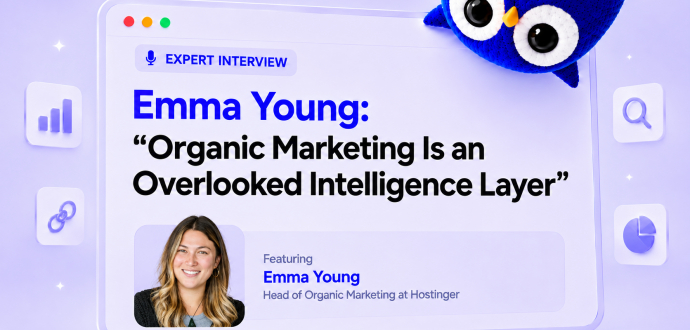
Emma Young describes her job as “organizing chaos into systems that scale.”
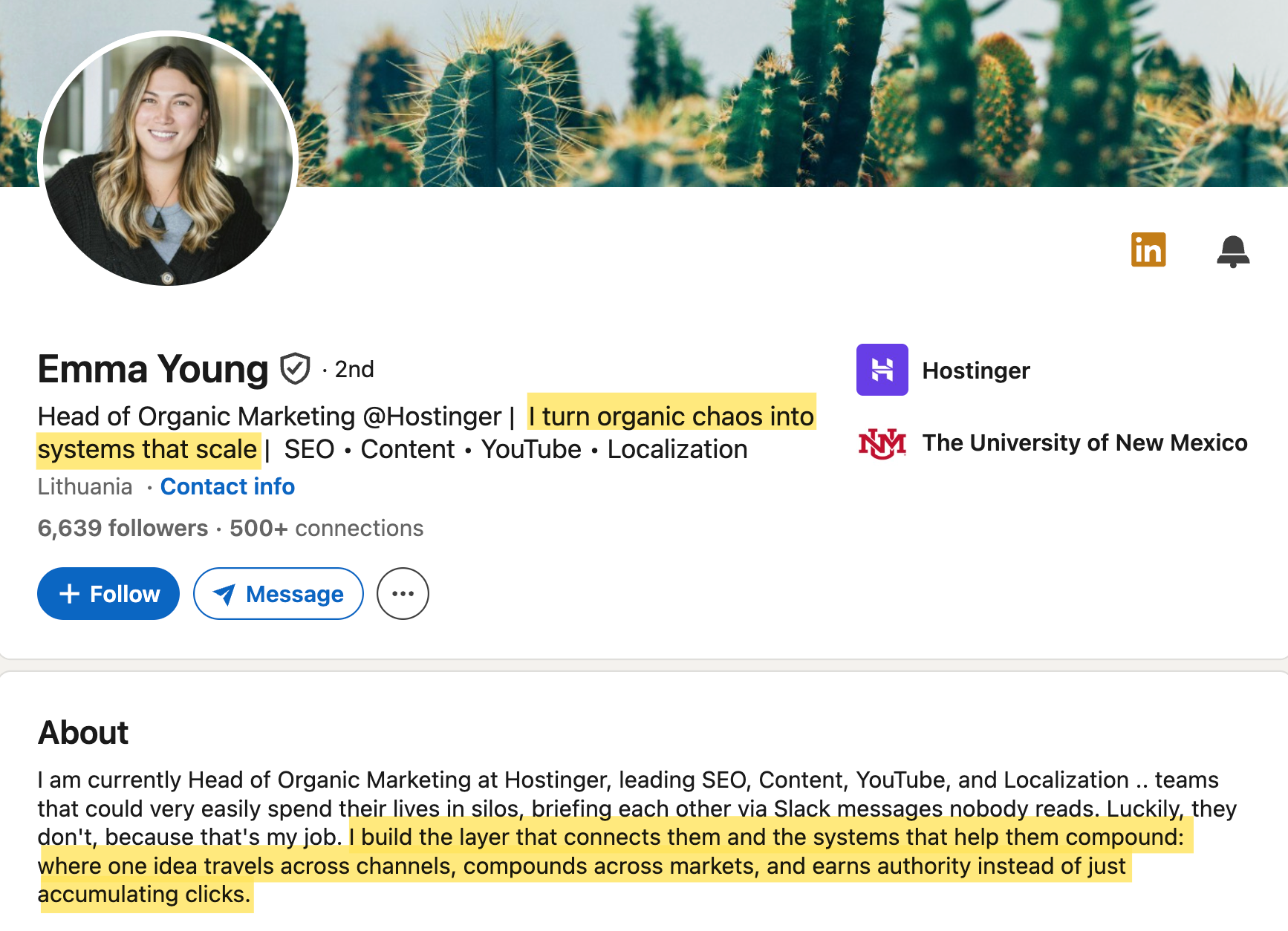
As Head of Organic Marketing at Hostinger, she leads SEO, Content, YouTube, and Localization. She also has opinions about all of them, and she’s not shy about sharing.
We talked about why organic marketing feels so chaotic, what AI actually changed, why attribution is so hard, and why replacing your marketing team with AI is a bad idea.
This interview is an extremely helpful read for brands that:
- Feel their organic marketing is chaotic
- Don’t know whether they’re supposed to “be everywhere”
- Are thinking about swapping your marketing team with AI
We promise you’ll learn, recognize yourself in many of these situations, giggle from time to time, and come away feeling calmer and more confident about what your organic marketing should look like.
Meet the guest
Emma Young
Head of Organic Marketing, Hostinger


Why organic marketing feels so chaotic, and what to do about it
Organic marketing often feels chaotic because it grows like a garden nobody’s in charge of. Each channel has its own KPI, tool, and person it reports to, but nobody’s looking at the whole plant.
Emma Young
Head of Organic Marketing, Hostinger
Interview highlights
You know the garden:
- A bit of SEO here.
- A blog someone’s cousin writes.
- A YouTube channel (maybe) that one enthusiastic PM started, then abandoned.
- A docs page that a dev created because ‘we needed’ it, without realizing we already had one.
Everything’s growing. Nothing’s connected.
The thing I got wrong
I used to believe that if SEO, content, YouTube, and localization each hit their own KPIs brilliantly, the business would automatically win.
But it doesn't work that way.
Channel-level excellence doesn’t always add up to company-level success. Teams can do great work in isolation and still miss the bigger opportunity because nobody’s connecting the dots.
Emma Young
Head of Organic Marketing, Hostinger
Interview highlights
Now, I think the layer that sits above the channels, the strategy, matters more than any single channel’s execution.
And that’s not just organic marketing. It’s true of any part of a company.
If the company’s overall strategy isn’t crystal clear, every team ends up guessing how to fill in the gaps.
Emma Young
Head of Organic Marketing, Hostinger
Interview highlights
I used to fill in the gaps when I wasn’t sure, and I can see now that others did too. Now, with AI search, we have to fix all the things we used to just brush under the rug.
So what actually helped us change? Two things. First, changing the question.
For effective organic marketing, organize around segments and funnels, instead of channels and content types.
Emma Young
Head of Organic Marketing, Hostinger
Interview highlights
Swap ‘What does the content calendar say we owe this week?’ for‘What job is the customer actually trying to get done?’
Suddenly you’re not asking four teams to solve the same problem four different ways. You solve it once, well, across every channel where it needs to show up.
Second, getting the right people in the room early.
If your organic marketing feels chaotic, start by getting the right people in the room before everyone builds their own roadmap.
Emma Young
Head of Organic Marketing, Hostinger
Interview highlights
Most teams build separate roadmaps and compare them afterward, if they compare them at all.
That’s how you end up with extra work and three slightly different versions of the same thing.
Instead, brainstorm together and decide who kicks it off, who owns it, and who repurposes it.The answer shifts with resources, focus, priorities, and can change with each planning.
What we get wrong about content repurposing
Editor’s note: Emma’s work is a lot about building systems. So, instead of constantly generating new ideas for organic marketing, she makes sure that every single idea gets enough exposure and actually brings results. That’s why we had to talk about repurposing.
In practice…
Good content repurposing isn’t really repurposing. It’s translation. And I don’t mean just through localization, but through channels.
Emma Young
Head of Organic Marketing, Hostinger
Interview highlights
The core insight stays intact. The format, language, and channel adapt to wherever the audience already is.
Take a strong idea, like how AI agents are changing hosting.
It shouldn't live as one blog post. It should show up as:
- A landing page that ranks,
- A YouTube explainer that gets cited by AI search,
- A tutorial that solves the how-to version of the same problem,
- And a localized version that doesn't just translate the words but adapts the examples for that market.
To make content repurposing work, don’t let channels plan in isolation. Start with a shared priority across products and markets, then ask how it should show up across each channel.
Emma Young
Head of Organic Marketing, Hostinger
Interview highlights
That shared priority is the connecting tissue. It's slightly chaotic to set up the first time, but you refine the process as you go.
The biggest change AI brought to organic marketing: from “get found” to “get cited”
AI shifted organic marketing from ‘get found’ to ‘get cited.’ Your content now needs to be clear, accurate, and structured enough for models to use as a source, not just readable enough for a human to click.
Emma Young
Head of Organic Marketing, Hostinger
Interview highlights
The user doesn't have to click anymore.
For years, "ranking well" meant earning a click. Now, an AI answer engine can read your content, synthesize it, and answer the question without the user ever landing on your site.
But to be honest, it’s less dramatic than it sounds.
I don’t think the fundamentals of good content have changed with AI. AI just added another layer: making that content machine-readable too. But it doesn’t have to be one or the other.
Emma Young
Head of Organic Marketing, Hostinger
Interview highlights
How to get started on YouTube (hint: not with the camera)
Editor’s note: YouTube is now largely considered one of the most cited sources in AI search. Besides, YouTube mentions show the strongest correlation with AI visibility. So, of course, we had to ask Emma where businesses should start.
Definitely don’t start with a question like, “What should our first video be?”
If your business wants to get started on YouTube, start with the job, not the camera. Ask what your audience is trying to figure out, and whether video is the best format for it.
Emma Young
Head of Organic Marketing, Hostinger
Interview highlights
So first, audit the questions your audience is already asking in search and your support inbox.
Then, pick the ones where seeing something explained works better than reading it, and build from there.
When starting on YouTube, don’t chase production value before you’ve proven the format works. A slightly rough video that answers the question will outperform a beautifully shot one that doesn’t.
Emma Young
Head of Organic Marketing, Hostinger
Interview highlights
Given how often YouTube gets cited in AI search results, the channel isn’t just a discovery play anymore.
It’s becoming a trust and citation play.
Is “be everywhere” actually good marketing advice?
Honestly? Terrible advice if you take it literally. And great advice if you translate it correctly.
‘Be everywhere’ in marketing should mean ‘be everywhere your specific customer already looks for this specific job,’ not ‘have an account on every platform that exists.’
Emma Young
Head of Organic Marketing, Hostinger
Interview highlights
So, how do you pick? How do you prioritize the right channels?
We use a simple tiering system across products and markets. It starts with an honest conversation:
When prioritizing marketing channels, ask where the real growth is vs. where you’re just defending what you already have.
Emma Young
Head of Organic Marketing, Hostinger
Interview highlights
This way, “be everywhere” won’t mean spreading five people across twelve channels equally. It will mean focusing effort where it matters most.
Why organic marketing is now a cross-team sport
We can’t function in marketing the way we used to, with each team having its own KPIs, working in silos, and planning separately.
AI search has completely changed how marketing needs to work with other teams. Even when teams share the same goal, their efforts won’t compound if they plan separately.
Emma Young
Head of Organic Marketing, Hostinger
Interview highlights
This is just how it is now:
- PR and Brand are key stakeholders.
- Offsite and affiliate teams get targeted lists.
- Influencers and partners need the same messaging intent as our in-house comms team.
- We need more devs to process tickets.
If something changes on a landing page, the tutorials, blog content, partner content, etc., all need to stay in sync.
Organic growth used to be something marketing did TO the website. With AI, it’s something the whole company does WITH the website.
Emma Young
Head of Organic Marketing, Hostinger
Interview highlights
We need to move as one function, not as individual teams. That makes communication, especially centralized communication, so much more important.
It also makes sense why smaller marketing teams can move so much faster: fewer people to wrangle :D
An existential crisis over attribution models or how to measure organic marketing
Editor’s note: Alright, so when we saw Emma’s post below, we could relate immediately, and we knew many of you would too. So, yes, here comes the painful attribution models talk.
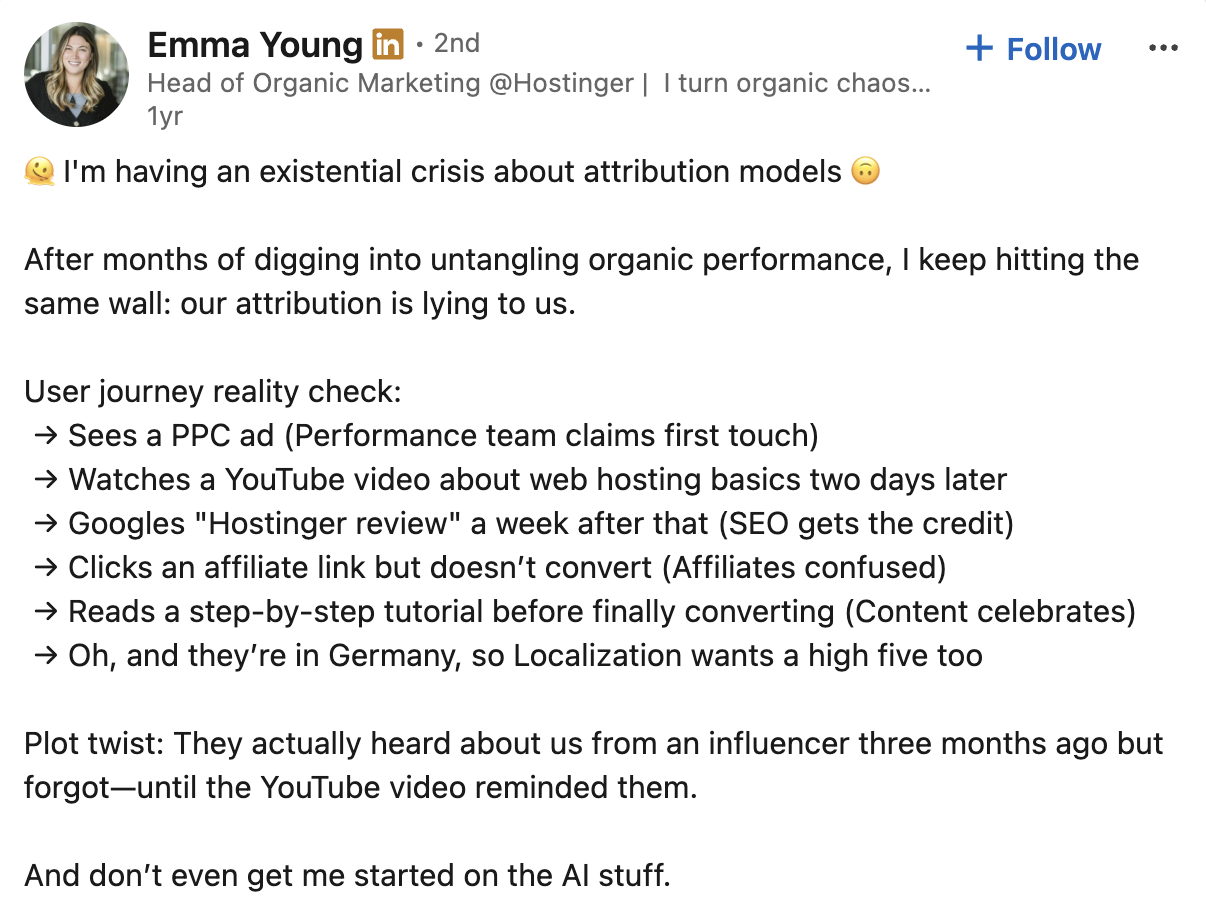
Source: LinkedIn
Haha, yes, I did have an existential crisis over attribution models, and I stand by it.
Last-click models lie to you. First-click models lie to you in a different way. And now AI search adds a whole new layer of ‘your traffic came from somewhere, we’re just not entirely sure where, good luck.’
Emma Young
Head of Organic Marketing, Hostinger
Interview highlights
Oh, and don’t even try to figure out what happened from the first click to the last click. Best of luck, brand ;)
So what do I do instead?
The least misleading way I’ve found to measure organic marketing is to stop looking for one number and triangulate: pair a leading indicator (rankings, LLM citation share, share of voice) with a business outcome (billings, new clients), and watch how both move.
Emma Young
Head of Organic Marketing, Hostinger
Interview highlights
This is much more useful than obsessing over a single attributed figure.
If your visibility is climbing and your revenue is climbing, you're probably fine, even if you can't draw a perfectly clean line between the two.
Chasing false precision in marketing is how you end up optimizing for the metric instead of the customer.
Emma Young
Head of Organic Marketing, Hostinger
Interview highlights
At the end of the day, there are so many vanity metrics and so many things you can track.
So, my logic is simple:
- If it helps me know that what I'm doing, testing, experimenting with is working, then it's a good thing to measure.
- If it's just something on my checklist to fill in a little cell each Monday, then it's not a good thing to measure.
This changes over time too, and sometimes you have to re-educate the company on what “good” looks like. AI is a good example: old traffic numbers aren’t always comparable to new ones. I think everyone freaked out a bit there.
The part of organic marketing many businesses ignore
Having it :D
I don’t know how many people I’ve met who said,“My company restructured or downsized because of AI. We used to have a team of SEOs and writers, and now we have automation.”
These businesses are screwed. I mean it.
Businesses that replace their organic marketing teams with AI are screwed.
Emma Young
Head of Organic Marketing, Hostinger
Interview highlights
Maybe if you have 100 people and cut back to 50, that could make sense. Roles change, scope changes, etc. But to fully replace your organic marketing team with AI? I wouldn’t work for a business that took that approach.
Now that my rant is over :D I think often, businesses don’t see the real value of organic marketing.
Yet, here is the thing: organic teams can be feeding insights back into the rest of the business.
SEO and content teams sit on an enormous amount of intent data: what people are actually searching, asking, and struggling with.
Most companies treat SEO and content as a ‘traffic-generation exercise’ instead of an intelligence layer. Emma Young Head of Organic Marketing, Hostinger Interview highlights
But this data should be shaping product roadmaps, sales messaging, and support content, not just blog topics.
Organic marketing isn’t just a content engine. It’s also a source of customer insight, and most companies don’t use it that way.
Emma Young
Head of Organic Marketing, Hostinger
Interview highlights
And it’s useful long before launch. I see a lot of businesses chuck SEO in at the end like, “Oh yeah, let’s do some SEO on that.”
One often-overlooked value of organic marketing is that it can help test a new market by looking at search intent and which products people are responding to. That insight can then help shape what gets launched first and where the business focuses.
Emma Young
Head of Organic Marketing, Hostinger
Interview highlights
Quick-fire questions
Which team outside marketing has the biggest impact on organic growth?
Engineering. We are only as good as what actually ships.
Should every organic team invest in YouTube?
No, only if your audience already turns to video (or AI search is already citing video) to solve their problem.
What is one content format you would invest more in today?
Journalism. There is so much crap and misinformation. We need to bring back actual journalism, investigative work, fact-checking, sharing a story, not just because everyone else is writing about it.
What is more important for AI visibility: content or brand authority?
Brand authority.
All trademarks, logos, images, and materials are the property of their respective rights holders.
They are used solely for informational, analytical, and review purposes in accordance with applicable copyright law.
 Sign Up
 Sign Up