




Belinda Conde: “Search Isn't Dying. It's Expanding” & Other Interview Highlights
Is AI replacing Google? What the data actually says
We often hear that AI search is replacing traditional search. It’s a myth. Google remains the backbone of discovery across the open web.
What the data shows is more interesting.
Traditional search and AI search are growing in parallel. They don’t cannibalize each other. Consumers are simply searching in more places.
- Around 11% of all desktop activity comes from traditional search.
- AI tools account for nearly 2%.
E-commerce search is almost twice as large as AI search.
Search isn't dying. It's expanding. Consumers are looking for information across traditional engines, AI, e-commerce, and social media platforms. They often use several of them during the same journey.
Why do scary headlines spread faster?
Content that makes us angry or outraged often gets more engagement. We comment, share, and discuss it without realizing we’re helping the algorithm spread it even further.
This can give misinformation an advantage over accurate data and more nuanced information.
In short, we don't just consume content. Our reactions help determine what gets amplified next.
The non-linear consumer journey: How consumers buy today
The traditional linear funnel is gone. Today, people move back and forth between awareness, consideration, and purchase all the time.
Even after buying, people may return to research how to use or set up a product.
Consumer journeys are fragmented across many touchpoints. People might check:
- Reddit,
- UGC platforms,
- Google,
- several AI platforms,
- and a brand’s website before making a decision.
And just before purchasing, they can experience FOBO. A fear of a better offer. And start looking elsewhere.
Clickstream data can give us a window into what consumers actually do online: how they research, compare options, and build confidence. Marketers can use that context to make better decisions about channel mix and investment.
Let’s take a look at a real-world example of a consumer journey.
Take Marcel, who was buying a Samsung TV in the U.S. His journey started eight days before the purchase: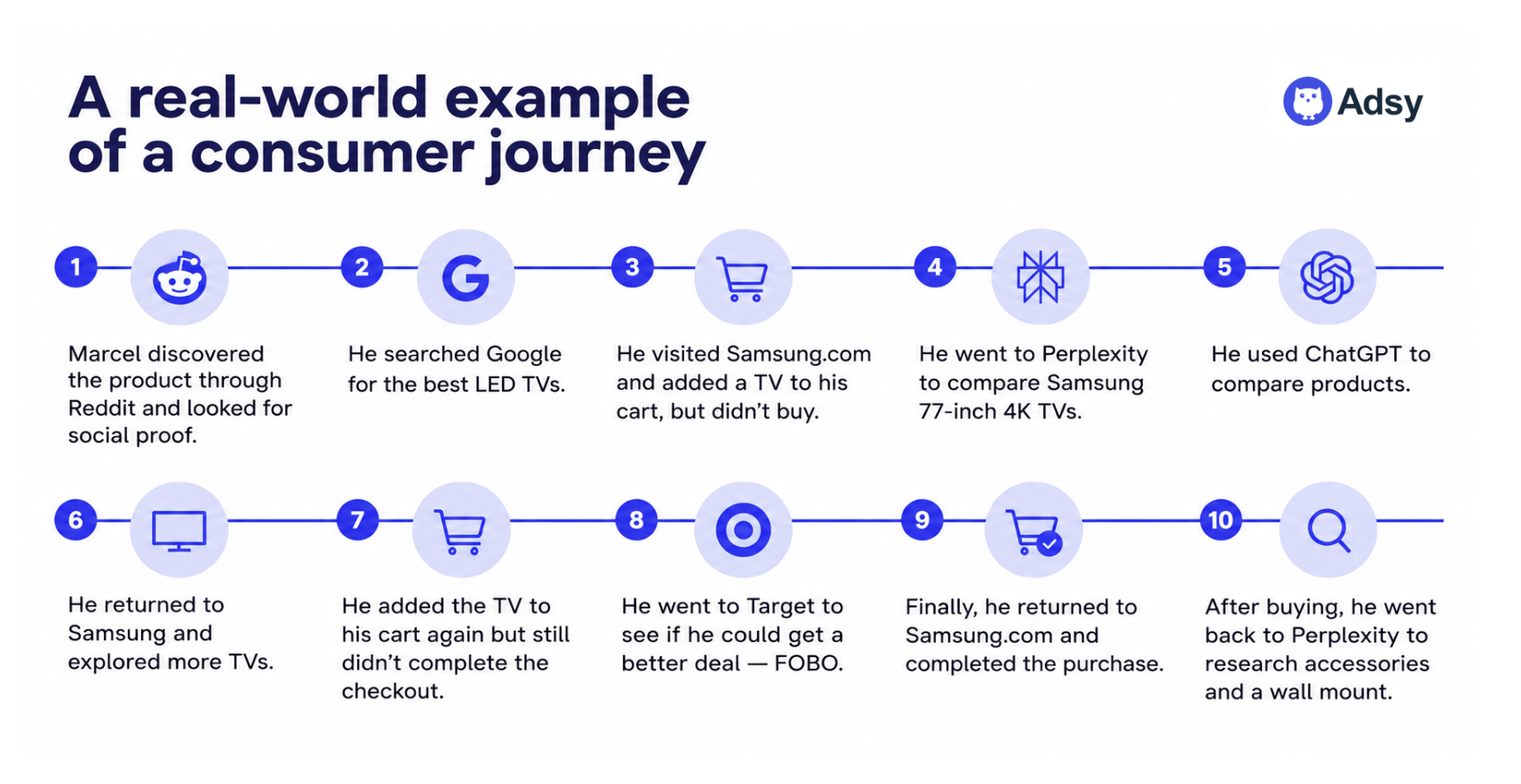
- Marcel discovered the product through Reddit and looked for social proof.
- He searched Google for the best LED TVs.
- He visited Samsung.com and added a TV to his cart, but didn't buy.
- He went to Perplexity to compare Samsung 77-inch 4K TVs.
- He used ChatGPT to compare products.
- He returned to Samsung and explored more TVs.
- He added the TV to his cart again but still didn't complete the checkout.
- He went to Target to see if he could get a better deal.
- Finally, he returned to Samsung.com and completed the purchase.
- After buying, he went back to Perplexity to research accessories and a wall mount.
This single journey included social, traditional search, AI, retail, and direct brand traffic.
That's why first-touch and last-touch attribution can both be misleading.
Your GA4 and other analytics tools can show what happens on your own website. But they don't show everything consumers do before and between those visits.
Clickstream data fills that gap.
The importance of each touchpoint also varies by industry.
And this landscape is changing constantly. The data can look very different from one week to the next.
Personalize every touchpoint
The more you understand your customers, the more effectively you can personalize their journey.
This matters even more as consumers increasingly expect tailored experiences.
We're seeing the same shift in search. Queries are becoming longer and more conversational.
Consumers increasingly expect answers that reflect their specific needs. This is happening across AI, traditional search, and e-commerce. So, use your own customer data to make every interaction more relevant and personal.
Visibility and trust go hand in hand
Online visibility alone may not be enough. Your visibility needs to be supported by a strong brand, an engaged community, reviews, and genuine user-generated content.
That happensbecause people still look for real human opinions.
That’s why brands need to start using Reddit.
It’s a fact that the amount of referral traffic going to Reddit from AI tools is outstanding. The number of people adding ‘Reddit’ to the end of their Google queries is also huge.
This shows that trust needs to go hand in hand with visibility.
Reddit is becoming an essential part of consumer journeys
Reddit is really important.
But you can't just post links and promote your product.
You need to earn trust and build genuine community presence.
On Reddit, participate in conversations beyond your own product or industry. Talk about things your audience actually cares about. Build credibility before trying to promote anything.
This platform is increasingly visible across Google and AI platforms.
It makes genuine community engagement valuable far beyond Reddit itself.
Don't treat community building as a vanity metric. It's part of building the trust and visibility that support the entire consumer journey.
Why zero-click search isn't something to fear?
With almost 58% of Google searches ending without a click, you can't optimize only for website traffic. But…
Zero-click search isn’t something marketers should fear. It's something we need to adapt to. Consumers still need products, software, and services. What's changing is how they discover and evaluate them.
So, create useful content that solves real problems and builds trust. Even when it doesn't generate a click.
Organic sessions dropped. What should you check first?
The purpose of measuring traffic is to make sure it leads to enough leads, sales, or revenue.
So if organic sessions drop, don't immediately assume something is wrong:
- First, look at your top-level KPIs. Are leads, conversions, and revenue also declining? If they're stable or growing, the drop in traffic may not be a problem.
- Then check beyond your own analytics. There may be important activity happening across AI platforms, Reddit, social media, and other channels that you can't see in GA4.
The key in marketing is to avoid drawing conclusions based on a single metric. For example, zero-click doesn't mean zero value.
Ask yourself:
- Is this actually a performance problem?
- Is it a symptom of something else?
- Or are the business results still strong?
If your top-level KPIs are healthy, keep focusing on what matters: high-quality content, expert insights, solving real problems, and providing value.
Besides, SEO best practices still apply to GEO and AIO.
Keyword research, content clusters, high-quality content, and a strong website can all improve your chances of being seen, cited, and recommended by AI tools.
Don't evaluate any channel in isolation. Look at the full picture.
Lazy content marketing is over
Lazy content marketing doesn't work anymore. That’s why authority, high-quality backlinks, digital PR, and community engagement are more important than ever.
These days, competition is higher. And AI tools have their own ways to determine what content and websites to surface.
AI optimization is a compounding effort, not a quick fix. Your brand, paid search, organic search, SEO, and social efforts all contribute to your AI visibility.
It requires a holistic, long-term approach where every marketing channel strengthens the others.
Which content should marketers focus on in the AI era?
For more online visibility, focus on original content and comparison pages. By publishing your own research and answering the questions buyers actually ask, you give AI tools, journalists, and social media users valuable information to reference.
This is how it works:
- Own the facts. Publish relevant, original information based on your own research and data. You may already have valuable data that could become a strong PR story, a journalist resource, or useful content for your website. Find those insights and turn them into something people can reference.
- Publish comparisons. Create comparison and alternative pages that answer the questions buyers actually ask. In SaaS, people want to know: What’s the difference between these products? Which has better features? Is the higher price worth it? This type of content can be useful for AI tools, journalists, media, and social platforms. It gives them clear information to reference when answering those questions.
But here is the most important thing to keep in mind:
Optimize for both humans and AI. But remember that AI visibility isn't the end goal. It's a way to reach people.
These are highlights from our Adsy Talks podcast with Belinda Conde. For more insights, watch the full interview on our YouTube channel:
All trademarks, logos, images, and materials are the property of their respective rights holders.
They are used solely for informational, analytical, and review purposes in accordance with applicable copyright law.
 Sign Up
 Sign Up