




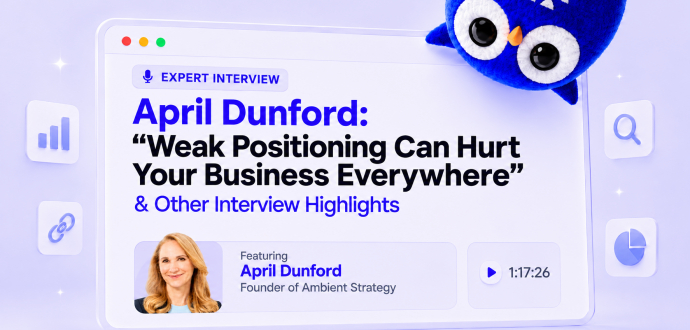
April Dunford: “Weak Positioning Can Hurt Your Business Everywhere” & Other Interview Highlights
Why positioning is so important
Weak positioning can hurt your business everywhere.So, get your story right first. Only then should you focus on distribution.
You also need to know who you are targeting.
Otherwise, you are spending money talking to the wrong people.
The biggest risk of poor positioning is becoming known for the wrong thing. Once that happens, repositioning becomes harder.
A clear positioning means one clear story
Every team should tell the same narrative and communicate the same message consistently. If everyone tells a different story about your brand, something is wrong with the positioning.
That story should be the clearest and strongest version of how we describe the company and what makes it different.
Your real competitors aren’t always who you think
When thinking about positioning, ask: “If my product didn’t exist, what would the customer do?”
Don’t just ask, “Who’s my competitor?”
Companies often define competitors as products that do something similar.
But here’s the thing: those products aren’t always the alternatives buyers are considering.
Start by asking: What are your customers doing today?
Before buying your product, customers are already solving the problem somehow. They might do it manually. They could be using an old tool. Or they may rely on an internal process. That’s the status quo. And it’s often your biggest competitor.
So, before you can convince someone to choose your product, you need to understand what you’re asking them to change and give them a good reason to do it.
Then ask the next question: If they decide to change, what would they choose instead?
Imagine they create a shortlist of three to five possible solutions. Those options make up your real competitive landscape.
Companies sometimes worry that customers could build their product using AI coding. But it becomes a competitive threat only if your buyers are actually considering that alternative.
Of course, you should still keep potential future threats in mind. They may matter for product and business decisions.
But when it comes to positioning, focus on the options customers are actually choosing between today.
Creating a new category: When it makes sense
Only about 1 in 10 companies actually needs to create a new category. This makes sense when the product is so different it doesn’t fit into an existing one. For everyone else, creating a new category is usually wishful thinking.
It takes significant time and money to educate the market. And competitors can eventually benefit from the category you created.
A better approach is often to find an underserved segment within an existing category.
Snowflake is a good example. Data warehouses already existed, but Snowflake built one specifically for the cloud. It used a category customers already understood while introducing a new approach.
So…
You don’t always need to create a new category to be different. Find an underserved segment and make your product the obvious choice for it.
Differentiated value and objection handling
You need to show customers why your product matters.
The strongest product value is differentiated value. It is something your product offers that competitors can't, and that actually matters to your customers.
Other things may be important but aren’t necessarily reasons to choose your product.
For example, fast deployment, compliance, or flexible implementation. Customers may expect them. They won't necessarily make you stand out, but their absence could stop someone from buying.
So, lead with value. Then address the concerns that could stop the customer from buying.
Some objections are unspoken. A customer may think, “This is too expensive,” or “This will be too complicated to implement.” A good pitch addresses these concerns before they become deal-breakers.
Value gives customers a reason to buy. Objection handling removes the reasons not to buy.
Both matter. But they should not have the same place in the pitch.
Three ways companies handle pricing in demos
Pricing depends on the product and where the customer is in the buying process. That’s why
There is no one-size-fits-all approach to pricing. The key question is: Could the customer disqualify us if we don’t discuss pricing now? If yes, share enough pricing information to keep the conversation moving. If not, wait.
Pricing should match the product and the stage of the sales process.
Let’s take a look at three common ways to handle pricing:
There are three ways to approach pricing conversations: wait until you know enough to give an accurate quote, share a general price range, or explain how your pricing model works instead of giving exact prices.
This is what each of them means:
- Don’t discuss pricing until you understand the exact cost. If the product could cost hundreds of thousands of dollars, there may be no useful price to give on the first call. You may need several conversations before you can even estimate it.
- Give a pricing range.If customers might assume you are too expensive, give them a general pricing range. This can prevent them from disqualifying you too early.
- Explain the pricing model.Instead of giving a number, explain how pricing works. This gives customers a sense of what to expect without committing to a specific price.
How to position a multi-product company
Multi-product companies usually need two levels of positioning. Umbrella positioning for the company as a whole. And product-level positioning for individual products.
But first, you need to understand how you want customers to buy.
- You might have a lead product that customers buy first. The other products then become add-ons or cross-sell opportunities. In this case, focus the positioning on the lead product. Don't try to sell the entire portfolio at once.
- You might also have several products for different customers or personas. In that case, each product should have its own positioning.
- You might also have several products that work well together. Then, you might position them as a suite or bundle.
The key lesson is:
Positioning should follow the go-to-market strategy, not your company's internal structure.
Your first positioning won’t be perfect from the start
Your positioning won't be perfect from the start. The only way to make it stronger is to put it out there, see how customers respond, and adjust it based on what you learn.
When a market shift requires new positioning
Not every market change means you need to reposition. What matters is whether your competitors, your differentiated capabilities, or the value you deliver to customers have fundamentally changed. If not, your positioning probably doesn't need to change.
If your brand positioning relies on gut feeling, every market change can make you wonder, “Should we change our positioning now?”
A better approach is to understand three things:
- Has the competitive landscape changed?
- Have our differentiated capabilities changed?
- Has the value we deliver to customers changed?
If the answer is no, you probably don't need to reposition.
When does change become a problem for customers?
Technology and product capabilities can change quickly. But the core value customers care about has to stay relatively stable.
The bigger question is whether customers can adopt and absorb those changes.
For larger enterprises, new technology can create concerns around many things. The most common ones are:
- Risk
- Compliance
- Scalability
- Cost
There are also two more things to consider:
AI may offer huge opportunities. But how much companies benefit from them depends on how quickly they and their customers can adapt.
Why a pov about the future is no longer optional for tech companies
Customers are not experts on every solution. They are trying to understand where the market is going and what it means for their business.
That creates a challenge: Why should they invest in your product today if the market could look completely different in two years?
This is why you need a clear point of view about the future.
You need to explain where the market is today and where you believe it is heading. A strong pov gives customers confidence that their investment will continue to create value as the market changes.
Without that confidence, they may decide to wait and see what happens.
How AI can turn positioning into content
AI can be very useful for positioning. But only when it has real customer data and the right context.
For example, AI can analyze sales calls to identify:
- Which competitors come up most often
- Which alternatives customers seriously consider
- Why deals are won or lost
- What triggers customers to look for a new solution
- How customers research and make decisions
This gives positioning teams valuable customer insights at scale.
AI can also help turn your positioning into messaging and content. Give it the right context:
- Your positioning,
- Competitors,
- Target customers,
- Brand guidelines,
- And tone of voice.
AI can then create content that stays aligned with your strategy.
But you cannot simply tell ChatGPT, “Here’s what my company does. Give me our positioning.”
It does not know your real competitors, customer behavior, shortlist criteria, or why customers choose you.
The best positioning comes from real customer knowledge. Much of that knowledge lives with sales, customer success, product, marketing, and leadership teams.
The good news: the fundamentals haven’t changed
The market is changing quickly. Competition is getting harder to understand. Buyer behavior is changing too.
But…
Despite all the market changes brought by AI, the fundamentals of marketing haven't changed much. Segmentation and positioning are still core marketing concepts.
What has changed is the environment around them.
Marketing execution may look very different in a few years. But the fundamentals will still matter.
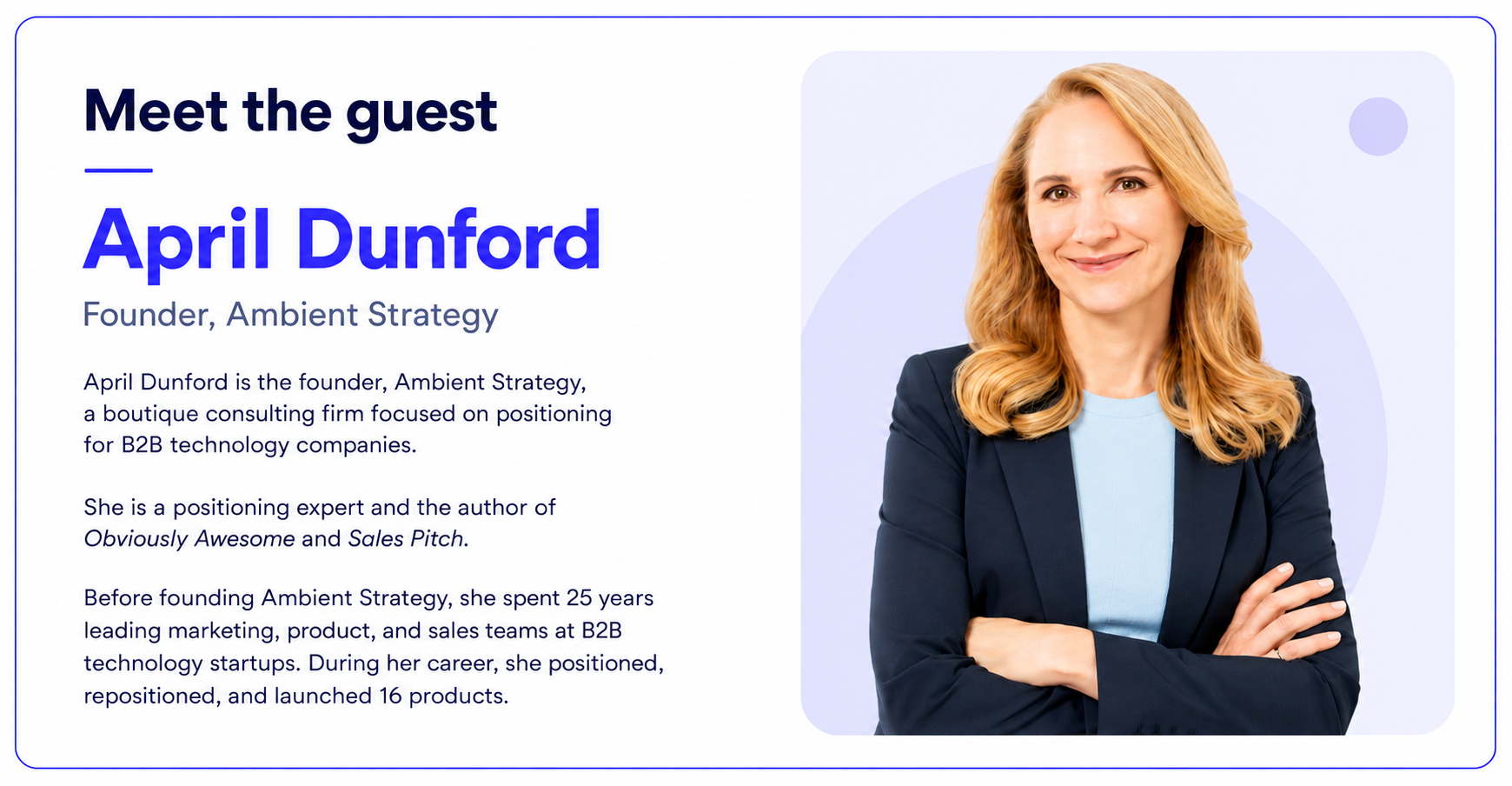
These are highlights from our Adsy Talks podcast with April Dunford. For more insights, watch the full interview on our YouTube channel:
All trademarks, logos, images, and materials are the property of their respective rights holders.
They are used solely for informational, analytical, and review purposes in accordance with applicable copyright law.

 Sign Up
 Sign Up