






International Link Building: A Practical Guide to Making It Effective
International link building is vital for brands that want to expand beyond their home market.
Yet, often, business owners and founders approach it too mechanically. Sometimes, their strategies replicate from one country to another. However, you should keep in mind that rules change once you leave your domestic market.
So, let’s find out what this strategy is all about and how to make international backlinks efficient for your brand in this guide.
What is it?
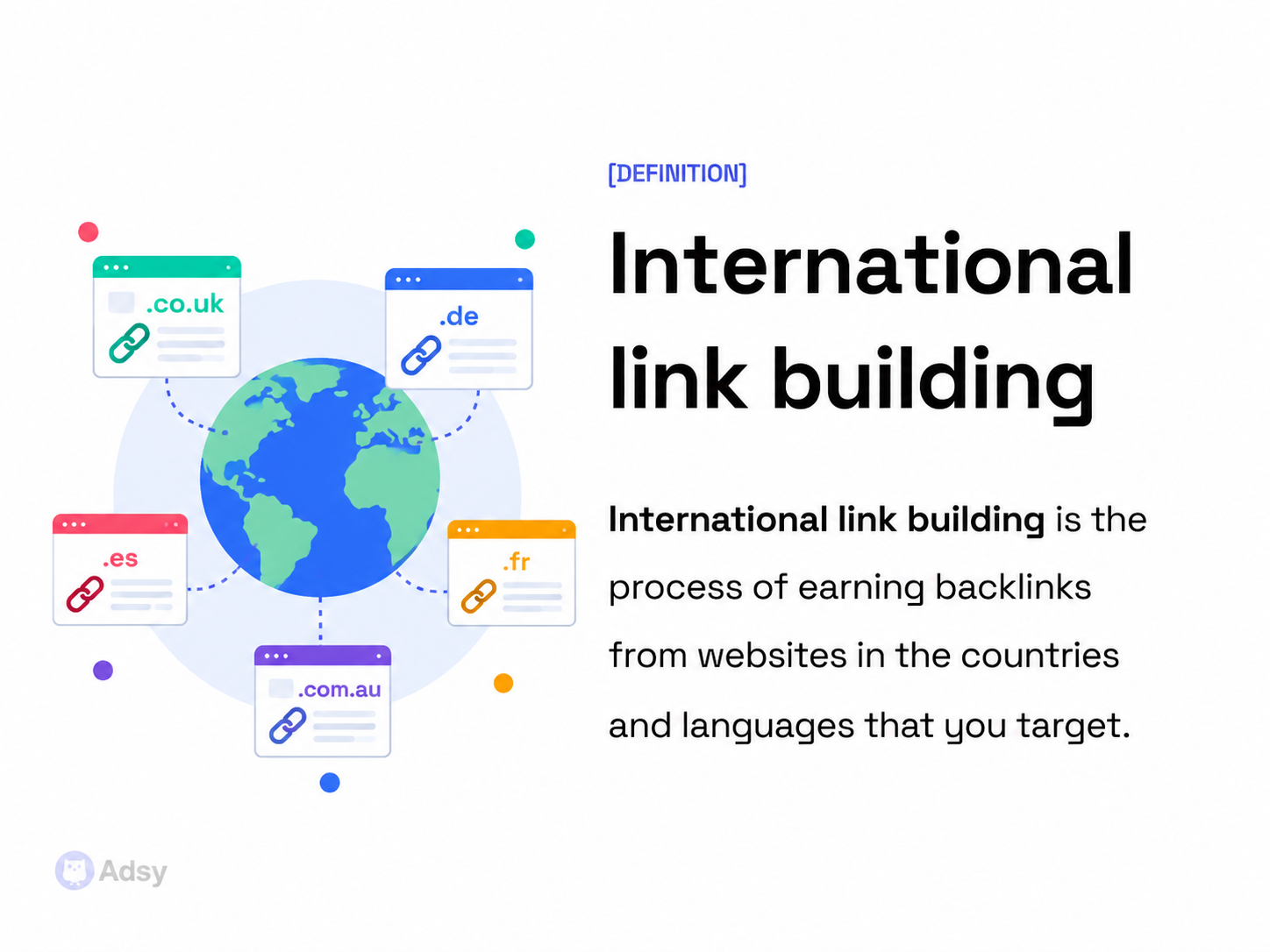
International link building is the process of earning backlinks from websites in the countries and languages that you target.
It doesn’t focus on links from websites in your home market only. Instead, it aims at building trust and authority within specific regions where you want to expand or already operate. So, search engines can understand that your site is relevant to users in that region.
Also, it becomes easier to rank for language-specific and country-specific searches.
International link building requires a localized approach. It has to consider:
- Search behavior,
- Regional authority,
- Culture,
- And language.
For brands that target multiple countries, earning local backlinks is often a must.
For example, if your company is expanding from the USA into Poland, it should earn backlinks from reputable Polish websites.
It doesn’t have to rely on links from English-language publications only. In this case, it is important to get backlinks from articles in Polish. These send stronger, more relevant linguistic and geographic signals. And they can better increase your local rankings.
How is it different from regular link building?
There is a difference between regular link building and international link building. Indeed, both these strategies aim at improving a website’s authority through high-quality backlinks.
However, their execution and objectives differ significantly.
Here’re their main differences:
|
Regular link building |
International link building |
|
Focuses on increasing overall domain authority. |
Focuses on increasing authority within specific languages and countries. |
|
Typically, uses one content strategy. |
Requires culturally relevant messaging and localized content. |
|
Improves rankings in a single market. |
Helps improve visibility across various international markets. |
International link building is often more complex than regular link building. It has many challenges. Among them are:
- Language barriers,
- Cultural differences,
- Finding quality local websites,
- Different SEO landscapes, and so on.
Also, you might face several issues when getting links globally.
For example, it can be difficult to translate outreach emails and build links to content that hasn’t been localized. Besides, companies can ignore country-specific search intent and prioritize quantity over relevance.
What are the benefits of international link building?
Getting backlinks from a relevant geography is an essential part of an international SEO strategy.
Earning links from reputable sites in your target country can strengthen your authority, credibility, and visibility in each market.
However, there are even more benefits like these:
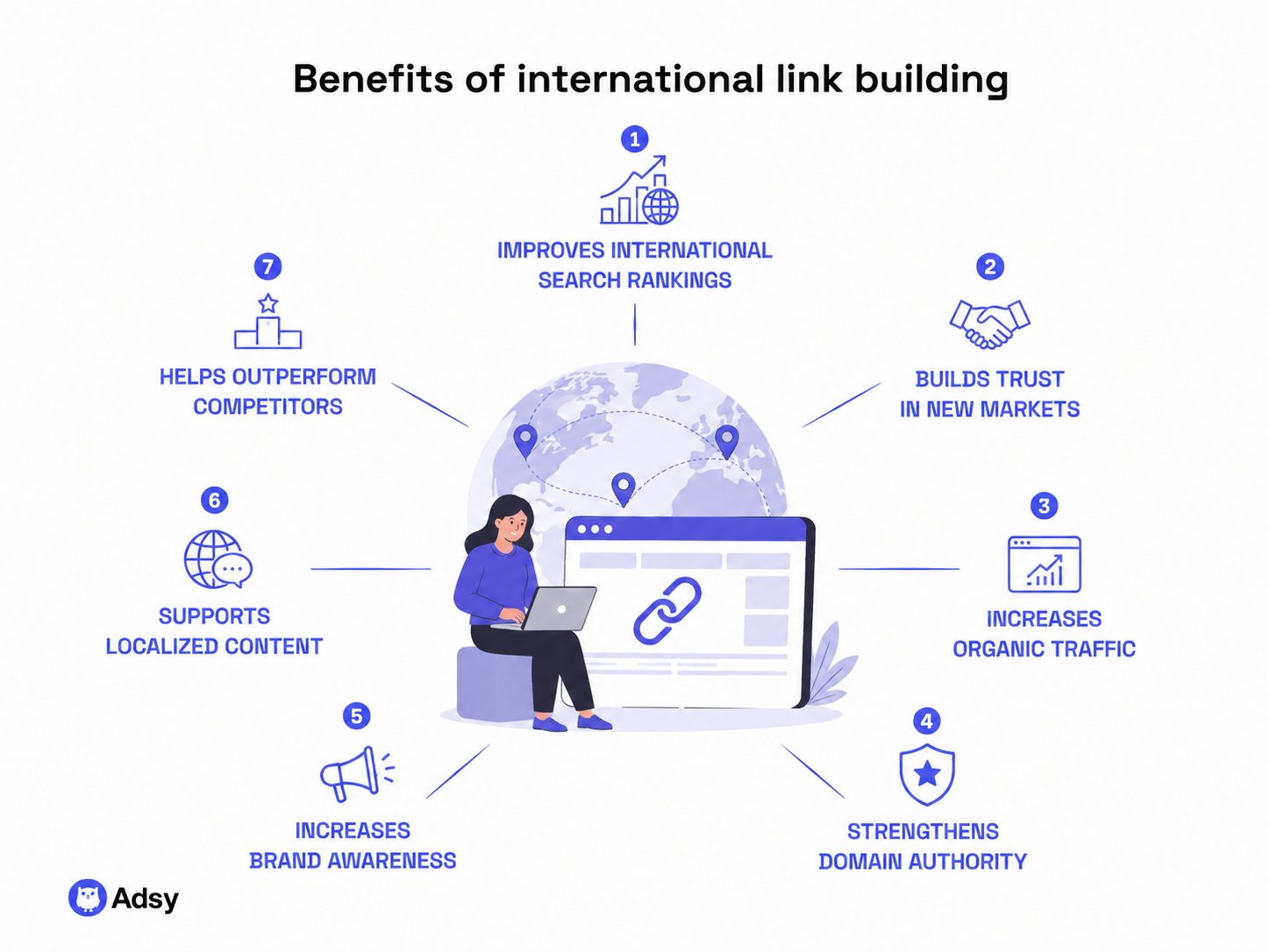
1. Improves international search rankings
Search engines can better understand that your site is relevant to users who live in a specific country.
Backlinks from reputable local sites give strong language and geographic signals. That makes it easier for your localized pages to rank for regional search queries.
2. Builds trust in new markets
Entering a new market is far more than just translating your website. It’s about getting credibility with a local audience.
And this is where international link building helps. By securing backlinks from reputable local media outlets, industry blogs, and regional publications, you gain more trust.
When trustworthy local websites mention your brand, users are more likely to consider your business as legitimate and reliable.
3. Increases organic traffic
If your rankings are high, it can lead to more organic traffic. Wait until your localized pages gain authority via relevant international backlinks. Then, these pages can become more visible.
Also, links you get can generate valuable referral traffic.
Often, visitors who click through from trusted industry websites are highly qualified. That’s because they have a genuine interest in your products or services already.
And this improves search visibility and increases targeted referral traffic.
4. Strengthens domain authority
Your website authority depends on the quality of backlinks. Simply put, the higher it is, the better your domain authority can get.
If you earn links from reputable sites from various countries, you strengthen your overall domain authority. Besides, you can improve the authority of your localized pages too.
Once your backlink profile is diverse, it shows that your site is recognized internationally.
Thanks to this broader authority, it is much easier to rank for competitive keywords. Besides, it can improve the overall SEO performance of your site.
5. Increases brand awareness
Each backlink from an international site introduces your brand to a new audience.
For example, users can discover your business through an online magazine, local blog, or an industry publication. Each brand mention there can increase your visibility in the market.
Don’t worry even if visitors don’t convert immediately.
Repeated exposure builds familiarity over time. Therefore, it is important for your brand to appear across trusted websites consistently.
Then, prospective customers can become more likely to remember, recognize, and trust your business.
6. Supports localized content
Creating country-specific and multilingual content is just a part of a successful international SEO strategy. To perform well in search results, your content needs authority.
International link building essentially backs up localized content
It does this by earning backlinks from sites that serve the same audience. Such links help search engines better understand the relevance of every localized page.
Besides, they can increase the ability of every such page to rank for local search intent. Therefore, your pages may be more likely to attract qualified visitors.
7. Helps outperform competitors
You can establish authority in new markets before your competitors do.
A strong international backlink profile can improve rankings, increase brand visibility, and build customer trust across various regions. As a result, your online presence can grow.
Thus, it may be much more complicated for your competitors to overtake your position in search results later on.
Besides, you may have more advantages in global markets than your competitors. This can also bring you more opportunities for industry collaborations, new partnerships, and media coverage.
9 best international link-building strategies
Here are nine efficient international link-building strategies you can implement for your business:
1. Create high-quality localized content
Websites are more likely to link to content that is relevant and useful to their local audience.
With SEO localization, you can adapt the content. This way, it’s more likely to match expectations, search behavior, culture, and language in a specific country.
Well-localized content goes beyond translating words.
It makes the content seem to be written for local readers. Such content considers:
- Country-specific laws and trends,
- Local statistics,
- Regional spelling,
- Cultural examples.
For example, imagine you sell HR software and want to expand into Germany:
- Don’t just translate your English step-by-step guide “How to Improve Employee Onboarding?”
- Instead, create a localized version of content like this: “How German Companies Can Improve Employee Onboarding When Supporting Employee Retention?”
To make this strategy work, you have to research the target market well, perform keyword research for every country, and adapt the content. You don’t need to localize every single page right away. Start with the most important business pages, and add on as needed.
To help you, use tools like Semrush, Ahrefs, DeepL, Smartcat, Crowdin, Localize, and Grammarly.

Source: Semrush
2. Guest post on local websites
Guest posting helps earn backlinks from trusted websites within your target country.
So, contribute valuable articles to news websites, industry publications, or local blogs and include a backlink to your website.
You should write original and high-quality content for websites that serve your target audience in a specific country or language. Focus on giving genuine value to local readers.
For example, imagine you want to expand to Greece. Then, you should publish an article on a respected Greek blog in your niche. Don’t just publish the same article on a generic international website.
You can implement a guest posting strategy through these five steps:
- Find reputable local websites. You can do that by simply googling for websites in your target language with your main keyword + “guest posting,” “write for us,” “guest contributions,” etc.
- Study the website before pitching. Generic pitches don’t work, especially if you target high-quality websites. So, make sure to research each target page and personalize your cold message.
- Create valuable and localized guest articles. Even though you publish this content on someone else’s website, it doesn’t mean that you have to sacrifice quality. Treat it like your own blog post.
- Include your backlink naturally. The link to your website has to look organic. So, make sure that it’s contextual, supports the other content, and the anchor text isn’t overoptimized.
- Build long-term relationships. Ideally, try to keep up your connections with website owners and editors to get more opportunities in the future.
If you want to save time on looking for websites and negotiating with them, you can simply browse 150,000+ websites on Adsy.


3. Do international digital PR
International digital PR focuses on earning brand mentions and backlinks from reputable online media, blogs, or news websites in your target countries.
It helps increase brand awareness, improve regional search rankings, and build credibility in multiple markets.
International digital PR targets editors, journalists, online publications, industry magazines, trade organizations, and so on.
It concentrates on creating interesting and useful content for local audiences. That content has to encourage publishers to link to and reference your site.
For example, imagine your software company wants to expand to France.
Don’t pitch the same global report everywhere. Instead, you can publish a localized study: “Software Trends Among French Small Businesses in 2026”.
Add statistics, insights, and survey results there. Then, pitch the study to French blogs, business newspapers, and technology publications.
You can implement the digital PR strategy through:
- Creating newsworthy content,
- Localizing your story for each country,
- Building a list of local media contacts,
- Writing personalized media pitches,
- Providing valuable media assets.
Use tools like Muck Rack, Cision, Prowly, Meltwater, Mention, Brand24, Canva, etc.
Source: Brand24
4. Build relationships with local influencers and journalists
Building professional relationships with local influencers, bloggers, or journalists is really important for the long-term international link-building strategy.
It involves becoming a trusted source for these people. So they can rely on your content, data, and insights.
Such relationships often lead to backlinks from social media content, news stories, interviews, blog posts, and so on. That helps your website build authority in a specific market.
Therefore, you should connect with influential people in your target country.
Share useful resources, expertise, and research that can help them create better content.
For example, imagine your fintech SaaS company wants to expand in Japan.
Don’t just immediately ask Japanese journalists to link to your website. Instead:
- Take your time to follow leading Japanese reporters on social media.
- Share and comment on their articles.
- Publish original research or something highly valuable and unique (e.g., a study about digital payment adoption in Japan).
- Pitch this research to several media outlets or bloggers.
Wait until the trust grows. Then, these industry experts, YouTubers, podcast hosts, or editors may mention your business and link to your website naturally. This can create additional high-quality backlinks without further outreach.
You can start building such relationships through:
- Finding relevant local influencers and journalists,
- Engaging with these people before making requests,
- Offering valuable sources,
- Personalizing your outreach,
- Becoming a reliable expert.
You may use tools like Statista, Google Analytics, Google Search Console, LanguageTool, etc.
Source: Statista
5. Publish unique information and research
Create original reports, surveys, studies, and data for other websites to cite and reference.
Original research provides information that you can’t find anywhere else. So, this data becomes valuable for researchers, bloggers, and industry publications.
Don’t just use the same data for every country.
Your research must be relevant to each target location. Local audiences, media outlets, and businesses are more likely to link to localized content. It must reflect their own culture, customer behavior, and language.
Imagine your SaaS company that sells project management software wants to expand into Brazil, Germany, and France.
Don’t just publish a single report with the title: “Global Remote Work Statistics.” Instead, create three localized studies:
- “How Brazilian Companies Manage Teams in 2026” for Brazil.
- “Remote Work Productivity Trends in Germany” for Germany.
- “The State of Workplace Collaboration in French Companies” for France.
It can even be the same topic, simply adjusted for different markets.
You may implement this strategy through:
- Choosing a topic that matters locally,
- Collecting original information,
- Localizing the research,
- Presenting the findings visually,
- Promoting the research locally.
You can use tools like SurveyMonkey, Qualtrics, Jotform, Tableau, Google Trends, Looker Studio, etc.
Source: Jotform
6. Study backlink profiles of your competitors
Analyze the websites that link to your competitors in each target country.
Discover where they earn backlinks. Also, try to understand why those websites linked to them in the first place. Finally, identify similar opportunities for your own site.
When reviewing your competitors’ backlink profiles, find trusted local organizations, industry directories, news publications, and blogs that show interest in businesses like yours.
For example, imagine your project management SaaS company wants to expand into Spain.
So, analyze Spanish local competitors. If they earn links from particular websites, there is a high chance that you can publish your content there as well.
By doing this, you can earn high-quality backlinks. And this can improve your local authority and rankings in international search results.
You can do it through:
- Identifying competitors in each target country,
- Analyzing their backlink profiles,
- Looking for link opportunities,
- Understanding the reasons why they earned specific links,
- Creating localized outreach campaigns.
You can use tools like Linkody, Similarweb, BuiltWith, Screaming Frog SEO Spider, etc.
Source: BuiltWith
7. Partner with local organizations
Collaborate with trusted organizations in your target country. It may be business associations, community initiatives, chambers of commerce, local events, universities, etc.
They can mention your resource pages, logos, company profile, event sponsorships, and case studies.
The backlinks from respected local organizations can signal that your brand is credible and relevant in that specific country.
For example, imagine your cybersecurity company wants to expand into Austria.
So, you can partner with an Austrian cybersecurity association. You may host a free webinar about protecting a small business from cyber threats. Then, the association may include a link to your company’s website or social media.
Later on, this organization may reference your company as its partner. And you will earn even more high-quality backlinks.
You can partner with local organizations by doing these:
- Identifying relevant local organizations,
- Finding partnership opportunities,
- Creating value for the specific organization,
- Requesting a website mention,
- Building long-term relationships.
For this, you can use tools like LinkedIn, Google Maps, Crunchbase, Eventbrite, Meetup, Snov.io, etc.

Source: Eventbrite
8. List your business in trusted local directories
Another way to get links globally is by submitting your company to reputable online directories in the specific countries you target.
Typically, they include a business profile with your company name, description, website link, contact details, and customer reviews.
As your main goal is to get backlinks, focus on high-quality and trustworthy directories. They must be relevant to each target market and have good metrics.
This way, you can both improve international SEO and strengthen your local authority.
For example, imagine your CRM company wants to expand into Canada.
Create a profile on trusted Canadian software directories, startup platforms, and local business associations.
Make sure your profile includes Canadian contact data and localized product descriptions.
Then, your company can earn relevant backlinks from local websites. And that can improve credibility, increase visibility, and strengthen your presence in the Canadian market.
Here is how you can implement this strategy by:
- Finding trusted local directories,
- Selecting directories that are relevant to your business,
- Creating a complete business profile,
- Localizing your listings,
- Keeping your listings updated.
You may use platforms and tools like Google Business Profile, BrightLocal, Moz Local, etc. But usually, you can simply search for relevant directories in your niche and location on Google or LLMs.
Source: BrightLocal
9. Create linkable assets
Produce high-value tools or content that other websites want to link to or reference naturally.
A linkable asset helps users learn something new and access data that is difficult to find elsewhere. Besides, it is valuable for users because it can solve their problems.
While you can create a universal linkable asset for all markets, it’s still important to localize it for each target language or country. Of course, it won’t be needed for all tools and resources.
But overall, when you address local market conditions, regulations, or cultures, you are much more likely to earn backlinks.
For example, imagine your payroll company wants to expand into Singapore.
Don’t publish a generic article about payroll management
Instead, create a localized linkable asset: “Free Singapore Salary and Tax Calculator”. Include downloadable payroll templates, National Insurance contributions, and current tax rates.
Then, you can reach out to local finance websites. They may recommend you as a useful resource and link back to you.
Here’s how you can implement this strategy step-by-step:
- Select a topic that your target audience considers to be valuable,
- Create a high-quality asset,
- Localize it (if needed),
- Promote it,
- Regularly update the asset.
You can use tools like Ahrefs Content Explorer, AnswerThePublic, AlsoAsked, Adobe Express, Typeform, Semrush Backlink Analytics, etc., to help you.
The most important part is to understand what people need and address that need with your tool or other type of asset.

Source: AlsoAsked
How to avoid low-quality international link building
Of course, getting backlinks globally offers many new opportunities. But it also introduces you to new risks.
Therefore, make sure you pay attention to the following:
- Focus on language and country relevance: Make sure your backlinks come from countries that are relevant to your market and target audience.
- Cooperate with reputable local websites only: Evaluate whether a certain website is respectful and brings value to its readers.
- Avoid PBNs and international link farms:These websites manipulate rankings and provide almost no value to real users.
- Don’t rely on automatic translation: Work with professional translators and native speakers to make your messaging natural.
- Localize your content before you build links: Adapt your content to local cultural expectations, currencies, terminology, examples, and so on first. And only after that, start building links.
- Personalize your outreach: Use local language and reference relevant topics when you tailor every outreach.
- Monitor backlink quality regularly: Ensure new links come from trustworthy and relevant websites.
- Build relationships, not just backlinks: Partner with local influencers, bloggers, and industry experts. It can bring more contributions, backlinks, brand mentions, and other opportunities.
Conclusion
Summing up, the success of your international SEO campaign often depends on the efficiency of your link building. So, partner with digital PR agencies, prioritize local language outreach, and analyze your competitors’ backlink profiles.
Keep in mind that international link building requires a tailored approach. Just copy-pasting a strategy from one country to another will usually not work.
So, adapt each strategy to every specific country, paying attention to local culture, customs, language, and laws.
FAQs
When do you actually need international link building?
It’s important when you are expanding your business into new countries. Also, it is critical if you already have a multiregional or multilingual website.
When your international pages aren’t ranking, it can often help. Besides, it can boost your international organic traffic and help gain visibility when your competitors have a stronger local presence.
To add more, it is essential if you want to build brand recognition abroad or support long-term international growth.
How does Google evaluate international backlinks?
Google evaluates international links with extra attention to language and geographic relevance.
The search engine assesses where the backlinks come from, whether they are relevant to your content, and how trustworthy they are.
Also, it evaluates how they relate to the languages and countries you are targeting.
Google considers such factors as topical relevance, authority, editorial nature of the link, geographic signals, natural backlink profile, link quality over quantity, anchor text, etc.
What is international digital PR?
International digital PR is the process of promoting your expertise, content, or brand across many countries.
It means introducing your business to industry publications, journalists, bloggers, and influencers. Earning backlinks, brand mentions, and high-quality media coverage from reputable international websites is usually the main goal of this strategy.
Unlike traditional PR, it is designed for the online world.
A typical international digital PR campaign includes expert commentary, company news, case studies, infographics, surveys, etc.
What is localization?
Localization is the process of adapting your marketing materials, products, content, and website to the culture, language, and regional expectations of a specific country.
It ensures every aspect of the user experience feels relevant and natural to local users. Its main target is to make your brand appear appropriate for the specific market.
Note that localization and translation are not the same terms:
- Translation focuses on converting text from one language to another.
- And localization concentrates on adapting content to reflect customs, culture, local language, user expectations, etc.
All trademarks, logos, images, and materials are the property of their respective rights holders.
They are used solely for informational, analytical, and review purposes in accordance with applicable copyright law.


 Sign Up
 Sign Up