






AI Link Building: What It Is, How to Make It Work, and 8 Best Tools
Have you ever been in a situation when you needed to do multiple link-building tasks but simply lacked time to complete them? Or maybe you are tired of routine and want to devote more time to decision-making?
If that’s the case, it’s time for you to consider link-building automation.
Of course, there is no magic pill to completely delegate your link-building routine to robots. However, if you at least partially use AI assistance, you might speed up your link-building campaign significantly.
Here, we are going to give you a practical way to improve your link-building process.
Still, keep in mind that AI-assisted link building and automated link building are not the same thing. So, let’s explore:
- The main difference between them,
- The elements of link building you should and shouldn’t automate,
- And the 8 best AI link building tools.
What is AI link building?
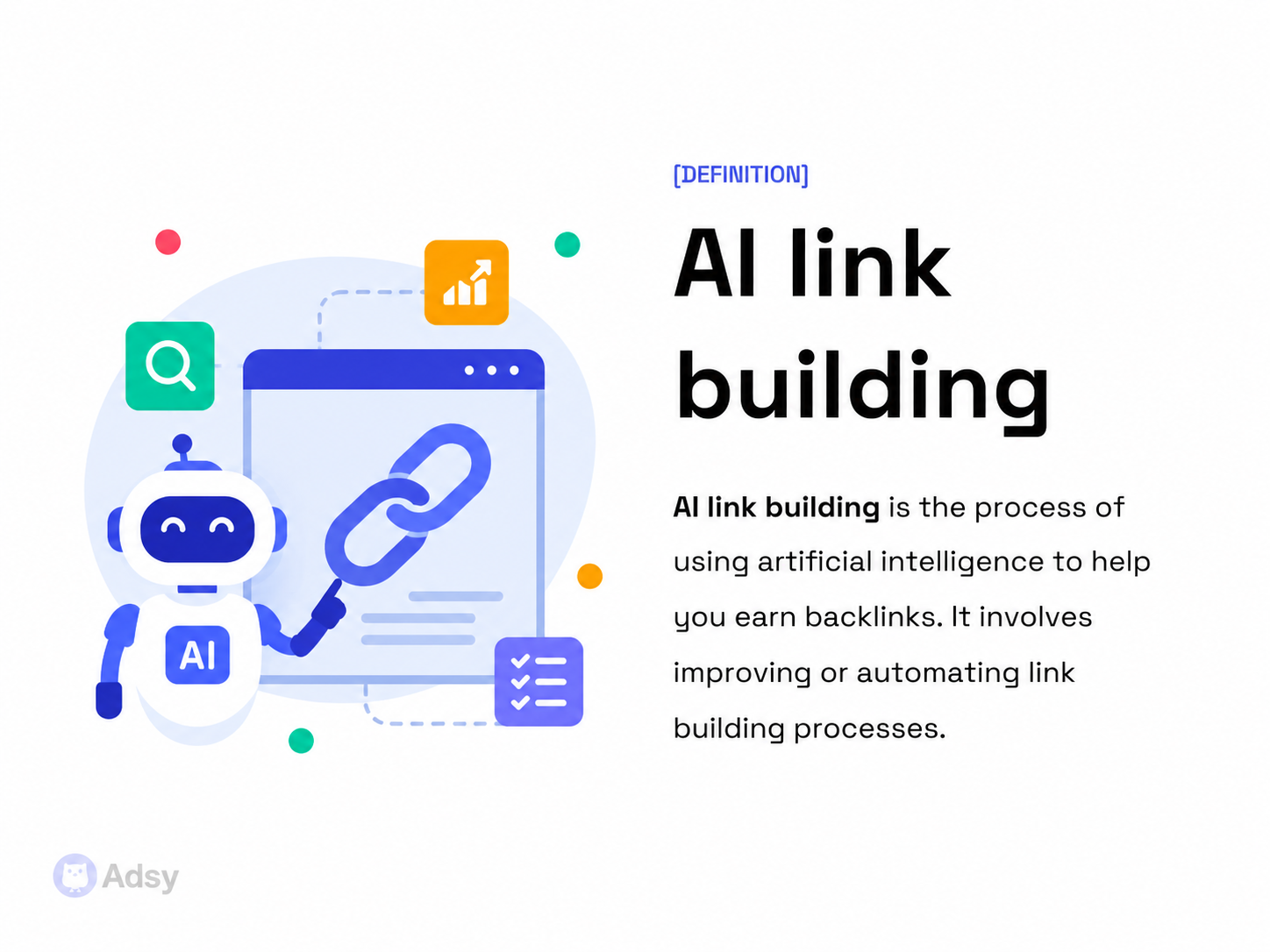
AI link building is the process of using artificial intelligence to help you earn backlinks. It involves improving or automating link building processes.
But it doesn’t mean that you have to automate every single task.
Unfortunately, you can’t just press one button and get hundreds of quality backlinks on autopilot. That’s just not how things work.
So, it’s important to understand the difference between:
- Partially automated link building: This is an approach that assumes automation of some repetitive tasks like follow-ups, email verification, and prospecting. However, it keeps negotiations, relationship building, and strategic decisions in human control.
- Fully automated link building: This is an approach that assumes software or AI to manage the entire link-building process. It may require either minimal or no human involvement at all.
The main difference comes down to who makes the important decisions: the AI or a human.
Essentially, partially automated link building requires human effort and responsibility and has a lower risk of mistakes.
At the same time, while fully automated link building may indeed work faster, it might damage your brand reputation if something goes wrong. So, think twice before you decide to use this approach.
What should (and shouldn’t) you automate?
You need to understand where automation helps and where it becomes dangerous or counterproductive.
Not every task should be automated.
Some tasks require empathy, persuasion, strategic judgment, creativity, trust, and other qualities that AI simply doesn’t have.
The rule of thumb is as follows:
- Automate repetitive and data-heavy tasks. Opt for AI assistance when you need quality reporting, research, and first drafts.
- Leave areas that require human expertise to humans.
In a nutshell, automate the process but do not automate the relationships. This is how you can build a successful link-building strategy.
Good to automate
Automating the following parts of link-building eliminates a lot of manual work. As a result, it helps your team concentrate on higher-value activities like relationship building and strategy.
Here are the processes where automation fits best:
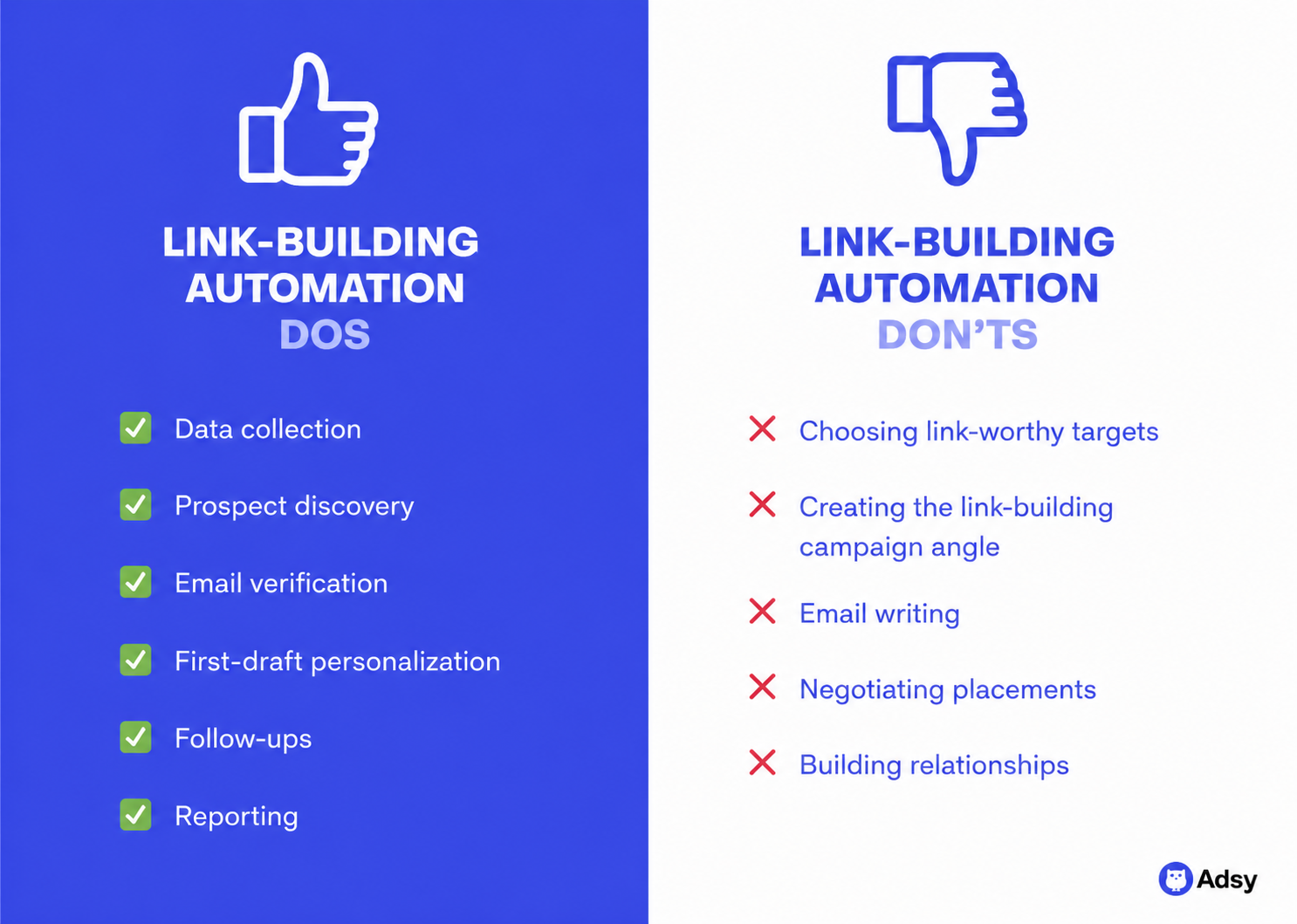
- Data collection: You can gather contact data, SEO metrics, and other details based on your requirements. The AI can identify sites that match your niche. Besides, it may analyze competitor backlinks and prioritize the most optimal opportunities depending on their traffic, authority, and relevance. Typically, you won’t spend much time automating it. But if you do, you can significantly reduce the manual effort. And usually, errors are minimal with these tasks.
- Prospect discovery: Find the contact information of the website owner/editor/writer with the help of AI. This way, you will not need to start searching from scratch. All you need to do after is simply verify those contacts, speaking of which…
- Email verification: Check smoothly whether the email addresses are valid. Verify emails with AI before you send a letter because it might significantly lower your bounce rates. Moreover, it may improve your email deliverability and protect your sender reputation.
- First-draft personalization: Use AI to research a prospect’s site. Some tools may help you make pretty good personalization, especially when you send out hundreds of emails daily. The AI might draft an email referencing recent interests, topics, and content. In general, this speeds up the overall writing process. But ideally, make sure to review and edit what AI writes.
- Follow-ups: AI tools can also remind you about your message when you get no answer. When you automate this process, you send reminders according to a set schedule without forgetting about it. This way, you often improve your response rate.
- Reporting: Automate your reports with AI. It might take a lot of time to manually track backlinks, campaign performance, conversions, and response rates. AI is very effective at processing large data sets and identifying trends. That’s why it’s much easier to make important data-driven decisions and measure ROI.
These tasks are ideal for automation because they are scalable, repetitive, and data-driven. Instead of spending too much time on completing these routine tasks, you can focus on creating valuable content or other creative tasks.
Avoid full automation
As the following tasks rely on context, human relationships, and strategic thinking, using AI for them isn’t recommended:
- Choosing link-worthy targets: When it comes to SEO metrics, content quality, user experience, natural backlink profile (incoming vs. outgoing links), topical relevance, etc., AI cannot completely understand your business priorities. In other words, there must be a human to decide which opportunities are worth choosing. AI can pre-select some options, but it’s much better to leave the final decision to your team.
- Creating the link-building campaign angle: You have to be creative and smart to understand what will resonate with your publishers and audience. This is where AI cannot step in. There has to be a human to create original stories, insights, and newsworthy angles that attract backlinks organically.
- Email writing: It goes without saying that refining email templates must be done by humans. Of course, you can use prompts generated by AI, but they still need to be polished by people. Everyone might soon understand whether a real person or a bot has written a certain email’s text. And AI emails can often create a bad impression.
- Negotiating placements: When it comes to sponsorships, digital PR opportunities, partnerships, and guest posts, negotiation is an important part of the process. You often need to communicate a lot before making the final decision. Unfortunately, AI cannot manage such questions effectively because it lacks flexibility and trust.
- Building relationships: Last but not least, AI cannot build the relationships that are very important in link building. You cannot just automate conversations with bloggers, journalists, industry experts, and editors. It is genuine communication that creates future opportunities and builds trust, which is impossible to do on autopilot.
These tasks require a human touch because they are difficult to automate. They depend on qualities like communication skills and contextual understanding that AI simply doesn’t have.
8 best AI link-building tools
Now, let’s check what software you can use to help you automate your link building.
We’ve selected the top AI link-building tools that are perfect for eight specific tasks:
Pitchbox: Best for finding and enriching link prospects
Source: Pitchbox
Pricing: Starts at $210 per month for the Pro plan (when paid annually).
Free option: 21-day free trial.
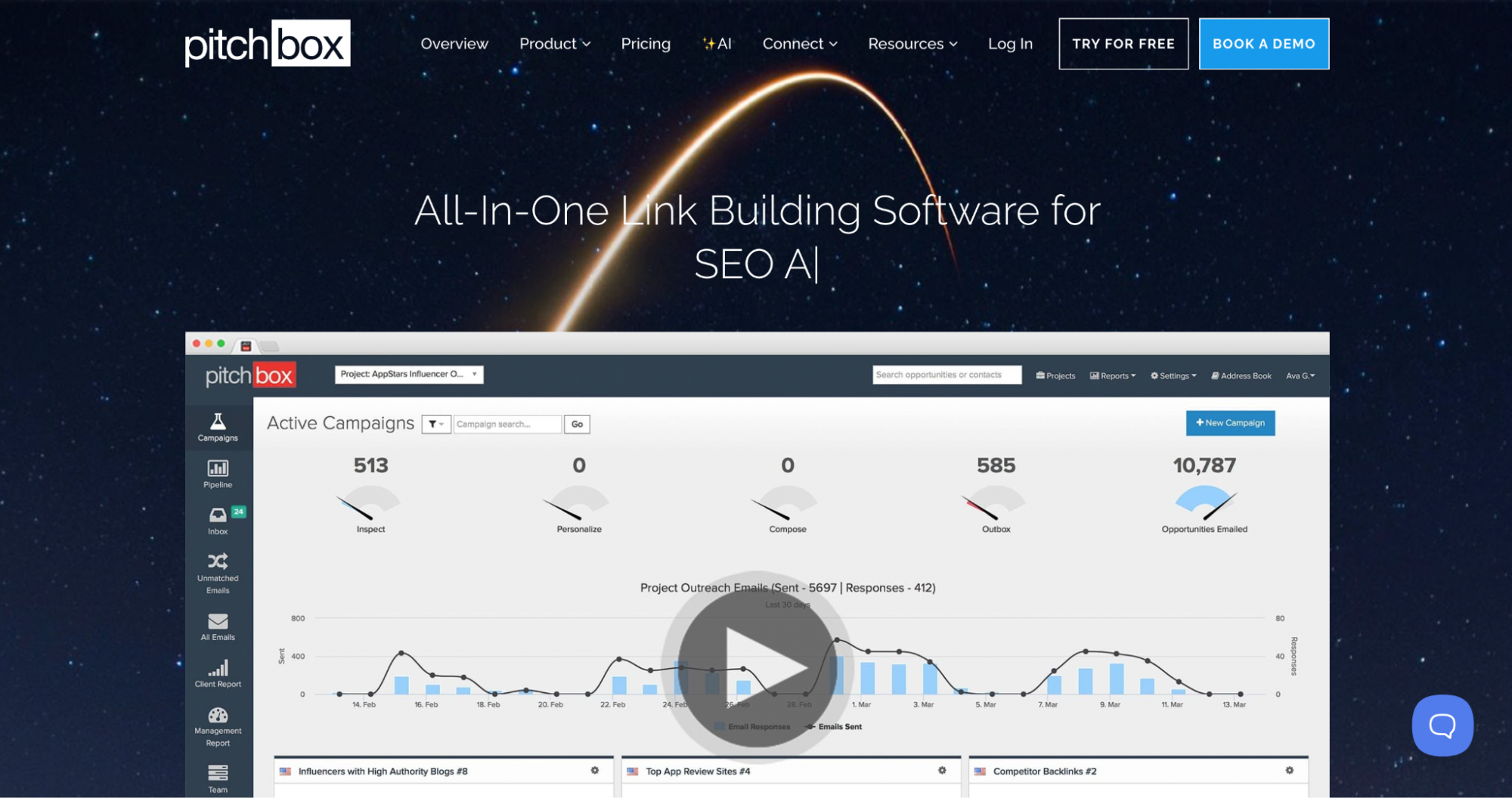
Pitchbox is a link-building and outreach platform. It helps content marketers, agencies, and SEO teams streamline their campaigns, starting with prospecting and finishing with reporting.
With its CRM-style relationship management, you can keep long-term partnerships, avoid duplicate outreach, and organize conversations.
These are some of the main features:
- Its prospect discovery feature helps you find relevant influencers, publishers, bloggers, and websites.
- Thanks to built-in email outreach, you might create personalized campaigns with automated follow-ups.
- With the contact discovery feature, you might identify verified email addresses.
- You can also use its detailed reporting to track team productivity, outreach efficiency, campaign success, and acquired backlinks. Besides, you can view team performance, replies, and outreach progress through campaign management dashboards.
- Also, Pitchbox integrates with other popular SEO tools like Majestic, Moz, Semrush, and Ahrefs. So, it gets much easier to evaluate domain metrics.
Pitchbox is a perfect platform for scalable link-building campaigns as it combines reporting, outreach, prospecting, and automation.
And while Pitchbox helps you automate repetitive tasks, it still allows manual personalization where it is most important.
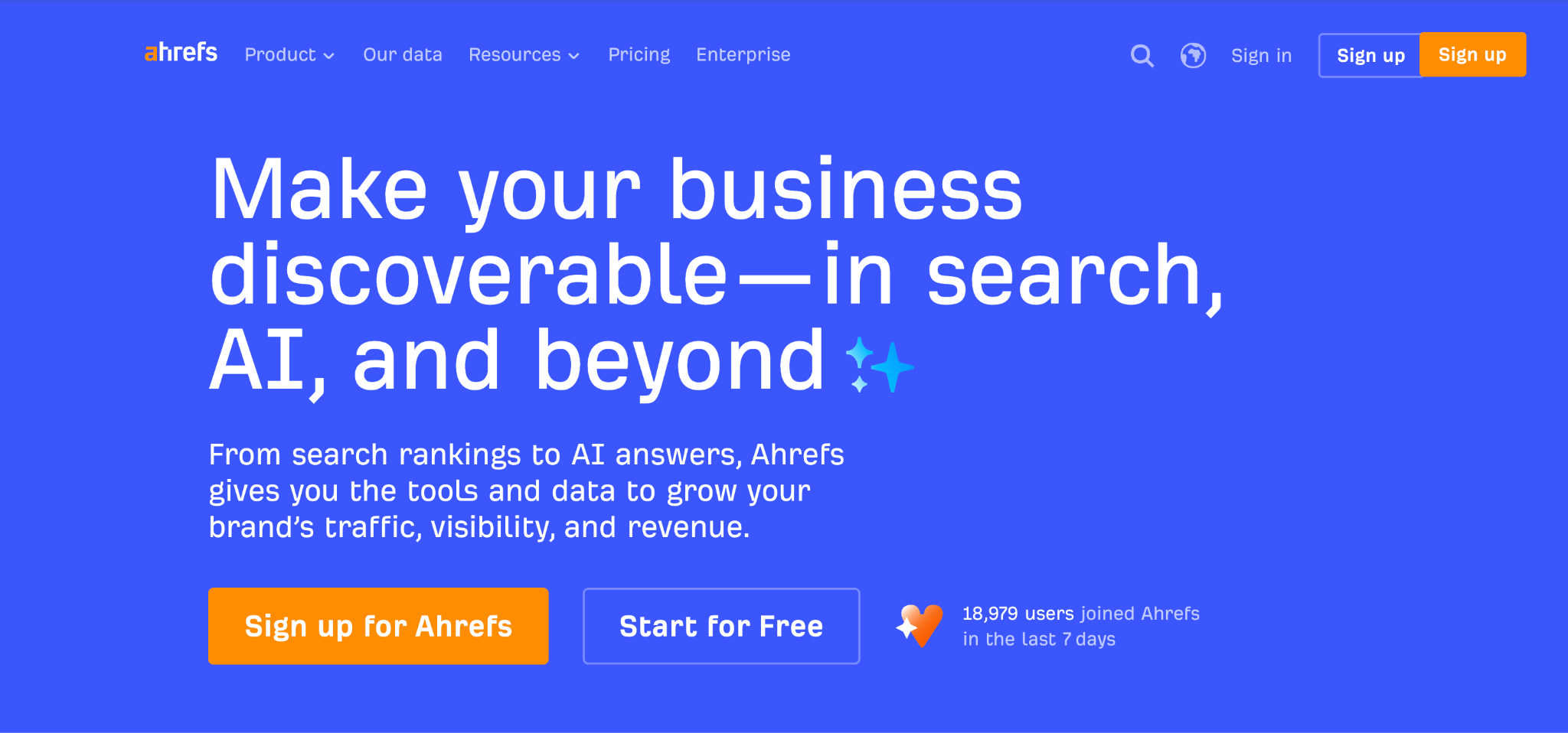
Ahrefs: Best for backlink analysis
Source: Ahrefs
Pricing: Starts at $29 per month for the Starter plan.
Free option: A free account with limited functionality available.
Ahrefs is one of the best-known SEO solutions. While its functionality is very diverse, it also has a set of AI backlink tools. It gives you insights for broken-link opportunities, link gap analysis, competitor analysis, and dozens of other backlink-research tasks.
If you want to analyze a backlink profile, these are some of the most useful features:
- There is a Site Explorer feature. It gives detailed insights about competitor backlink strategies, link types, top linked pages, and anchor text distribution.
- In the Backlink profile section, you can analyze your site’s backlink profile, monitor various projects, and identify referring domains. Besides, you can assess link quality using metrics like URL Rating (UR) and Domain Rating (DR). Ahrefs also assists in detecting toxic links and historical link growth trends.
- Using the Link Intersect feature, you can discover websites that link to your competitors. Therefore, it would be much easier to explore valuable outreach opportunities.
All in all, Ahrefs helps make smarter SEO decisions and makes backlink analysis faster and more actionable.
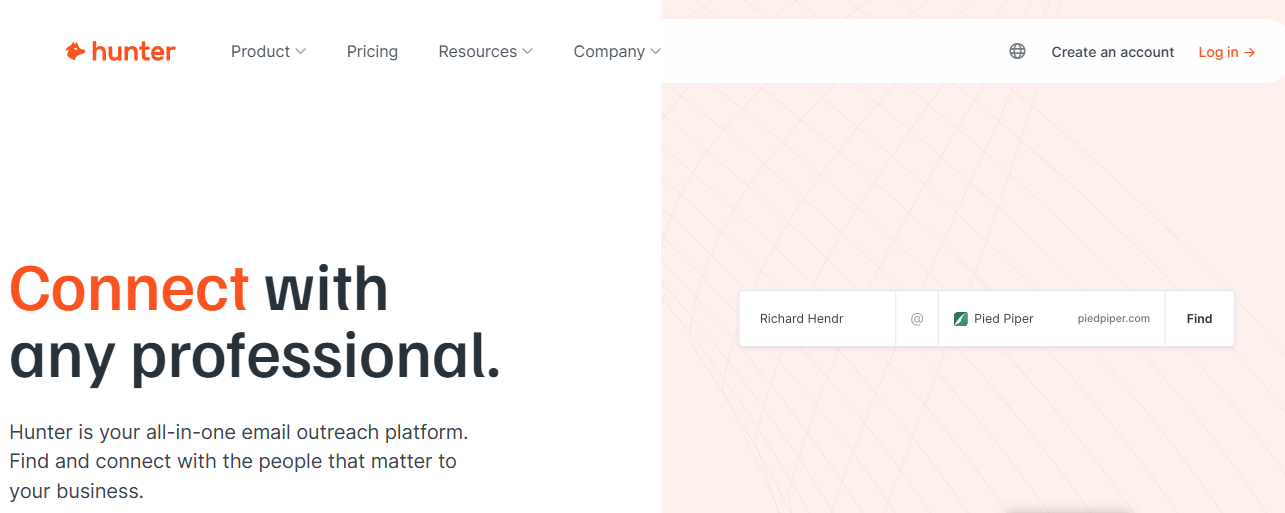
Hunter.io: Best for finding and verifying contacts
Source: Hunter.io
Pricing: Starts at $34 per month for the Starter plan (when paid annually).
Free option: There is a free option where you get 50 credits per month, unlimited team members, and 1 connected email account.
Hunter.io is one of the best tools for finding and verifying contact data. Here are just some of its useful features:
- You can use its Domain Search feature to identify publicly available email addresses.
- With its Email Finder feature, you can locate specific contacts using a person’s domain and name.
- And there is an Email Verifier feature. With it, you can check whether your email addresses are real to improve outreach deliverability, eliminate bounce rates, and check address validity.
This platform integrates with Google Sheets, CRM systems, and popular outreach tools. Thanks to Hunter.io, you can be confident that you are contacting the right people with verified data.
And of course, it’s really valuable when you focus your campaigns on AI backlinks. In these cases, accurate contact information is essential to boost partnership opportunities and response rates.
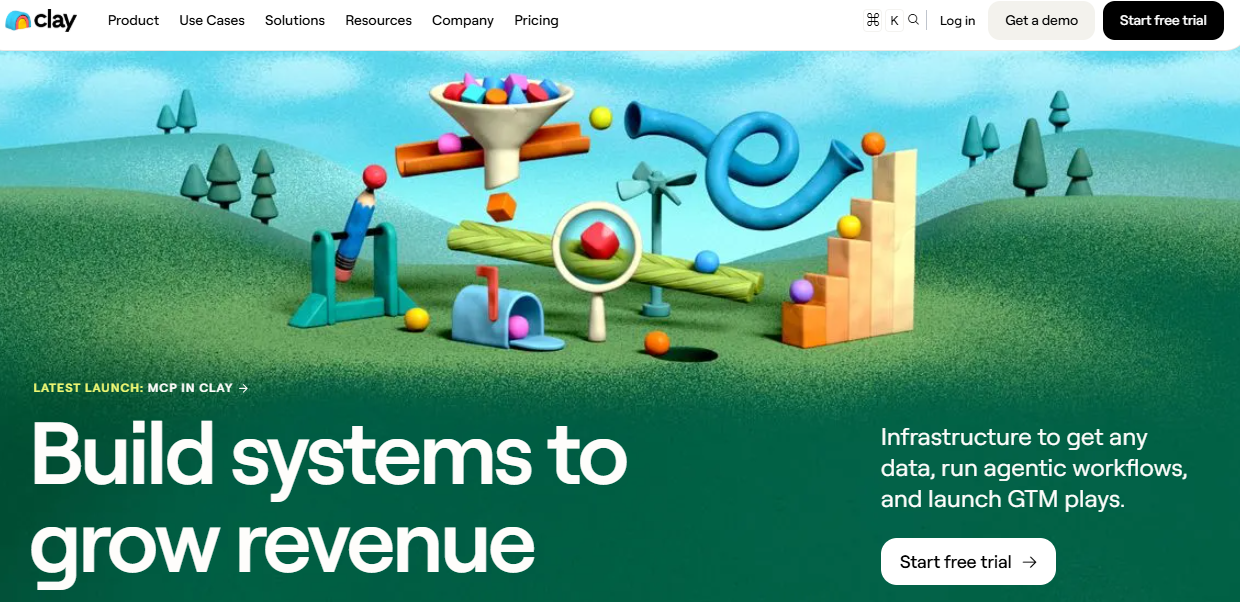
Clay: Best for prospect research
Source: Clay
Pricing: Starts at $167 per month for a Launch plan (when paid annually).
Free option: There is a free plan with 6,000 actions and 1.2K data credits per year.
Clay is a great tool for prospect research as it combines AI, data enrichment, and workflow automation all in one. With it, you may pull hiring activity, funding data, social profiles, contact data, company details, and more automatically.
Besides, Clay integrates with multiple APIs and data providers.
Here’s what you can do with Clay:
- Easily build highly targeted prospect lists.
- Find out more about your potential partners with its AI assistance.
- Create automated workflows to update prospect records regularly.
Besides, Clay features CRM integrations, lead scoring, and custom formulas.
As a result, this platform eliminates research time and helps improve campaign efficiency, prospect quality, and overall outreach success. Therefore, your outreach becomes more efficient, personalized, and requires minimal effort.
Using Clay is optional for many link building campaigns.
But if you have some really important or complex campaigns, it can save you lots of time on research.
BuzzStream: Best for automated outreach and follow-ups
Source: BuzzStream
Pricing: Starts at $49 per month for a Starter plan (when paid annually).
Free option: Free trial available.
BuzzStream is automated outreach software. It is designed specifically for link-building workflows and digital PR.
With BuzzStream, you can:
- Centralize relationship tracking, email outreach, contact management, and prospect research in one workspace.
- Create personalized email sequences with automated follow-ups, depending on recipient behavior.
- Track campaign progress and organize conversations.
- Avoid duplicate outreach and have long-term relationships with influencers and publishers.
- Improve response rates, scale outreach campaigns better, and build much stronger partnerships.
So, it is a worthy addition to a contemporary AI SEO tool stack as BuzzStream integrates with popular SEO and CRM platforms.
Linkody: Best for link monitoring
Source: Linkody
Pricing: Starts at $14,90 for a Webmaster plan (when paid annually).
Free option: Free 30-day trial, no card required.
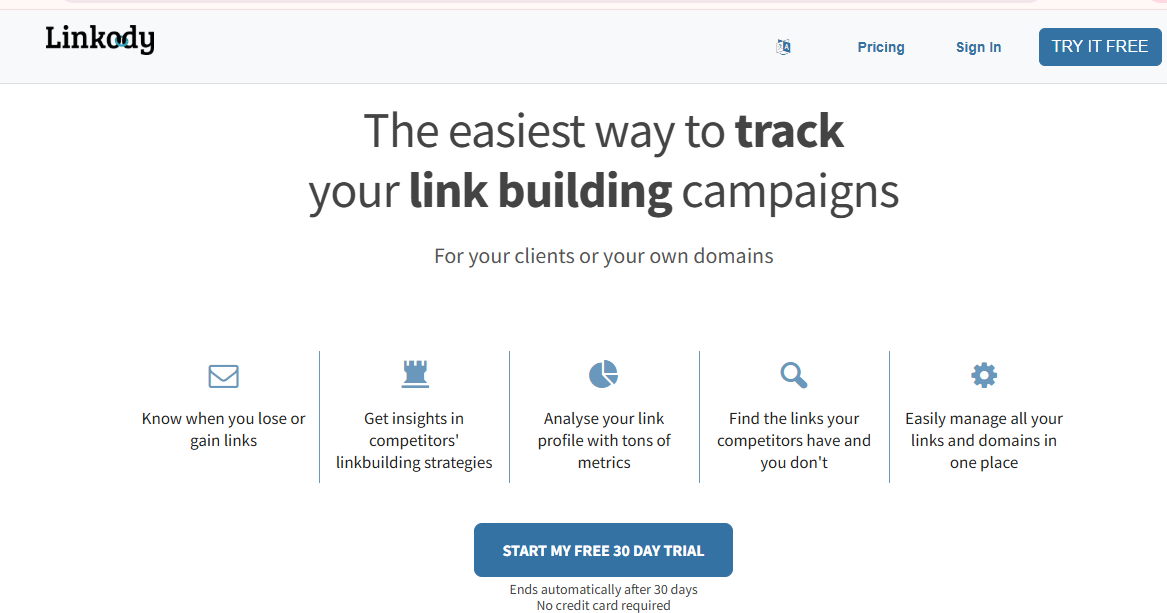
If you need a link monitoring tool, Linkody is an option to consider.
With its intuitive dashboards, you can track all of the key metrics for any website. For example, among them are anchor text, link status, spam indicators, and domain authority.
Here’s exactly what Linkody can help you with:
- Track your backlinks automatically. So, you will not need to manually check whether backlinks are active or not. It can also notify you when something changes.
- Track the backlinks of your competitors.
- Monitor link health by identifying suspicious or broken links.
- Track backlink status daily without lengthy manual checks.
- Get scheduled reports that summarize backlink performance.
Linkody offers many automation capabilities that make it a worthy tool to improve backlink monitoring and keep a healthy backlink profile. As a result, it can help you protect the value of your link-building campaigns.
Brand24: Best for finding unlinked brand mentions
Source: Brand24
Pricing: Starts at $199 for an Individual plan (when paid annually).
Free option: Free 14-day trial.
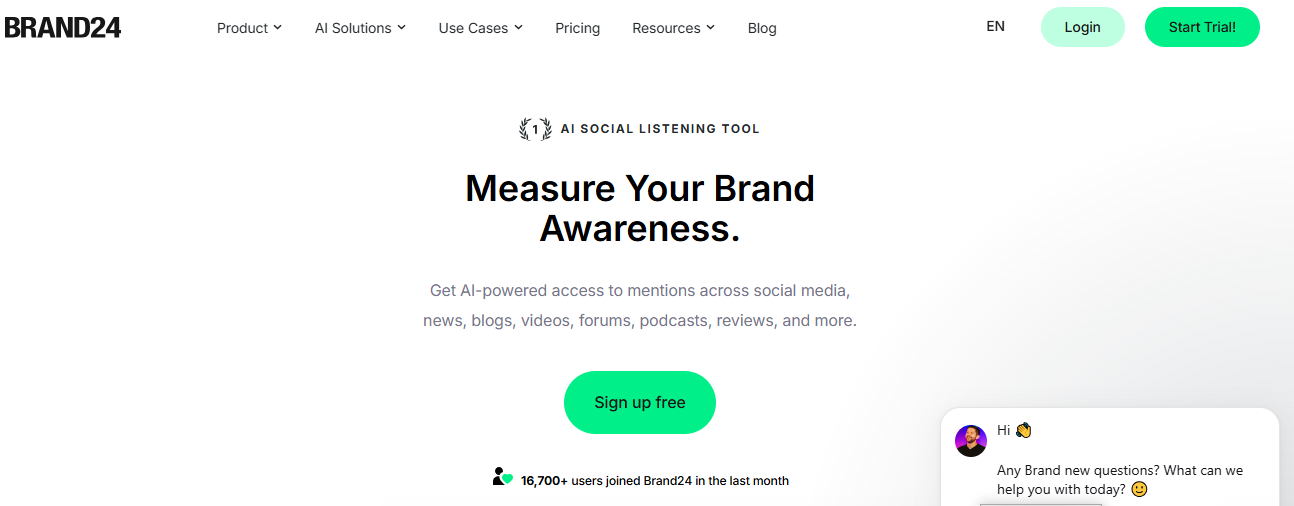
Brand24 is a great tool for finding unlinked brand mentions. It can help you discover where someone discusses your brand, team, products, and services online without linking to you.
For this, the platform monitors a multitude of online sources. For instance, it can monitor social media, review platforms, podcasts, forums, blogs, news websites, etc.
Here’s what Brand24 can help you with:
- Finding good opportunities to turn brand mentions into valuable backlinks.
- Setting custom monitoring projects. So, you will not need to continuously scan the web. It delivers real-time notifications each time a new mention shows up.
- Filtering results by influence score, sentiment, language, or source. Besides, you may prioritize the most worthy outreach opportunities.
- Classifying mentions as negative, neutral, or positive with AI-powered sentiment analysis.
- Detecting spikes in online conversations. Thus, it may help your team react quickly to reputation problems or new PR opportunities.
- Preparing automated reports that can help you summarize brand mention trends, brand visibility, and engagement over time.
Snov.io: Best all-in-one option
Source: Snov.io
Pricing: Starts at $39 for a Starter plan (when paid annually).
Free option: Free plan with 50 credits, 100 recipients, and 1 email warm-up slot.
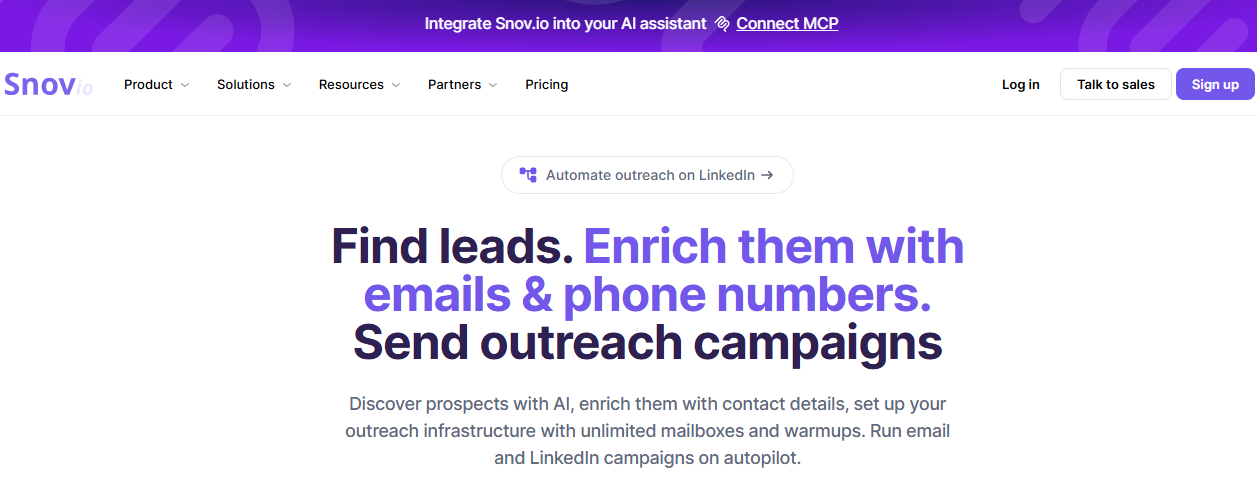
Snov.io is an all-in-one link-building tool that combines lead management, email outreach, prospect discovery, and automation in one workplace. With it, there is no need to switch between multiple tools.
This platform can help you:
- Discover verified contact data and launch personalized outreach campaigns.
- Reduce bounce rates thanks to built-in email verification.
- Generate email copy and personalized subject lines with its AI Email Writer. It gives AI-assisted suggestions that help refine messaging.
- Monitor campaign performance, track conversations, and organize prospects from a single dashboard with the help of CRM functionality.
Snov.io is perfect for marketers who seek efficient and scalable link-building. It is a smart combination of campaign management, automation, and AI assistance in one platform.
Conclusion
All in all, you can use AI to remove the slow, repetitive work from link building without automating the judgment that determines whether the links are valuable.
Using AI to save time without losing quality is great.
However, using automated systems to generate or place links at scale can produce irrelevant placements, spammy campaigns, reputational damage, and search-policy violations.
Besides, AI can also magnify your gaps if you have any. That’s why humans are still responsible for relevance, strategy, relationships, and final decisions.
Nevertheless, if you want to build more relevant links without hiring a much larger team, AI link-building tools are a must.
FAQ
What are the parts of link-building to automate without penalties?
The winning strategy would be to automate placing internal links, data enrichment, monitoring, sequencing mechanics, QA checks, prospecting, and scoring.
If you do, you will significantly speed up your workflow without any damage.
How to automate outreach without spamming?
You should automate the logistics, some of the most repetitive tasks that don’t involve much judgment. However, leave the parts that require persuasion and quality control to humans.
Do automated backlinks work?
First of all, automated backlinks are against Google policies. Besides, usually this tactic is only used for low-quality websites. So, the backlinks you get this way will, generally, do more harm than good.
But automated link building and automated backlinks aren’t the same thing.
Automated link building refers to automating some parts of the process, like searching for prospects, filtering websites, finding contact data, researching more about the brand, etc.
And automated backlinks refer to links placed automatically at scale, often as part of spammy tactics designed to manipulate rankings.
All trademarks, logos, images, and materials are the property of their respective rights holders.
They are used solely for informational, analytical, and review purposes in accordance with applicable copyright law.


 Sign Up
 Sign Up