




About Us Page Examples: 10 Ideas for Telling Your Brand’s Story
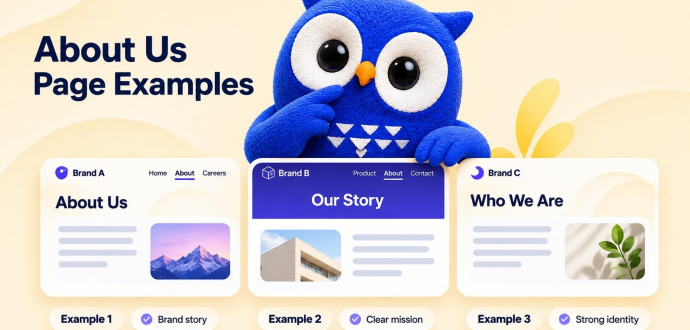
Writing about your own business sounds easy in theory. As soon as the writing begins, you’ll notice that you have plenty to say, but there is only so much space on your screen, and visitors will only spend so much time reading your story.
You’ll have to prioritize and decide what deserves a place on the page. Should you explain how it all started? Introduce your team? Talk about what you believe in?
There’s room for all of that. But whatever you choose should echo in the minds and souls of your visitors, and they should understand what those details mean for them.
Looking at how other businesses approach this can help. Below, we’ve gathered 10 About Us page examples, each with a storytelling idea you can adapt to your own website.
10 storytelling ideas and About Us page examples
Each example below represents a different way to tell your business story. We’ll look at what the brand does, why it works, and what you can borrow for your own About Us page.
1. Start with the problem that inspired your business — Warby Parker
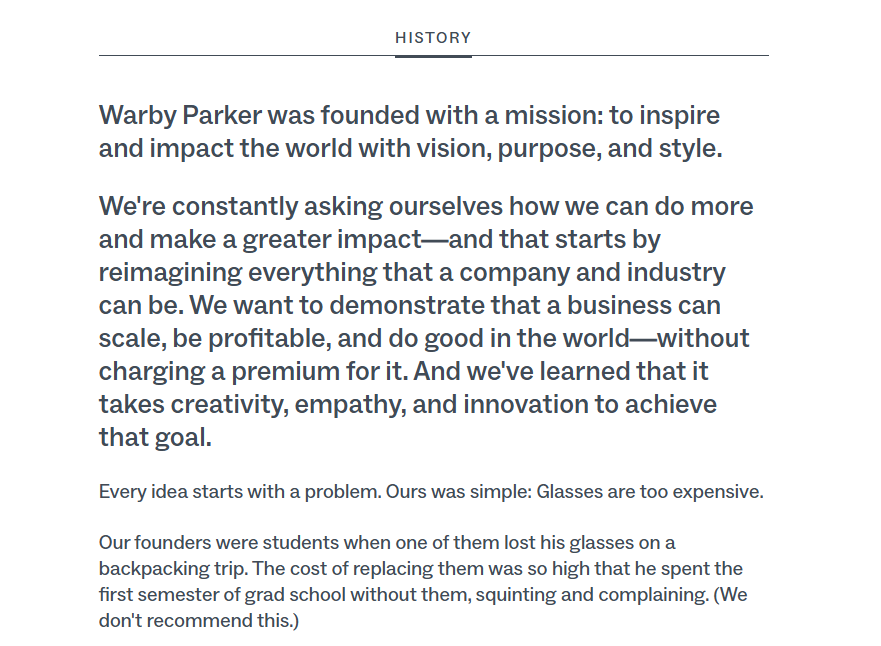
Warby Parker is a popular manufacturer of glasses and eyewear. Their main page starts with a clear mission: “To inspire and impact the world with vision, purpose, and style”. Their story includes a concrete problem that motivated its founders to “scale, be profitable, and do good in the world—without charging a premium for it.”
The narrative that follows is personal; it explains how one of its founders lost his glasses while backpacking. Replacing them cost so much that he went through his first semester of graduate school without them:
Source: Warbyparker
Why it works
- The problem is familiar. Losing comfortable, quality glasses is frustrating. Replacing them is expensive, especially for someone on a low budget, like a student.
- The details make it personal. Spending a semester without glasses is frustrating. It’s a painful experience that will affect performance and study results, for sure. Many people can relate to such an experience immediately.
- The solution follows naturally. Warby Parker explains how they found a way to overcome that problem: they started designing glasses in-house without hiring expensive contractor designers and selling them directly to customers, bypassing intermediary sellers (whose charges also add up to the final price).
What to borrow
If you’ve experienced the same problem as your customers, use that shared experience to your advantage. The key ingredient of success here is honesty. If not one of your founders, then perhaps one of your employees can share a true story of how they faced a similar problem. Like Warby Parker, connect one unique and genuine story to what your business offers today.
2. Tell your founder’s story through a defining moment — Clif Bar
Energy bar maker Clif Bar opens its company timeline with a bike ride that changed things for its founder, Gary Erickson. This ride became known as The Epiphany Ride. When Gary felt exhausted and wanted to refuel his biological energy tank, he realized he couldn’t take any more of those unappetizing energy bars that he had in his pocket.
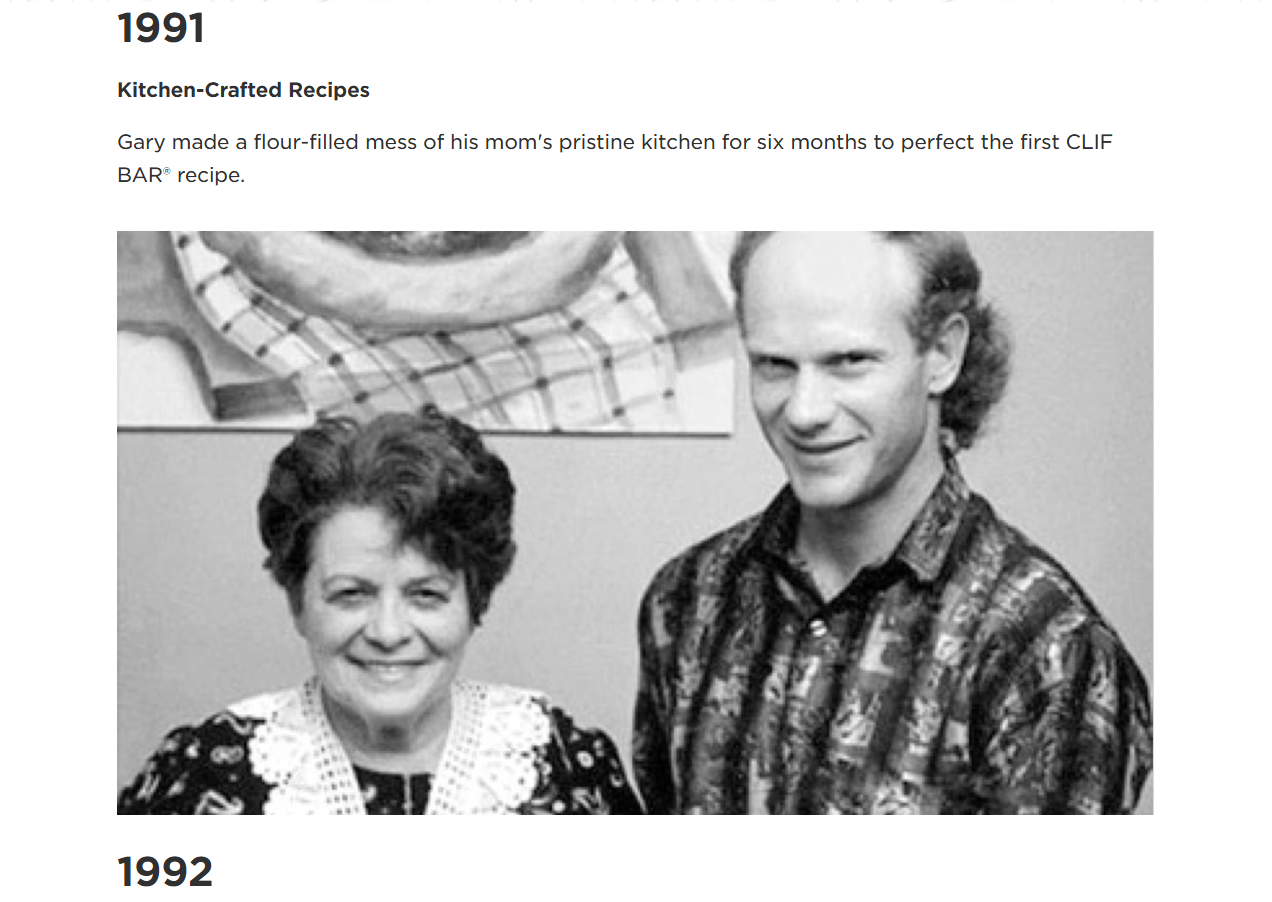
It was the early 1990s when Gary literally occupied his mother's kitchen to make a difference—to perfect a truly tasty and energizing bar, the first one in the family of the first CLIF BAR® recipes.
Source: Clifbar
Why it works
- The moment is specific. It captures a long and exhausting bike ride, then extreme hunger and fatigue, and a tasteless energy bar that was disgusting to eat.
- The founder relates to his customers’ experience. Gary has done what millions of his customers wanted to do, but never dared and never succeeded. Out of his frustration, he created a product that would become a favorite among the army of other sportsmen just like him.
- The story moves from realization to action. The kitchen experiments show what he did with the idea, giving the opening moment a meaningful follow-up.
What to borrow
Refer to a specific moment that inspired your founder to change things for the better. Describe a hard journey that took them to move from point A to point B (creation of a new product), so readers can feel empathy with how that defining moment became a business. When describing the moment, use specific details, but be concrete and laconic, i.e., without unnecessary “water”.
3. Explain your purpose in one clear sentence — Kickstarter
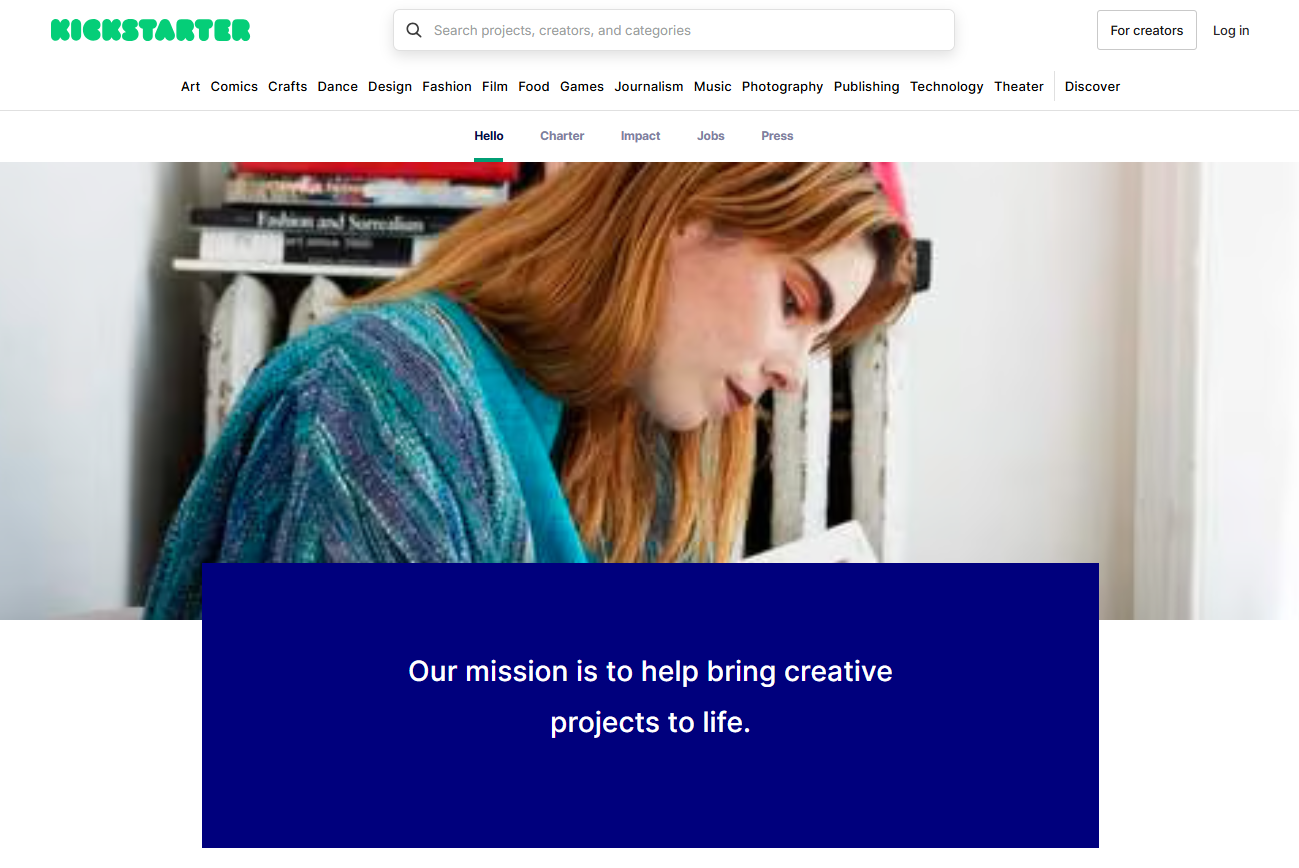
Crowdfunding platform Kickstarter opens its About page with a straightforward statement: “Our mission is to help bring creative projects to life.”
The mission statement is short and clear, indeed. Moreover, it is visually noticeable—written in white font, bold type, and on the bright blue background that stands out from the rest of the page. Impossible to miss.
The remaining page content demonstrates how that mission is put into practice: it contains interesting examples and case studies that further explain how the company operates.
Source: Kickstarter
Why it works
- The language is easy to understand. Their About Us page demonstrates that it doesn’t take a crowdfunding scientist to understand how this business model works.
- The purpose focuses on the outcome. Readers can easily relate to how important (and often hard) it is to turn a creative idea into something useful.
- The rest of the page supports the mission statement. Case studies and explanations make it obvious how Kickstarter turns its mission into practice.
What to borrow
If, by this time, you can’t explain what your company or brand does in one sentence, you have missed something far more important than expensive PR campaigns and the development of cohesive brand voice. Get back to the drawing board to develop and refine your business mission. You should do that first thing and make sure you use words that your customers can easily understand.
4. Make your customers part of the story — Airbnb
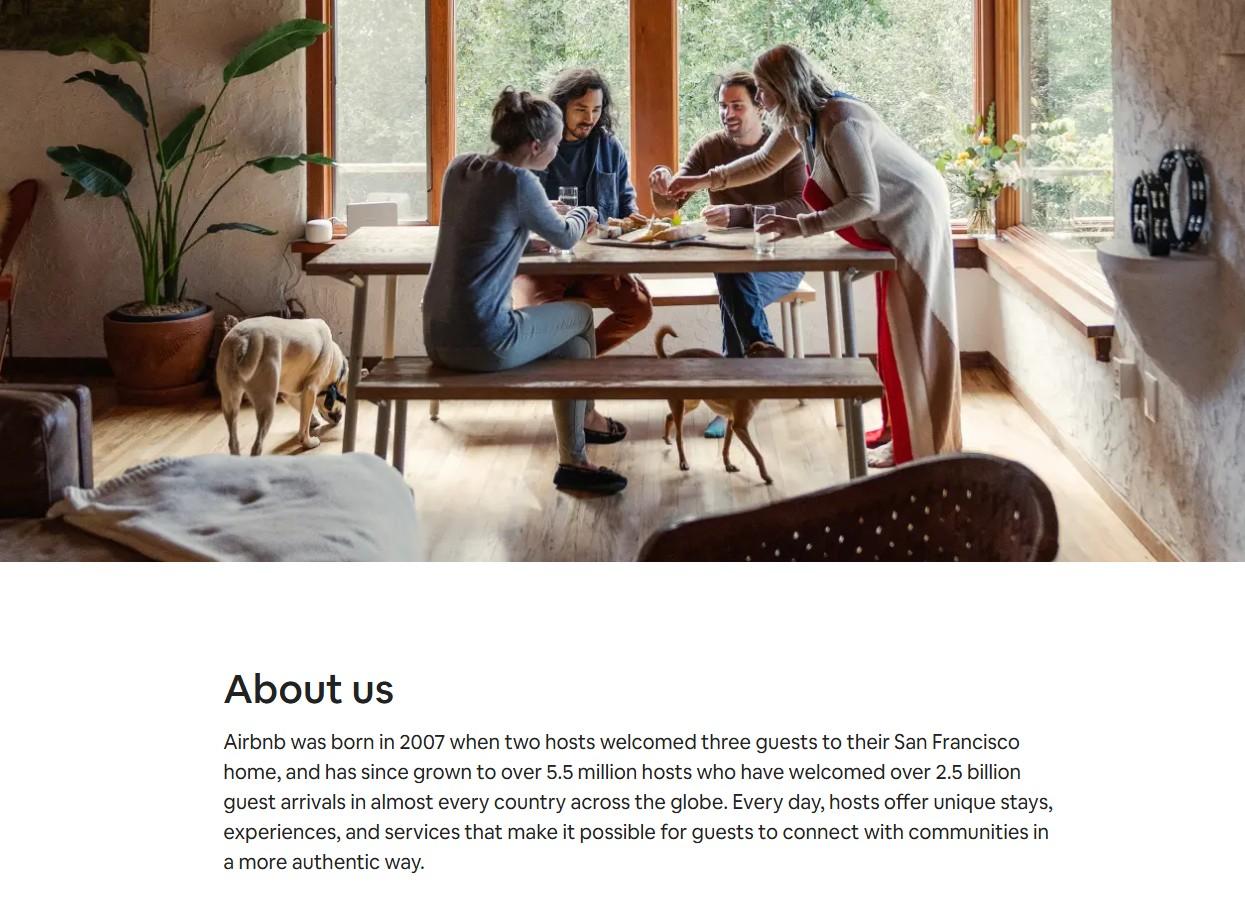
Travel booking platform Airbnb’s About Us page opens up with a warm illustration and a short story of the two hosts welcoming three guests into their San Francisco home in 2007. The idea is that businesses often fill their websites with claims about themselves, but customers also look for information on websites about people whose needs resemble their own.
So, in the case of Airbnb, people—real customers—are part of the story from the first paragraph.
The growth story that follows on the next couple of screens describes how travelers use the platform to find hosts. The hosts’ contribution, embedded in relevant services and advice (e.g., on local places to visit and experiences worth having), helps readers place themselves in similar situations.
Source: Airbnb
Why it works
- Customers have an active role. The story of Airbnb is centered around real people who struggle to find a place to stay. Their needs, demands, and interests are what drive the supply, not the other way around.
- Growth becomes a shared achievement. The page also acknowledges the critical contribution of the hosts. Without them, Airbnb wouldn’t become what it is today—a developed host community where any customer can find what they need.
- The story explains the experience. Visitors get a sense of what participating means, whether they want to host someone or book a stay.
What to borrow
Think about how you can acknowledge the contribution of your customers to the success of your business. It’s crucial that they see their role and feel that they’re valued. You need to be specific: perhaps your customers’ requests inspired a particular service, or their early support helped your brand get started.
5. Turn company milestones into a meaningful timeline — Ben & Jerry
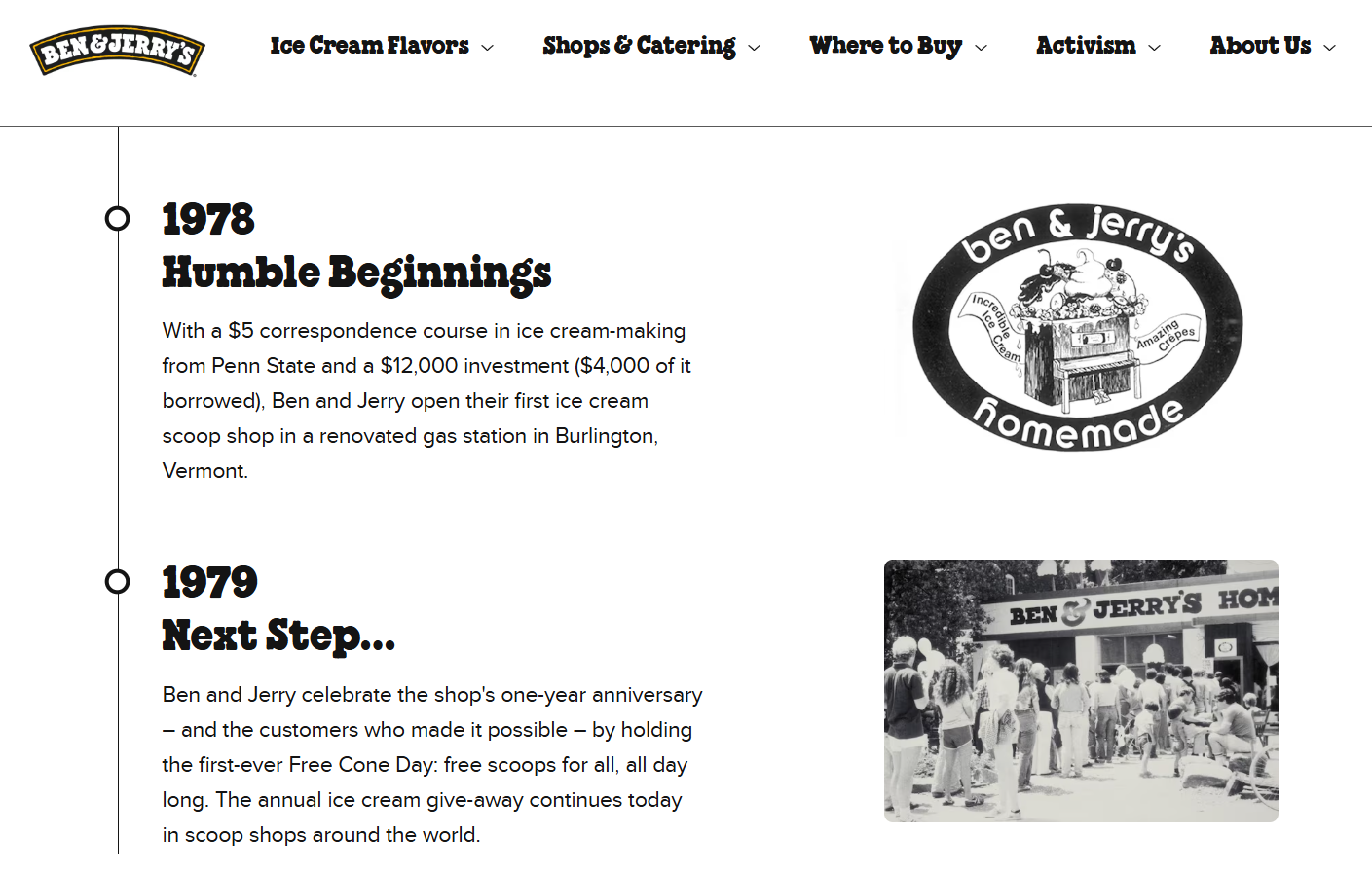
Ice cream maker Ben & Jerry’s uses its About Us page to take readers through its history by decade. Founders Ben Cohen and Jerry Greenfield opened their first ice cream shop in a renovated gas station in Burlington, Vermont, in 1978. The first Free Cone Day was held in 1979, and already by 1980 the company was selling its packaged pints.
Each milestone relates to a particular year and brings real people into the spotlight. Ice cream lovers get carried away into their sweet childhood years and get to learn interesting facts about their favorite ice cream brand along the way.
The detail about making early deliveries from an old Volkswagen alone makes the story worth reading.
Source: Benjerry
Why it works
- The milestones connect the dots. Readers get to know about the first baby steps of their brand, how the business was started, and how it developed into a world brand.
- Small details keep the history interesting. Mention of places, people, and cars (e.g., the delivery car) gives visitors more to remember than dates alone.
- The format is easy to browse. Old images next to each milestone help readers feel and recall the epoch when their favorite ice cream brand was as young as they, or their mothers and fathers.
What to borrow
A look back in history facilitated by one’s favorite brand can create a powerful emotional connection. Choose meaningful milestones in the history of your brand and explain how each one contributed to the current success.
A proper description is what matters the most: an archive photo is better than hundreds of fancy words, and an easy-to-follow, graphical timeline of how your brand developed is the best story that’s easy to understand and remember.
6. Introduce the people behind the business — Buffer
Social media management platform Buffer gives its team a prominent place on its About Us page. That is a logical thing to do. Social media takes collective effort to manage, which is only doable for a group of highly talented and engaged people.
Buffer introduces their team to reassure visitors of its people capabilities.
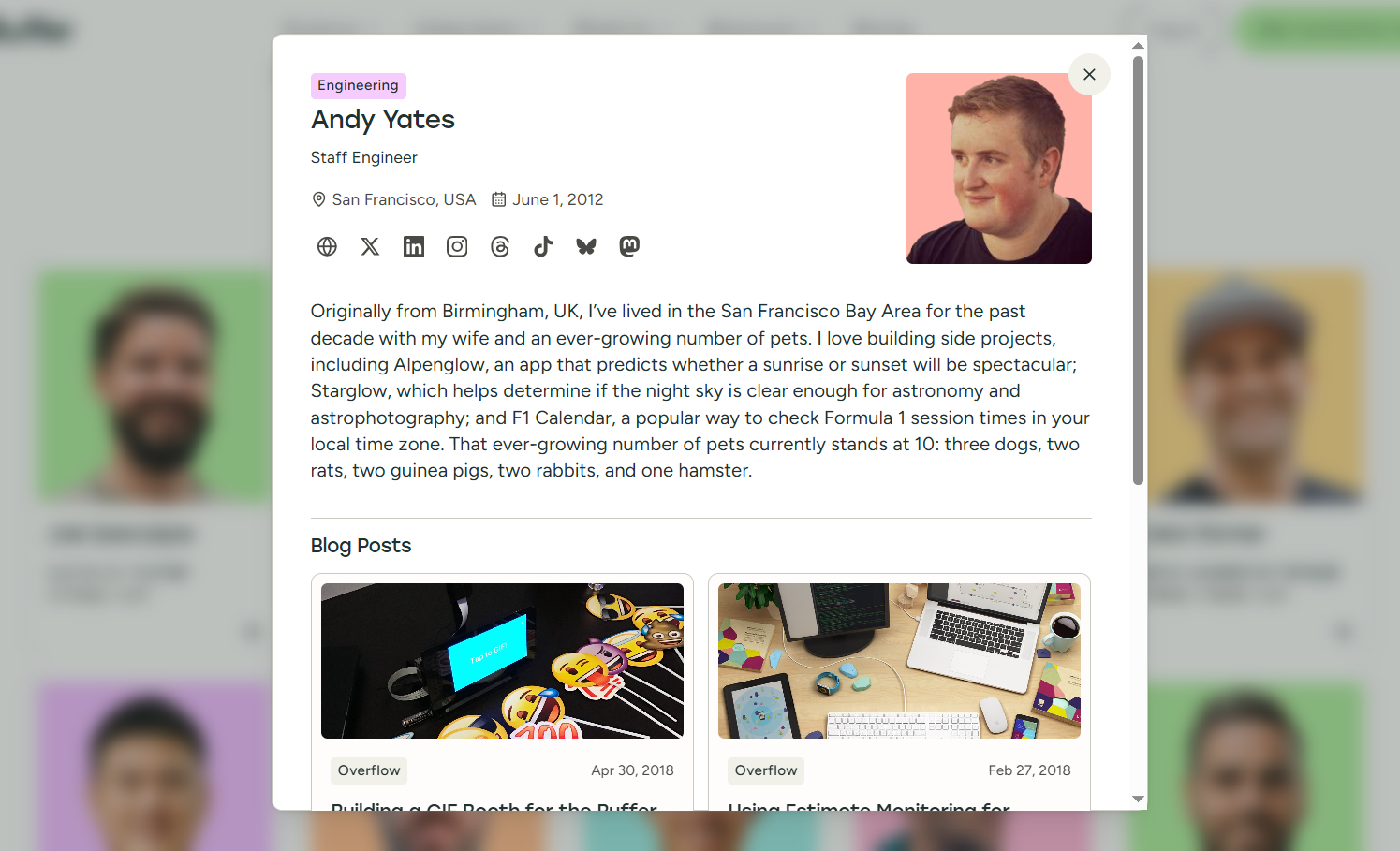
Under the “A team of real people” section, visitors can select all team members to browse or pick particular countries or organizational functions/departments. Clicking on a particular team member opens up their unique card with a short bio, links to social media accounts, and relevant blog posts and other materials created by that person.
Source: Buffer
Why it works
- Names and faces make the company less anonymous. Visitors can see that the company is operated by real people with real social media proficiency (can be contacted and followed).
- Job titles reassure of the necessary competence. Readers learn what each person’s competence is and how they contribute. It is qualitatively different from most similar “Our stuff” sections by other brands.
- Locations reveal something about the company. They show what Buffer’s remote working culture and diverse workforce look like through the real people involved.
What to borrow
Introduce real people behind your business. Make it informative by including their bio, social accounts, job title, function, and contributions if available. A good photo is a must, as looking at empty boxes is worse than having no personnel cards at all.
7. Show what happens behind the scenes — Ugmonk
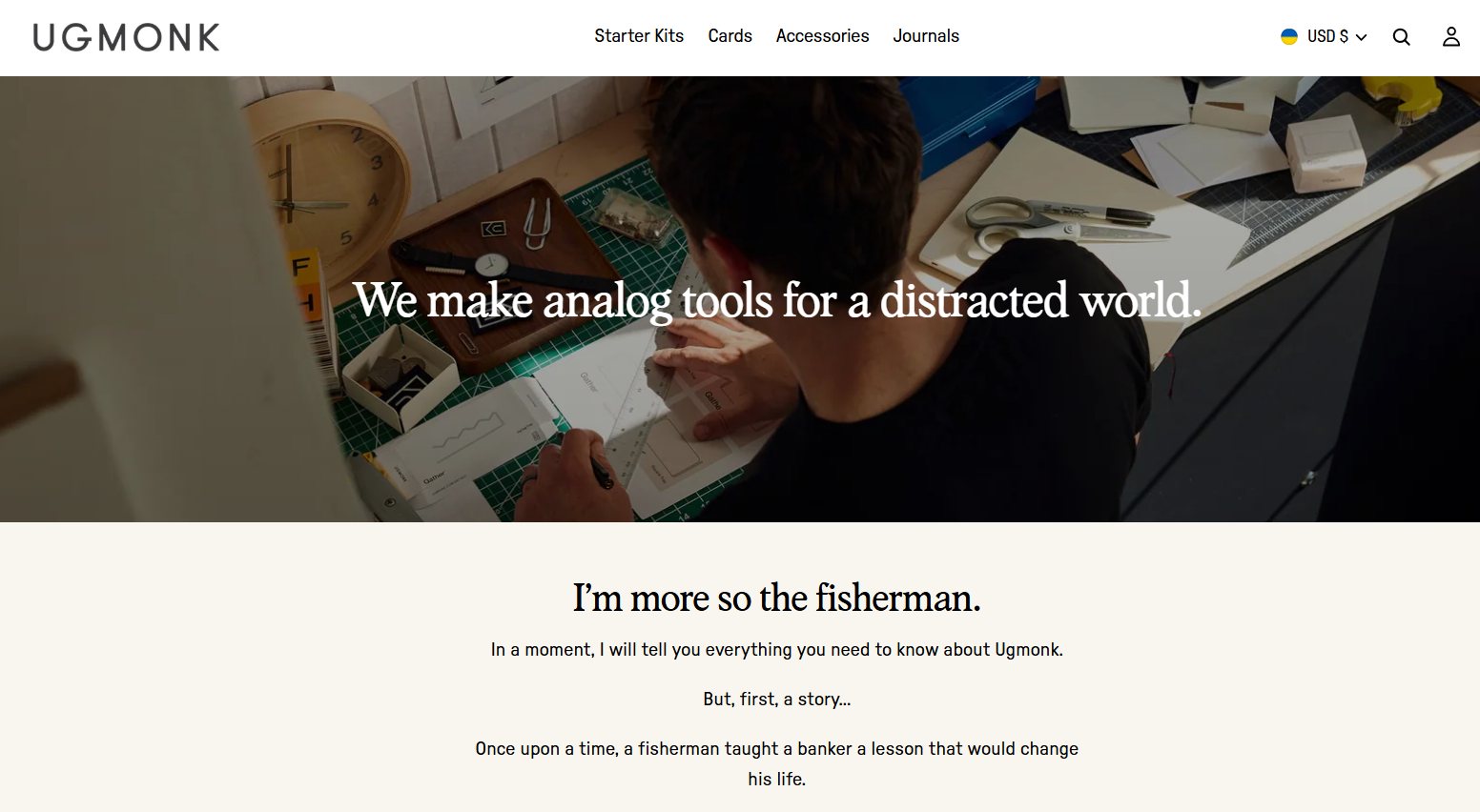
Ugmonk makes paper-based planning tools and desk accessories. Its About page gives visitors a glimpse of what the company is making, depicting an old-fashioned work desk, filled with paper note holders, a simple wooden clock, pens, pencils, and other desktop accessories.
Ugmonk founder Jeff Sheldon explains that in a world filled with digital noise and distractions, simple physical accessories help us pause, find a mental balance, and start creating or planning the traditional way. The one that never changes and brings real joy.
The About Us page also tells a reader an inspiring story of a fisherman and a banker. The story is one of the most exotic that one can find. It goes like this:
When they once met, and the banker saw the fisherman’s catch, he advised him to spend more time fishing, catching more, and becoming a richer person. But the fisherman replied that he was living a simple, yet very enjoyable life that he would never trade for any wealth or status.
This same philosophy of a simple, yet enjoyable life for everyone is embedded in Ugmonk’s mission. A small company of only 4 people makes a big difference in the busy digital world.
Source: Ugmonk
Why it works
- The workspace adds context. Visitors can see the workspace where Ugmonk operates. Traditional desktop accessories trigger good memories in a world where digital notifications and tools constantly test our nervous systems.
- Specific details explain the effort. Examples of concrete materials used, the time it takes to make each product, plus product measurements explain how much effort is invested in what visitors can find on Ugmonk’s website.
- Custom approach and focus on quality make the products appealing. When everything around us is made of cheap plastic and thin, shiny metal, Ugmonk’s products and the approach to making them stand out help customers see the difference.
What to borrow
Show what happens behind the scenes of your business. A manufacturing process, or a handmade making routine with emphasis on concrete materials used, can make a huge difference in potential customers’ perceptions. Make quality photos of your workers doing their job, record videos, and do other creative things to explain what happens and why it matters to the finished result.
8. Connect your story to a place or community — East Fork
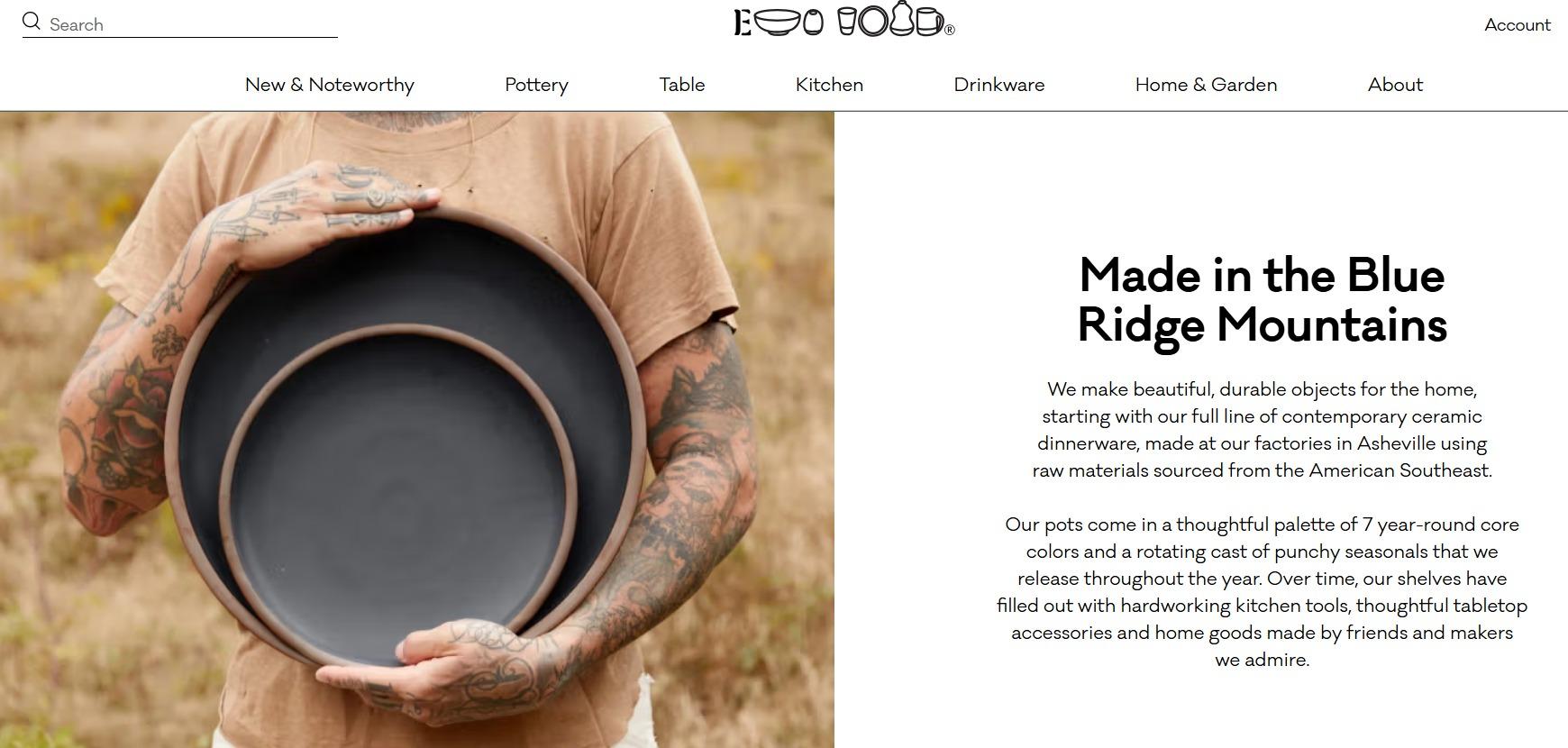
East Fork is a pottery-making family business. Its About page takes readers to the Blue Ridge Mountains of North Carolina.
Everything began 15 years ago on an old tobacco farm, where a small group of potters worked with clay, filled a wood-fired kiln, and sold their pottery to visitors. It’s a success story of a small business that became famous worldwide.
The next screen titled “Made in the Blue Ridge Mountains” draws an even stronger connection to the local culture and community. East Fork explains that its ceramic dinnerware is made in Asheville using local raw materials (the keyword is local). It is sourced from the American Southeast.
The location is important as it points to the locally sourced clay and the exceptional craftsmanship of the local claymakers. The result is a beautiful table and a joyful experience for families all around the world.
Source: Eastfork
Why it works
- The setting makes the story memorable. A careful depiction of the old, traditional process of making kitchenware, made of locally sourced clay, processed in a wood-fired kiln, is so bright and vivid that readers don’t struggle to remember it.
- The roots connect to the products. Local materials (clay, wood) and hard, manual labor make it fascinating for the customer to track geographical details to concrete products.
What to borrow
Explaining how a particular location contributes to a business is a subtle, yet very effective form of marketing. Find that connection between geographic locations and your products to strengthen relationships with your customers (especially local ones).
9. Demonstrate your values through specific actions — Bombas
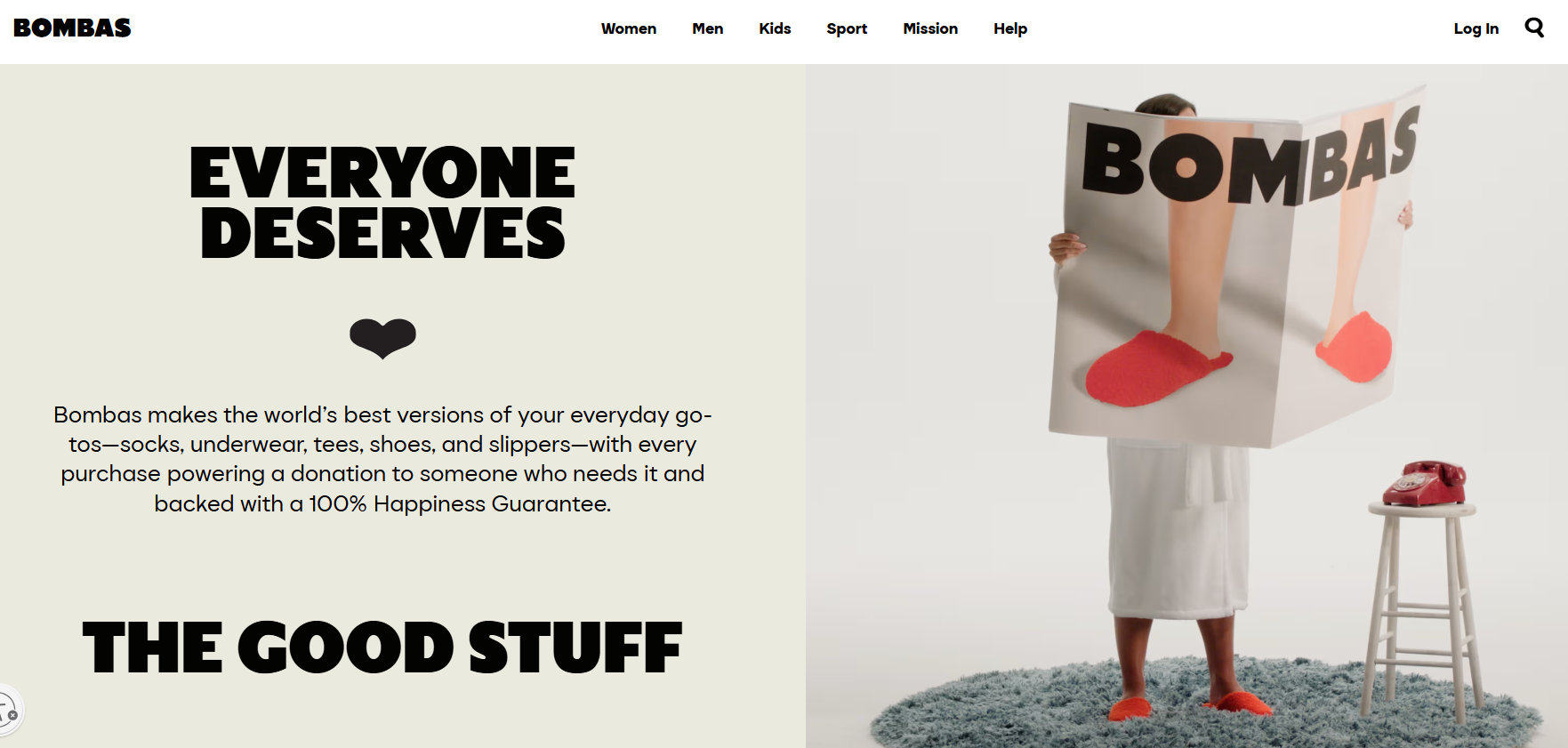
Clothing brand Bombas, on its About Us page, lays out its commitment in plain language: “One Purchased, One Donated.” It then explains that every item a customer purchases contributes a donation to those who need clothes the most—homeless people.
However, that doesn’t mean that a clothing item provided to those in need through charity funds is of subpar quality. On the contrary, the About Us page makes it clear: the same care is given to donated products, including their materials, comfort, and durability. This illustrates how the company lives through its values, fulfilling its promise of “comfort for all”.
Source: Bombas
Why it works
- The page explains how help reaches people. Bombas explains how its giving partners select a relevant donation program in local communities to channel the donated value.
- Product decisions support the values. The company manufactures the items given to charity funds with the same care and attention to quality as it does for regular items sold to retail customers.
What to borrow
Out of your complete corporate value set, choose one specific item and show how your brand’s actions support that value. For example, if you care about reducing waste, show what you reuse or repair. If accessibility matters, explain what you’ve changed to make your service easier to use. Claims on websites about sustainability or social responsibility mean little without specific actions to support them.
10. Give visitors a clear next step — charity: water
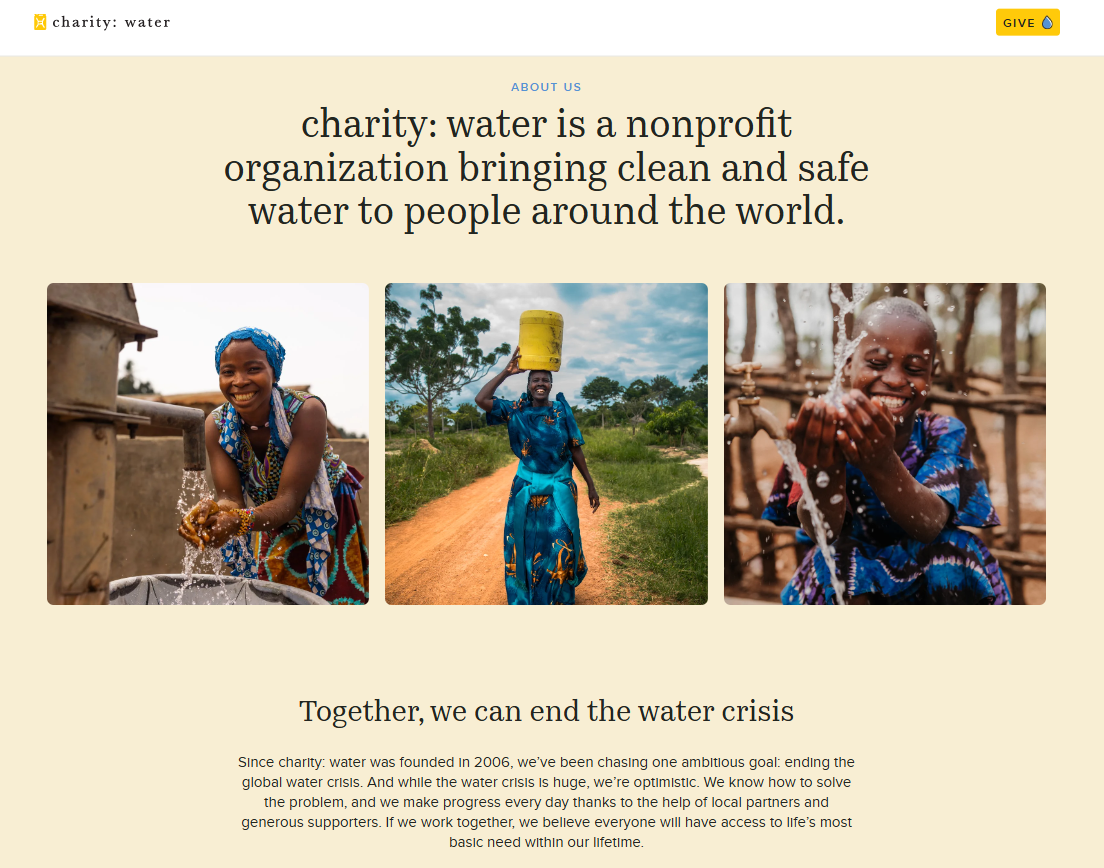
Nonprofit organization charity: water helps bring clean and safe water to communities around the world. Its About Us page makes what they do look simple: it explains the company’s mission (“bringing clean and safe water to people around the world”), explains the impact, and provides a clear next step.
After those explanations, visitors reach an invitation: “Ready to give the gift of clean water?” A large, yellow “Give Today” button is a direct invitation to make a contribution.
The whale process is explained in three simple steps: (1) the company provides proof that it tracks every donated dollar, (2) it regularly wins awards for being financially transparent, (3) and the company’s activists partner with local communities to build sustainable water projects.
Source: charitywater
Why it works
- The invitation follows relevant information. Website visitors get to know how the organization works and how end users receive their money (access to clean water) before they push the button and make their donations.
- The wording makes the action clear. “Give Today” is a clear action that is only available at the bottom of the page once visitors read and learn about the company’s charity business.
- Charity: water connects its donation button to its clean-water mission. Each donation can be tracked to a specific local community in need of clean water. Photos of poor people from Africa make the story look real and complete.
What to borrow
Whether your business is a charity or a commercial one, you can always provide visitors with a clear next step. Your About Us text should support user navigation and can act as a landing page, instead of being a purely informational one.
How to choose the right approach for your brand
Your business is the subject of your About Us page, and you might have dozens of interesting facts and stories to tell. However, the tricky part is that you only need one, or at most two. Simply because you cannot talk about everything and everyone on your About page.
Marketing has long had the solution to that type of challenge: it recommends following the customer. Your customers’ questions and concerns should guide your About Us page content. A fact or a story earns its place only when it helps visitors understand something that matters to their buying decision.
To choose the right approach for your brand, follow a few steps.
Step 1. Find and answer the question your customers have
Go through sales emails, product reviews, survey findings, and notes left by your consultants. Do people ask why your products cost more, whether you’re using the best materials, or who will handle their maintenance requests? Pick the question that bothers your customers the most and answer it in full.
Step 2. Match that question to a storytelling idea
When customers want to know whether you understand their struggles, start with the problem that inspired your business or make customers part of the story. And if you’re wondering how to write an About Us page for ecommerce website, start with what shoppers want to know before buying. For example, when they want to get the highest quality for their buck, show what happens behind the scenes, i.e., how your products are made.
Step 3. Choose the example you can support best
Format should come second, but the material, the substance, should always be first. For a strong behind-the-scenes section, gather good workshop photos and details about your workers, or the tools they use. If you want to tell a founder’s story, pick a specific experience that helped them shape the business.
Before collecting more About Uspage ideas, check whether you have the photos, stories, and specific details needed to make your chosen approach work.
Step 4. Check the order from a customer’s perspective
Look at your headlines or milestones only. Can customers understand your story and follow its flow? Rearrange your page content, especially data points and the key facts, first before filling them in with more details and style.
A good way to end your story is to offer the visitor a clear next step. An inspiring story should end with an invitation to take action, shouldn’t it? You’ve built momentum, so take full advantage of it.
Conclusion
A good About Us page gives visitors a clear sense of who you are and what you do. It should also help them get to know the people they’ll be buying from or working with.
However, there is much more to the About Us page than purely informational aspects. Visitors open these pages when they not only need to know more about you, but when they are in doubt and need reasons to choose your business among your competitors.
Here are a few universal things that need to be included:
- A clear introduction. Explain what your business does and whom it serves. Visitors shouldn’t have to piece this together from vague statements.
- Details that belong to your business. How you started, why you chose a particular approach, or what your team brings to the work.
- A way to continue. Make it easy to explore your products, learn about your services, or get in touch.
- Reasons to trust you. Relevant experience, real team photos, customer feedback, or specific achievements can support what you say.
How you present these details matters as much as, if not more than, the details themselves. Here, we enter the realm of storytelling, and in every great story there are a couple of rules to follow:
- First and foremost, the page should sound like you. If your usual communication is friendly and straightforward, there’s no need to become formal just because you’re talking about the company.
- Secondly, the page should sound like you in an inspiring way. You can present the same fact in a dry, concise manner that won’t resonate with the reader and won’t touch their feelings. Alternatively, you can wrap this very detail in such an attractive story that makes someone pause and think, “These people understand what I need.”
This may only appear like something difficult. You don’t need to be a pioneer in storytelling, nor do you need to invent unique approaches in it.
There are plenty of ways to tell your story. You just need to substantiate and decorate it with your own details. And the 10 ideas explored in this post show how real, successful businesses approach it—and what you can borrow for your own About Us page.
FAQ
What is the difference between an About Us page and a homepage?
The task of the homepage is to introduce your offer and to help customers move across your pages to the relevant products and services. Whereas the task of your About Us page is to tell the visitor who you are, what you believe in, and why your business exists. The latter gives them the reasons to choose you.
How long should an About Us page be?
There is no golden rule for the length of this type of page. It should be long enough to persuasively tell your story and explain to your visitors who you are. It should engage and “hook” the reader. But it shouldn’t force the visitor to read long texts and lose engagement. So, there is a thin line between enough and too long; that’s why crafting a great About Us page takes time and a collective effort of several stakeholders.
How do you write an About Us page for a new business with little history?
There could be plenty of ways to begin. For example, explain your mission, walk through your manufacturing (creative) process, and introduce the team behind your brand, focusing on individual members and their contributions. The goal is to tell why you started, whom you want to help, and what you bring to the work.
For example, you could adapt this sample text: “We started after struggling to find . Today, we help by .”
Should you write your About Us page in the first or third person?
First person usually suits a page where you’re speaking directly to customers: “we” for a team or “I” for a solo business. Third person is used less often, but it’s indispensable when it comes to more formal company profiles and sometimes for individual team biographies. Ultimately, the choice comes down to your brand voice and writing style, but the first person generally works better for this type of page.
All trademarks, logos, images, and materials are the property of their respective rights holders.
They are used solely for informational, analytical, and review purposes in accordance with applicable copyright law.


 Sign Up
 Sign Up