






How to Promote a Podcast: A Step-by-Step Growth System With Real Examples
Many podcasters tend to pour everything into creating great episodes and expect success to follow.
But when they publish their first brilliant episodes, nothing happens.
And there's a reason for that.
Not because the podcast is bad. It's simply because no one knows it exists.
Here's the part nobody wants to hear: great content alone is not enough. A mediocre show with a smart promotion strategy will outperform an outstanding show with no promotion strategy almost every single time.
Why podcast promotion is non-negotiable
Podcasts have become incredibly popular nowadays. People listen to them while exercising, cooking, driving, and even while falling asleep.
And that's not just a passing trend.
In fact, as of 2026:
- There are over 4.7 million podcast shows worldwide.
- Around 619 million people listen to podcasts each month.
As you can see, the opportunity is huge, but so is the competition.
Discoverability has become the #1 challenge.
72% of podcasters say that growing an audience and getting discovered are their biggest struggles.
But smart podcast promotion can help overcome that.
With it, you can take your show out of a crowded podcast landscape and bring the audience to your content.
To help you get there, we analyzed many strategies and tactics that drive podcast growth and organized them into a practical framework.
This guide walks you through the entire process. From building a strong foundation and maximizing distribution to implementing growth tactics.
Let's get into it.
Foundation
Step 1. Identify your target audience
Before you start promoting your podcast, you need to know who you're actually talking to.
Sounds obvious. But almost nobody does it properly.
For example, people on Reddit discuss how they wish they had focused more on audience research.
Let's look at how you can approach this in 3 stages.
1. Identify your listeners' profile
Go beyond demographics. Ask yourself:
- Who is this person?
- How old are they?
- What do they do for a living?
- What are they trying to figure out right now?
- What shows do they already listen to?
- What's missing from those shows?
Sit with these questions. And if needed, research more on Reddit, forums, in the YouTube comment sections, etc. Your goal is to actually understand the person on the other side of the screen.
The clearer your answers, the easier it becomes to make smart promotion decisions later.
Here are some data points worth keeping in mind while defining your listeners’ profile:
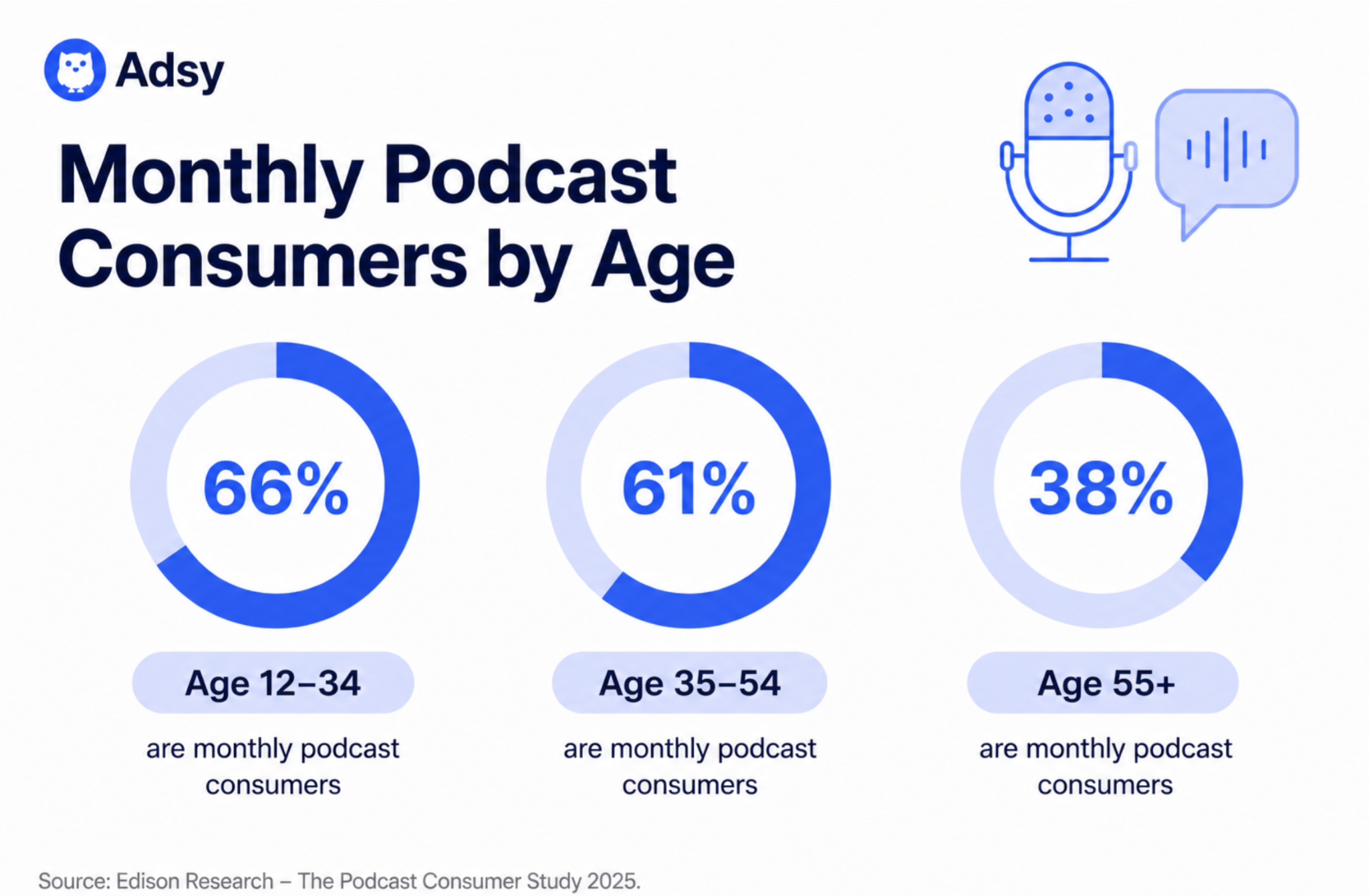
As you can see, the majority of listeners are younger, which may not be surprising. Still, older listeners make up a big part of the total audience.
Here are a couple of other interesting facts about a typical podcast listener: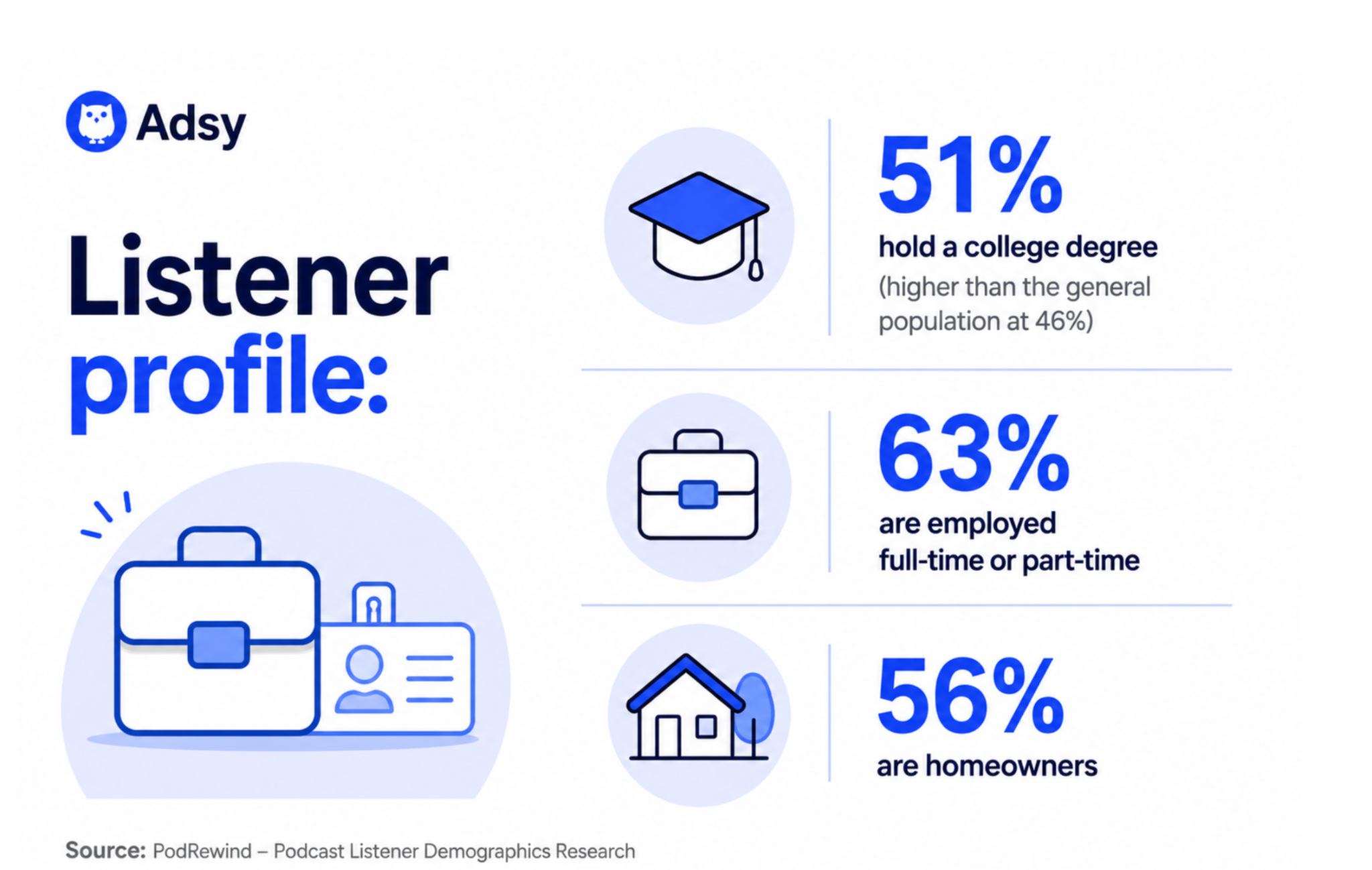
This data shows that podcast listeners are an established audience.
They tend to be educated, professionally active, and in a stable stage of life. These factors can help you build a stronger promotion strategy.
And there's plenty more data like this available. The deeper you dig into who your listeners actually are, the easier promotion becomes.
2. Match your platform strategy to your audience’s
Understanding how people discover podcasts is key to shaping your marketing plan. It’s not just about reaching “podcast listeners” in general. It’s about reaching the right people and in the right place.
Take Gen Z. 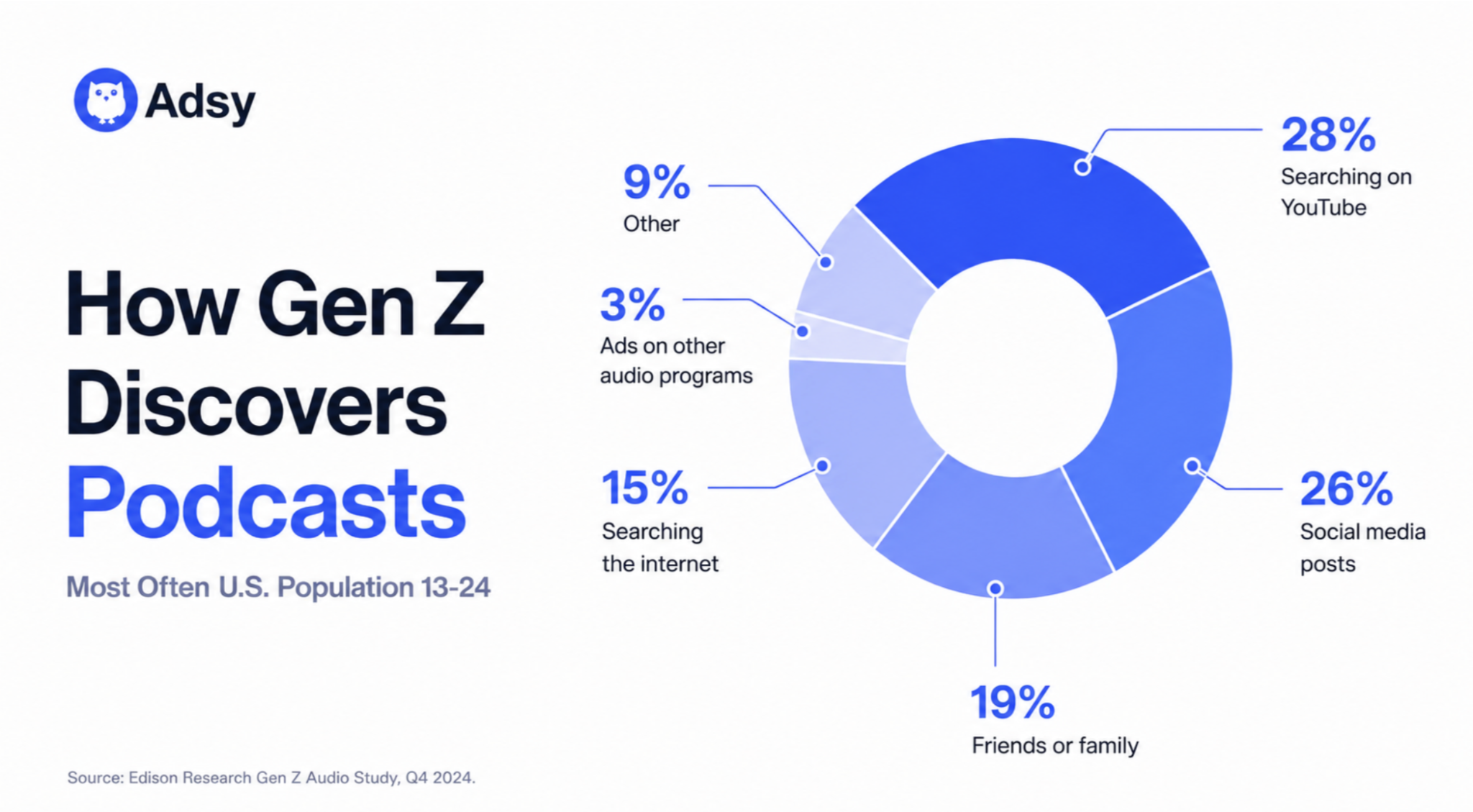
For them, discovery often starts on YouTube or in social media feeds. Not inside a podcast app.
Meanwhile, word-of-mouth ranks as one of the most effective ways people discover new podcasts across all ages.
That’s why focusing only on traditional podcast apps can limit your reach.
Instead, you need to think about where discovery actually starts, and make sure your content is visible there.
3. Narrow your topic specifically to that audience
Take My First Million as an example. Technically, it’s a business podcast.
Shaan Puri and Sam Parr launched it in 2020 after Sam sold his company and wanted more time to explore ideas and talk with founders. Now, it’s one of the top business podcasts that has a 4.8 rating and even a Webby Award. 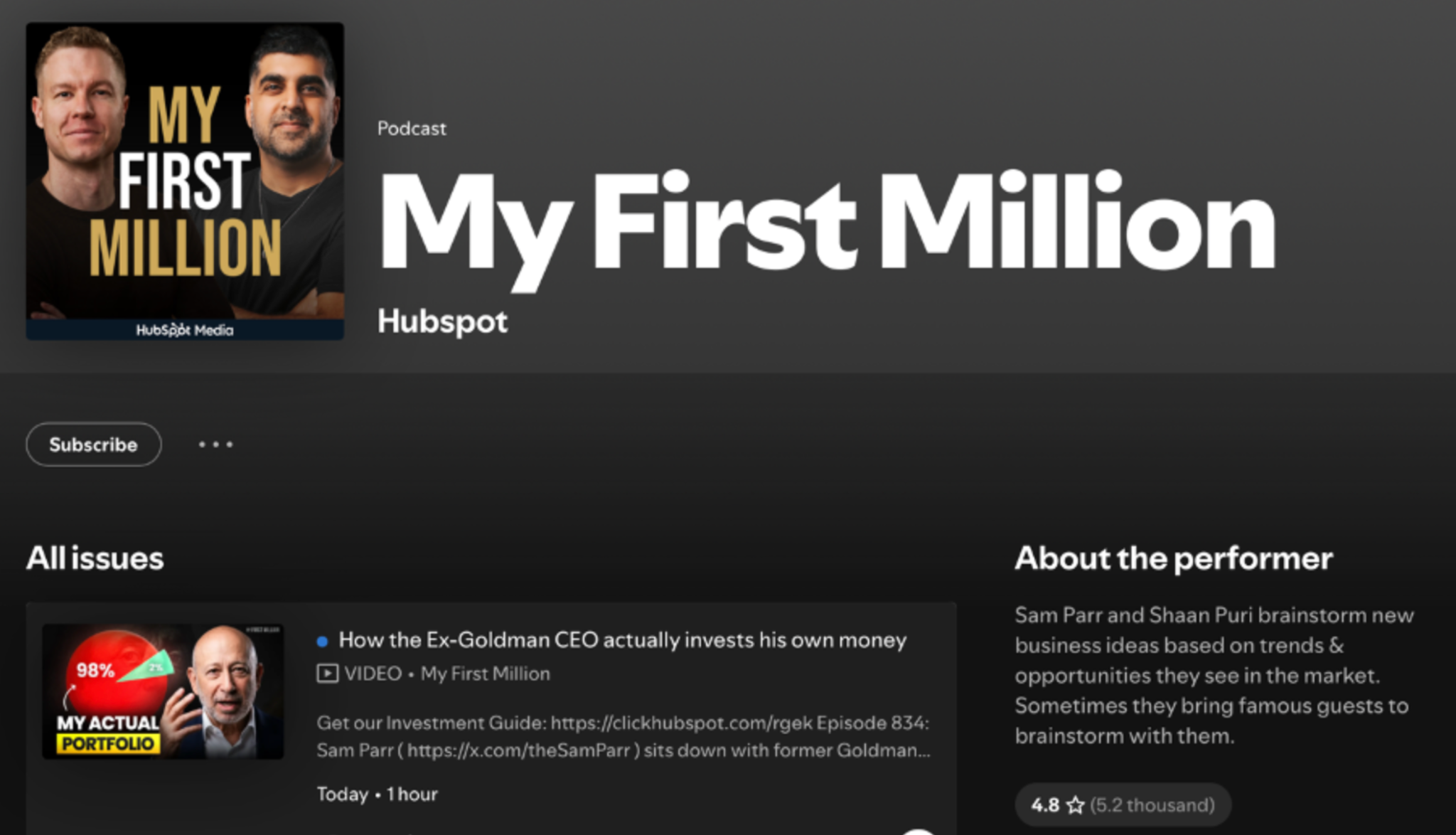
The thing is, their listeners aren’t just “people interested in business.”
They are people who love to think about new ideas and what they would build next.
That’s a very different listener from someone who wants MBA-style shows or a perfect guide on how to write a business plan. And the show works because it’s built for a specific person. Not the broad category.
The narrower your focus, the easier it is for the right person to stumble across your show and think, “This is exactly what I've been looking for.”
Step 2. Podcast marketing SEO
SEO is a core part of your podcast promotion strategy. When done right, it helps listeners find your show on Google, Spotify, Apple Podcasts, and other platforms.
The key is to optimize your podcast for both search engines and listening platforms.
Yes, they work differently.
Put yourself in your audience's shoes. What would they type into Google or Spotify when looking for information related to your topic?
Understanding those search habits can help you optimize your episodes. As a result, you can reach more listeners organically.
Here are a few things you should always keep in mind:
1. Do title SEO optimization
Think about your title carefully. If it's too short or not descriptive enough, it may never appear in search results.
Here's an example of a bad title: Episode 54
If you only use the episode number, it’s not a really good tactic. Yes, it’s the easiest one. Probably the most understandable for you. But potential listeners won’t understand what your episode is about if the title tells them nothing.
Here's a better one: What Happens When A $30B Founder Uses ChatGPT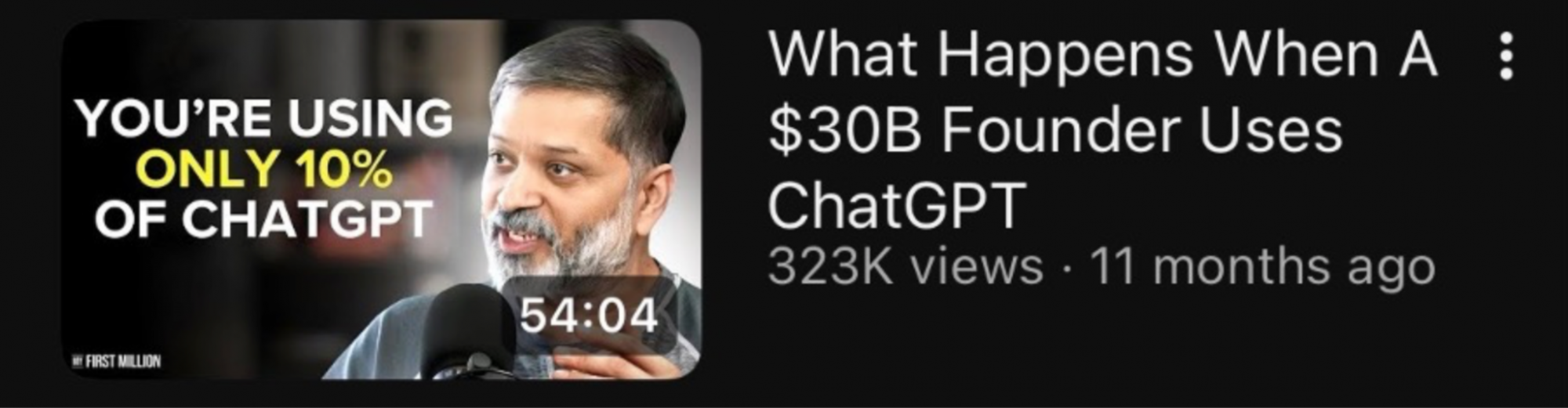
This headline tells listeners what they'll learn, includes a searchable phrase, and gives them a reason to click.
But don't overdo it. Your titles shouldn't be too long either. Try to keep them under 60 characters so they don't get cut off in search results.
Since most people use their smartphonesto listen to podcasts, shorter titles often work much better.
2. Use long-tail keywords
These are specific three- to five-word phrases that reflect how people search. For example:
- “Marketing Podcast” is a broad keyword with a lot of competition.
- “B2B SaaS content marketing podcast” is much more specific. It's a long-tail keyword with a niche audience.
Long-tail queries usually have lower search volume. But they often attract listeners with higher intent.
Tip: Use tools like Google Keyword Planner, Ahrefs, or Spotify's autocomplete suggestions. They can help you find terms your potential listeners are already searching for.
3. Don’t do keyword stuffing
The problem is that keyword stuffing can undo all your efforts. Google doesn't like to recommend such content.
Meanwhile, Apple can basically reject you if you use too many keywords. It wants users to have a clean, relevant experience when searching on Apple Podcasts.
Daniel J. Lewis dug deep into this problem and shared an example of a keyword-spamming podcast that had a high chance of being removed from Apple Podcasts:
After analyzing this example, Daniel created his own title, as he thought, without keyword stuffing:
But here’s the funny thing: even with this clean title, the podcast was still rejected. After discussing this issue with Apple Podcast Support, he realized that the problem was his author tag.
As you can see, it’s extremely important not to go overboard here. Even tiny details can make a big difference.
4. Optimize differently for each platform
Every major platform has its own search algorithm. What helps your podcast grow on Spotify isn't necessarily what works on Apple Podcasts or YouTube.
That's why a one-size-fits-all approach to podcast SEO rarely works.
Here are some of the key differences:
- Spotify: It’s all about engagement, so follows and shares matter a lot here. Your first minute is also important. So make sure you hook listeners early and do everything to keep them engaged.
- Apple Podcasts: This platform relies on metadata. That’s why your show titles and categories are very important here. Reviews and subscriptions also help, especially when you’re just starting out.
- YouTube: It works both as a video platform and a search engine. Titles, descriptions, transcripts, and engagement all impact discoverability.
- Google: It pulls information from RSS feeds and websites. That means your written content can help people discover your show even outside apps.
5. Write show notes and transcripts
When it comes to podcast SEO, there's one important thing: give search engines something to actually read.
- Show notes are the long-form companion to each episode. This is a post that lives on your website and summarizes the key insights from the episode. It can also include guest quotes, links to resources mentioned, and keywords you want to rank for.
- Transcripts go further. They give search engines a full-text version of your episode to index, increasing your long-tail keyword surface area.
Therefore, skipping this step means every episode you publish is invisible to Google. No matter how good the content is.
6. Description also matters
You can already tell that written content is important. So don't stop at transcripts or show notes. Your description is just as important:
- First, open your description with your primary keyword in the first one or two sentences.
- Then explain what your show is about and why this podcast matters.
- Finally, write in plain language. And don’t forget to include the exact words people might type into a search bar.
Here's what a strong podcast description looks like in practice:
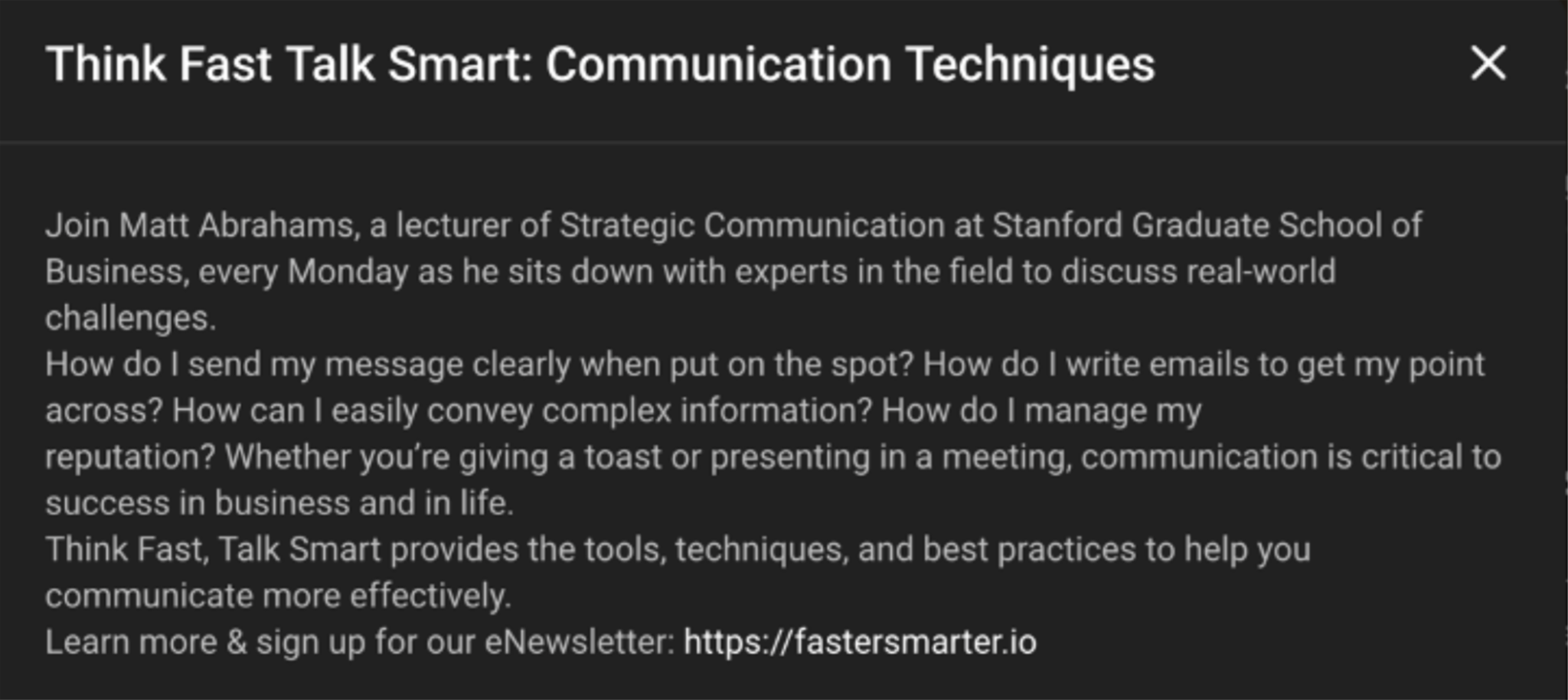
Notice how Think Fast, Talk Smart starts its description with “Strategic Communication at Stanford Graduate School of Business.” This is a phrase people might search for when looking for communication skills.
Then it moves immediately into the listener's real questions:
- How do I send my message clearly when put on the spot?
- How do I write emails to get my point across?
- How can I easily convey complex information?
This tactic not only helps readers understand what the podcast is about. It also helps the show appear in Google Search when the audience types these exact questions in.
7. Use keywords in your show
Today, Google not only reads your content, it actually listens to it. It can understand what a video is about, especially on YouTube.
So take this as a new tactic while recording your next podcast. Verbally highlight your main keywords in your episodes.
This can help you rank not only in Google Search but also get recommended by AI.
Step 3. Build a podcast website
Your podcast needs a home that belongs to you.
A page on Spotify or YouTube is usually not enough. Your podcast should have an actual website to become a brand.
Here are some of the benefits a podcast website gives you:
1. Better SEO opportunities
Platform profiles are SEO-limited by design. While a website can become a home for many more things, such as:
- Transcripts
- Blog posts
- Guest bios
- Episode archives
Each one can be indexed by Google and help you build long-term search traffic.
A podcast with 100 episodes and a well-structured website has 100 potential search entry points.
If you’re just starting out, check our checklist to learn how to optimize your website and make it more profitable.
2. An email capture system
Your website is where casual listeners can turn into a loyal audience that actually looks forward to new releases and updates.
The best way to start is with a dedicated landing page. It doesn't need to be complicated.
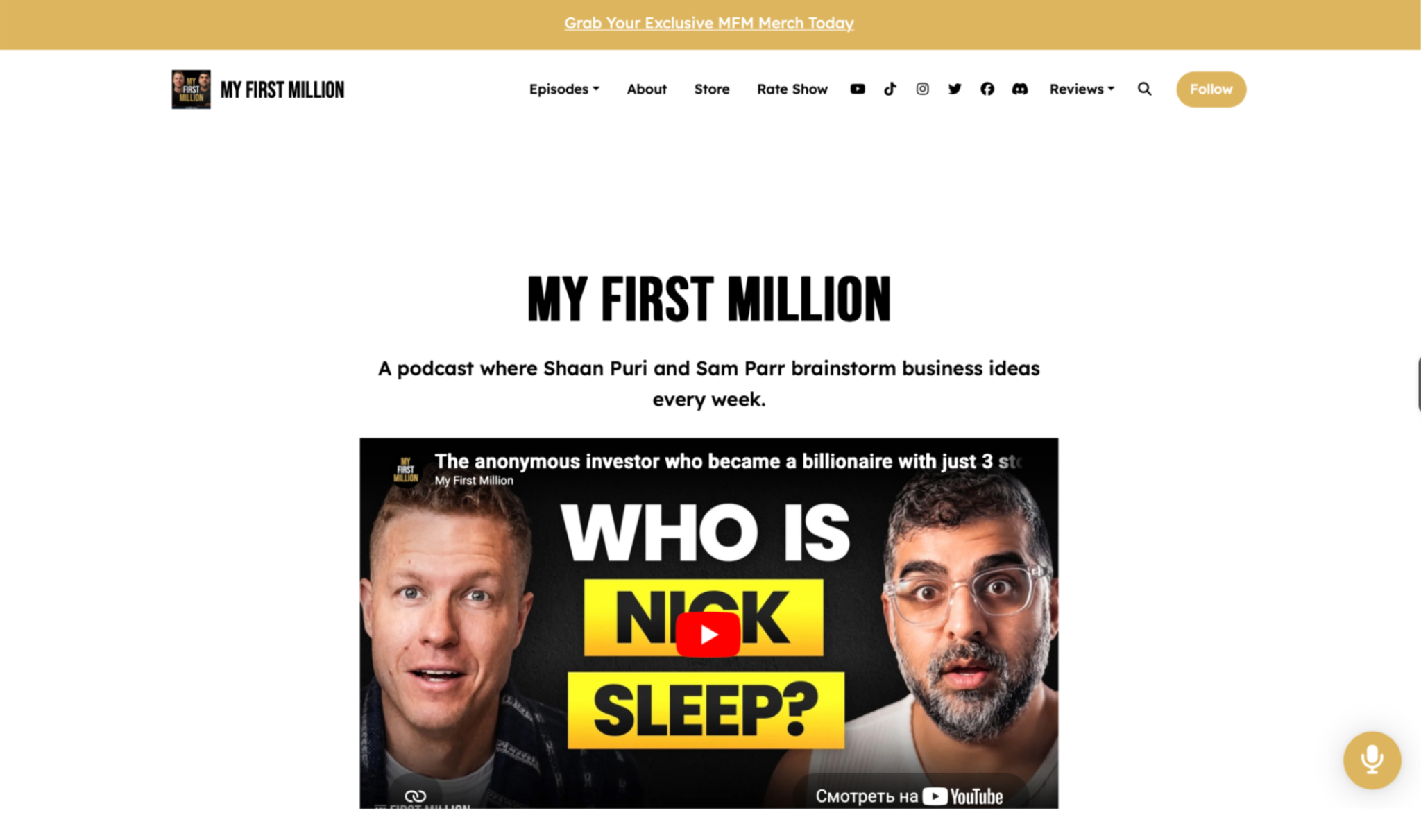
A good podcast landing page usually includes these simple things:
- Headline that tells visitors what the show is about.
- Short paragraphs describing your podcast's mission.
- Recent episodes they can click on.
- Subscribe links to your social media, podcast platforms, and newsletter.
 Source: My First Million
Check out how the My First Million home page looks.
It doesn’t feel overwhelming. And at the same time, it provides all important information for their readers and listeners, including a lead magnet that builds their mailing list.
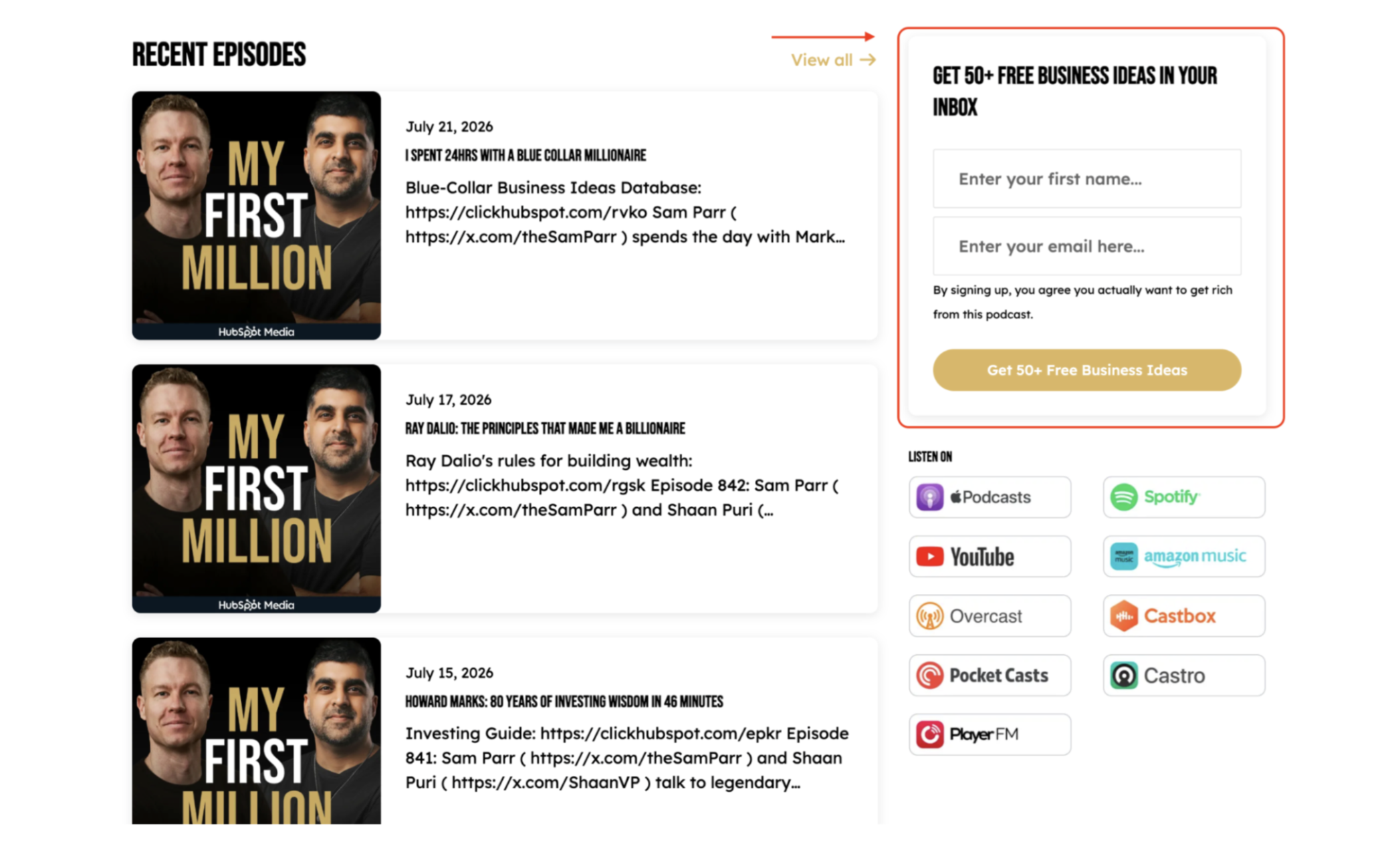 Notice how simple the newsletter signup process is. You only have to enter your name and an email address. Plus, you get a nice bonus of a lead magnet.
Their sign-up form is in a visible spot on the same main page. And it is not pushy at all. The form tells readers exactly what they will get, and it has a clear CTA button. They don’t force users to navigate to another page or type unnecessary information.
So, here is what this example teaches us.
When you add the subscription form to your website, place it where people can easily notice it (e.g., homepage, sitewide banner, footer, header, etc.).
Besides, give people a reason to sign up. You can do that by offering something useful in return, such as:
- Free guide related to your podcast topic
- Topic list of your most popular episodes
- Short PDF with takeaways or recommendations
- Bonus content
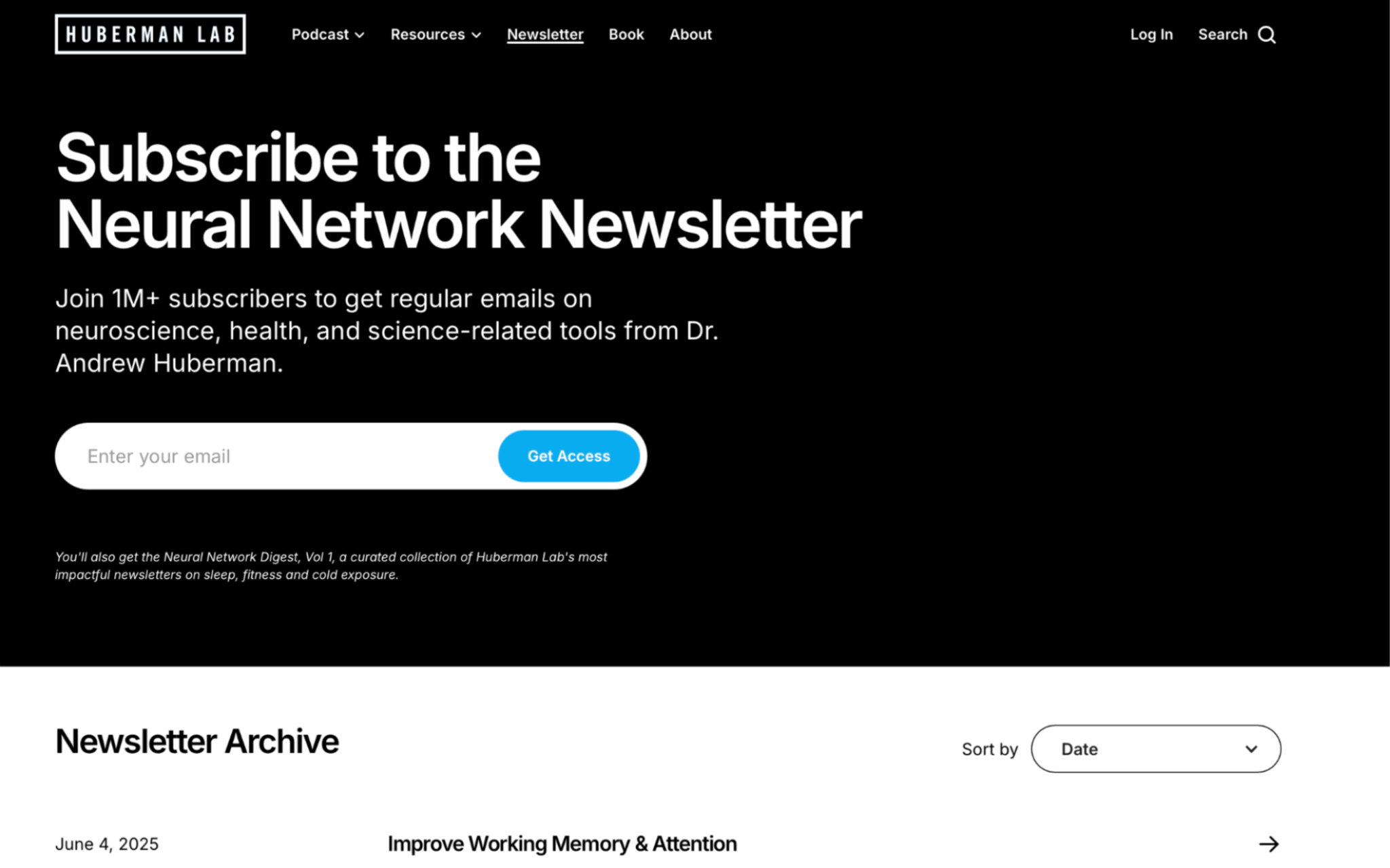
If you feel that adding a sign-up form isn’t working well on your website, try other approaches. For example, create a separate Newsletter page.
Don’t make it just a single form. Add valuable content related to your newsletter, such as a newsletter archive or some highlights.
Take a look at how Huberman Lab does it.
Source: Huberman Lab
As you can tell, there are many ways to do this. Experiment and find what works best for your website.
Keep in mind: the goal here is not just to collect emails. It’s to build a direct line to your audience that you fully control and can reach anytime.
Distribution
Step 4. Write blog posts
Write a blog post for your website every time you publish a new podcast episode.
This opportunity can help your episode stay relevant for a long time.
People are constantly searching online for insights and real examples.
Your episode already has it. So turn it into a written copy.
But don't repeat the episode word for word. It’s not a transcript.It’s an updated version of the same ideas, designed for clarity and search.
Reshape it into something structured and discoverable.
Start by pulling out the main idea of the episode. Then rebuild it in written form.
What usually works best is:
- Identifying the core topic or takeaway
- Extracting key frameworks or insights
- Restructuring them into clear sections
- Adding context so it works without the audio
This blog post can rank on Google and attract new audiences to your podcast.
Besides, some people simply prefer reading a 15-minute blog post instead of listening to a one-hour podcast.
Take a look at how Author Media posts and structures its blog posts. They keep it simple and easy to read.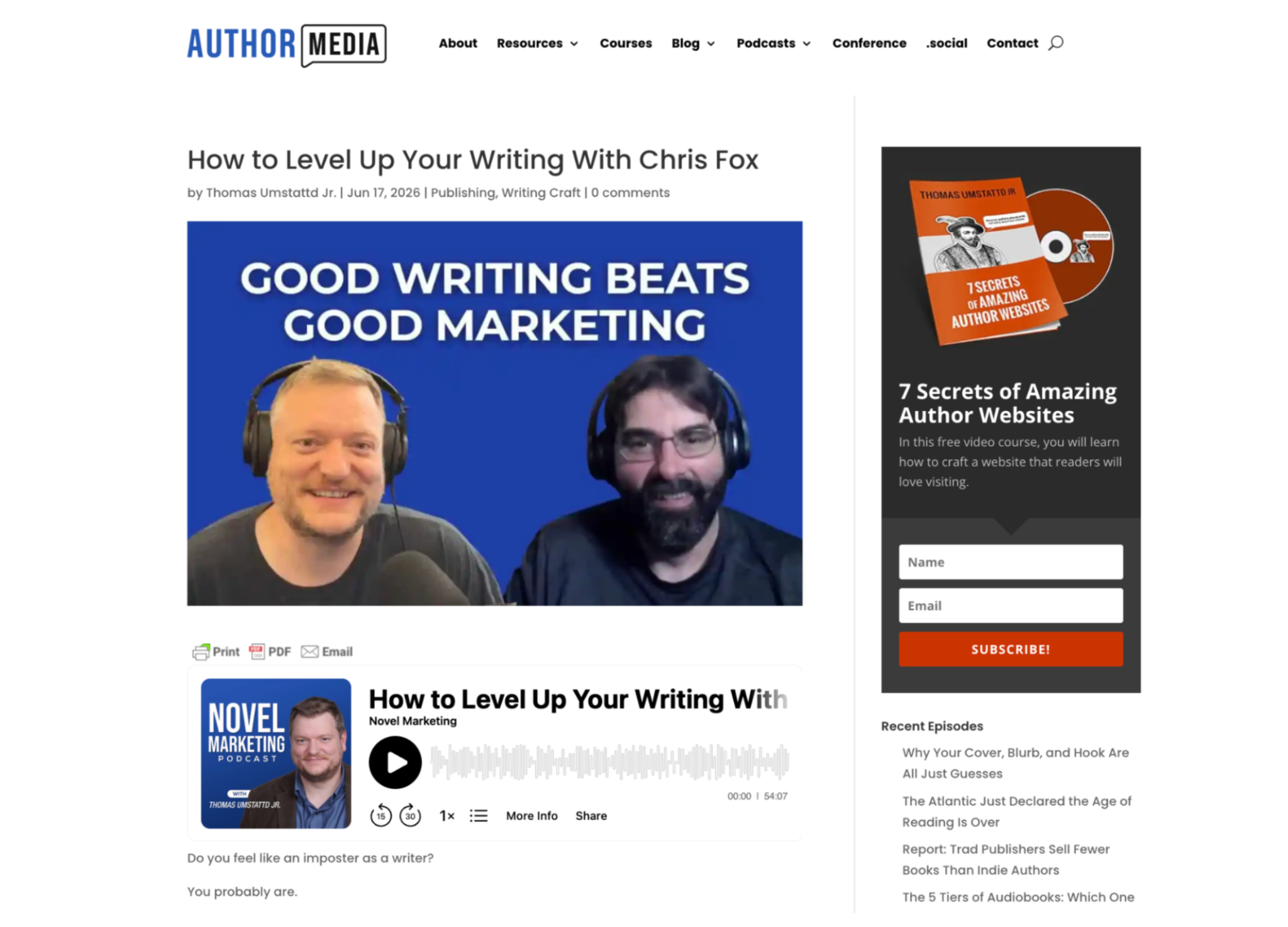
Source: Author Media
They don’t rewrite the entire podcast. Instead, they focus on better structure, readability, and key takeaways.
You can also format the post in a Q&A style when it fits the episode. This works especially well for interviews because it keeps the natural flow of the conversation while still making it easy to read and scan.
Want to create an even stronger blog post page?
Then, you can also try to write new content for your website. Of course, it should still be related to your podcast theme. But you can experiment with fresh ideas and topics you haven’t covered much (or at all) in your episodes.
For example, Tim Ferriss writes blog posts on topics related to his podcast. At the same time, he explores fresh angles and ideas that go beyond what he covers in the episodes.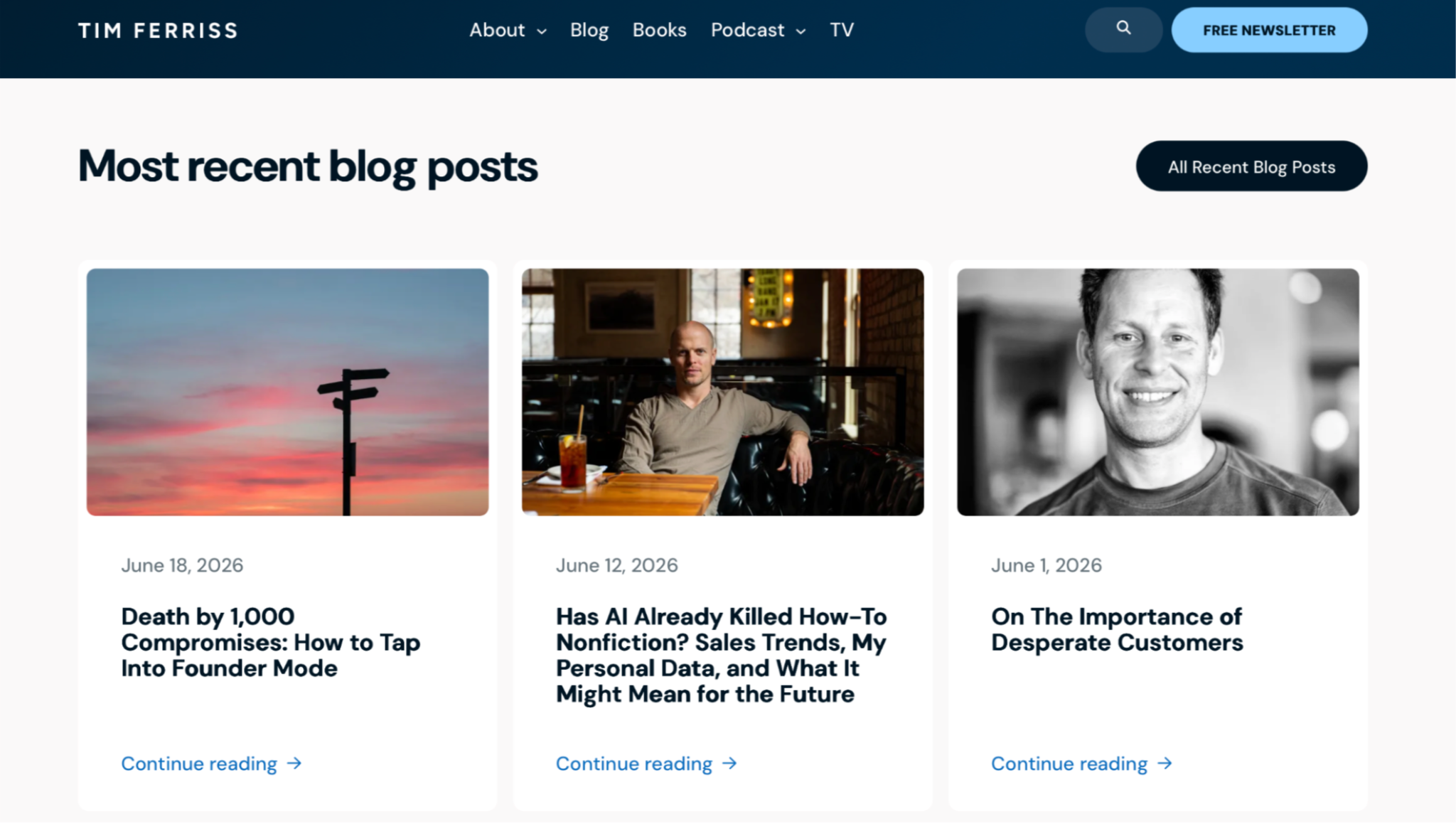
Source: Tim Ferriss
As you can see, there are many ways you can format your blog post. So, try to vary them to better engage your audience.
But no matter the format, each post should still be guided by one main keyword. But avoid randomly stuffing SEO terms into your text. Your keyword should naturally fit in the content and match what people are searching for.
Once you choose a keyword, it should appear naturally in:
- The post's H1 heading
- Some H2, H3, H4 subheadings
- ALT descriptions
- The post's meta description
- Throughout the content
Another important layer is internal linking. Every blog post should connect to:
- Related podcast episodes
- Similar blog posts
- Your main podcast homepage
This makes it easier for readers to follow your content naturally. It also helps search engines better understand the structure.
Over time, this also strengthens your podcast link-building. Each post creates additional pages that can be shared and linked to from other websites.
Step 5. Social media distribution
As we already know, many people discover podcasts through social media. So it’s very important to build a clear social media strategy to promote your podcast and attract new audiences.
Don’t just post links. Focus on creating content that grabs attention.
Here are some tactics to build a great social media strategy:
1. Structure your content with the 40/40/20 approach
This isn’t a must. But it’s a great framework that can help you structure your content calendar more easily:
- About 40% of your content should be related to your podcast. It can be clips or guest insights.
- Another 40% should be your own thoughts and reactions to trends.
- The remaining 20% should show behind-the-scenes moments that make your content more human.
This balance allows you not to overly promote your podcast and be closer to your listeners. At the same time, it keeps your podcast visible.
2. Turn each episode into multiple content formats
A single episode should never result in just one post. Instead, think in formats depending on what works best:
- Audiograms: An audiogram is the perfect format if your podcast is audio. Take 30-60 seconds of high-value or emotional moments. Then turn them into a video optimized for social media like Instagram or Twitter. Check this real example of an audiogram to better understand what it is about:
- Short clips: Short clips are one of the most popular and effective ways to promote your podcast on social media. They are short highlight segments from video podcasts with captions. They perform well on Instagram Reels, TikTok, LinkedIn, and YouTube Shorts. Check out one of the reels:
- Quote posts: Pull strong guest statements and turn them into visual quote cards. These are highly shareable and help extend reach beyond your audience.
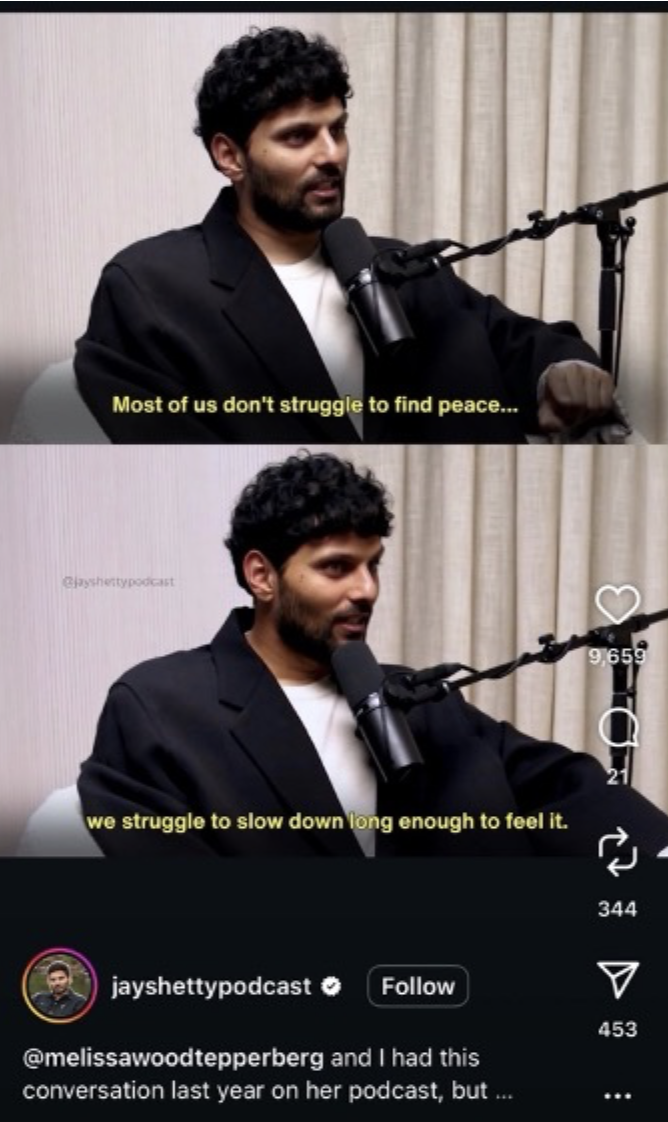
Source: Instagram
3. Match platforms to audience behavior
Different platforms require different communication styles. So, ideally, avoid copying and pasting your content. Make it different or try to adapt to each platform.
Here's what you should know about each one:
- LinkedIn works best for insights and professional lessons. One strong takeaway can already be useful for LinkedIn users.
- X (Twitter) is about discussions. Share your opinion or news to engage people. It’s especially a good place to announce your podcast or share a trailer.
- Instagram is about visual posts. Reels, posts, and highlights can show your personality and add variety to your content.
- TikTok is driven by hooks. The first seconds matter most. Focus on strong statements instead of full explanations.
- YouTube works both as a content platform and a search engine. Of course, you should publish your long-form episodes. But it is also a great platform for Shorts.
4. Run social media giveaways
Giveaways can turn your passive viewers into active participants.
And for that, you don’t need to spend a lot of money on expensive gifts if you don’t have the budget.
Of course, if you want, you can do that. But you can also offer something like:
- Checklist
- Practical resources
- Small reward related to your podcast. For example, merch.
In return, ask your audience to engage in simple ways, such as:
- Sharing the episode
- Tagging someone who should hear it
- Commenting
Don’t ask listeners to take actions that require too much effort. Such as subscribing to all your 100 sponsors or tagging 10 friends. That can frustrate your audience and reduce loyalty.
Step 6. Use your email list
Today, email is still one of the most reliable ways to stay connected with your audience. The best part is that you’re not dependent on algorithms or platform changes. You own it.
And the numbers back it up. Email has the highest ROI of any digital marketing channel. It also has a higher engagement rate than social media, paid ads, or SEO content.
But here's the thing: most podcasters either don't have an email list at all, or they use it only to announce new episodes. Both are missed opportunities.
So, what should you actually do with it?
1. Build an email list from day one
Don't wait until you have a thousand listeners to start capturing emails.
The person who finds you in the first episode and subscribes is worth more to your long-term growth than 10 passive Spotify followers.
2. Send a newsletter, not just an episode announcement
A newsletter is one of the most effective things you can do as part of your email marketing campaign. But most podcasters get this wrong.
Your message doesn't need to say "new episode out now." Nobody opens an email for that. It needs to give your subscriber something they didn't have before:
- A key insight from this week's conversation
- Three resources mentioned in the episode
- Your own take on the topic in two paragraphs
- Context for why this episode matters to them specifically
Something like: "If you've been struggling with X, this conversation with Y will change how you think about it."
That kind of specificity is what turns a reader into a listener.
3. Serve every type of subscriber
Some people will read every email and listen to every episode. Others will read the email and skip the episode entirely. That's fine.
A subscriber who regularly reads your newsletter and trusts your thinking is still a valuable connection. They'll share your work when the right episode finally grabs them.
4. Add links at the end of every email
When you close out your message, make it easy for people to find your content and get in touch. Include your social handles, a subscribe link, and an email address.
To help you get a clear picture of what your emails could look like, check out this example:
Source: Really Good Emails
Growth
Step 7. Podcast link building and outreach
Most podcasters miss one of the biggest growth opportunities. Not because it’s complicated. Just because no one really talks about it.
Links.
Backlinks remain a top-3 Google ranking factor in 2026.
The rule is simple: the more high-quality websites link to your podcast website, the more search engines trust it. And the higher your pages rank.
Beyond that, 73.2% of SEO professionals believe backlinks influence the chance of appearing in AI search results.
So, how do you actually build those links?
1. Start with guest posting
Over 40% of SEO experts say content marketing and guest posting are the top link-building methods.
But how does it work? Essentially, guest posting comes down to:
- Writing and placing your blog posts on a credible website in your niche.
- Including a link to a relevant episode or your podcast homepage.
- And earning your podcast backlinks from a site your ideal listener already reads.


But not all backlinks are the same.
Here’s what a high-quality referring domain actually looks like: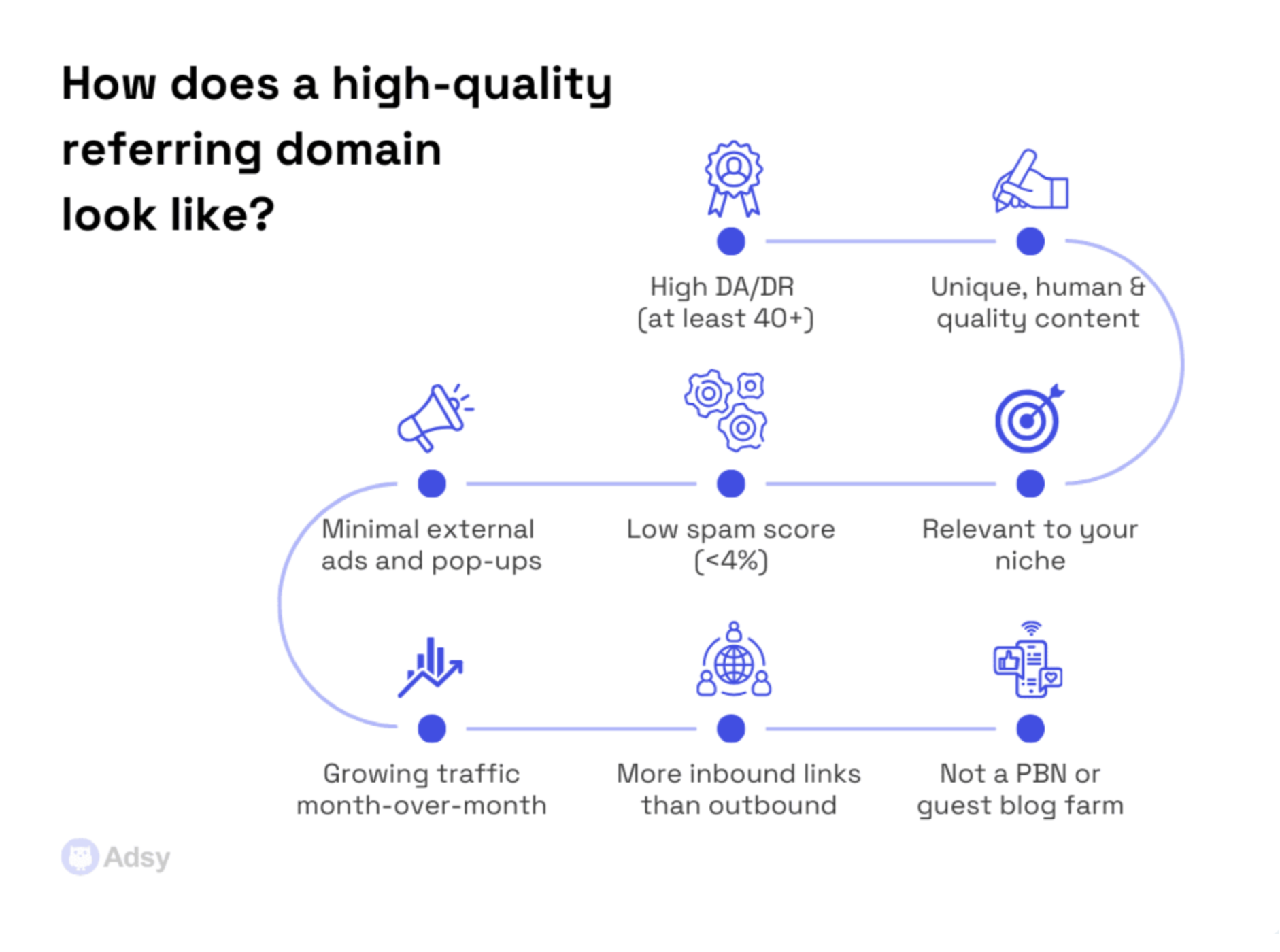
A single link from a relevant, credible website does much more for your authority than dozens of links from spammy blogs.
2. Use podcast guest opportunities to do link exchanges
When you invite someone onto your show, you’re not just creating an episode. You’re also building a connection with someone who already has their own audience and online presence.
Every guest appearance is a chance to earn a podcast backlink.
Most guests will share the episode with their audience and may even link to it from their website or show notes. You can do the same for them in return.
For SEO, it also helps to focus on guests who already have strong websites with good authority before you reach out. You can check their domain rating in tools like Ahrefs or Semrush.
This is like a new way of thinking about discoverability. And it still comes down to the same core idea of traditional SEO: earning links from sources people trust.
Here, for example, Mel Robbins interviewed Steve Bartlett (The Diary of a CEO). And after that podcast, her team created a whole page with featured clips, a transcript, a guest bio, and so on.
But most importantly, they added a number of links to his website, social media, podcast, and even his book.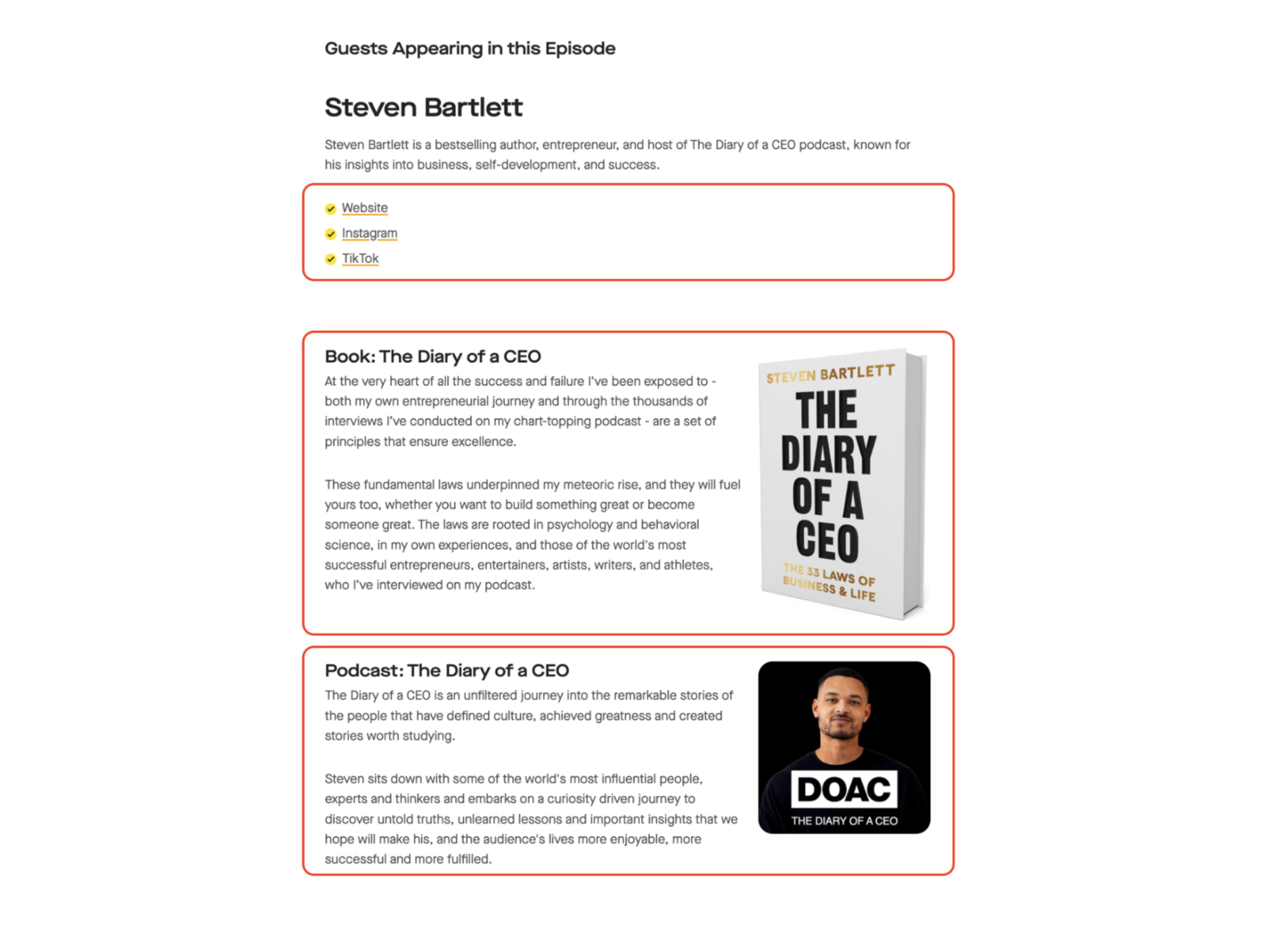
Source: Mel Robbins
Step 8. Get others to talk about you
Have you ever discovered a podcast because a friend sent you an episode with a message like “This one’s for you!”?
That's not marketing.
That's word of mouth.
And it's still the most powerful discovery channel available to any podcaster.
The question is: how do you make it happen on purpose?
The thing is, listeners don't share podcasts randomly. They share them when an episode:
- Solves a specific problem.
- Changes how they think about something.
- Or says out loud what they've been feeling for months.
Your job is to create those moments. And then make sharing as easy as possible.
This strategy works because:
- People trust recommendations from someone they know more than any ad.
- A specific ask outperforms a generic one every time.
- External mentions compound over time into real discoverability.
So instead of saying “please subscribe and leave a review,” try something like: "If this episode helped you think differently about X, send it to someone who's dealing with the same thing."
1. AI visibility
But word of mouth isn't the only way to get people talking about your show.
Help users find you in AI search by improving your AI visibility.
Today, Google shows AI Overviews at the top of most of the search results. It’s basically an AI-generated summary that appears before any regular links. 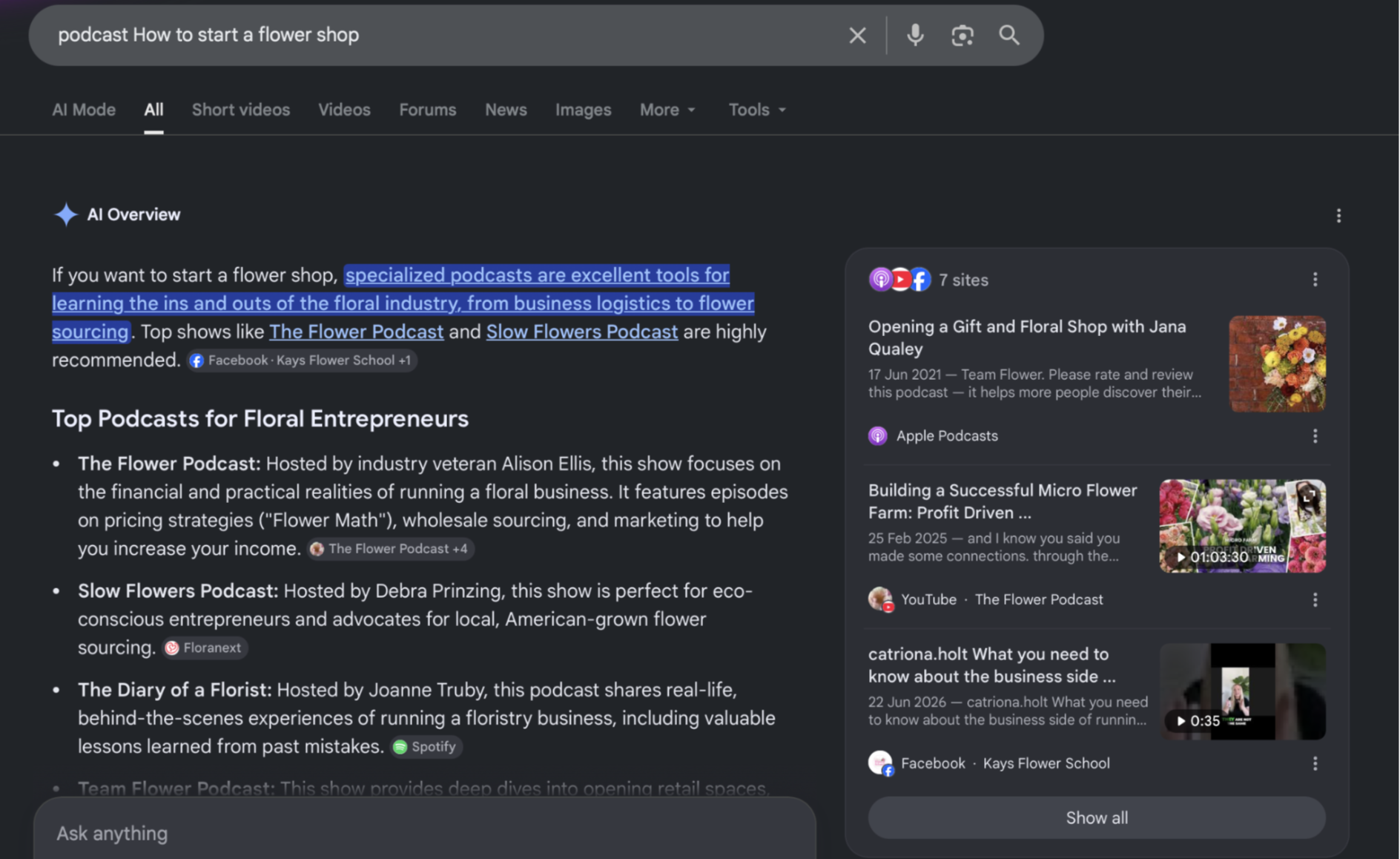
And the way to get into those responses is different from traditional SEO.
It's not only about keywords. It's about being mentioned and referenced by sources Google already trusts.
When multiple credible websites mention your podcast in the context of a topic, Google's AI starts to associate your show with that topic.
And once that association is made, it can surface your brand in AI Overviews every time someone searches for something related to your niche.
So how do you get those mentions? One of the ways is by doing Digital PR.
2. Digital PR
You can work with a PR service to write professional press releases and distribute them through outlets like PRNewswire or EIN Newswire. This way, you’ll get your show in front of journalists, bloggers, and publications that already have Google's trust.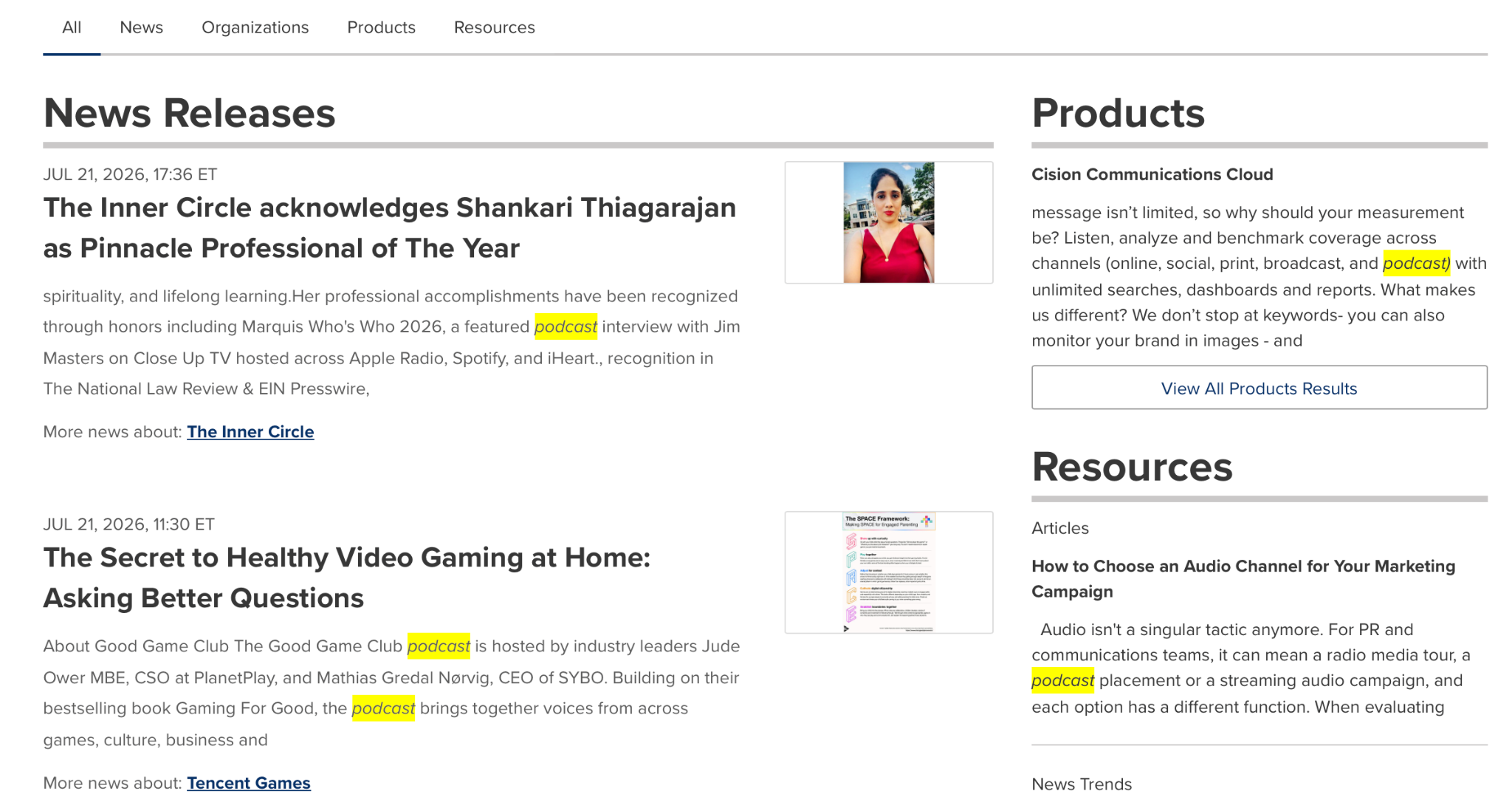
Source: PR Newswire
The more credible places your podcast gets mentioned, the more visible it becomes. In search, in AI results, and in the minds of people who haven't found you yet.
3. Influencer partnerships
Influencer partnerships work the same way.
Find creators and bloggers whose audiences overlap with your ideal listener. But don't ask for a promotional favor. Offer something worth sharing. For example:
- Co-created piece of content
- A feature
- A collaboration that gives their audience real value.
Relationships built on mutual benefit last longer. One genuinely enthusiastic mention from a trusted creator is worth more than a dozen paid placements.
Step 9. Cross-promote
No podcast grows in isolation. The fastest-growing shows have a strong network of relationships with other creators.
But how does this actually work in practice?
Here are the three most effective ways:
1. Ad swaps are the simplest place to start
The idea is simple:
- You record a short, friendly promo for another podcast, and they record one for yours.
- Then, each host plays the promo in an upcoming episode.
As a result, the audience hearing the recommendation is already warm. They trust the host who is introducing you, and some of that trust naturally carries over to your show.
The key here is relevance.
For example, a freelance writing podcast and a creative entrepreneurship show are a natural fit.
A tax law podcast and a parenting show? Not so much.
So, always choose shows that serve similar or complementary audiences.
2. Content collaborations go deeper
By collaborating with other podcasters, you create something valuable together for your audiences. That can include:
- Co-hosting a special episode together.
- Making a shared guide or checklist
This gives listeners a real taste of the other show. It creates genuine curiosity that lasts longer than a one-time recommendation.
3. Guest appearances are your biggest growth opportunity
When you appear as a guest on another show, you step into a room full of people who already trust the host.
One strong appearance can bring in more new listeners than months of social media posting.
To do that successfully, show up prepared, be yourself, and focus on providing value. Let your personality attract your target audience. And the connection you build will do the rest.
Here is, for example, how Mel Robbins showed up on the DOAC podcast, twice actually: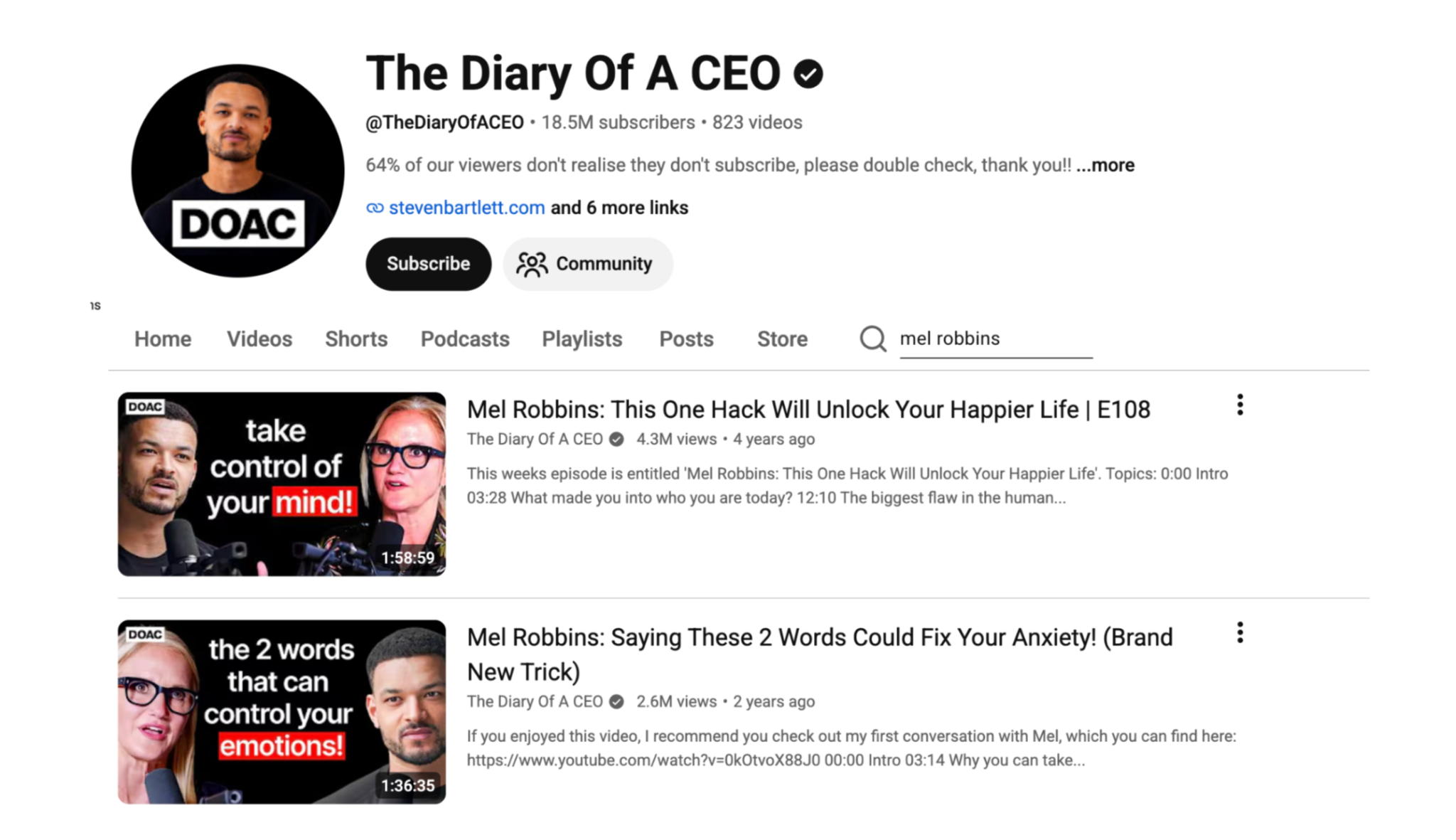
Source: YouTube
And as we’ve already seen above, he became a guest on her podcast as well. As a result, they got to expand and interchange their audiences.
Final words: Put it all together
Here is the most important thing about the nine steps above: they're not meant to be done in isolation. They're designed to work together.
That's what turns it into a system rather than just a collection of tactics:
- SEO without distribution means you're optimizing content that nobody shares.
- Distribution without a website means you're sending people somewhere they can't stay and can't be reached again.
- Word of mouth without an email list means you're losing people the moment they find you.
Each piece depends on the others in ways that aren't always obvious until you see them working in combination.
Here's what the compound effect looks like in practice.
You publish an episode. The title is optimized for search. The show notes live on your website as a proper blog post.
You email your list something worth reading. It’s not just a "new episode" notification. It’s a real insight that came out of the conversation.
Your guest shares the episode and links back to it from their own site.
Over time, that single episode can bring you new listeners every week without requiring any additional effort from you.
Start with whatever feels most urgent or most achievable right now. Get that working.
Your listeners are already out there. They just need to be able to find you.
FAQ
How do I promote my podcast for free?
To promote your podcast for free, follow these steps:
- Focus on organic strategies like optimizing your titles and show notes for SEO.
- Build a simple website.
- Share clips on social media.
- Reach out for guest appearances.
- Do ad swaps with similar shows.
All of these approaches don’t require any budget. You just need consistency and time.
How long does it take to see results from podcast promotion?
Results from podcast promotion usually take a few weeks to a few months.
It depends on how consistent your podcast outreach, guest appearances, and content distribution are.
What is podcast outreach?
Podcast outreach is a process of reaching out to podcast hosts, potential guests, influencers, or industry experts. The goal is collaboration opportunities, such as:
- Get appearances on podcasts
- Content exchanges
- Joint promotions
- Exchanging backlinks
Podcast outreach can significantly help promote your show in your niche over time. It helps you get featured on relevant shows, reach new audiences, and grow visibility in a natural way.
How can I appear as a guest on other podcasts?
Start by finding podcasts that align with your niche.
Then build relationships with podcast hosts. Listen to their shows and send personalized pitches. Show them that you've actually taken the time to understand their content.
Most importantly, explain how your expertise or story can provide value to their audience.
How can I get more guests on my podcast?
To get more guests on your podcast, you should connect with potential guests on social media.
Reach out to them with personalized invitations. Let them know why you think they’d be a great fit for your show. And don’t forget to highlight what they’ll get from being a guest.
It also helps a lot to look professional. The stronger your social media, website, and episode list are, the more likely the guest will agree to participate.
All trademarks, logos, images, and materials are the property of their respective rights holders.
They are used solely for informational, analytical, and review purposes in accordance with applicable copyright law.


 Sign Up
 Sign Up