




How to Write an SEO Friendly Article: A Practical Guide
You’ve finished a blog post, added important statistics and high-value keywords, and checked the grammar. It looks ready to publish. Then you read it again and realize the most useful information doesn’t appear until halfway down the page.
That’s easy to miss when you’re working on an article with an inward-looking mindset, too focused on making it perfect by your own standards.
An SEO friendly article starts with knowing what the reader came for. Everything that you add — your keyword choices, statistics, examples, and writing style — should help you deliver it.
And you don’t have to figure everything out at once.
This guide offers an incremental approach to writing SEO-optimized articles. In eight consecutive steps, we cover everything: from choosing the audience to polishing the finished piece. It also addresses one of the key aspects that everyone wants to understand these days —how to make an article appear in AI search.
What is an SEO friendly article?
An SEO friendly article is one that is optimized to rank high in search engine results. It answers a reader’s question in a way that both people and search engines can understand. Usually, it is characterized by a clear topic, useful and novel information, and a descriptive title.
Sounds easy, doesn’t it? The difficulty is deciding what “useful” means for a particular search.
Take someone searching for how to repot a houseplant. They probably need to know which pot to choose, what soil to use, and whether those roots hanging out of the bottom are a problem. A beautifully written history of indoor gardening won’t help them much.
A useful article would include:
- A direct answer to the main question.
- Enough detail to follow the explanation.
- Examples or evidence where something needs clarification.
- Headings that make specific information easy to find.
An SEO article brings these reader needs together with the language people use to search. Keywords help establish the subject, while the explanation gives someone a reason to keep reading.
Of course, publishing a useful article doesn’t secure a top position. But it gives your page a clear purpose: helping someone with the question that brought them there.
How to write an SEO friendly article in 8 steps
HubSpot’s 2026 State of Marketing report found that 45% of marketers use websites, blogs, and SEO as a marketing channel. If your business is among them, you’ve probably faced a familiar question: how do you turn a promising topic into an article worth publishing?
It helps to make a few decisions before you start writing. Who needs this information? What are they searching for? Which details will they expect you to explain?
The eight steps below take you through those decisions, then into drafting and editing. Each gives you something concrete to work on, so you don’t have to solve every content and SEO question at once.
1. Define your audience and the question your article will answer
Some writers think that their biggest challenge is the fear of a blank sheet of paper. So, if they know a subject well, it’s tempting to choose a topic and start writing while the ideas are coming.
But who’s going to read their finished piece? If the answer is “anyone interested in marketing,” there is probably a critically important aspect that is missing.
An SEO article about newsletters, for example, could help a shop owner send their first email. Or it could help an experienced marketer understand why subscribers have stopped clicking. There’s plenty to say in both cases. Combining them would make a perfect (comprehensive and exhaustive) guide, but given the modern attention span, it would also be a rather confusing read.
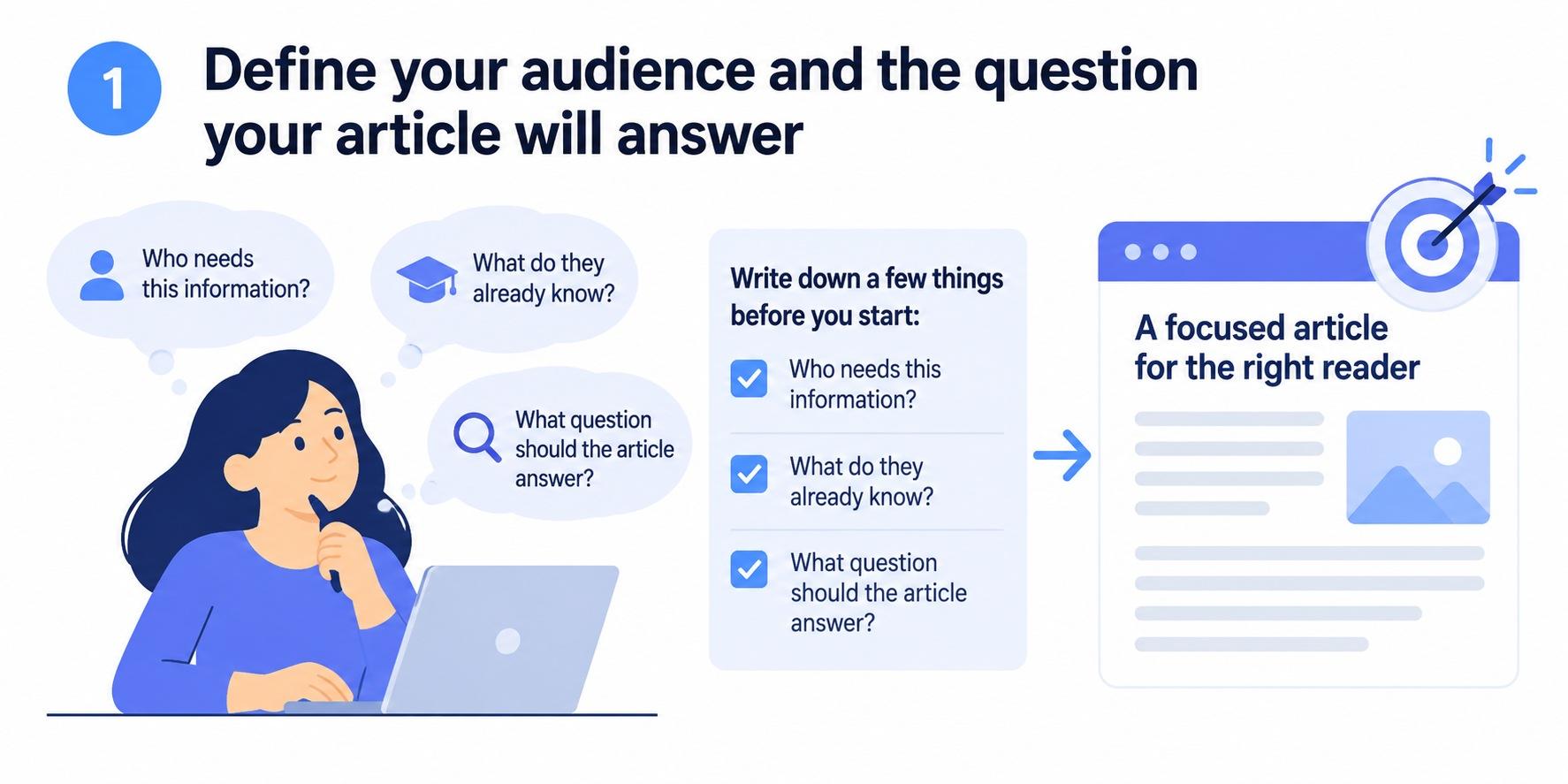
Therefore, before drafting, put a few things on paper:
- Who needs this information?
- What do they already know?
- What question should the article answer?
Keep your notes specific. “A shop owner who has collected customer emails but hasn’t sent anything yet” gives you something useful to work with.
Now you can judge which details belong. That reader may need a sample newsletter and an explanation of consent. Advanced testing methods can wait for other blog posts.
2. Choose a primary keyword and relevant supporting terms
A keyword list can get surprisingly long before you’ve written a single sentence. Depending on what you enjoy doing the most (writing or the technical SEO stuff?), you can end up spending too much time doing keyword research. You start with “welcome email,” find a dozen related phrases, and suddenly feel obliged to cover automation, newsletters, subject lines, and software.
That’s not how you approach writing an SEO friendly article. In SEO, little is often more.
Choose the main phrase first. What would someone search for if they needed exactly the article you’re planning?
For example, if you’re helping a shop owner write their first message to subscribers, “how to write a welcome email” is a reasonable starting point. That becomes your primary keyword.
Now move to the related questions. Keep a small working list:
- Alternative wording: “Writing a welcome email.”
- Examples: “Welcome email examples.”
- A detail worth explaining: “Welcome email subject lines.”
These terms you can disseminate evenly across your draft. Some will fit into headings; others will come up naturally as you explain.
📌 Pro tip: make your every keyword count.Inthe art and science of keyword research, less is often more.There’s no need to squeeze in every variation you find, or stuff your outline with too many keywords and their variations. You don’t need to use the whole phrases either; cut them into meaningful terms and add those to your key chapter and section titles.
3. Check search intent and find gaps in existing content
Before you commit to the keyword, search for it and open a few results. Does the content look anything like the article you had in mind? Sometimes a phrase seems right on paper, but the results suggest that people want something quite different.
“Welcome email examples” is a good illustration. Someone searching for it probably wants actual emails to look at. Explaining the meaning of a welcome email may help a beginner, but it won’t be enough to satisfy that search.
Unfortunately, many of the articles that claim to provide examples, in reality, only contain the term “examples” itself, but no actual examples to look at.
Go on and read a few pages as if you needed their advice. Pay attention to:
- Questions they mention but never properly answer.
- Instructions that assume you already know what to do.
- Examples that recycle someone else’s content, or contain no real examples at all.
Perhaps every article shows attractive emails, yet none explains what a small shop should write when it has no discount to offer.
That’s one promising gap that you can close. You can include an example for that situation without expanding your article into a complete email marketing course.
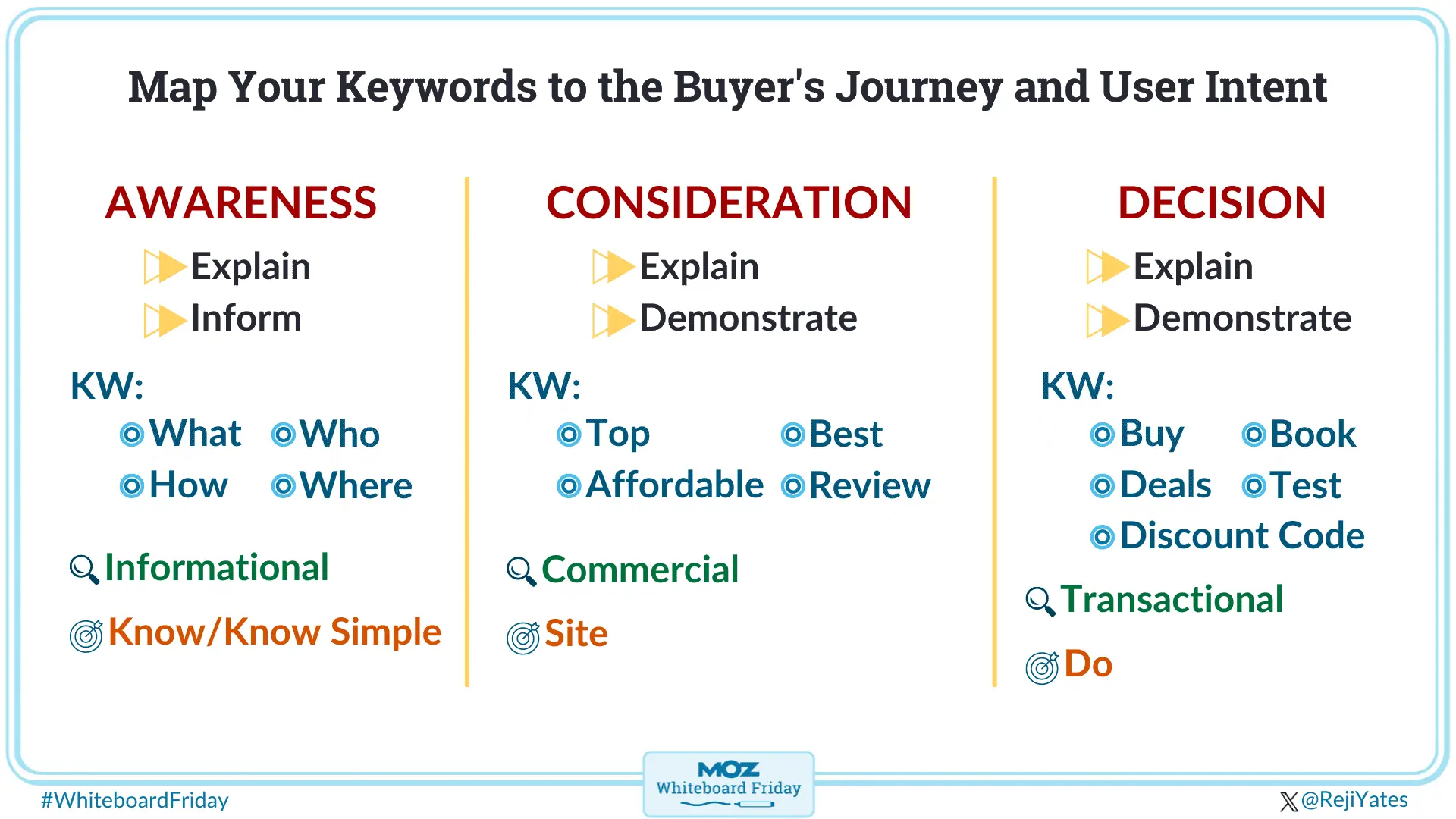
Right after your keyword identification, Moz also recommends mapping your keywords to a particular user intent or a stage in a buyer journey:
Source: Moz
4. Build an outline with clear, descriptive headings
It’s easy to underestimate the outline when you already know what you want to say. A few headings, a conclusion, and you’re ready to write. Outlining seems like a superfluous exercise that reminds you of college essays and the boring routine they were.
So, you skip it. Then, halfway through, you realize that two sections cover almost the same thing and an important explanation has nowhere to go.
That’s why you should give yourself a little more detail to work with. An outline, even a brief one, can be of good help here.
For each heading, jot down what you’ll explain beneath it. A sentence or two in your blog is enough. This will help you spot repetition before you spend time writing it.
Ideally, check these three things:
- Does each heading name a specific subject or question?
- Do the sections follow a sensible order?
- Have you given your main question enough space?
That last point is easy to miss. An article about writing a welcome email could end up with five sections explaining its benefits and only one explaining the writing process.
Therefore, give most of the space to the task promised in your title. Background information can help, but decide how much your reader needs before getting to the instructions. A short explanation may be enough.
And one last piece of advice: don’t bury your key point too deep in the content. If it’s a hypothesis you want to prove, state it clearly in the introduction, then prove it with examples and reiterate the same claim in the conclusion.
5. Write a direct introduction and develop complete answers
Someone opening your welcome-email guide probably doesn’t need convincing that email exists or that businesses use it. Yet it’s easy to spend the introduction explaining things at that level, especially when you’re struggling to get started.
You can begin closer to their problem: they have new subscribers and need to decide what to say first. A few sentences about that situation and what the guide covers will give readers a reason to continue.
Then deliver what you promised.
Advice such as “make your email useful” sounds reasonable, but what should the shop owner actually write? Develop the answer with:
- Information the subscriber needs.
- An example of how to phrase it.
- An explanation of when to adapt that example.
Complete answers don’t always need long explanations. Sometimes one sample sentence does the job. Elsewhere, you may need a paragraph to explain a condition that matters.
📌 Pro tip: During writing, look for places where you’ve told readers to do something without explaining how. Those are often the sections that need another pass.
6. Add original insights, examples, and reliable sources
“Add original insights” can sound like a request to discover something nobody has ever thought of. Today, given the volume of information regularly produced by billions of connected minds and readily made available online, that would be a hard task, indeed.
However, nobody really asks you for such a heroic deed. For a practical article, the contribution can be much smaller. You might explain a detail that other writers skip because they assume everyone understands it.
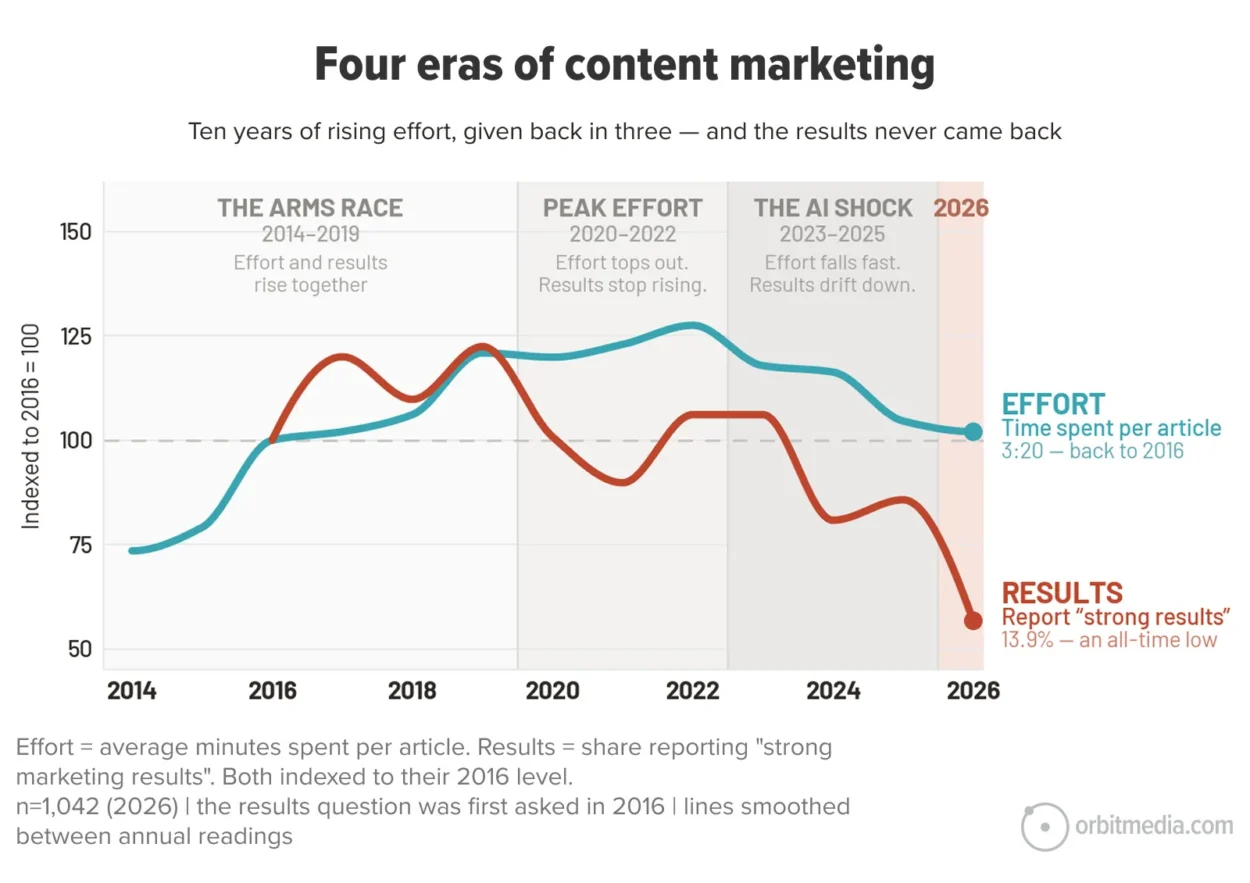
Even if you do a little, you’d already be ahead of the competition. Data shows that for the past three years, since AI has made content creation super easy and effortless, the effort spent on average content creation has dropped dramatically:
Source: Orbitmedia
This shows immense opportunities for those who care and are willing to go the extra mile with their article research and writing.
For instance, you can take screenshots. Showing the finished email is helpful, but pointing out why the sender’s name matters gives the reader something else to consider. That explanation is your contribution. Plus, screenshots are almost always unique.
Then, depending on the subject, you could add:
- A screenshot from a task you’ve completed.
- A customer question and the explanation it needed.
- An explanation of a problem that a practitioner regularly encounters.
- A demonstration of one of your tips with a before-and-after example.
You can easily get carried away and try to include all five in your article or page. But there is no need to. You are not required to do so. In fact, that would make for a serious informational overload.
Social media and other technologies have dramatically reduced the volume of information that an average person can digest in a given time frame.
📌 Pro tip: Choose the material that helps you explain your subject. And give borrowed evidence a proper check. Follow the link, read past the summary, and look at who or what was studied. You may find that a widely repeated claim rests on a narrow example. In that case, qualify the claim—or leave it out.
7. Use keywords naturally and connect relevant pages with links
With a decent draft in front of you, where you’ve researched the reader’s intent, made a relevant outline, and compiled an interesting read with unique angles and facts, it’s time to return to the keyword list.
The good part is that some phrases will already be there because you’ve been writing about the subject. Others may be missing, and this is where you’ll need to work a bit harder.
The key is not to overdo (overstuff) the piece with too many keywords.
Add only what makes sense and creates SEO value. Ask yourself: can I add this phrase without ruining the sentence’s logic? Will it continue to describe what you’re actually explaining? If yes, use it. But if you have to build a whole paragraph around it, reconsider whether it belongs.
An optimized article should only increase its value, not lose it due to complex paragraphs and sentences stuffed with long-tail keywords.
Links must be treated with genuine care too. Your welcome-email guide might mention subjects you’ve covered elsewhere, such as creating a database of email dissemination recipients, choosing an email marketing platform, or measuring engagement after a major PR campaign.
Link to those pages where the subject comes up. The reader can then explore the details without you repeating another article inside this one.
📌 Pro tip: Your anchor text should help readers see what they can expect when they click on the link. “Examples of outreach pitches” will give readers a clearer idea of what they’ll find than “click here” or “learn more.”
8. Refine your title, meta description, URL, and images
By this point, you might be tired of looking at your article. That’s totally understandable, as no work, no matter how engaging and inspiring it may be, tends to get tedious if done regularly.
That’s why professional writers advise you to take breaks. Pause for a day or two, then come back to your creation. You’ll be surprised how much more energy and enthusiasm you have this time to finish your piece and make it perfect.
Suddenly, you’ll begin noticing obvious errors and gaps that your busy eye overlooked before. The path to compilation would also become much clearer.
It’s the best time to refine the key elements: your title, meta description, images, and the URL.
Here is what you can do to these elements to make them perfect:
- Ensure your meta description summarizes the actual content. Avoid promises such as “everything you’ll ever need.”
- Check that your page’s URL is readable and doesn’t skip keywords or contain unnecessary ones or numbers.
- Resize and compress images, keeping any text inside them readable.
- Add descriptive alt text to your images, placing the main keyword here and there, but not in every image description (as that would trigger Google’s suspicion).
📌 Pro tip: Read the title and meta description together. If both say almost exactly the same thing, use the description to add a useful detail about what’s inside.
How to make your article easier to understand and cite in AI search
For an average writer, AI search is more like a new terra incognita, i.e., something they don’t know how to approach or how to optimize for. It often seems like an additional layer of optimization on top of conventional SEO.
In reality, GEO (generative engine optimization) and AEO (answer engine optimization) don’t require additional sophisticated optimization, as they perfectly coexist with SEO and introduce only a few new things to consider.
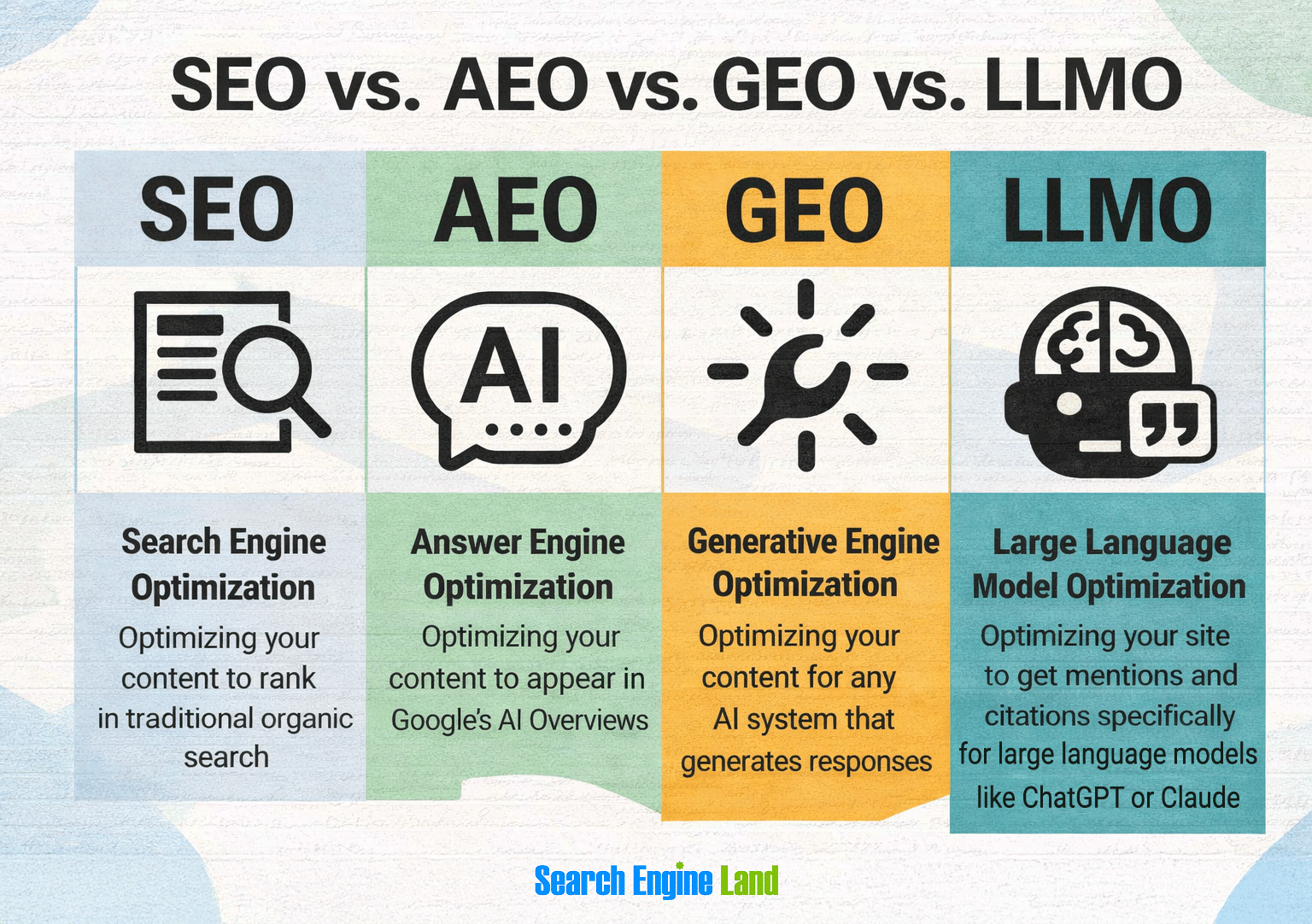
Source: Searchengineland
Their overlapping goal is to make information discoverable and useful in answer-based search experiences. But an SEO friendly article still needs the research, relevance, and clear explanations covered earlier.
What changes with GEO and AEO is the context in which those explanations may appear. These tips will help you account for that.
Write passages that make sense on their own
When writing an SEO article, you naturally assume that the reader remembers what you explained a few paragraphs earlier. After all, you’ve already introduced the subject. Why repeat yourself?
But a passage taken out of that article may lose an important part of its meaning. Phrases like “this approach” or “the second option” become difficult to understand when the explanation they refer to is somewhere else.
Take a simple recommendation: “Send it immediately after confirmation.” Within your article, the instructions might be perfectly clear. On its own, it leaves the reader guessing what to send and what has been confirmed.
“Send the welcome email after the subscriber confirms their email address” provides the missing context.
When reviewing your draft, pay attention to:
- Instructions that don’t name the task or subject.
- Comparisons that leave the reader guessing what is being compared.
- Advice separated from the conditions that make it applicable.
There’s no need to repeat whole explanations in every paragraph. Usually, naming the subject and adding a relevant condition will be enough.
💡 Pro tip: Copy one of your answers into a blank document. If you need to paste another paragraph above it to explain what you mean, revise the answer so it can stand on its own.
Identify people, products, and organizations clearly
Generative engines like ChatGPT, Gemini, and Claude understand the web through entity information. Entities in GEO comprise people's names (e.g., founders), organizations, brands, products, places, locations, concepts, and terms.
When your page mentions and defines relevant entities clearly, AI search bots will be able to scan your content, connect the dots, and understand the relationships between entities.
It’s important that you give relevant names in the introduction you would have appreciated. Who is the person you’re quoting? What does the organization do? Is the name in your comparison a company, a product, or a particular subscription plan?
For optimized content, those distinctions make all the difference. A feature available on one plan shouldn’t sound as though it comes with every version of the product.
Usually, a few words can perfectly describe an entity. Introduce the name properly on its first appearance, then use a shorter form (or an abbreviation) where the reference remains clear.
Keep evidence close to the claims it supports
“Research shows” sounds reassuring, but it won’t impress or convince a hard-nosed reader. These days, readers want proof backed up by authoritative sources. Empty claims won’t cut it.
For instance, you support your arguments by saying that some research was conducted. Which research? What did it measure? And where can the reader check it?
In your writing, you may say that one welcome email received more clicks than another. Then you discuss subject lines, images, and discounts before finally linking to the test. Does the test support all those recommendations, or just the comparison?
In an SEO friendly article, keep that connection easy to follow:
- Place the source beside the statement it supports.
- Include any condition that changes how the result should be understood.
- Separate the reported finding from your own explanation.
This also means that your own research must be backed up by hard evidence. If you make a screenshot of marketing campaign results, you’ll also need to add a caption to explain what exactly was measured. Otherwise, readers can see the numbers and get confused or misunderstand what they mean.
Understand why clear formatting cannot guarantee AI citations
As a writer, you can make your material easier to understand and verify. You can clarify all entities, edit and optimize headings, and position hard evidence beside your claims.
But you still cannot decide which sources an AI service will use. This is not the decision you make.
That doesn’t make the editing wasted effort. Readers still benefit from clear explanations, whether they arrive through a citation, a link, or a search result.
The fact that a well-presented answer isn’t necessarily the answer selected makes many writers mad and frustrated. Some even stop trying.
However, without creating and publishing content, your pages will never get into search results, not AI-generated answers. Perseverance is what makes all the difference and eventually separates successful writers from the rest.
Conclusion
Let’s go back to the shop owner who opened your article because they didn’t know what to write in a welcome email. Can you be certain that after reading it, they can put together their first message? Or do they simply have a better understanding of why welcome emails matter?
That’s the most important, practical question to ask before publishing any SEO article. You may have researched and covered the subject accurately and included every keyword, spicing the final version with clear and relevant evidence, yet left the reader unsure what to do next.
Understanding doesn’t equal action.
An SEO friendly article should help the reader move from understanding to action. Ideally, without hesitation. Sometimes the missing piece is a sample sentence, an explanation beside a screenshot, or a condition you forgot to mention.
Read your draft once more with their task in mind. Where would they still need help?
FAQ
How long should an SEO friendly article be?
Give the question enough space to answer it properly. A simple explanation may need only a few paragraphs, while a detailed tutorial needs more. If extra sections repeat earlier advice, they probably aren’t helping.
How many keywords should an article target?
There is no recommended number of keywords for an article. It depends on the article’s length and on what your article covers. Also, the quality is more important than the quantity here. So, begin with one primary keyword and its closely related terms. Start with one primary keyword and a few closely related terms. You don’t need a separate section for every variation, especially when several phrases mean the same thing.
Can AI help write an SEO friendly article?
Yes. AI chatbots like Gemini, Claude, and ChatGPT are great at helping write SEO-optimized articles. However, you should not trust them to do all of your writing work from A to Z. Better use them as assistants, e.g., to generate topic ideas, find relevant keywords, draft outlines and meta descriptions, or suggest improved flow and grammar. But without a unique human contribution (e.g., personal experience, style, humor, etc.), the article will never rank high in search.
How long does it take an article to rank?
An SEO-friendly article may show up at the top of the search results within weeks or even days. However, it’s not guaranteed. If the topic is trending and there is an objective interest in what the article lays out, it will rank high. Also, your website’s condition (authority, publishing cadence, etc.) plays a key part. At the same time, highly competitive topics can take months or longer to rank.
How often should you update an article?
Updated material tends to rank higher; that’s true. However, updating should have a reason, e.g., when something important changes (a product feature, a price, a source, or the advice itself), or when the market conditions demand a new focus/angle. For technical articles, you may consider reviewing and updating their content more often, but for evergreen content, there is no need to change stats or claims every month.
All trademarks, logos, images, and materials are the property of their respective rights holders.
They are used solely for informational, analytical, and review purposes in accordance with applicable copyright law.



 Sign Up
 Sign Up