




SEO Outreach: 16,168 Emails, 2,536 Replies & 792 Backlinks Analyzed
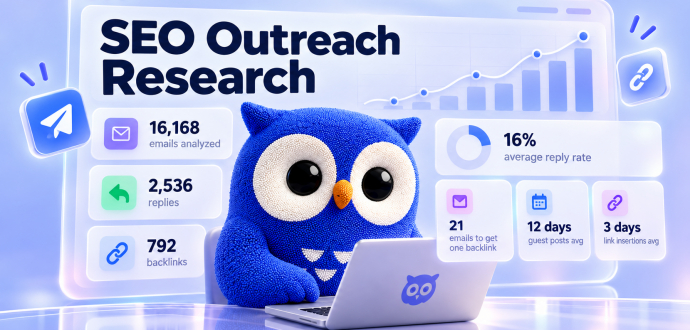
Based on 16,168 real backlink outreach emails sent by our in-house team, we analyzed reply rates, backlink conversion rates, follow-ups, and the most common reasons why outreach succeeds or fails.
And we put all those findings together into the Adsy SEO Outreach Report 2026.
This study is for anyone who wants to know:
- What it really takes to get a backlink, from the number of emails to the time required,
- Which websites are more likely to respond,
- The difference between emails that get replies and those that get ignored,
- What helps turn positive replies into actual backlinks,
- And how to build an effective SEO outreach strategy based on real data.
Key takeaways
 What it takes to get one backlink with SEO outreach:
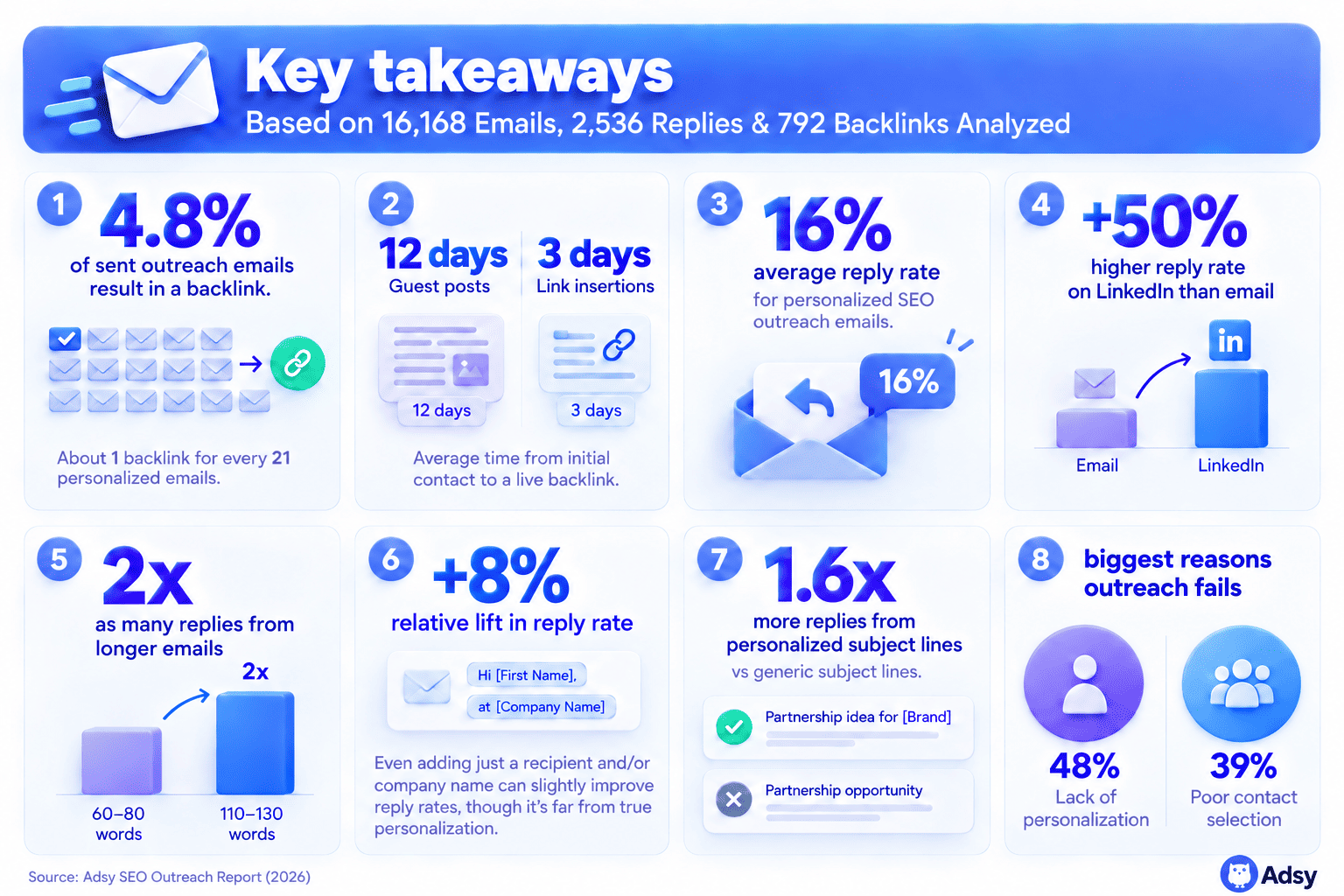
- To get one backlink, on average, you need to send 21 personalized outreach emails. This means that only 4.8% of sent emails result in a backlink.
- On average, guest post backlinks take 12 days to go live, while link insertions take just 3 days.
Reply rates:
- The average reply rate for personalized outreach emails is 16%.
- There is almost no difference in reply rates between websites with 5,000 and 99,999 organic traffic.
- On average, LinkedIn has a 50% higher reply rate than email.
Subject lines & email body:
- Longer emails (110-130 words) get 2x as many replies as shorter emails (60-80 words).
- Personalizing cold emails with only the company and/or recipient name improves reply rate by 8% (relative lift) compared to no personalization at all.
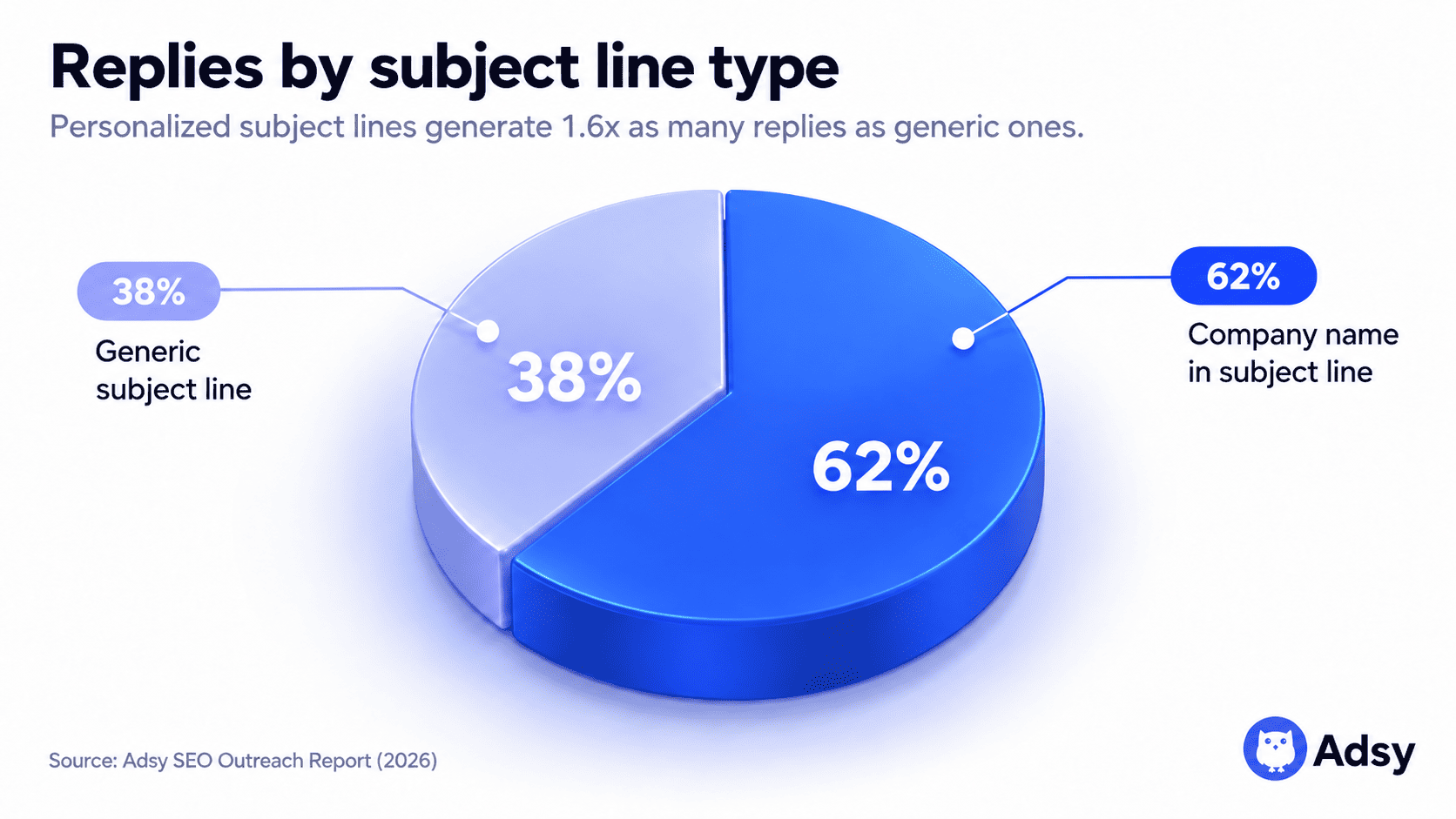
- Personalized subject lines generate 1.6x as many replies as generic ones.
What makes outreach succeed or fail:
- Lack of personalization (48%) and poor contact selection (39%) are the biggest reasons link outreach fails.
- Things that help turn replies into backlinks: Showing SEO results from previous guest posts (2.7x higher chances), highlighting previous publications on well-known websites (2.3x), and offering high-quality, AI-free content (1.9x).
Data & methodology
Data source: Internal SEO outreach team at Adsy.
Timeframe: January 2026 - September 2026.
Eligibility: We only analyzed direct SEO outreach campaigns. This excludes backlinks earned organically or through digital PR, partnerships, sponsorships, and other marketing activities.
Limitations and scope: Our campaigns primarily targeted websites in SEO, marketing, tech, SaaS, business, and related niches. The findings are based on personalized outreach, not mass cold emails. We also excluded many potential websites because they didn’t meet our SEO quality requirements. So, results may vary depending on your niche, target websites, and outreach approach.
What it takes to get one backlink: Our SEO outreach funnel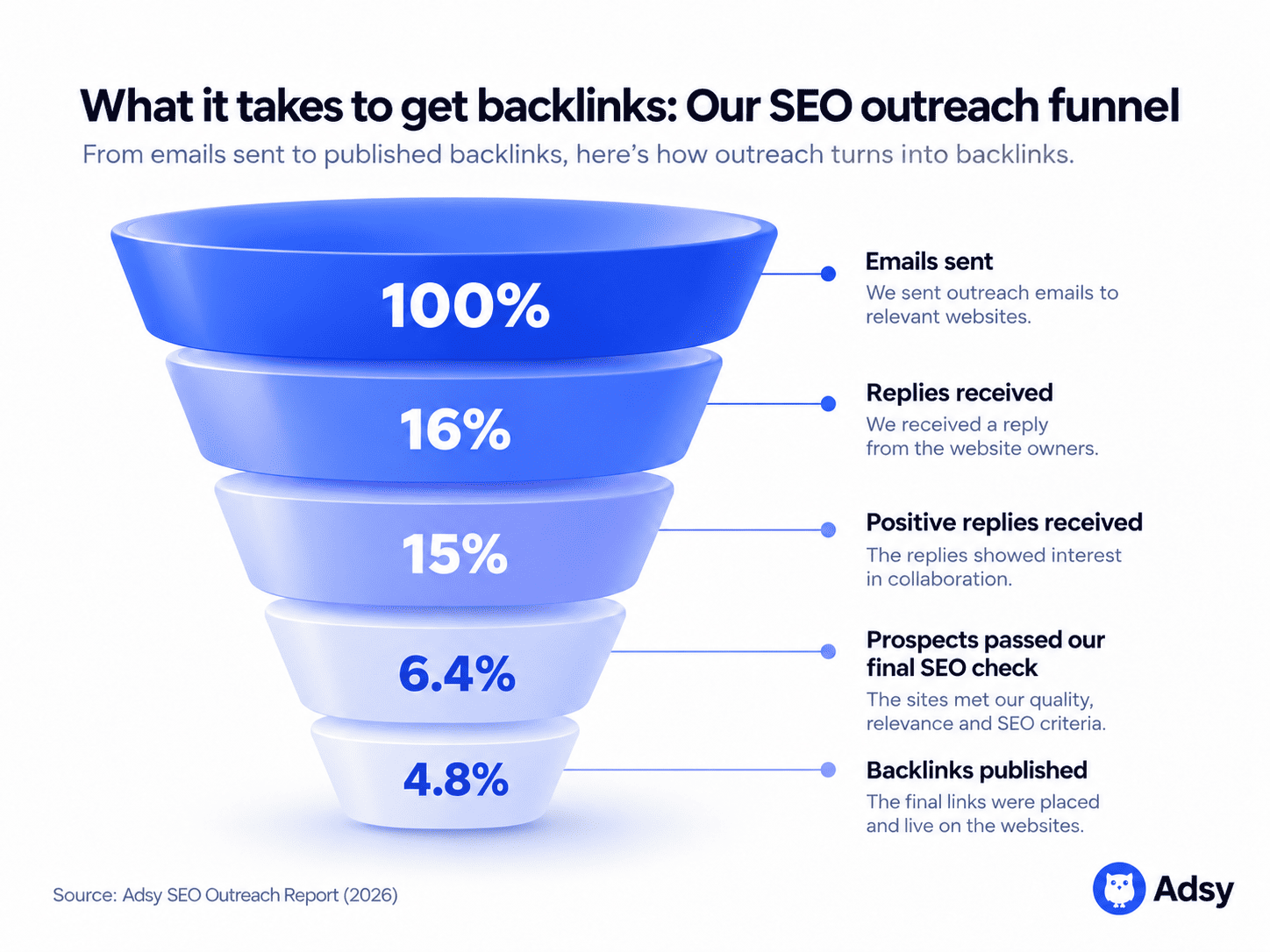
Here is what our average outreach funnel looks like:
Emails sent (100%) → Replies received (16%) → Positive replies received (15%)→ Prospects passed our final SEO check (6.4%) → Backlinks published (4.8%)
When it comes to backlink outreach, many people wonder how much time they’ll spend and how many emails they’ll need to send. Here is what we found out.
Time required:
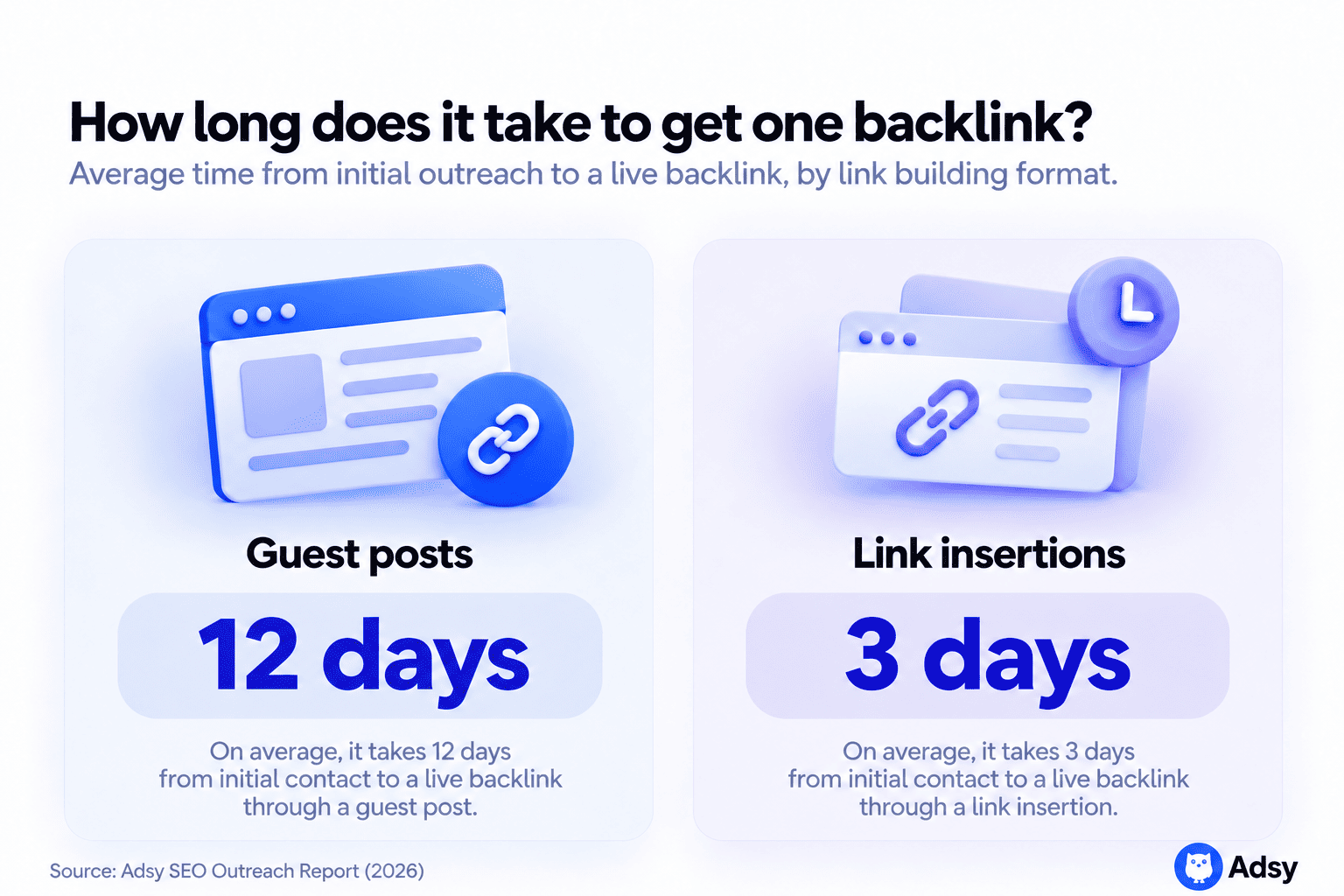
- For guest posts, it takes an average of 12 days to get a backlink published, from initial contact to the live link.
- When it comes to link insertions, it takes 3 days on average to get a live backlink.
Overall, the better the website, the longer it takes because these websites usually have higher editorial requirements. So, topic selection, guest post writing, and editing often take more time.
But an average is still an average.
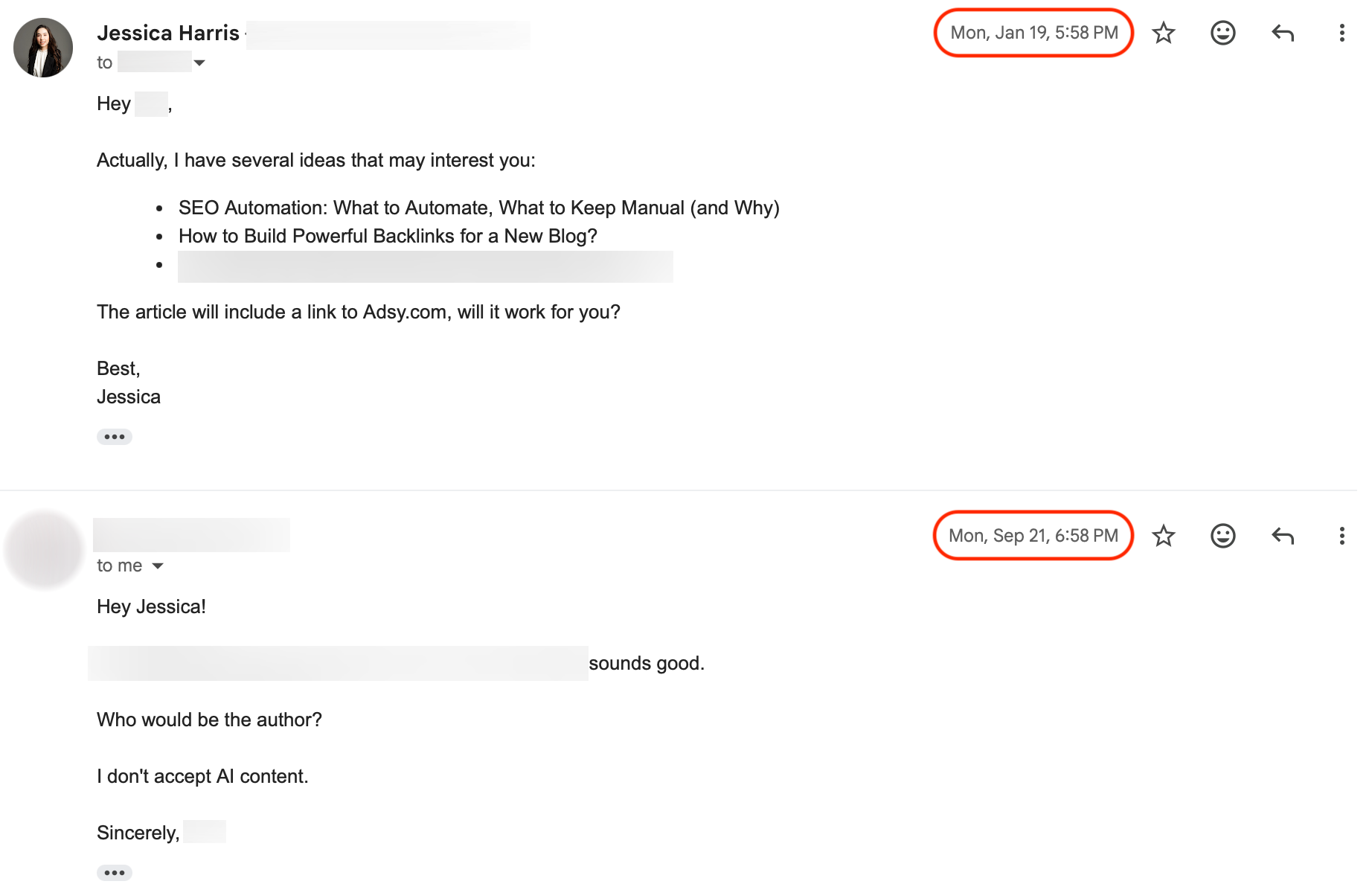
Some backlinks can go live within a few days, especially when it’s a link insertion. But others can take weeks or even months after you first send the email.
There was a case when we reached out to a prospect in January 2026 and got a reply 9 months later in September 2026.
Jessica Harris, Partnerships Manager at Adsy.
Emails required:
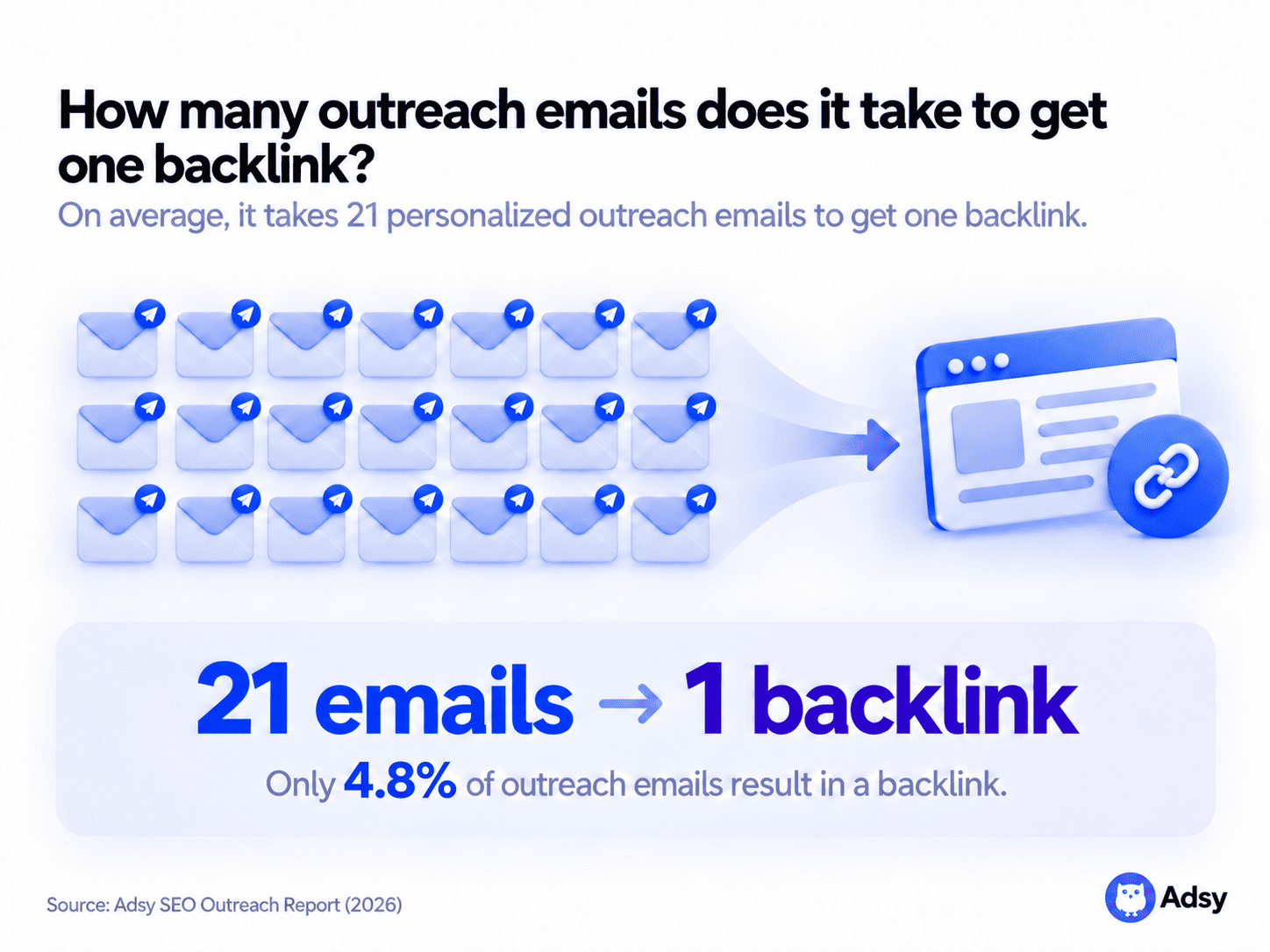
To get one backlink, on average, you need to send 21 personalized outreach emails.
So, only 4.8% of sent emails result in a backlink.
Reply rates
The first step in every outreach funnel is getting a response. So, naturally, reply rate was one of the first metrics we looked at.
Based on our data, on average:
- 16% of the personalized emails receive a reply.
- Of all emails sent, 15% are positive replies.
As you can see, there isn’t a big gap between positive and negative replies. Only 1% of emails receive a negative reply.
The reason is pretty obvious: the majority of prospects who aren’t interested simply ignore the emails.
Email vs. LinkedIn
General outreach works well, but email is not the only channel you can use.
LinkedIn can also show strong reply rates. Based on our data, LinkedIn gets 50% more replies than email:
- LinkedIn reply rate: 24%
- Email reply rate: 16%
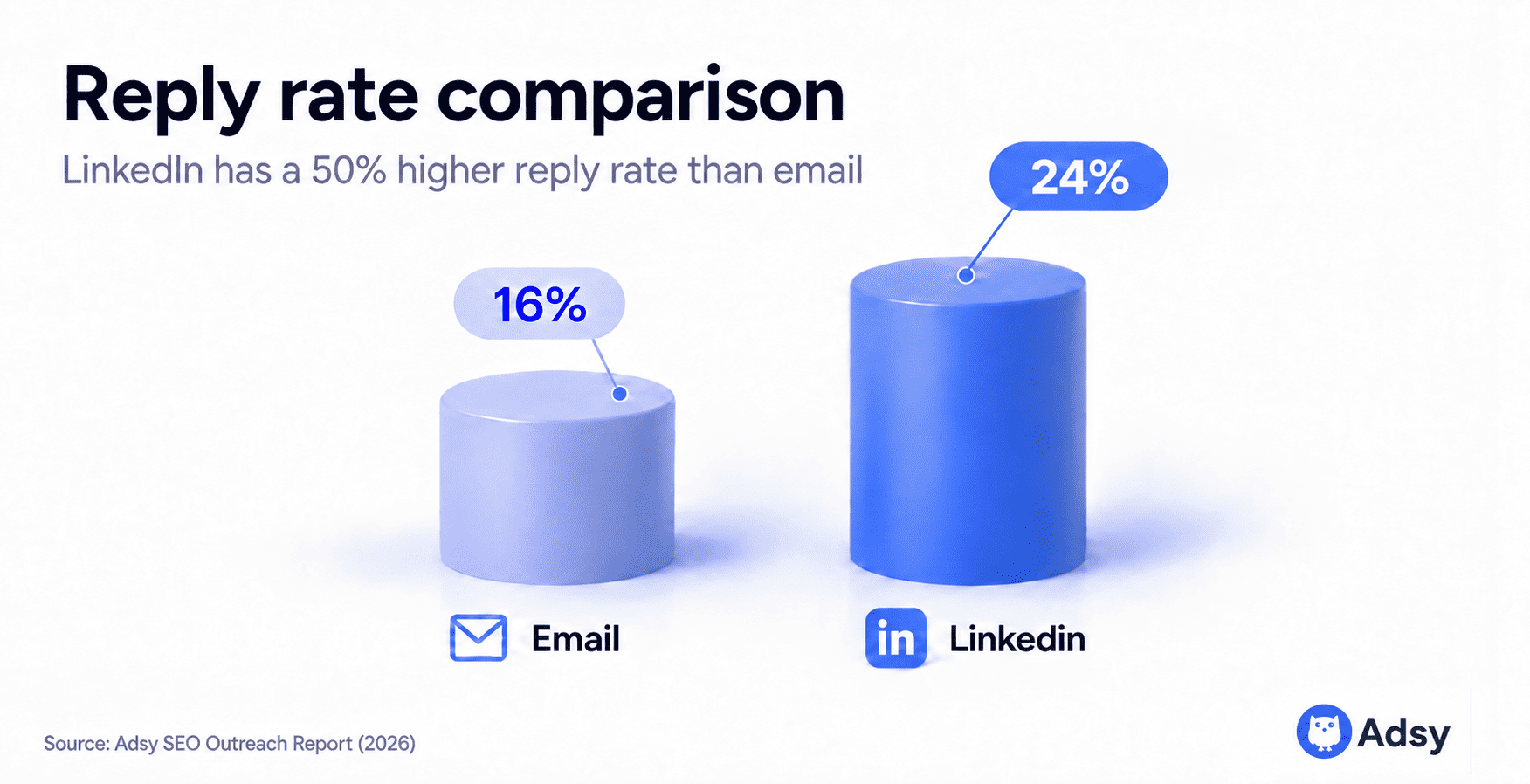
As you can see, LinkedIn can potentially have a higher reply rate than email. But usually, it’s only because it’s more personal and targeted.
With email outreach, you can contact company-wide accounts, like @info or @support. Yet, with LinkedIn, you typically reach specific people, and the entire message feels more relevant.
But even despite this reply rate difference, email is still our primary outreach channel because it allows us to reach far more prospects.
Follow-up effectiveness
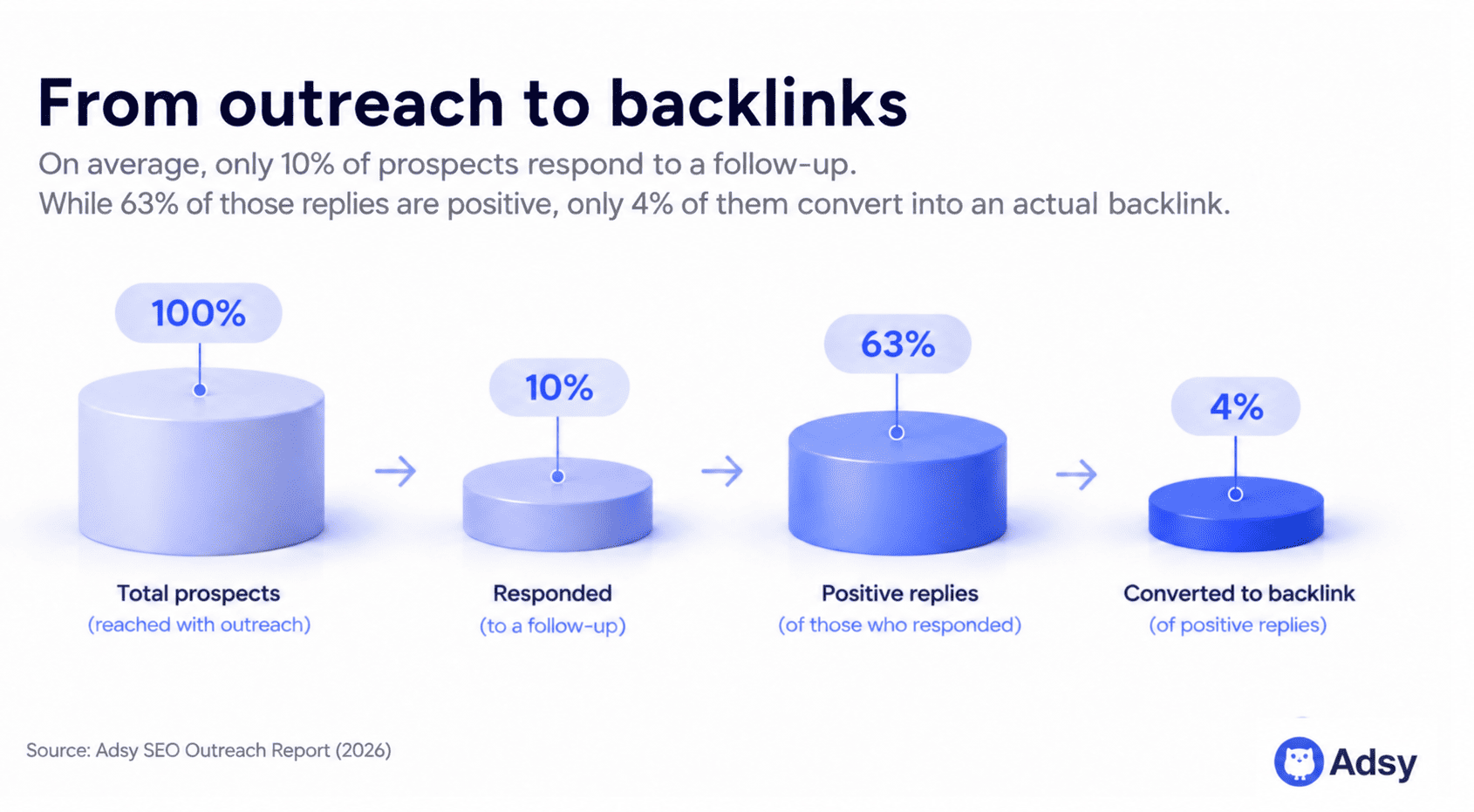
On average, only 10% of prospects respond to a follow-up.
But while 63% of those replies are positive, on average, only 4% of them convert into an actual backlink.
Which websites are more likely to respond to outreach?
Getting a reply or backlink doesn’t depend only on how well you write your email. The website you target can also make a big difference.
To understand which factors have the strongest impact on outreach results, we analyzed our campaigns based on three key website characteristics:
- Domain Rating (DR)
- Organic traffic
- Competitor backlinks (whether websites that already link to our competitors are more likely to respond and link to us as well)
Here’s what the data showed.
DR:
Here’s how the average reply rate changes depending on the target website’s DR:
- DR <40: 17.15% reply rate
- DR 40-69: 16.2% reply rate
- DR 70-89: 14.2% reply rate
- DR 90+: 7.0% reply rate
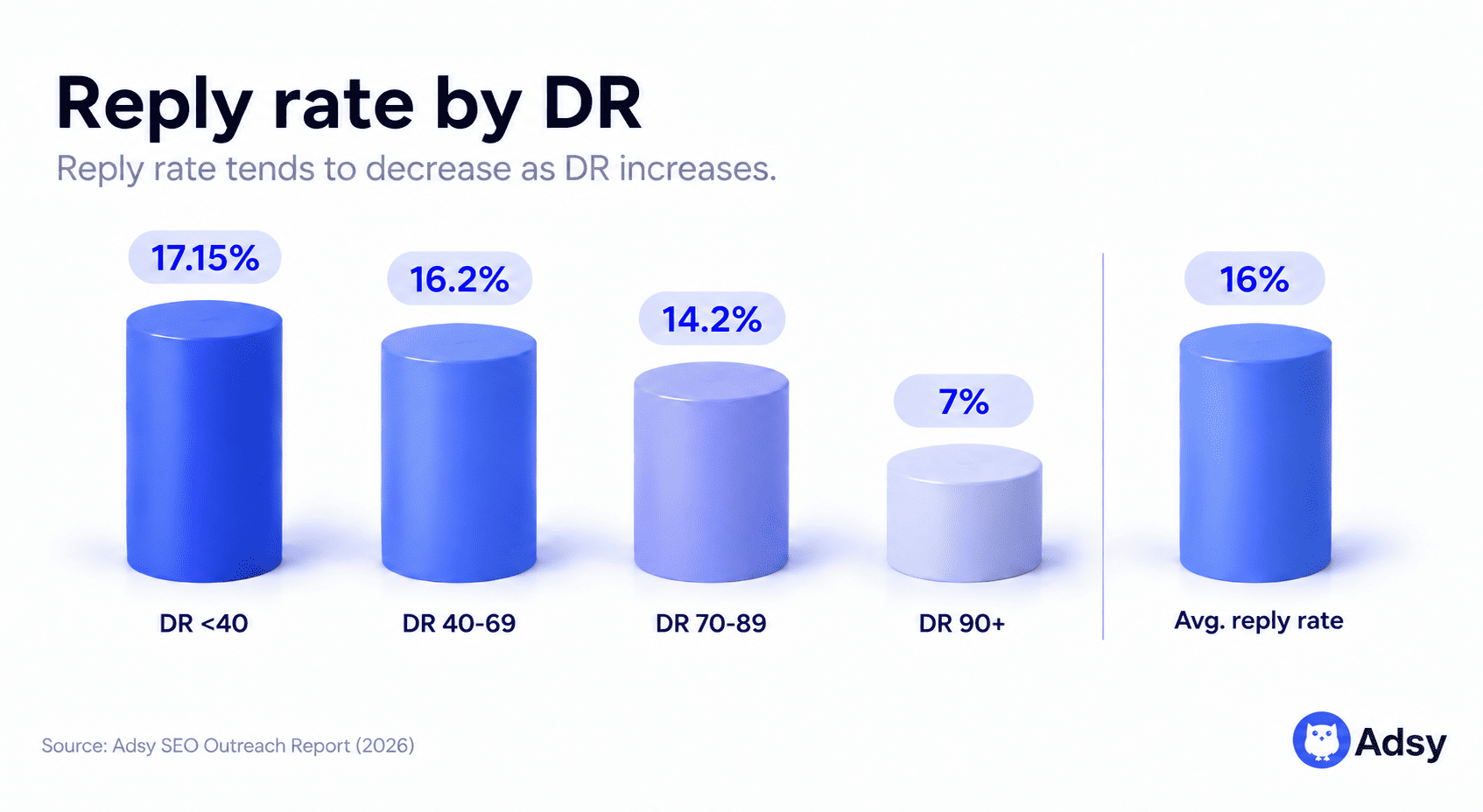
As you can see, the reply rate tends to decrease as DR increases.
This makes sense because high-authority websites usually receive more emails, have stricter requirements, and rarely accept guest content.
But it's not always that straightforward:
You never really know what to expect with outreach. Sometimes, we spend more time negotiating with a website that barely meets our SEO requirements than with a top publication. DR doesn't always tell you how difficult a placement will be.
Jessica Harris, Partnerships Manager at Adsy
Traffic:
We also looked at how website organic traffic influences the reply rate:
- Traffic of 500-999: 11% reply rate
- Traffic of 1,000-4,999: 16.2% reply rate
- Traffic of 5,000-9,999: 18% reply rate
- Traffic of 10,000-49,999: 19% reply rate
- Traffic of 50,000-99,999: 18.7% reply rate
- Traffic of 100,000+: 8.9% reply rate
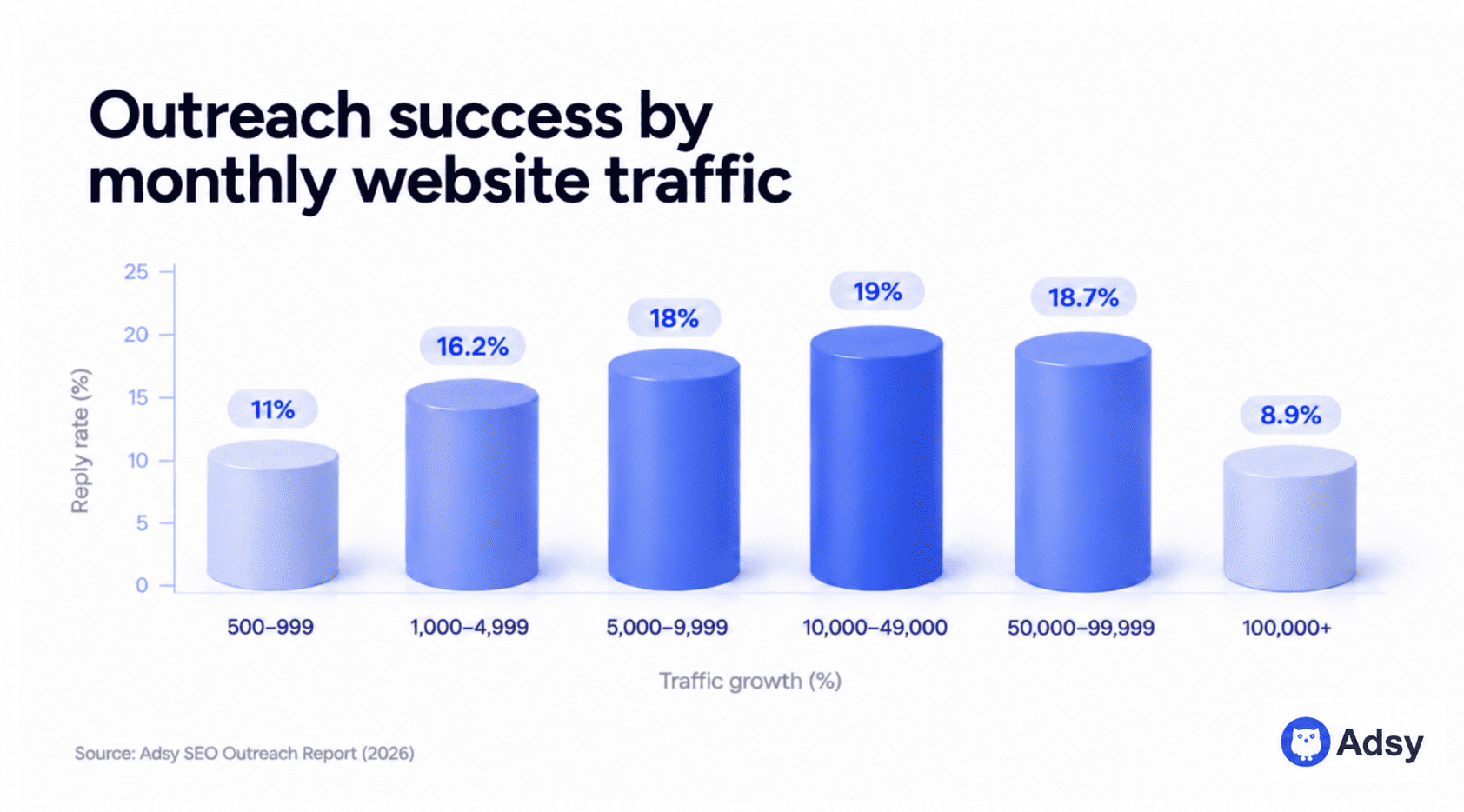
It’s not surprising that websites with very high monthly traffic (100,000+) have the lowest reply rate.
What’s more interesting is that there is almost no difference in reply rates between websites with 5,000 and 99,999 organic traffic.
We also noticed two extremes among websites with lower traffic (500-999):
- Some have almost no interest in collaboration because they aren’t working on their link building.
- But the ones that are actively growing and investing in SEO are much easier to negotiate with.
That’s why websites with growing traffic and improving SEO metrics are often more open to collaboration.
Links to competitors:
Another factor we looked at was whether a website has already been linking to one or more of our competitors. And this is the difference in reply rates we noticed:
- No competitor backlinks: 17.8% reply rate
- Competitor backlinks: 15.5% reply rate
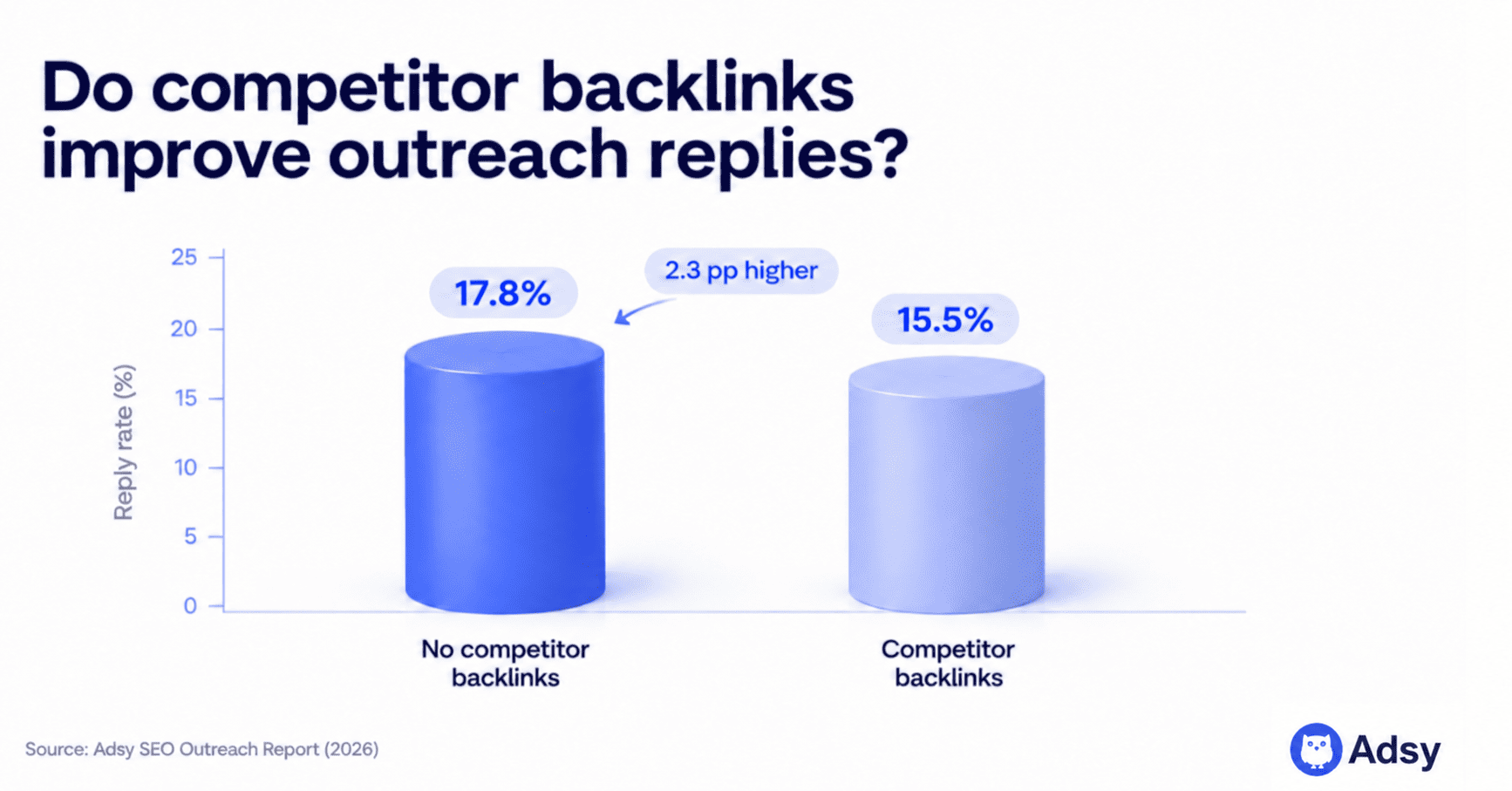
Our SEO outreach team was really surprised to see this.
Because the negotiation with websites that don’t link to competitors takes much longer. Even though they have a slightly higher reply rate.
Most common rejection reasons
Of course, positive replies are always the outcome we want to see after sending an email. But negative replies can also be useful.
Unlike prospects who simply ignore the email, people who reject the offer sometimes give us a reason why they are not interested. These responses help us understand what is stopping prospects from accepting our offer.
Most negative replies don’t explain why. But when they do, these are the three most common reasons for rejection:
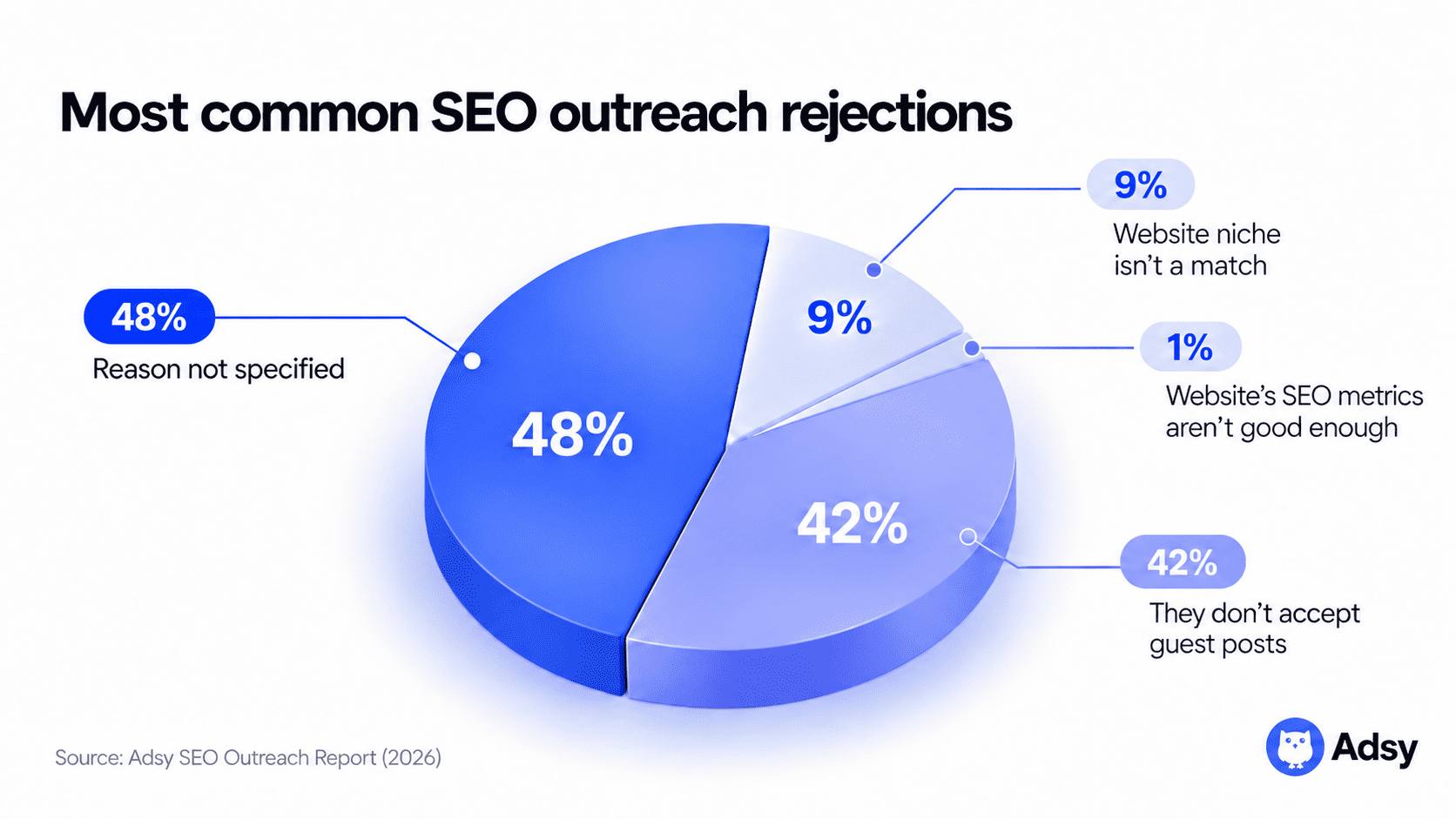
- Website niche isn’t a match (9%)
- Website’s SEO metrics aren’t good enough (1%)
- They don’t accept guest posts (42%)
- Reason not specified (48%)
Why outreach fails
We also analyzed less-successful campaigns run by our junior specialists. These turned out to be the three most common reasons link outreach fails:
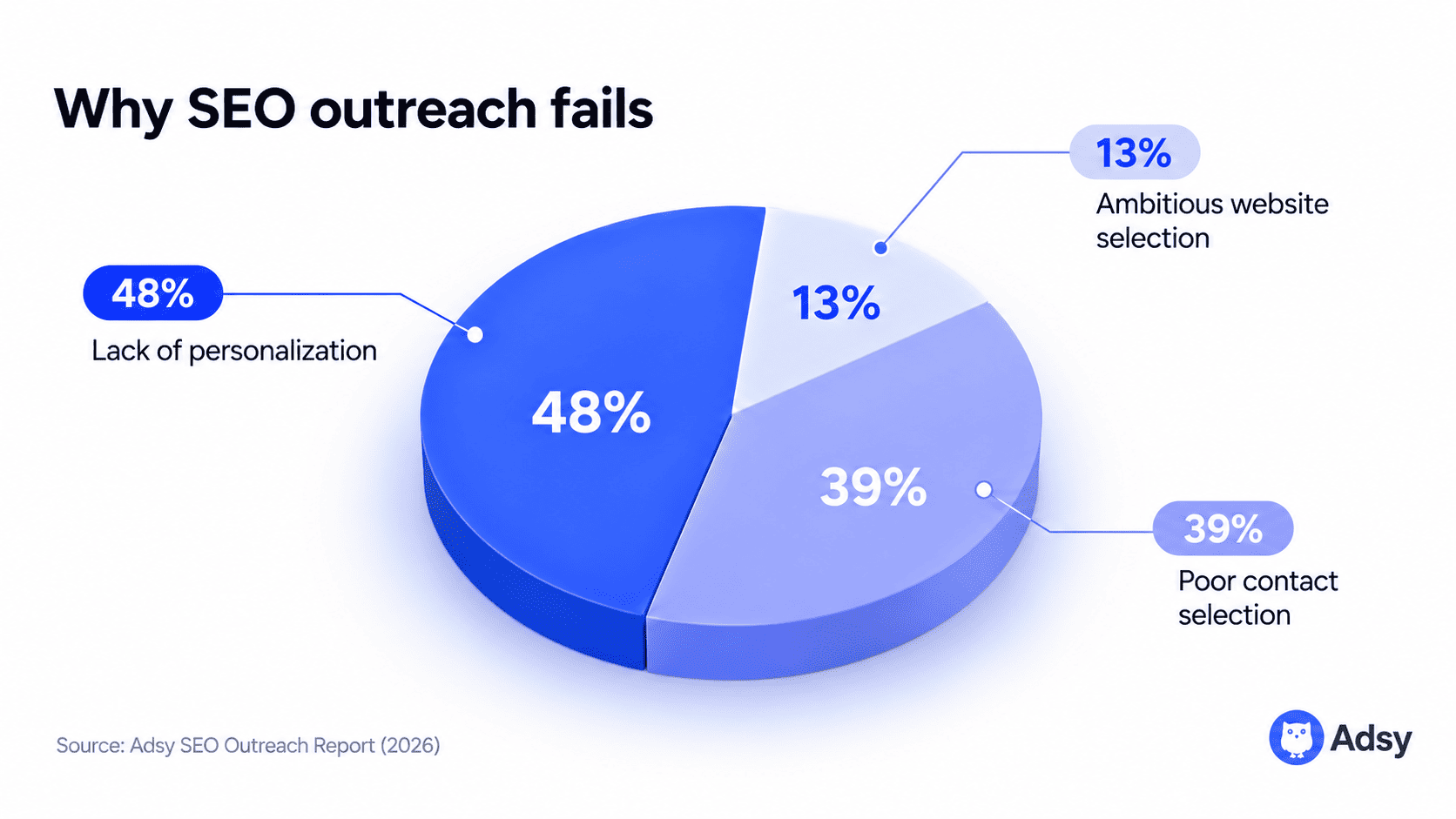
- Ambitious website selection is responsible for 13% of outreach campaign failures.
- Poor contact selection is responsible for 39% of outreach campaign failures.
- Lack of personalization is responsible for 48% of outreach campaign failures.
|
The reason why outreach fails |
What’s wrong with it |
|
Ambitious website selection |
While everyone wants to get backlinks from top-tier sites only, they often reply less. So, if you only target these sites, your overall reply rate will likely be lower. |
|
Poor contact selection |
There are two main issues with contact selection. Typically, it’s choosing the wrong contact or relying on a single contact when you could send emails to multiple people. |
|
No personalization |
Good websites receive way too many outreach emails. So, without proper personalization, your campaigns will fail. |
Subject lines
There is a common belief that the shorter the subject line and email body, the better.
But our data shows that there is not much difference between short and long subject lines.
- Short subject line (10-30 characters): 51% reply rate
- Long subject line (31-60 characters): 49% reply rate
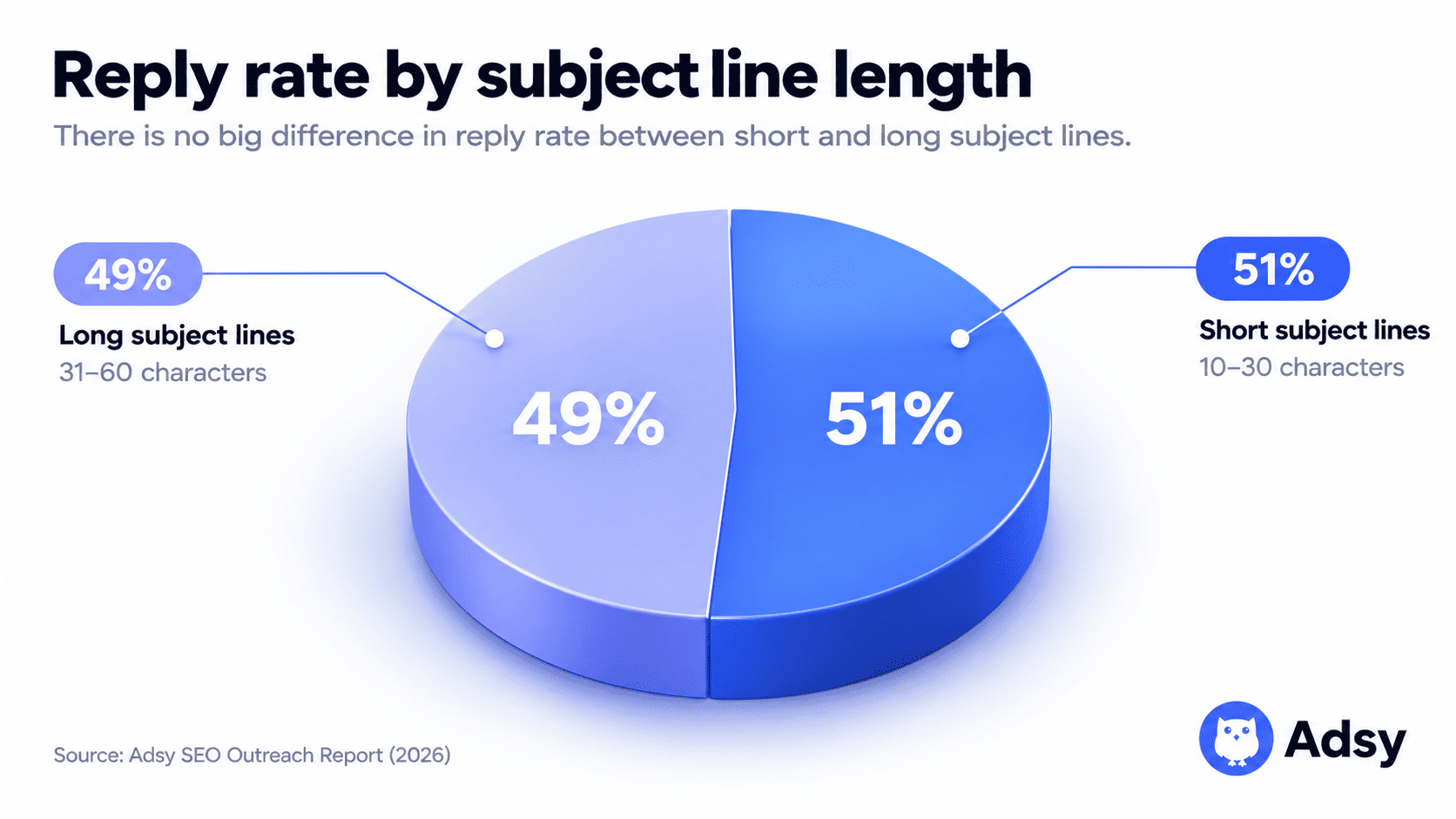
As you can see, the difference is very small. Shorter subject lines receive only 2% more replies.
This suggests that subject line length alone may not have a major impact on whether a prospect replies.
What influences the reply rate, then? Personalization.
Among all replies:
- 62% came from emails with personalized subject lines that mentioned the company name,
- Compared with 38% from emails with generic subject lines.
In this section, we share the most successful elements we use in our subject lines.
Email body
The email body is no less important than the subject line. But email bodies tell a different story.
While shorter subject lines work a little better, our data shows that longer SEO outreach emails get 2x as many replies as shorter ones.
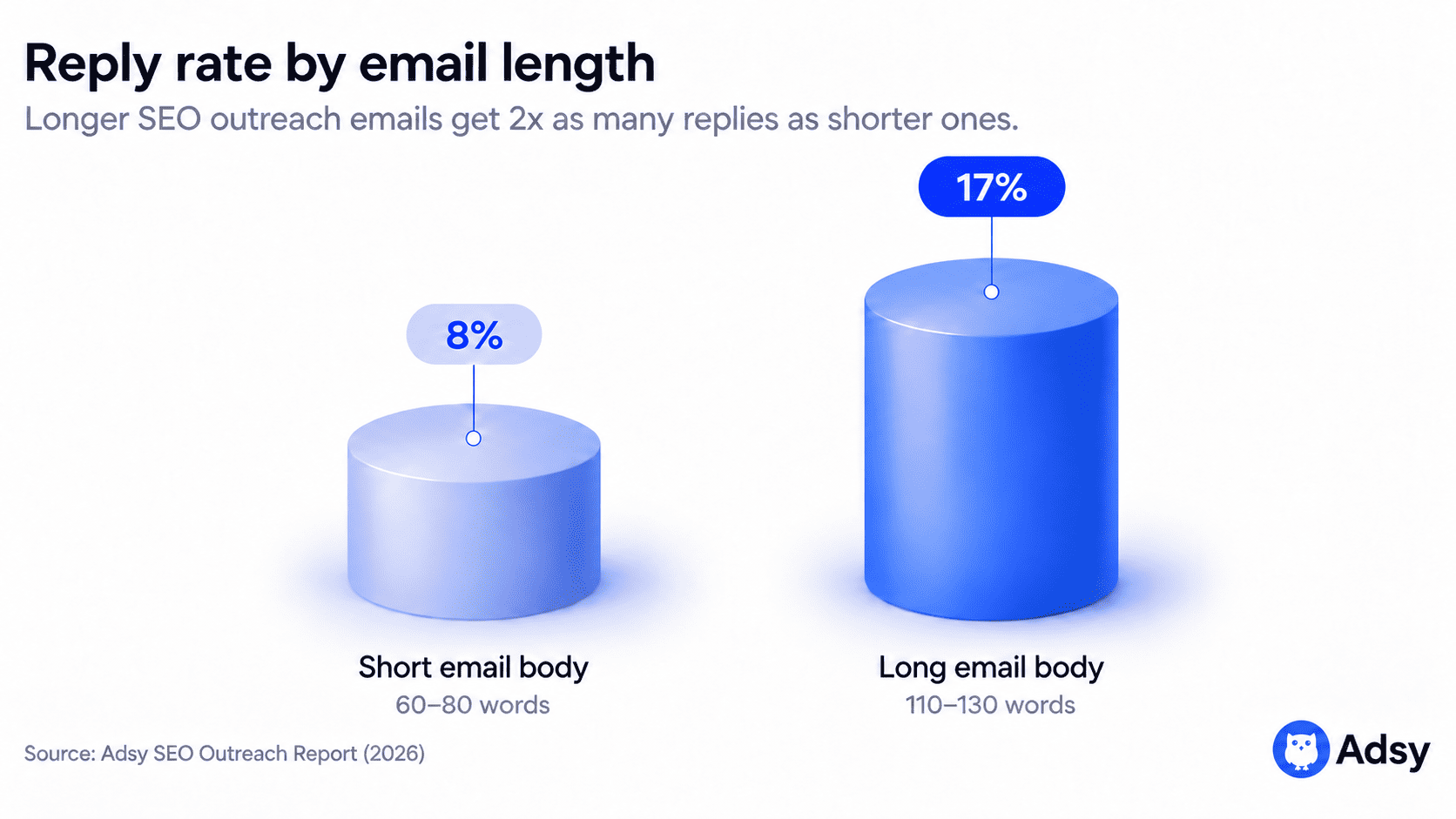
- On average, longer outreach emails (110-130 words) have a 17% reply rate.
- Shorter outreach emails (60-80 words), on average, have an 8% reply rate.
Of course, your email shouldn’t be too long. Include only information that can be useful to the prospect and avoid unnecessary text.
The impact of personalization
Personalizing cold emails with only the company and/or recipient name improves reply rate by 8% (relative lift) compared to no personalization at all.
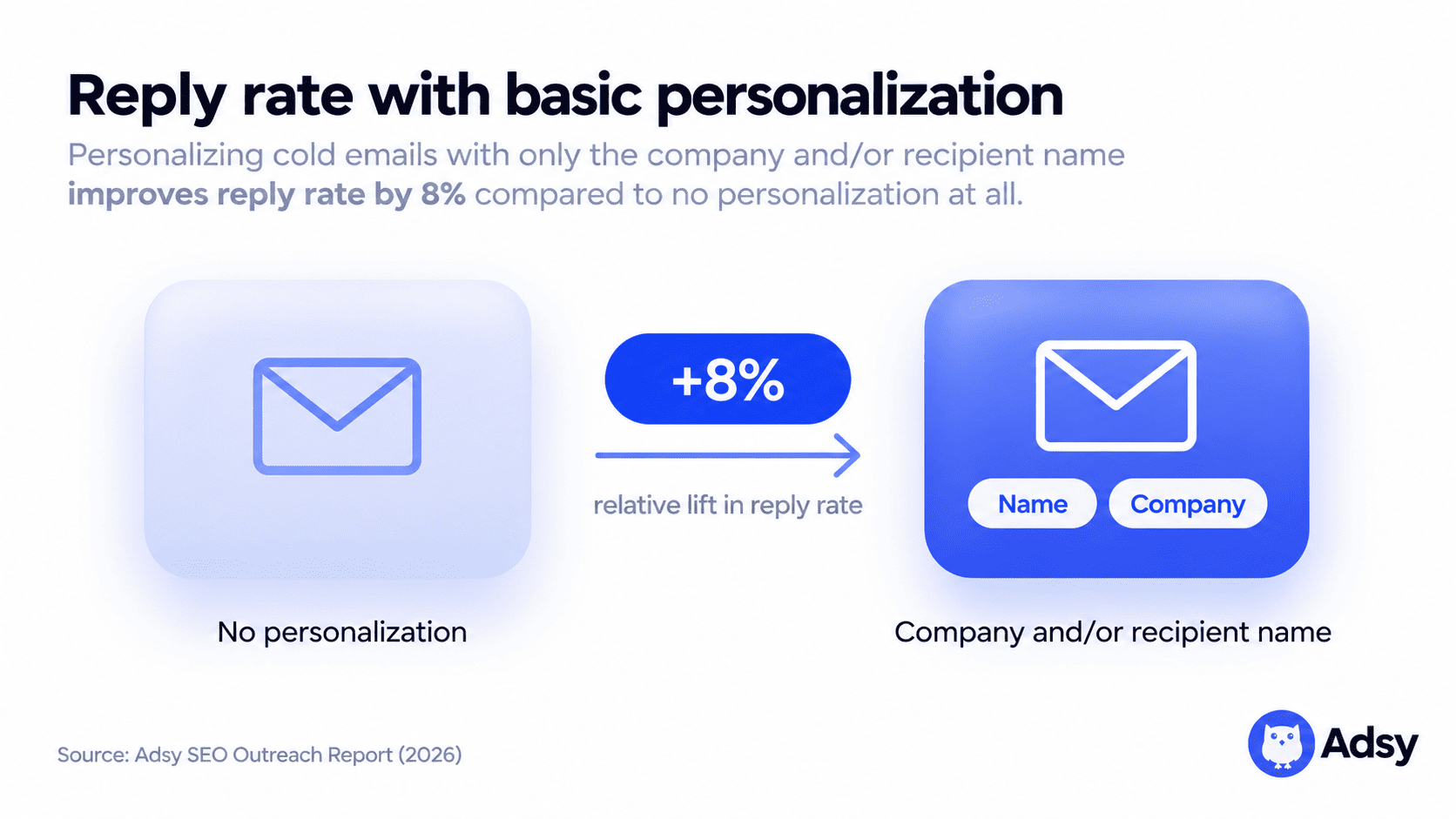
So, while it’s better than nothing, taking personalization a step further can help you achieve results similar to ours, or even better.
If you’re interested in how we personalize our emails, please check this section below.
Factors that help replies turn into backlinks
Throughout our SEO backlink outreach campaigns, we identified several factors that made a positive reply more likely to actually result in a backlink.
Here are the most effective approaches:
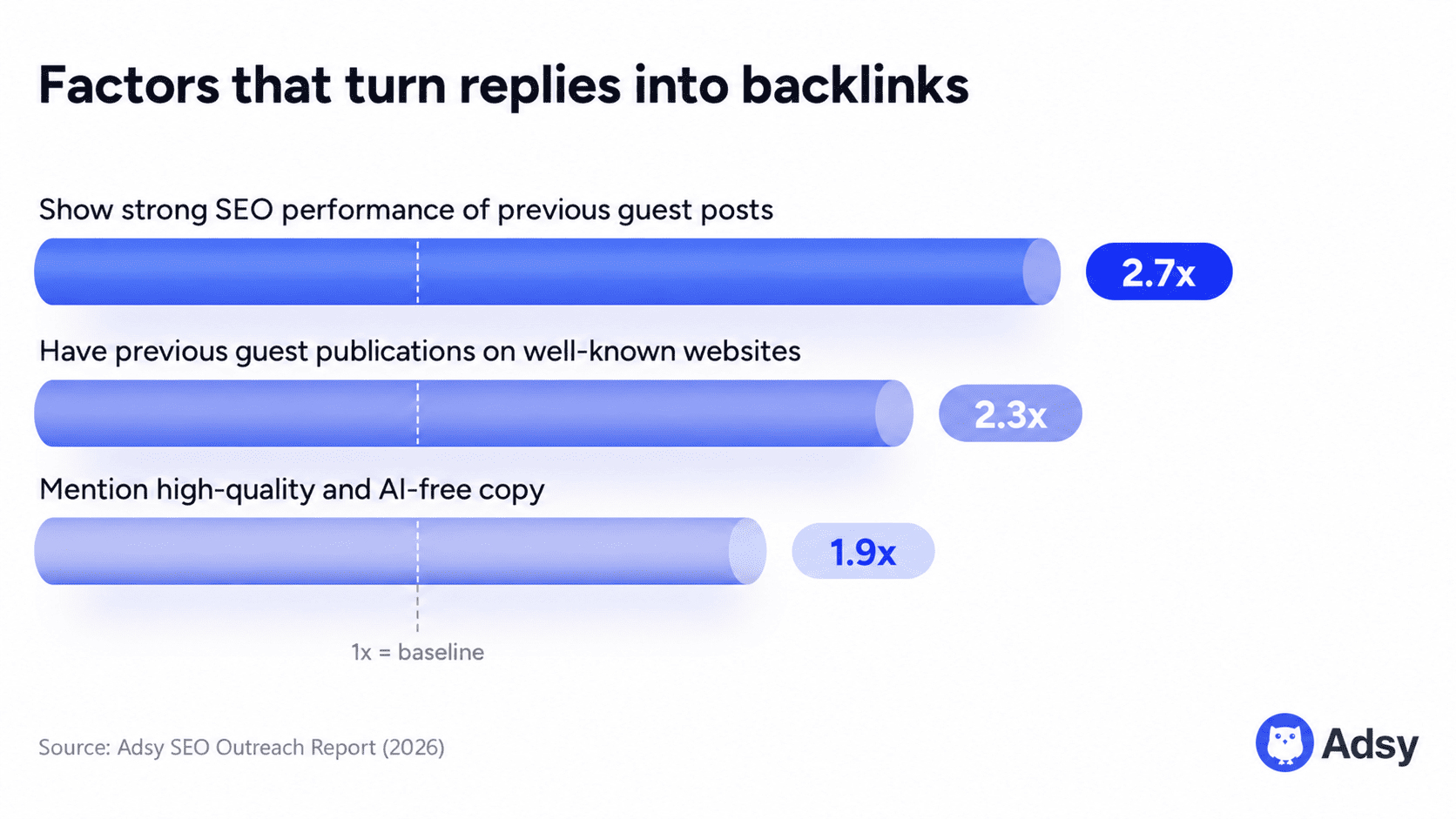
- Showing strong SEO performance of previous guest posts. This increases the chances of turning replies into backlinks by 173% (2.7x as likely).
- Having previous guest publications on well-known websites. This increases chances of turning replies into backlinks by 126% (2.3x as likely).
- Mentioning that we provide high-quality and AI-free copy. This increases chances of turning replies into backlinks by 85% (1.9x as likely).
|
Tactic |
Why it works |
|
Showing strong SEO performance of previous guest posts |
Proves that the content you write can actually perform well in search |
|
Having previous guest publications on well-known websites |
Makes your offer more trustworthy and gives you real-life social proof |
|
Mentioning high-quality and AI-free copy |
Gives you extra points and differentiates you from many other offers |
We’ve also tested other things like mentioning top-tier events where we participated or the industry awards we got. But these things didn’t show any direct influence on positive reply rates.
Note: We often combine several of the elements above. We don’t necessarily add all of them in the first cold email, but we do tend to mention several points throughout our conversation.
How to build an effective SEO outreach strategy (based on what we learned from 16,168 link-building emails)
Step 1: Decide what pages on your website deserve links
You don’t need to build backlinks to every single page on your website. It just wastes resources and doesn’t bring any tangible results. So, it’s important to prioritize.
And it’s totally okay if you build 10 links to one page and zero to another.
But what pages should you prioritize?
- Homepage. It’s important to build links to your homepage, as it can strengthen your link profile, improve your DR, build trust, help pass more authority to other internal pages, and so on.
- Important business pages. Usually, these are landing pages, blogs, and other pieces that play important roles in your funnels.
- Pages that perform well in SERPs, but they aren’t in the top 10, 5, or 3. It makes much more sense to give a “push” to the pages that already have good performance. But it only makes sense if those pages are relevant to your business.
- Content that has good organic linking potential. For example, if you publish original research, there is a big chance that it needs an initial boost before it will generate backlinks naturally (for most websites).
Note: Not every website will agree to link to your landing/sales pages or even the home page. It’s okay. But it’s still important to include them in your link building plan.
Step 2: Find relevant target websites
The next step is to actually find the websites in your niche that could be interested in linking to you.
These are the most common approaches:
- Google websites that accept guest contributions. Simply search for “your niche/keywords” + “write for us,” “guest posting,” “guest contributions,” “guest blogging,” etc. For example, “marketing” + “write for us.” You can also use scraping to collect this data automatically.
- Analyze the sites that link to your competitors. By checking your competitors’ backlink profiles, you can find websites that publish guest content in your niche. Simply take a look at as many competitors as possible and export all the potential domains to a spreadsheet.
- Check link building inventories. These are the sites that have databases of websites that accept guest content. For example, Adsy has one of the biggest inventories on the market, with 150K+ unique websites.


Step 3: Check SEO performance of your target sites
If you’re doing outreach for SEO, it makes little sense to get published on low-quality websites.
That’s why the next step in our SEO outreach strategy is to check the search performance and quality of each site.
At Adsy, we usually look at these metrics to understand whether the potential referring domain is actually good:
- Domain Rating (DR) and how it changes over time. Checking DA/DR/AS is a good start to get link authority. But it’s also important to see how domain rating changes over time. If the DR keeps falling, it can be a warning sign.
- Traffic and month-over-month changes. Organic traffic is an important indicator of whether a website is truly “alive.” So, it’s important to check it and look at how it changes. If it’s steady or growing, it’s usually a green flag.
- Traffic by region. Make sure most of the traffic comes from your target markets. If you’re targeting the US, for example, traffic from other regions might not be as valuable to you.
- Inbound vs. outbound links. If a website links to far more sites than link back to it, it’s worth taking a closer look. A high number of outbound links can be a sign of a spammy website.
- The websites it links to. Check what kind of websites your target site links to. If you see lots of links to casinos, adult sites, or other unrelated niches, be careful. These links might be normal for some industries, but they can be a red flag for others.
- The amount of guest post content. If almost every article looks like a guest post or the website publishes too many sponsored articles, it might be focused more on selling links than providing value to readers.
- Content quality. Check whether the content is useful, relevant, and well-written. If you see lots of generic, low-quality, or seemingly AI-generated articles, the website might not be worth your time.
- User experience. If the website has too many ads and pop-ups that make it impossible to read the content, it often means that user experience isn’t a priority for the site owners. And that’s a bad sign.
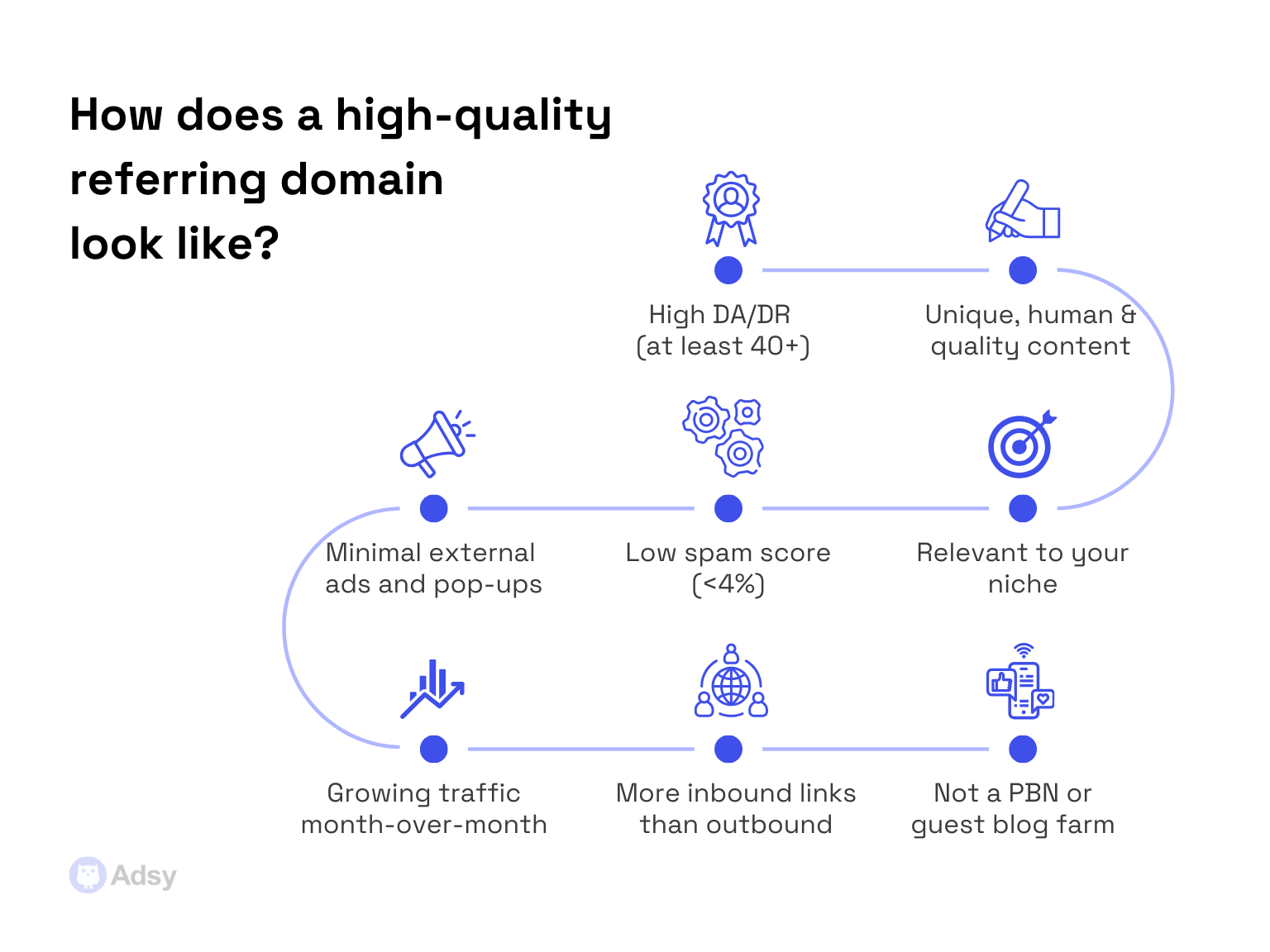
Once you’ve checked these metrics, you’ll have a better idea of which websites are worth your time and which ones to skip.
Step 4: Make sure you have an email infrastructure
Even a well-written email won’t do much good if it never reaches the recipient’s inbox. But the good news is that you can control it. Of course, not fully. But there are some things you can do to improve your chances:
- First, authenticate your domain. For that, you can set up SPF, DKIM, and DMARC. These help providers verify your message and its legitimacy.
- Second, it is important to protect your sender reputation. Email providers pay attention to how you send emails and how recipients respond. That’s why you should avoid practices that could damage your reputation.
- Finally, keep track of deliverability. Monitor bounces, spam complaints, and other warning signals. That can help you catch problems that may affect your campaign. It’s best to use email deliverability tools to test your setup and find out what needs fixing. Some of them have pretty generous free versions for beginners.
If you’re just getting started, don’t start by sending hundreds of emails at once. Begin with a small volume and then gradually increase it.
Step 5: Find contact information
Once you have a list of target websites and the email infrastructure, you need to find contact details to actually have someone to send your pitches to.
Email finder tools can help you search for contact information. But you shouldn’t stop at just collecting email addresses. Check the person’s role and make sure your offer is relevant to them.
Who should you look for exactly?
For backlink outreach, you’d usually want to contact people who are related to content and SEO, like:
- Writers, contributors, and editors,
- SEOs, outreach teams, and link builders,
- People responsible for partnerships, etc.
The right contact depends on how the website operates.
But don’t limit yourself to one contact per website. Finding two or three relevant people can give you more chances of reaching the right one.
Still, avoid being spammy and sending the same pitch to everyone at once.
You can also send your pitch through a contact form or to the @info or @support emails. It won’t always work, but if you ask to redirect you to the right person, you might get a reply.
Step 6: Improve your email body
We’ve already mentioned the importance of email body length in your outreach strategy. But, of course, what you include in the body itself is just as important.
Here are some elements you can include to improve your reply rate:
- Easy-to-scan structure. Breaking the email into shorter paragraphs can make it easier to read and scan. So, even a longer email can work well if it is structured properly.
- Valuable emails. People are already tired of receiving identical templates and typical AI-generated messages in their inboxes. That’s why it’s so important to make an effort and write an actually valuable email. This can make your offer feel more genuine and attractive to website editors.
- Ending with a question. Ending your email with a question gives the prospect an easy way to respond. For example: “As we work in the same niche and are both obsessed with quality content, would you be interested in a content collaboration?”
- Using emojis. A small number of relevant emojis can make the email feel more friendly and less formal. However, using too many can make your email look spammy.
- Adding an email signature. A professional email signature can make your message look more trustworthy. It is especially useful when you are already having an ongoing conversation with the prospect.
Step 7: Use personalization
Best outreach strategies focus a lot on data enrichment. It gives you context that makes it easier to personalize your pitches.
Honestly, the only limit to personalization is when it starts to feel stalkerish.
Other than that, you can connect with people over almost anything: recent events, contacts in common, changes in their career, achievements, etc.
But you can start by trying the basics:
- Mention their recent blog post. Mention a prospect’s relevant article work and add a few thoughts about it. It’s one of the easiest ways to make the email feel much more personal.
- Give a genuine compliment. If you liked something about the website or its content, mention it. A relevant and genuine compliment can also help make the email feel less like a template.
Step 8: Test your subject lines
There are many ways to improve your subject lines. The most important thing is to test different options because what works may differ depending on your niche and your target websites.
According to our AdsySEO Outreach Report 2026, on average, 62% of replies come from emails with a personalized subject line that includes the company or recipient’s name.
So, these are some of the ideas you could test first:
- The target website name
- Your brand name and the target website name
- A CTA question
Here are some simple examples:
- A short version: “(Your Brand) & (Website Name): Let’s collab.”
- A longer version: “Would you like to collaborate with (Your Brand)?”
Generally, it’s also better to avoid overused subject lines like“Partnership opportunity” or “(Name), got a sec?”
Most likely your target website already has a bunch of emails saying the same thing.
Step 9: Find topics that work for you and the target site
The best guest blog topic should work for both sides. That’s why, before suggesting your ideas, it’s important to:
- Check what the website already publishes (look at its main categories, recent articles, topics that seem to perform well, etc.).
- Think of the ideas that weren’t covered yet.
- Consider whether you have real expertise on the topic to offer some unique insights.
- Double-check whether a backlink to your content fits naturally into the topic.
Step 10: Choose anchor texts that make sense for your SEO strategy
Before building links, it’s important to have an anchor text plan.
Anchor text tells readers and search engines what the linked page is about. For example, Google recommends using anchor text that is descriptive and relevant to both the page where the link appears and the page it points to.
But that doesn’t mean every anchor should be your target keyword.
In fact, trying to force keywords into every anchor can make your links look unnatural. That’s why your anchors should not only be added naturally to the text but also be diverse, including:
- Branded anchors,
- Exact keyword-match anchors,
- Partial keyword-match anchors,
- URL (naked) anchors,
- Generic.
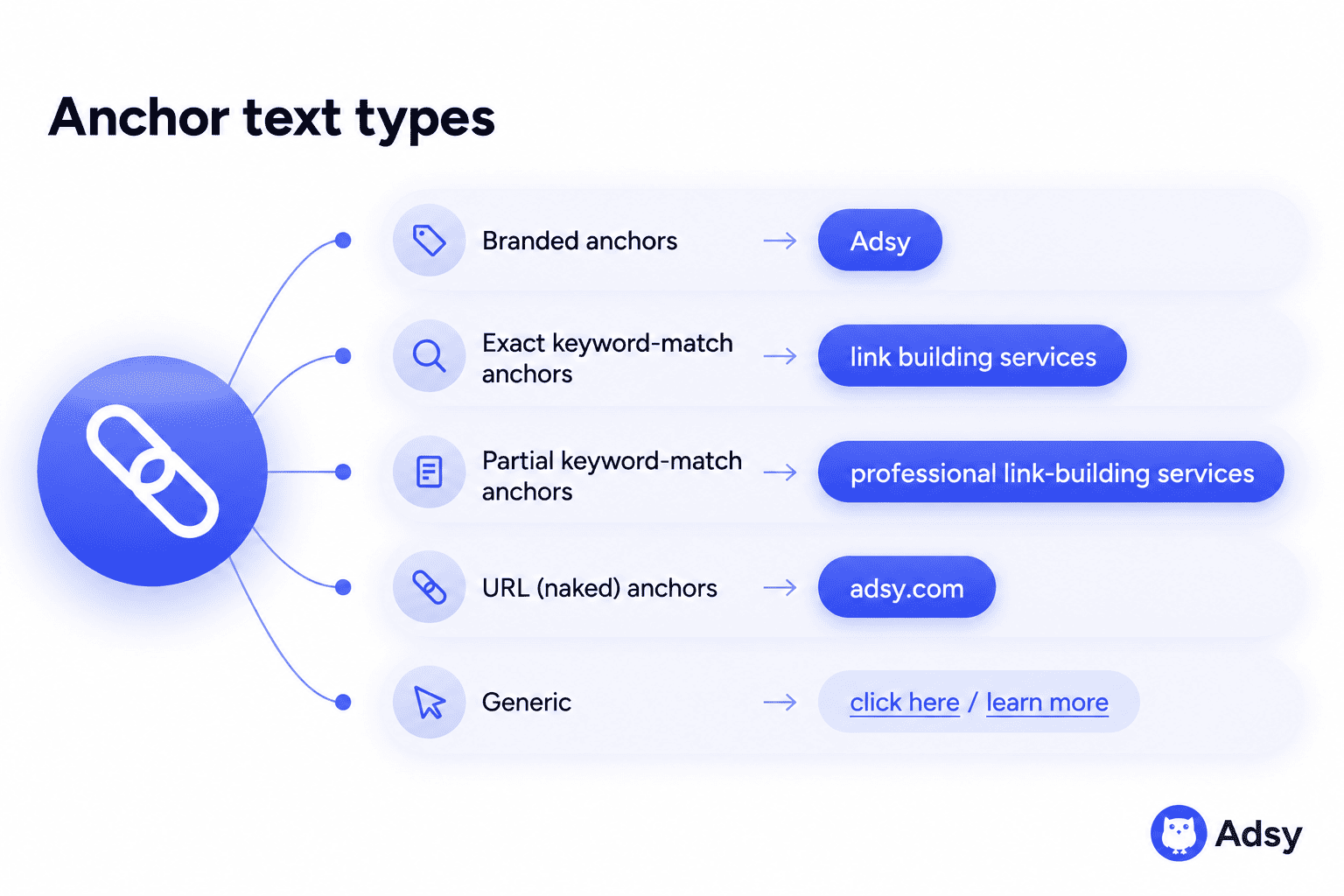
Using multiple types of anchors can make your backlink profile look more natural and trustworthy to both users and Google.
Step 11: Write valuable content in the site’s ToV
Once your topic is approved, comes the most important step: writing valuable content.
Start by checking the site’s tone of voice, blog post structure, formatting, and any other individual details to make your article fit in well.
The content itself should provide real value to their readers and be fully AI-free. Where relevant, you can add:
- Internal links to other useful articles on the target website.
- Credible external sources that support your claims.
- CTAs that lead readers to the website’s own products or services.
- Examples, original data, visuals, or expert insights.
But, of course, don’t forget about yourself either. Your link should be a natural part of the content and, in the best scenario, placed in the first part of the article.
Step 12: Check your backlinks after publishing
When your article is published, there are still several things you need to check, like whether:
- Everything was published as agreed. Make sure the link points to the correct URL and uses the right anchor text.
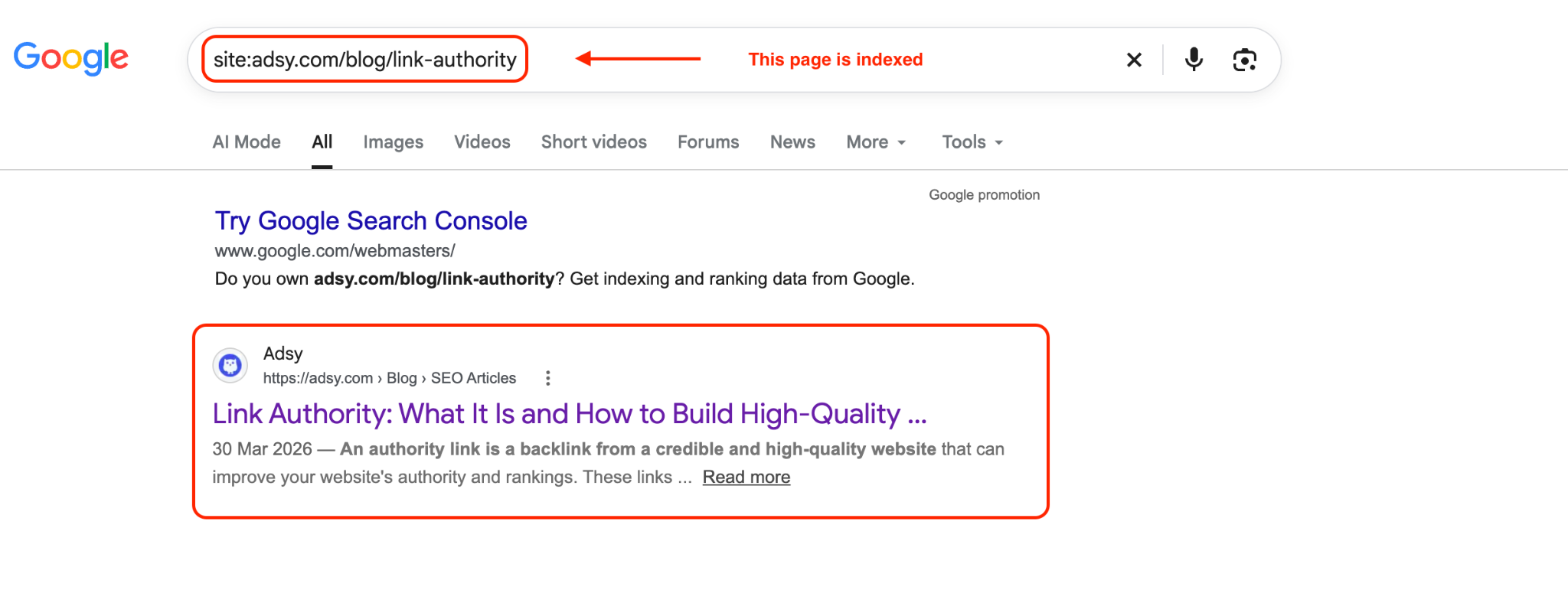
- The page can actually be indexed. Look for a noindex tag in the page's source code to understand whether it can be indexed. And to check whether it’s already indexed, you can simply use site:website.com/your-guest-post. And if you can see the search result, it’s indexed. Like here:
 3. Your link has a
And don’t forget to monitor them over time. A page can disappear, the website can remove your link, the URL can change, or the publisher can update the link attributes later. So, it’s always worth checking these things regularly to catch any changes as soon as possible.
Step 13: Test creative link building strategies
Blogger outreach and guest posting are good ways to get backlinks.
But they are not the only ones. So, once you build an effective classic SEO outreach strategy that works, try other link building tactics as well.
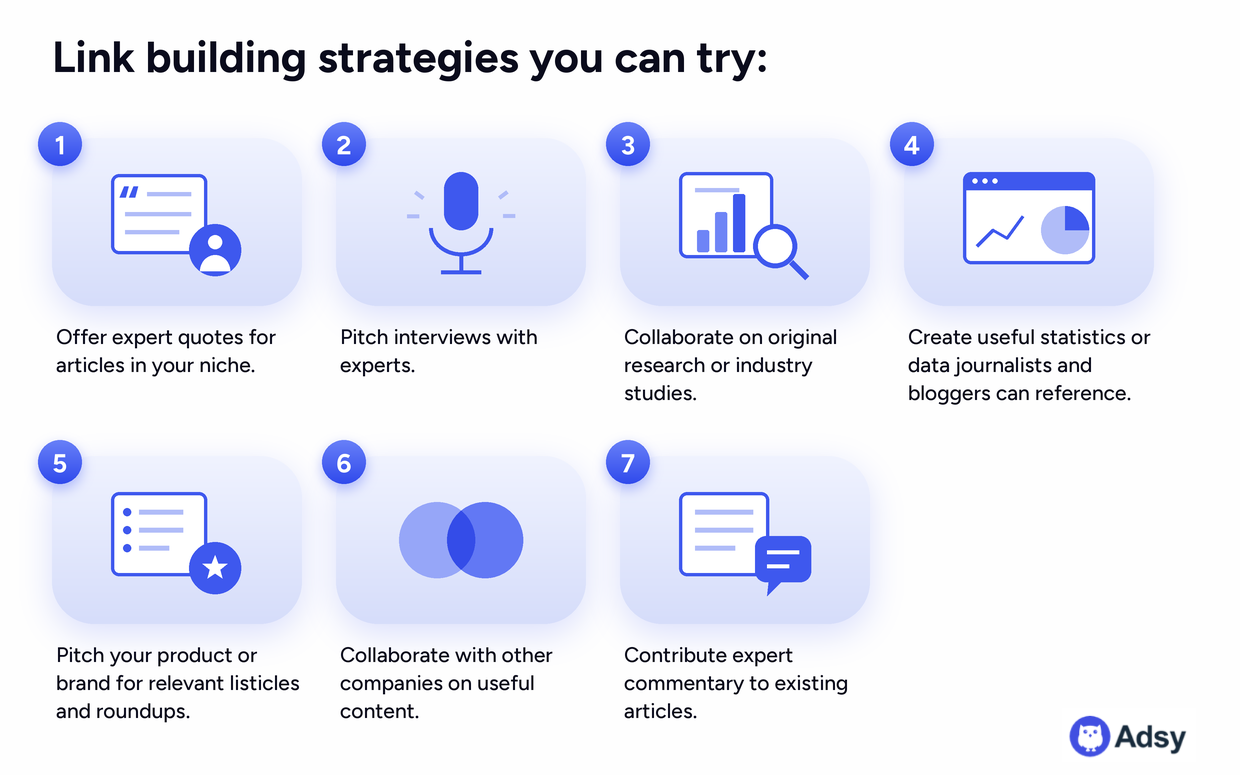
For example, you can:
- Respond to journalist requests through HARO, Connectively, Qwoted, and similar platforms. These services connect journalists looking for sources with experts who can provide useful quotes and insights.
- Do expert roundups and interviews with industry experts to get links as one of the perks.
- Collaborate on any projects (e.g., research, webinars, podcasts, etc.) with other brands.
- Pitch your product/service to listicles on other sites or write listicles yourself and pitch them to other brands.
 But don’t test creative strategies just to place a link somewhere.
Look for collaborations where your brand can provide something genuinely useful. The backlink should make sense as part of the content, not be the only reason that content exists.
Conclusion
While sending those 16,168 link-building emails, our team has tested plenty of things. Not every common practice worked for us. And that’s fine. It’s all part of the process.
Over time, we built our own best practices.
That’s why you shouldn’t be afraid to test different approaches either. Try ours, find others, monitor the results, and find what works best for your business.
The goal isn’t just to get as many backlinks as possible. It’s to build a strategy that can actually support your overall SEO strategy.
And one more thing…
Special thanks to our outreach team, and Jessica Harris in particular, for letting us dig into their processes and data to uncover all these insights. We may have been a little too nosy, but we think the results were worth it. Hopefully, they agree :)
FAQ
What is SEO outreach?
SEO outreach is the process of contacting relevant websites to build backlinks to your website.
This usually involves sending personalized emails to suggest:
- Content collaboration
- Guest post
- Link insertion (niche edits)
The goal is to get your content published on another website. This can earn you a backlink that helps improve your website’s visibility and SEO performance.
How many outreach emails does it take to get one backlink?
The number varies significantly depending on the campaign, prospect quality, SEO requirements, etc.
According to the Adsy SEO Outreach Report 2026, which analyzed16,168 emails, it takes 21 outreach emails to get one backlink.
What is a good reply rate for SEO outreach emails?
There is no single good reply rate for every link outreach campaign.
According to the Adsy SEO Outreach Report 2026, which analyzed 16,168 emails, a good reply rate for personalized campaigns is 16%, with a 15% positive reply rate.
Yet, again, it depends, and even a 1% reply rate can be a good result if you’re targeting top-tier websites and those replies actually result in backlinks.
Because reply rate alone can’t show how successful a campaign was. If replies never turn into a published backlink, how valuable are they, really?
How can you increase your backlink outreach response rate?
There are many ways to improve your reply rate. The most basic and common practices are:
- Personalize your emails beyond just adding a name.
- Contact the right people from relevant websites.
- Write clear and useful email bodies.
- Test different subject lines.
Remember that even if you create what you consider the best SEO outreach strategy, you will never get responses to all your emails. There will always be messages that get ignored, and that’s okay. The key is to monitor your results and find what works best for you.
All trademarks, logos, images, and materials are the property of their respective rights holders.
They are used solely for informational, analytical, and review purposes in accordance with applicable copyright law.


 Sign Up
 Sign Up